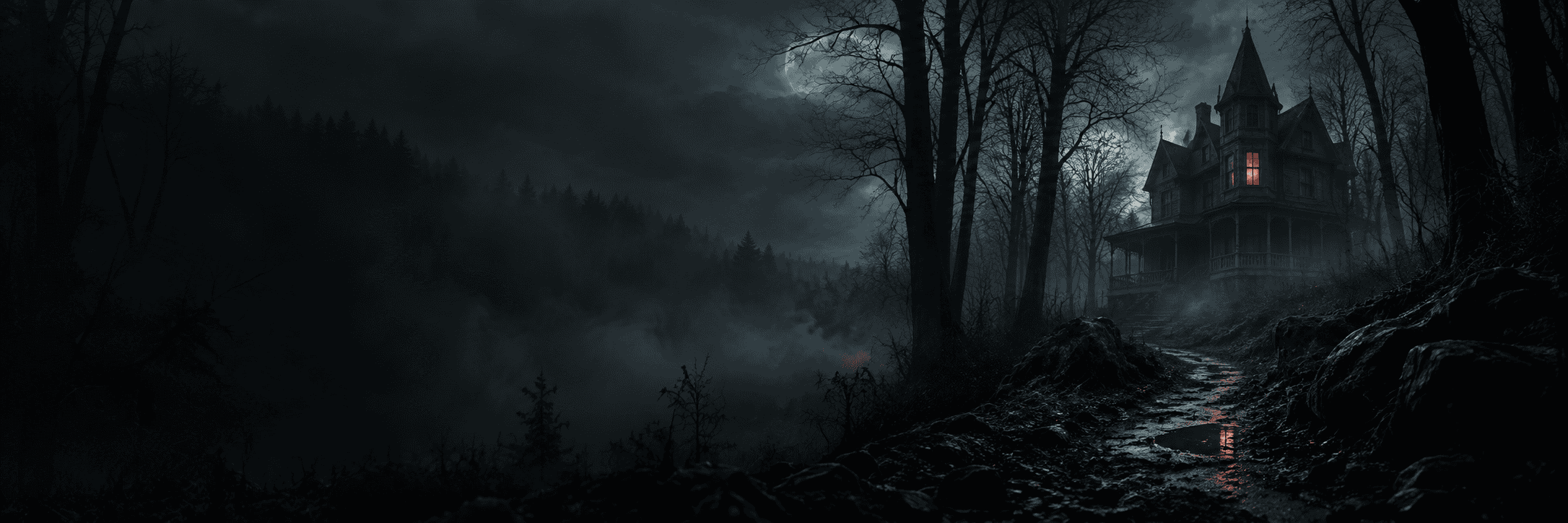
The Jack of Hollow Hill
Every Halloween, the quiet town of Hollow Hill follows one unbreakable rule: never leave a carved pumpkin outside after midnight. Most believe it's nothing more than an old superstition—until one family ignores it. When a young girl vanishes without a trace and a sinister jack-o'-lantern appears in her place, her brother uncovers a centuries-old curse tied to Elias Thorn, the legendary Carver who harvests souls through glowing pumpkins. As reality twists into haunted cornfields, forgotten roads, and a nightmarish world hidden beneath Hollow Hill, Caleb must confront an ancient evil before sunrise—or become the Carver's next masterpiece. In Hollow Hill, every carved face tells a story... and the next one could be yours.
The Jack of Hollow Hill
Experience the story with audio, captions, and full-screen playback.
The Jack of Hollow Hill
Chapter One
The Rule Everyone Ignores
In Hollow Hill, Halloween began before the leaves turned.
By the first week of October, paper ghosts swung from every lamppost along Main Street. Plastic skeletons sat on porch swings. Storefront windows filled with cotton-webbed spiders and grinning witches, and the old clock tower wore a giant orange bow around its narrow throat.
Tourists called Hollow Hill charming.
The people who lived there knew better.
They knew about the rule.
It appeared in the town newspaper every October beneath announcements for the harvest parade and the elementary school costume contest.
ALL JACK-O’-LANTERNS MUST BE BROUGHT INSIDE BEFORE MIDNIGHT ON OCTOBER 31.
No explanation followed.
The rule was announced at school assemblies, printed on grocery-store receipts, and repeated by tired parents who no longer remembered why their own parents had taught it to them.
Most people laughed about it.
Some blamed raccoons.
Others said teenagers smashed pumpkins after midnight.
But every family in Hollow Hill obeyed.
Every family except the Mercers.
“You’re seriously bringing that thing inside?” seventeen-year-old Caleb Mercer asked his younger sister.
Sophie stood on the front porch with both arms wrapped around an enormous jack-o’-lantern. She had carved it herself, cutting wide triangular eyes and a crooked mouth full of square teeth.
“It’s the rule,” she said.
“It’s a pumpkin.”
“It’s almost midnight.”
Caleb leaned against the doorway, wearing black jeans and a faded horror-movie shirt. Behind him, laughter rolled through the house. Their parents were hosting their annual Halloween party, which meant half the neighborhood was inside drinking cider, eating chili, and pretending not to watch the football game in the den.
Music rattled the windows.
The porch smelled of candle wax, damp leaves, and the first cold breath of winter.
Sophie tightened her grip on the pumpkin.
Caleb grinned.
“You know why they made the rule?”
“Because something comes for them.”
“Wrong. Because old people hate fun.”
Sophie was twelve, old enough to reject childish fears but young enough to still believe in them when the street went quiet.
And the street had gone very quiet.
Only minutes earlier, children had run between houses in glowing costumes. Now the sidewalks were empty. Porch lights clicked off one by one as families carried their pumpkins indoors.
Across the street, Mrs. Vale dragged three jack-o’-lanterns through her doorway and looked directly at Sophie.
“Hurry,” she called.
Her voice sounded too sharp.
Sophie looked down the hill.
At the far end of Hawthorn Street, where the pavement curved toward the abandoned Miller farm, something glowed between the trees.
A small orange light.
Then it vanished.
“Caleb.”
He followed her gaze.
“What?”
“I saw something.”
“You saw a porch light.”
“There aren’t any houses down there.”
He glanced at his phone.
11:57.
“Fine,” he said. “Bring yours inside.”
Sophie relaxed.
Then Caleb reached past her, grabbed the pumpkin by its stem, and carried it down the steps.
“Caleb!”
He set it in the center of the front walkway.
“There. We’ll test the legend.”
She lunged for it, but he blocked her with one arm.
“Stop.”
“You’re being stupid.”
“That’s my job.”
“Mom!”
Caleb caught Sophie around the waist and pulled her backward into the house. She kicked at his shins as he shut the door and locked it.
“You are such a jerk!”
“Three minutes. If the Pumpkin King shows up, I’ll apologize.”
“There is no Pumpkin King.”
“Then what are you worried about?”
Sophie stared through the narrow glass beside the door.
The jack-o’-lantern’s candle flickered on the walkway.
Inside, the grandfather clock began to chime.
One.
Two.
Party guests cheered from the kitchen.
Three.
Sophie pressed closer to the glass.
The flame inside the pumpkin went out.
Four.
“Caleb,” she whispered.
Five.
The candle reignited.
But the light was no longer yellow.
It burned a deep, wet red.
Six.
A shadow moved across the lawn.
Seven.
Caleb stepped beside her.
Eight.
The shadow was too tall to belong to a person.
Nine.
It stretched from the sidewalk to the porch.
Ten.
The pumpkin’s carved mouth moved.
Eleven.
Its square teeth slowly closed.
Twelve.
Every light in the Mercer house went out.
The party fell silent.
For one breathless second, no one moved.
Then the front door shook beneath three heavy knocks.
Boom.
Boom.
Boom.
Sophie screamed.
The lights returned.
Music resumed in the kitchen. Someone laughed nervously and blamed the old wiring.
Caleb stared through the glass.
The walkway was empty.
The pumpkin was gone.
Their father searched the yard.
Then the garage.
Then the street.
He found nothing.
“Probably some kid,” he said, though no one had seen anyone running away.
Sophie would not stop crying.
Caleb tried to apologize, but she refused to look at him.
By one in the morning, the party had ended. Their parents went upstairs. Sophie locked herself in her bedroom.
Caleb stayed awake in the den, watching old monster movies with the sound low.
At 2:13 a.m., he heard whispering outside.
At first, he thought it was wind dragging leaves along the siding.
Then he heard his name.
“Caaaaleb.”
He muted the television.
The voice came again.
“Caaaaleb.”
It sounded like Sophie.
He crossed the den and pulled back the curtain.
The missing pumpkin sat on the lawn.
Its candle burned red.
Its face had changed.
The crooked grin was gone.
Now it had human lips.
Human cheeks.
A small pointed chin.
Caleb stared at the carved face.
It looked exactly like Sophie.
A scream erupted upstairs.
He ran.
His parents reached Sophie’s room at the same time. The door was locked from the inside.
Caleb slammed his shoulder against it until the frame split.
The bedroom was empty.
The window stood open.
Wet footprints crossed the floor.
Not shoe prints.
Bare footprints.
They led from the bed to the window.
Each one was filled with black soil.
On Sophie’s pillow lay a single pumpkin seed.
Chapter Two
The Pumpkin That Vanished
By sunrise, Hollow Hill knew Sophie Mercer was missing.
Police searched the woods, the drainage ditches, and the abandoned farms beyond town. Volunteers walked shoulder to shoulder through fields stripped bare after harvest.
Helicopters circled overhead.
Dogs lost Sophie’s scent at the center of the Mercer lawn.
No one mentioned the pumpkin.
Caleb tried.
He told Officer Delaney about the red candle, the moving mouth, and the face carved into the rind.
Delaney listened without interrupting, then asked whether Caleb had consumed alcohol at the party.
Caleb had not.
The officer asked whether he had taken anything else.
“I know what I saw.”
“You were scared.”
“I left the pumpkin outside.”
“That did not make your sister disappear.”
Mrs. Vale, who had been standing nearby, flinched.
Caleb noticed.
Later, he found her watching the search from behind her curtains.
He crossed the street and knocked.
She opened the door only a few inches.
“You know what happened,” Caleb said.
Mrs. Vale looked toward his house.
“I know your parents need you.”
“You told Sophie to hurry.”
“I tell everyone.”
“Why?”
She tried to close the door.
Caleb caught it with his hand.
“Why do we bring pumpkins inside?”
Mrs. Vale’s face tightened.
She was nearly eighty, with thin white hair and a back permanently bent from years spent working at the town library.
“Because Hollow Hill remembers,” she said.
“What does that mean?”
“It means some rules survive after people forget the reason.”
“My sister is gone.”
“I know.”
“You saw the pumpkin, didn’t you?”
Her eyes flicked toward him.
That was answer enough.
“Come inside,” she whispered.
Her living room smelled of dust, cinnamon, and old books. Every curtain was closed despite the bright morning.
Mrs. Vale led Caleb to a dining table covered with newspaper clippings.
Some were yellow with age.
CHILD MISSING AFTER HALLOWEEN FESTIVAL — 1978
LOCAL FARMHAND VANISHES — 1952
THREE LOST IN HOLLOW HILL FIRE — 1921
Each disappearance had occurred on November 1.
Each article mentioned a pumpkin found outside the victim’s home.
“The town has always called them accidents,” Mrs. Vale said. “Runaways. Abductions. Fires. Animal attacks. People prefer ordinary horrors.”
“What really happened?”
She unfolded a brittle newspaper from 1891.
A woodcut illustration showed a gaunt man standing beside a cart piled high with pumpkins.
Below it was the name Elias Thorn.
“He came to Hollow Hill after the Civil War,” Mrs. Vale said. “Bought the farm beyond the old mill. Grew pumpkins larger than anyone had ever seen.”
Caleb studied the image.
Thorn’s eyes were deep-set and black. His mouth formed a narrow line.
“He was a carver,” Mrs. Vale continued. “Not the harmless kind. He made lanterns in the likeness of people he hated. Merchants. Neighbors. Children who stole from his fields. He displayed their faces along the road.”
“That’s creepy, but it doesn’t explain Sophie.”
“The faces became more accurate.”
She handed Caleb a diary page sealed beneath plastic.
The handwriting shook across the paper.
Thorn carved my husband’s face upon a pumpkin three nights before he drowned. He carved Mrs. Bell’s infant before the fever took her. Yesterday, he began carving mine.
“People believed Thorn could place a soul inside a lantern,” Mrs. Vale said. “They burned his farm on Halloween night in 1891.”
“They killed him?”
“They tried.”
The fire spread from the barn to the fields. Witnesses reported hearing Thorn laugh from inside the farmhouse while the roof collapsed.
When the flames died, the townspeople found no body.
Only hundreds of pumpkins.
Each contained something black and beating where the candle should have been.
Caleb pushed the clipping away.
“This is a story.”
“Yes.”
“You actually believe it?”
“I believe my brother vanished on Halloween in 1952.”
Caleb looked up.
Mrs. Vale’s eyes shone.
“We found his lantern the next morning,” she said. “It had his face.”
The room seemed to grow colder.
“Can we get Sophie back?”
Mrs. Vale did not answer.
“Can we?”
“The missing are taken to Thorn’s field.”
“Where?”
“The old farm.”
“The police searched it.”
“They searched the land that exists during the day.”
Caleb felt irritation cut through his fear.
“What is that supposed to mean?”
“It means the road changes after dark.”
Mrs. Vale reached beneath the clippings and pulled out a hand-drawn map. It showed Hollow Hill surrounded by farms and forest, but behind Miller’s property was another field marked only by a black circle.
“Thorn’s farm burned down more than a century ago,” she said. “But every Halloween, between midnight and sunrise, Hollow Hill grows a second shadow.”
Caleb stared at the map.
Outside, a truck rolled past with volunteers calling Sophie’s name through loudspeakers.
“Tonight isn’t Halloween,” he said. “It’s November first.”
Mrs. Vale shook her head.
“Not for him.”
Chapter Three
The Lantern in the Cornfield
Caleb did not go alone.
His best friend, Mason Reid, called the plan insane three times before agreeing to come.
Mason was broad-shouldered, practical, and incapable of abandoning anyone he cared about, even when common sense demanded it.
Their other friend, Tessa Ward, needed less convincing.
Her father had disappeared on Halloween when she was six.
Everyone said he had left town.
Tessa had never believed it.
At eleven that night, the three met behind the abandoned Miller barn.
Mason carried a flashlight, a hunting knife, and enough nervous energy to power the town.
Tessa brought her father’s old compass.
Caleb carried the map.
“No police?” Mason asked.
“And tell them what?” Caleb said. “We’re entering a ghost farm to fight a pumpkin man?”
“When you say it like that, I feel even better.”
The moon hung thin and pale above the fields.
Dead cornstalks rattled in the wind.
According to Mrs. Vale’s map, they needed to walk north from the Miller barn until they reached a split oak tree.
There was no oak tree.
Only an empty field.
They walked anyway.
After twenty minutes, Mason stopped.
“We should have reached the highway.”
The lights of Hollow Hill had disappeared behind them.
Caleb checked his phone.
No signal.
The time read 11:59 p.m.
“It’s been 11:59 for ten minutes,” Tessa said.
A church bell rang in the distance.
Twelve slow chimes.
With each strike, the field changed.
Corn rose from the soil around them.
Not growing.
Appearing.
Tall black stalks crowded close, their dry leaves scraping against one another like fingernails.
A narrow path opened ahead.
At its entrance stood a split oak tree.
Mason turned back.
The Miller barn was gone.
Behind them stretched an endless wall of corn.
“Nope,” he said.
“We keep going,” Caleb replied.
A light flickered deeper in the field.
Orange.
Tessa’s compass needle spun wildly, then pointed toward it.
They followed.
The path twisted through rows that seemed to move whenever they looked away. Faces appeared in knots along the stalks. Human expressions stretched beneath the husks.
Caleb heard whispering.
Some voices begged for help.
Others laughed.
One sounded like Sophie.
“Caleb.”
He stopped.
A jack-o’-lantern sat between two rows.
Its face was Sophie’s.
Its lips moved.
“Caleb, please.”
He rushed toward it.
Tessa grabbed his coat.
“Wait.”
“She’s in there.”
The lantern began to cry.
Clear tears rolled from its carved eyes and hissed against the soil.
“I’m cold,” Sophie whispered. “Please pick me up.”
Caleb pulled away from Tessa.
The pumpkin smiled.
Not Sophie’s smile.
The mouth split wider, tearing through the rind.
A black tongue uncoiled from inside.
Mason swung his knife, cutting it in half.
The pumpkin shrieked.
Every stalk in the field bent toward them.
“Run,” Mason said.
They sprinted down the path as the corn closed behind them.
Something followed.
Heavy footsteps struck the earth.
Slow.
Unhurried.
Thump.
Drag.
Thump.
Drag.
Caleb looked over his shoulder.
A figure moved through the corn.
It was taller than any man, dressed in a filthy one-piece costume with a torn ruffled collar and three black buttons down its chest. Mud and rot clung to the fabric.
Its head was covered by a cracked white mask.
Round black eyes watched them through empty holes.
A stitched smile curved across its face.
In one hand, it carried a rusted carving knife.
In the other, it dragged a sack that squirmed and whispered.
The creature tilted its head.
Then the lanterns began appearing.
Dozens of them.
Hundreds.
They lit the path in both directions, each carved with a human face.
The creature raised its knife.
Every lantern screamed.
Chapter Four
The Carver Appears
They ran until the path split into three.
Caleb checked the map.
The lines on the paper had changed.
“What does it say?” Tessa asked.
“Nothing useful.”
Behind them, the footsteps continued.
Thump.
Drag.
Mason pointed to the center path.
“That one.”
“Why?”
“It’s uphill.”
They climbed.
The corn gave way to a clearing containing the burned skeleton of a farmhouse.
Its roof had collapsed inward. Charred beams clawed at the sky. An old stone chimney stood alone at the rear, coughing black smoke despite the absence of fire.
The moment they crossed into the clearing, the footsteps stopped.
Mason bent over, gasping.
“Please tell me that thing can’t come in here.”
Tessa stared at the farmhouse.
“This is where they burned him.”
A child’s voice drifted from inside.
“Help us.”
Then another.
“Please.”
Small orange lights glowed beneath the ruins.
Caleb climbed through a gap in the wall.
A staircase descended into the earth.
The steps were lined with candles made from black wax.
Tessa touched the wall.
“It’s warm.”
Mason glanced at the field.
The masked figure stood at the edge of the clearing.
Watching.
It lifted one long finger and pointed toward the cellar.
“It wants us to go down,” Mason said.
“Then Sophie is down there,” Caleb replied.
“Or it’s a trap.”
“It can be both.”
They descended.
The cellar stretched far beyond the boundaries of the farmhouse.
Rows of wooden shelves disappeared into darkness. Thousands of pumpkins sat upon them, arranged by year.
Names were carved into small wooden tags.
Caleb swept his flashlight across the nearest shelf.
1952
Mrs. Vale’s brother was there.
A boy’s face had collapsed inward with age, but its eyes still moved beneath the rotten skin.
Tessa searched the shelves.
“1997,” she whispered.
They found the row.
Her father’s lantern sat near the end.
The pumpkin looked fresh.
His carved eyes opened.
“Tessa?”
She dropped to her knees.
“Dad?”
The lantern’s mouth trembled.
“You got so big.”
Tessa covered her mouth, sobbing.
“I knew you didn’t leave.”
“I tried to come home.”
She reached for him.
The lantern screamed.
Black roots burst from beneath it and wrapped around her wrist.
Mason hacked at them with his knife.
The roots recoiled, leaking thick red sap.
“Don’t touch the shelves,” he said.
Every lantern in the cellar opened its eyes.
Caleb heard breathing behind him.
The masked creature stood at the bottom of the stairs.
It had made no sound entering.
Up close, the mask looked less like porcelain and more like dried human skin stretched across wood.
The stitched smile twitched.
The creature held out its empty hand.
Something moved beneath its palm.
A tiny flame appeared.
It lowered the flame into a pumpkin lying at its feet.
Sophie’s face emerged in the glow.
“Caleb,” she gasped.
He stepped forward.
The creature raised the carving knife.
“What do you want?” Caleb asked.
The mask tilted.
The sack in its other hand began whispering.
Voices overlapped.
Face for a face.
Flame for a flame.
Blood for the hollow.
The creature pointed at Caleb.
Then at Sophie’s lantern.
“You want me instead?”
Its stitched smile widened.
Caleb looked at his sister’s face.
She shook her head.
“No.”
He looked back at the Carver.
“Let her go.”
The knife moved so fast Caleb barely saw it.
Pain exploded across his cheek.
He fell backward.
Blood ran down his neck.
The creature caught a drop on the tip of its blade.
It painted the blood across Sophie’s carved mouth.
Her lantern inhaled.
A real breath.
Then the cellar shook.
The shelves began sliding apart.
A doorway opened in the far wall.
Beyond it lay a tunnel filled with pulsating orange light.
The Carver pointed into it.
Tessa helped Caleb stand.
“It wants us to follow.”
“No,” Mason said. “It wants to separate us.”
The creature drove its knife into the wall.
Roots erupted from the floor.
They wrapped around Mason’s legs and dragged him backward.
Tessa grabbed his arms.
Caleb seized his jacket.
The roots pulled harder.
Mason kicked and screamed as he slid toward the creature.
The Carver opened its sack.
Inside were dozens of human faces.
Not heads.
Faces.
They floated in darkness, mouths whispering.
One wore Mason’s features.
“No!” Caleb shouted.
The creature reached for him.
Mason tore free of his jacket and rolled away.
The three scrambled through the glowing doorway.
It slammed shut behind them.
On the other side, something began carving.
Scrape.
Scrape.
Scrape.
Chapter Five
The Roads That Lead Nowhere
The tunnel opened onto Hawthorn Street.
For one hopeful second, Caleb believed they had escaped.
Then he saw the houses.
They leaned at impossible angles, stretched tall and thin like reflections in warped glass. Every porch held dozens of jack-o’-lanterns. Their candlelight pulsed like heartbeats.
No stars shone above.
A black sun hung over Hollow Hill.
“This isn’t our town,” Tessa said.
A car sat abandoned in the street.
Its doors stood open.
Corn grew from the seats.
They walked toward the Mercer house.
The front door hung crooked on one hinge. Inside, the party was still happening.
Or something that looked like it.
Guests stood frozen in the kitchen, each holding a drink. Their bodies were made from dried vines woven into human shapes. Pumpkins sat on their shoulders.
Caleb’s mother turned toward him.
Her jack-o’-lantern face smiled.
“Where is your sister?”
His father appeared behind her.
“You were supposed to watch her.”
“I’m trying to bring her back.”
“You left her outside.”
“I know.”
His mother’s pumpkin split open.
The hollow interior was filled with teeth.
“This is your fault.”
Caleb stumbled away.
The vine figures advanced.
Mason smashed the nearest pumpkin with a chair.
Black moths poured out.
The house filled with screaming.
They fled through the back door.
The backyard stretched into a vast field where thousands of people stood buried to their waists in soil.
Their heads had been replaced by pumpkins.
Every face turned toward Caleb.
Sophie stood among them.
Not a lantern.
Her real body.
Her skin was pale, and black roots climbed her legs beneath her pajamas.
“Caleb!”
He ran toward her.
The soil shifted.
Hands burst from the ground and grabbed his ankles.
He kicked free and reached her.
“I’m sorry,” he said.
“You have to get me out before sunrise.”
“There is no sun.”
“There will be.”
She pointed toward the black horizon.
A thin gray line had appeared beneath the darkness.
Tessa and Mason dug at the soil around Sophie.
The roots tightened.
“Stop,” Sophie cried. “They’re inside me.”
A shape moved through the field.
The Carver approached between the buried victims, dragging its sack.
Behind it walked Elias Thorn.
He was not the creature.
He was a thin old man wearing a black coat burned away at one shoulder. His face had been carved from pale pumpkin flesh. Candlelight glowed behind his eyes.
“You brought friends,” Thorn said.
His voice sounded like dry leaves tumbling over stone.
Caleb stood between him and Sophie.
“Let her go.”
Thorn smiled.
“I did not take her.”
“You came to our house.”
“I came for the lantern.”
“You took Sophie.”
“The lantern took her.”
Caleb glanced at his sister.
Thorn spread his hands.
“A jack-o’-lantern is a door. Everyone knows this, though they pretend not to. A face is cut. A flame is placed within. Something looks out.”
“You put souls inside them.”
“I preserve what the world wastes.”
Tessa stepped forward.
“My father has been trapped here for twenty-nine years.”
“He is safe from age. Safe from illness. Safe from forgetting.”
“He’s a pumpkin.”
Thorn’s smile vanished.
“Everything becomes something else.”
The Carver stopped behind him.
Caleb studied the creature.
“Who is that?”
Thorn looked over his shoulder.
“My first lantern.”
The Carver tilted its head.
“I made him from the men who burned my home. A hand from one. A voice from another. Skin from those who carried the torches.”
The whispers inside the sack grew louder.
“But the mask,” Thorn continued, “was mine.”
Caleb understood.
“You’re controlling it.”
“For now.”
The Carver slowly turned toward Thorn.
The old man’s expression tightened.
“Bring me the boy,” he commanded.
The creature did not move.
Thorn repeated the order.
The Carver raised its knife.
And drove it through Thorn’s chest.
Orange light burst from the wound.
Thorn screamed as vines tore through his body. The Carver lifted him from the ground and opened its sack.
The floating faces inside shrieked with hunger.
They pulled Thorn into the darkness.
The sack snapped shut.
For the first time, the Carver spoke in its own voice.
“Now,” it whispered, “I choose.”
Chapter Six
Inside the Hollow
The field erupted.
Roots burst from the soil. Buried victims screamed as their pumpkin heads split open.
The Carver walked toward Caleb.
Its mask began to crack.
Beneath it, countless faces shifted across one another—old, young, male, female—every victim used to build the creature.
Mason raised his knife.
“That didn’t work well last time,” Tessa said.
“It’s all I have.”
The Carver lifted its sack.
The field tilted.
Caleb fell forward into darkness.
He landed on a floor of wet wood.
A candle burned nearby.
He sat inside a vast hollow chamber.
The curved walls were orange and fibrous.
He was inside a pumpkin.
Sophie crouched beside him.
Mason and Tessa lay unconscious nearby.
Around them, hundreds of people wandered through tunnels carved into the flesh.
Some were children.
Others wore clothes from different centuries.
“This is where it keeps us,” Sophie said.
“The field?”
“The pumpkins. They’re all connected.”
She pressed a hand to the wall.
It pulsed.
“Every lantern is part of one body.”
A distant scraping echoed through the chamber.
The Carver was cutting into the pumpkin from outside.
“What happens when it gets in?” Caleb asked.
“It chooses a face.”
A crack appeared overhead.
Black light poured through.
Tessa woke and helped Mason to his feet.
“My dad is here,” she said.
A man emerged from the crowd.
He looked exactly as he had in the photograph Tessa kept in her room—thirty-two years old, with a denim jacket and tired green eyes.
They embraced.
Caleb looked away.
There would be no reunion waiting for him if they failed.
Only another lantern.
Tessa’s father led them deeper into the tunnels.
“There is a heart,” he said. “Thorn built this place around it.”
“What kind of heart?” Mason asked.
“The first pumpkin he ever carved.”
They descended through chambers filled with memories.
Caleb saw scenes glowing inside the walls.
Children trick-or-treating.
Families carving pumpkins.
Doors closing before midnight.
Every year of Hollow Hill existed here.
The town had fed this place with fear and ritual.
They reached a cavern where a gigantic pumpkin hung suspended from black roots.
Its surface had been carved into hundreds of overlapping faces.
At its center burned a white flame.
“That’s the heart,” Tessa’s father said.
“So we put it out,” Mason replied.
“No flame, no lanterns.”
Caleb approached.
The faces opened their eyes.
His own face appeared among them.
Then Sophie’s.
The white flame brightened.
A voice filled the cavern.
One flame must always remain.
The Carver stepped from the tunnel behind them.
Its knife dragged along the floor.
Sparks scattered.
Mason charged.
The creature struck him aside with one hand. He hit the wall and collapsed.
Tessa screamed and ran to him.
The Carver pointed its knife at Caleb.
The heart showed him what would happen.
Sophie returning home.
Their parents holding her.
Morning sunlight over Hollow Hill.
Then another image.
Caleb trapped inside the heart.
His face carved into every pumpkin the town would ever make.
The voice returned.
One for the many.
Sophie grabbed his arm.
“No.”
“It’s the only way.”
“We don’t know that.”
“I started this.”
“You made a stupid joke. You didn’t create that thing.”
The Carver moved closer.
Caleb looked at the white flame.
Fire needed air.
Pumpkins were hollow because the flame consumed what was trapped inside.
“What if we don’t put it out?” he said.
Mason groaned from the floor.
“What?”
“What if we give it too much?”
Caleb pulled the old map from his pocket.
The paper had become dry and brittle.
He held it over the white flame.
It ignited instantly.
He pressed the burning page against the pumpkin’s inner wall.
The flesh caught fire.
The heart screamed.
Every face carved across it opened its mouth.
Flames raced through the roots.
The Carver staggered.
Its costume began to burn.
“You’ll kill everyone!” Tessa’s father shouted.
“No,” Sophie said, understanding. “He’s burning the doors.”
The fire spread into the tunnels.
The walls split.
Sunlight poured through the cracks.
The trapped victims began fading.
Tessa clung to her father.
“Come with us.”
He smiled sadly.
“I’ve been here too long.”
“No.”
“You didn’t stop looking.”
“I never will.”
“You can now.”
He kissed her forehead.
Then his body dissolved into a swirl of sparks.
All around them, the missing vanished into light.
The Carver fell to its knees.
Its mask broke apart.
Beneath it was not a face.
It was a doorway.
Inside, Caleb saw a burning farmhouse and hundreds of people trapped behind windows.
The creature reached toward him.
Not attacking.
Begging.
Caleb took the carving knife from its hand.
“What do I do?”
The whisper came from every stolen voice inside it.
“Open me.”
Caleb drove the blade into the creature’s chest and pulled downward.
The costume split.
A storm of faces burst out.
They circled the cavern like birds, each glowing brighter as the heart collapsed.
The Carver’s empty body fell into the fire.
The world turned white.
Chapter Seven
The Last Sunrise
Caleb woke on the Mercer lawn.
Morning light filtered through bare trees.
Sophie lay beside him.
She was breathing.
Tessa and Mason appeared moments later near the sidewalk.
Mason’s shoulder was bruised, but nothing was broken.
Tessa still held her father’s compass.
Its needle pointed north.
Police vehicles lined the street.
Caleb’s mother came running from the house.
Her scream became a sob as she dropped beside Sophie and pulled her into her arms.
Their father followed, grabbing Caleb so tightly he could barely breathe.
Across Hollow Hill, other people were waking.
In gardens.
On sidewalks.
Inside abandoned barns.
Some had vanished hours earlier.
Others had been missing for decades.
Mrs. Vale’s brother appeared near the old library, still twelve years old.
He aged rapidly after sunrise, years crossing his face in seconds until he became the old man he should have been.
Mrs. Vale held his hand as he died.
He was smiling.
Hundreds of jack-o’-lanterns throughout town collapsed into ash.
The field beyond Miller’s farm burned until noon.
When firefighters arrived, they found only black soil and the stone foundation of a house that had not existed for more than a century.
No bodies.
No pumpkins.
No Elias Thorn.
The town stopped printing the rule.
People tried to forget.
Most succeeded.
Caleb did not.
Neither did Sophie.
She refused to carve pumpkins after that. Every Halloween, she stayed inside with the curtains closed.
Mason joked about the experience, though he never entered a corn maze again.
Tessa left Hollow Hill after graduation and did not return.
Caleb stayed.
Partly because his family needed him.
Partly because he knew towns had memories, even when their people did not.
For five years, nothing happened.
No one vanished.
No lanterns breathed.
No red flames burned after midnight.
The legend of the Jack faded.
Children left pumpkins outside again.
At first, only one or two.
Then entire streets.
On the fifth Halloween after Sophie’s return, Hollow Hill held its largest celebration ever.
Caleb was twenty-two.
He worked at the local newspaper and lived in an apartment above Main Street.
At 11:48 p.m., he stood at his window watching costumed crowds disappear into their homes.
Pumpkins remained on every porch.
He considered warning people.
They would laugh.
He had laughed once too.
At 11:59, the clock tower stopped.
The town went silent.
Caleb saw a light at the end of Main Street.
Orange.
A small figure emerged from the fog.
It wore a tattered costume with a ruffled collar.
Too small to be the Carver.
The figure dragged a sack behind it.
Caleb’s phone rang.
It was Sophie.
He answered.
“Caleb,” she whispered. “There’s something outside.”
Three knocks sounded through her phone.
Boom.
Boom.
Boom.
At the same moment, someone knocked on Caleb’s apartment door.
He turned slowly.
A thin red light glowed beneath it.
He took a kitchen knife from the counter and approached.
“Who is it?”
A child laughed.
The voice sounded familiar.
Caleb opened the door.
No one stood in the hallway.
A jack-o’-lantern sat on the floor.
Its face had been carved to resemble Elias Thorn.
A folded note rested inside its mouth.
Caleb pulled it free.
The words had been scratched into the paper with something sharp.
YOU BURNED THE HOUSE.
YOU FREED THE FACES.
YOU LEFT THE HOLLOW EMPTY.
Behind him, the apartment window shattered.
Black vines burst through the glass and wrapped around his arms.
The pumpkin opened its eyes.
A white flame ignited inside.
The voice did not belong to Thorn.
It belonged to the heart.
One flame must always remain.
Caleb realized the truth too late.
They had not destroyed the first lantern.
They had released it.
Every soul trapped inside the Carver had been part of Thorn’s prison.
Without them, the thing beneath Hollow Hill was free to choose a new shape.
And it had chosen someone the town trusted.
Someone who knew the rules.
Someone who carried guilt like an open door.
The vines pulled Caleb toward the window.
Across the street, every jack-o’-lantern turned to face him.
Their mouths opened.
Sophie’s voice came through the phone.
“Caleb?”
He looked into the pumpkin’s white flame.
A figure stood inside it.
Tall.
Waiting.
It wore Caleb’s face.
Chapter Eight
Every Face Tells a Story
The following morning, Hollow Hill woke beneath a sky the color of ashes.
Caleb Mercer was missing.
Police found his apartment door open and his window broken. Vines covered the floor, though no plant grew anywhere near the building.
There was no blood.
No sign of struggle.
Only a carving knife resting on the windowsill.
Sophie arrived before the police finished searching.
She saw the pumpkin on the floor.
Its face no longer resembled Elias Thorn.
Now it looked like Caleb.
His carved eyes were closed.
His mouth formed a peaceful smile.
Sophie knelt beside it.
“Caleb?”
The eyes opened.
A red flame burned inside.
“Run,” he whispered.
The pumpkin split apart.
Roots exploded through the apartment walls.
Outside, the clock tower struck midnight.
Though it was nine in the morning.
Across town, porch lights flickered on.
Every pumpkin left outside the night before began to breathe.
Children pressed their faces to windows.
Parents stepped onto porches.
One by one, the lanterns opened their eyes.
At the end of Main Street, a tall figure emerged from the fog.
It wore a new costume stitched from black cloth and dried vines.
Three dark buttons ran down its chest.
A ruffled collar circled its throat.
Its mask was smooth and pale.
The face carved into it belonged to Caleb Mercer.
In one hand, it held a rusted knife.
In the other, it dragged a sack that whispered with a single voice.
Elias Thorn laughed from inside.
The new Carver stopped beneath the clock tower.
Every lantern in Hollow Hill turned toward him.
Then he raised the knife.
And began choosing faces for next year.
