1 Jun

The Diary that Wrote Back

Story Summary

The Diary that Wrote Back

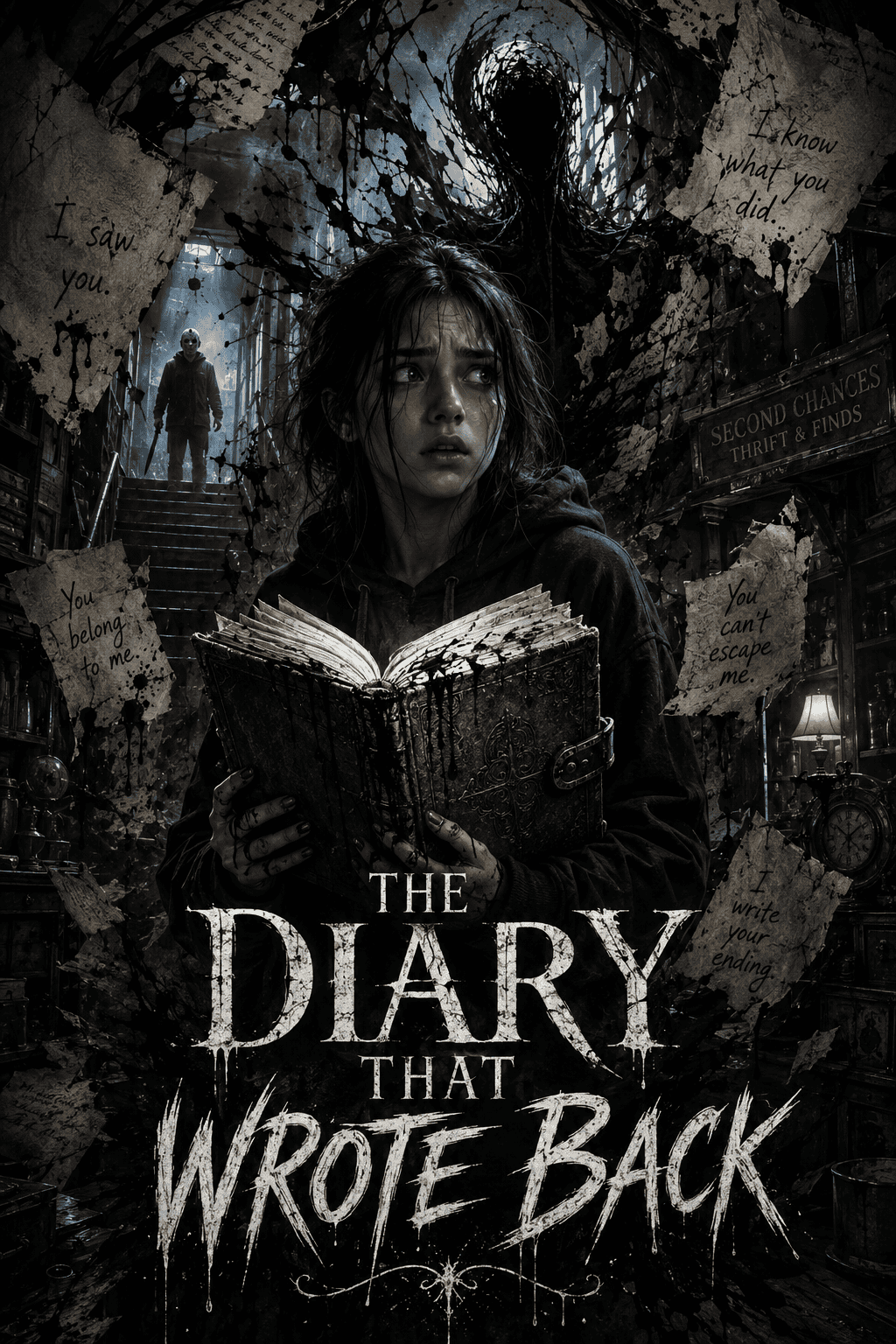
A bullied teenage girl named Maya discovers a mysterious leather-bound diary in a thrift shop and soon realizes that the dark, violent things she writes inside it come true in real life. At first, the diary seems like a twisted form of revenge against the people who hurt her, but its power quickly grows beyond her control, feeding on her anger and fear while writing back in her own handwriting. As the diary pushes her into more dangerous horrors, Maya accidentally unleashes a masked attacker and a supernatural entity at a school party, putting her only friend Jonah in danger. When she tries to destroy the diary and undo everything, it traps her in a repeating nightmare, sending her back to the thrift shop as a character inside its pages, doomed to begin the story again.

Listen to the Story

The Diary that Wrote Back

Experience the story with audio, captions, and full-screen playback.

Reading Mode Skip to Ending

The Diary That Wrote Back

Maya found the diary on a Thursday afternoon, wedged between a cracked porcelain angel and a box of VHS tapes no one had touched since the nineties.

The thrift shop was called Second Chances, though everyone in town called it “the dead people store,” because most of what sat on its shelves looked like it had been emptied from houses where someone had recently passed away. The place smelled like dust, old fabric, and rainwater trapped in wood. Coats drooped from metal racks like tired ghosts. Lamps with stained yellow shades glowed dimly in the corners. Somewhere near the front, a radio played soft oldies under a layer of static.

Maya didn’t usually go there after school. She usually went straight home, locked herself in her room, and waited for the house to become quiet enough to think. But it had been one of those days where every hallway at school felt narrower than the last, every laugh felt aimed directly at her, and every minute stretched like wire around her throat.

So she had walked past her street, crossed the old bridge near the laundromat, and gone into Second Chances because it was the only place in town where nobody expected her to be someone else.

She liked the forgotten things.

Old books with names written on the inside covers. Sweaters that smelled faintly of other people’s lives. Jewelry boxes with missing ballerinas. Half-empty sketchpads. Typewriters with sticky keys.

Things that had belonged to someone.

Things nobody wanted anymore.

Maya understood that.

She was sixteen, thin in a way that made adults ask if she was eating enough, with dark hair she usually hid behind and a backpack covered in tiny pins Jonah had given her over the years. Most of them were horror movie pins. A skull with heart eyes. A vampire drinking coffee. A black cat that said, “I’m fine,” even though it looked furious.

Maya was not fine.

At school, she was mostly invisible until someone needed a target.

That someone was usually Tessa Moore.

Tessa had perfect hair, a loud laugh, and the supernatural ability to sense weakness from across a cafeteria. She called Maya “Morticia” because Maya wore black hoodies and wrote strange stories in the margins of her notebooks. She once stole Maya’s journal and read a paragraph out loud in English class, doing a dramatic trembling voice while everyone laughed.

Except Jonah.

Jonah Reyes had stood up, snatched the journal from Tessa’s hands, and said, “Wow, obsessed much?”

That had made Tessa turn on him too, but Jonah never seemed to care what people thought. He was tall, messy-haired, and kind in a way that embarrassed Maya because she didn’t know what to do with kindness when it was offered without conditions.

Jonah liked her stories. He said they were “messed up in a good way.”

Maya kept writing them because, sometimes, putting monsters on paper made the real ones seem smaller.

That afternoon, in Second Chances, she found the diary on the bottom shelf of a wobbly bookcase.

It didn’t look like the other journals.

There were plenty of those around: pastel notebooks with inspirational quotes, floral planners from years ago, leatherette diaries with broken locks. This one was plain, dark brown, and bound in leather that looked too old to still be holding together. No title. No markings. No price sticker.

Maya pulled it out.

The leather was cold.

Not cool from the room.

Cold.

Like it had been sitting outside in winter.

She almost put it back.

Instead, she opened it.

The pages were thick, creamy parchment, completely blank. Not lined. Not dated. Just page after page waiting for words.

Maya ran her thumb over the first sheet.

It felt expensive. Handmade. Wrong in a way she couldn’t explain.

“You like that one?”

Maya jumped.

The shop owner stood at the end of the aisle, a small woman with gray hair pinned into a bun and glasses hanging from a chain around her neck. Her name was Mrs. Bell, and she always spoke softly, as if the merchandise might wake up if she used her full voice.

“I guess,” Maya said.

Mrs. Bell glanced at the diary, and for one quick second, her face changed.

Not much.

Just enough.

Her mouth tightened. Her eyes seemed to recognize it.

Then the look was gone.

“No sticker?” Mrs. Bell asked.

Maya shook her head.

Mrs. Bell walked over and took the diary from her. She held it carefully, not like it was fragile, but like it might bite.

“Two dollars,” she said.

Maya blinked. “Really?”

“Really.”

“It looks old.”

“Most things here do.”

Maya hesitated. “Where did it come from?”

Mrs. Bell’s thumb pressed into the leather cover. “Estate box, I think.”

“You think?”

“We get many boxes.”

Maya waited for more, but Mrs. Bell only handed it back.

At the counter, Maya paid with quarters from the bottom of her backpack.

As she left, Mrs. Bell called after her.

“Miss?”

Maya turned.

The old woman seemed about to say something. Her lips parted. One hand rested on the counter near a little brass bell.

Then she looked down at the diary in Maya’s arms.

“Be careful what you keep,” Mrs. Bell said.

Maya gave an awkward half-smile because adults loved saying strange things like they were in a movie.

Then she stepped out into the gray afternoon.

The diary felt heavier on the walk home.

By the time Maya reached her house, her stepfather’s truck was already in the driveway.

Her stomach dropped.

Ron was home early.

The house was a narrow two-story rental on the edge of town, with peeling blue paint and a porch light that flickered no matter how many times her mother replaced the bulb. Her mother, Claire, worked double shifts at the hospital cafeteria and came home exhausted, smelling like fryer oil and disinfectant. Ron had moved in two years ago, first as “just someone helping with bills,” then as her mother’s husband, then as the thing that made the house feel smaller every day.

He wasn’t always drunk.

That was the terrible part.

When he was drunk, at least the rules were obvious. Stay quiet. Don’t look at him too long. Don’t answer unless asked. Don’t leave cups in the sink. Don’t breathe like you were trying to annoy him.

When he was sober, he could almost seem normal. He asked Claire about work. He fixed the leaky faucet. He made pancakes on Sundays and called Maya “kiddo” in a voice that made her skin crawl because she knew how fast it could change.

That evening, he was in the kitchen.

Maya could hear him before she opened the door.

“Where the hell have you been?”

She stepped inside and closed the door behind her.

“School.”

“School ended an hour ago.”

“I stopped somewhere.”

Ron stood at the counter in his work boots, holding a beer bottle in one hand. His face was red from the cold or the beer or both. He looked past her shoulder toward the porch, as if checking whether someone had followed her.

“You think your mother needs more reasons to worry?”

Maya tightened her grip on her backpack strap. “No.”

“No,” he repeated, mocking her small voice. “No. That all you got?”

She stared at the floor.

Ron walked closer. The kitchen floor creaked under him.

“What’s in the bag?”

“Nothing.”

“Then show me.”

“It’s just school stuff.”

Ron reached for the backpack.

Maya stepped back without thinking.

His face darkened.

“Don’t do that.”

“I said it’s just school stuff.”

“Don’t make me ask twice.”

Her chest tightened. The diary was in the backpack. She didn’t know why she didn’t want him touching it, only that the thought made panic flash through her body.

Ron grabbed the strap and yanked.

The backpack slipped off her shoulder, spilling open onto the floor. Books, pencils, crumpled papers, and the diary scattered across the linoleum.

The diary landed with a heavy thud.

Ron looked down at it.

“What’s that?”

“A notebook.”

“You writing about me in there?”

“No.”

He bent and picked it up.

The second his fingers touched the leather, he flinched.

Maya saw it.

He tried to hide it, but she saw.

His hand twitched like he had grabbed a live wire.

“What the hell?” he muttered.

Then his expression hardened, embarrassed by his own reaction. He tossed the diary back at her. It hit her chest, and she caught it before it fell.

“Freaky little thing,” he said. “Fits you.”

Maya gathered her things quickly.

Ron watched her.

“You know, girls like you think being weird makes you special,” he said. “It doesn’t. It just makes people tired.”

Maya said nothing.

“Go to your room.”

She went.

She didn’t cry until she had locked the door.

Her room was small and cold, with a slanted ceiling and one window that looked out over the backyard. The wallpaper was faded yellow. Her bedspread was gray. Stacks of books crowded the desk, along with pens, loose paper, and a chipped mug filled with sharpened pencils.

Maya sat on the floor with her back against the bed.

For a long time, she did nothing.

Then she pulled the diary into her lap.

She opened to the first page.

Blank.

Waiting.

She found her favorite pen, the black one Jonah had given her because it didn’t smear, and pressed the tip to the paper.

At first, she only meant to write what happened.

But the words came out sharper than that.

Ron grabbed my bag today. Again. He thinks he owns everything in this house, including the air. He talks like he’s teaching me something, but all he does is make Mom smaller. He makes every room feel like a trap.

The ink sank into the parchment instantly.

Maya kept writing.

I hate him. I hate his boots on the stairs. I hate the way Mom gets quiet when he walks in. I hate that he gets to stomp around like nothing can touch him.

Her hand moved faster.

I wish something would.

She stopped.

Her breathing sounded loud.

Then, before she could think better of it, she wrote one final sentence.

I wish he would just break a leg.

Maya stared at the words.

They looked childish now. Dramatic. The kind of thing Tessa would read aloud in class and make everyone laugh at.

She almost tore the page out, but the diary looked too beautiful to damage.

Instead, she closed it.

That night, she dreamed of scratching.

Not at her window. Not at her door.

Inside the walls.

A soft, patient scraping.

Like fingernails dragging across paper.

The next morning, Ron fell down the stairs.

Maya woke to a scream, a crash, and her mother shouting his name.

She ran into the hallway just in time to see him lying twisted at the bottom of the steps. His face was pale. His beer belly rose and fell in short bursts. One leg bent beneath him at an angle no leg should bend.

Claire knelt beside him, panicked and shaking.

“Call 911!” she screamed.

Maya stood frozen.

Ron looked up at her.

His eyes were wet with pain.

For one second, their gazes locked.

And Maya felt something rise in her chest.

Not happiness.

Not exactly.

Relief.

Then guilt hit so hard she almost doubled over.

She called 911.

At the hospital, they said Ron had broken his tibia in two places. He needed surgery. He would be off his feet for weeks.

“It was the stairs,” Claire kept saying, as if someone had accused her. “He must have slipped. The stairs are old.”

Ron claimed something had grabbed his ankle.

No one believed him.

Maya did not speak.

At school, Jonah found her sitting under the back stairwell during lunch, her untouched sandwich still wrapped in foil.

“You look dead,” he said, sliding down the wall beside her. “Not cool dead. Like medical dead.”

Maya gave a weak laugh.

Jonah studied her face. “What happened?”

She almost told him everything.

The diary. The entry. Ron’s fall.

Instead, she said, “Ron broke his leg.”

Jonah’s eyebrows lifted. “Seriously?”

“Fell down the stairs.”

“Wow.” He paused. “Is it bad that my first thought is ‘good’?”

Maya looked at him.

Jonah softened. “Sorry.”

“No,” she said. “It’s not bad.”

He bumped her shoulder with his. “You okay?”

Maya thought about the diary sitting in her backpack.

“I don’t know.”

That afternoon, curiosity gnawed at her so hard it felt like hunger.

It was impossible, obviously.

People wrote angry things all the time. People said they wished terrible things would happen, and terrible things sometimes did. Coincidence was not magic. Coincidence was just the universe being lazy and dramatic.

Still, when she got home, Maya locked her bedroom door, pulled out the diary, and opened to the first page.

Her entry was still there.

But the ink looked different.

Darker.

Almost raised, like veins beneath skin.

She turned to the next blank page.

“Okay,” she whispered. “If you’re real…”

She stopped, feeling stupid.

Then she wrote:

Tomorrow at school, I win the raffle for the art store gift card.

The school raffle was harmless. Every Friday, the office drew a name from a box of students who had turned in “positive behavior tickets,” which teachers gave out for things like helping clean up or not actively making their lives worse. Maya had one ticket in the box from weeks ago.

She closed the diary.

The next day, during afternoon announcements, Principal Donnelly’s voice crackled over the speakers.

“And this week’s raffle winner is…”

Maya held her breath.

“Evan Miller.”

A cheer went up from somewhere down the hall.

Maya exhaled.

Nothing.

Of course nothing.

She felt embarrassed, then relieved, then oddly disappointed.

At home, she opened the diary again.

The entry about the raffle had changed.

Not much.

Just enough.

The ink had faded to a weak gray, as if the page had rejected it.

Below her sentence, new words appeared slowly, bleeding up through the parchment.

Not hungry.

Maya jerked backward so fast her chair nearly tipped.

The words were in her handwriting.

Exactly.

Same slant. Same uneven pressure. Same little curl on the lowercase y.

She stared until her eyes watered.

Then she slammed the diary shut and shoved it into her desk drawer.

For three hours, she didn’t touch it.

She did homework. She ate dinner. She listened to her mother and Ron argue in low voices because Ron hated being helpless and Claire hated being blamed for things she hadn’t done.

At ten, Maya climbed into bed.

At ten fifteen, she got up.

She opened the drawer.

The diary waited.

Her hands shook as she opened it again.

Not hungry.

Maya whispered, “What does that mean?”

The page remained still.

A sane person would have thrown it away. A sane person would have told someone.

Maya turned to a new page.

She told herself it was a test.

Just a test.

Tessa Moore had posted a picture of Maya that afternoon. Maya hadn’t even known Tessa had taken it. In the photo, Maya was sitting alone under the stairwell, looking down at her notebook. Tessa had added the caption: Local haunted girl composing a spell to make someone love her.

The comments were worse.

Maya had read all of them.

More than once.

Now she pressed her pen to the diary.

Tessa loves her hair more than anything. I hope she wakes up tomorrow and it starts falling out. Not all at once. Enough that everyone sees. Enough that she knows what it feels like to be looked at like something is wrong with you.

The moment Maya finished the sentence, the page warmed under her hand.

Not a little.

A lot.

Like fevered skin.

Maya pulled away.

The ink darkened.

The diary gave a soft creak.

Somewhere inside the house, Ron shouted for Claire.

Maya closed the book.

The next morning, Tessa Moore came to school wearing a beanie.

That alone was strange. Tessa did not wear hats because hats disturbed the architecture of her hair, which was usually curled, glossed, and arranged like she had been born with a ring light following her.

By second period, everyone knew.

By lunch, someone had a video.

Tessa in the girls’ bathroom, sobbing while handfuls of blonde hair came away in her brush.

By the end of the day, people were whispering “alopecia” like it was a curse word.

Maya watched from across the hall as Tessa walked past with her head down, face blotchy, hands tugging the beanie low over her ears.

Tessa looked small.

Maya had imagined feeling powerful.

Instead, she felt hollow.

Jonah appeared beside her.

“Something is weird,” he said.

Maya didn’t answer.

“You heard about Tessa?”

“Everyone heard.”

Jonah glanced at her. “Are you smiling?”

Maya touched her mouth.

She was.

Barely.

She dropped the smile like it had burned her.

“No.”

Jonah looked down the hall at Tessa. “She’s awful, but that’s… intense.”

“Yeah.”

“Maya.”

“What?”

He lowered his voice. “You’ve been weird since Ron’s accident.”

“I’m always weird. That’s kind of my brand.”

“Not like this.”

The warning bell rang.

Maya walked away before he could say more.

That night, she decided not to write.

She put the diary under her bed and covered it with a shoebox full of old birthday cards. She turned off her lamp. She closed her eyes.

The scratching began at midnight.

Soft at first.

Scritch.

Scritch.

Scritch.

Maya lay still.

Scritch.

Scritch.

From under the bed.

She pulled the blanket over her head.

The sound grew louder.

Not frantic. Not impatient.

Steady.

Like something with all the time in the world.

Maya finally snapped on the lamp and dropped to her knees.

The shoebox had been pushed aside.

The diary lay in the center of the floor.

Open.

On a blank page, words appeared one letter at a time.

Why stop?

Maya’s mouth went dry.

She grabbed the diary and slammed it shut.

“I’m not doing this.”

The leather pulsed beneath her hands.

Once.

Twice.

Like a heartbeat.

Maya threw it across the room.

It hit the wall and landed open.

More words spread across the page.

You liked it.

Maya backed away until she hit the bed.

“No,” she whispered.

The ink continued.

You wanted it.

“No.”

You fed me.

Maya slept with the light on.

For three days, she did not write in the diary.

Those three days were worse than anything that had happened before.

At first, she only felt anxious. A crawling sensation under her skin. A constant feeling that she had forgotten something important. Then came the headaches, sharp and sudden behind her eyes. Then the dreams.

In the dreams, Maya stood inside a library made of skin.

Books lined shelves that stretched into darkness. Every book whispered. Every book had her name on it.

When she opened them, she saw scenes that had not happened yet.

Ron screaming in his sleep.

Tessa pulling out clumps of hair in a bathtub full of black water.

Jonah standing in the street, calling Maya’s name while something tall and paper-thin unfolded behind him.

And always, from somewhere deep in the library, a voice turned pages.

Maya woke exhausted each morning.

Her writing hand cramped constantly.

At school, Jonah cornered her by the vending machines.

“Okay,” he said. “You’re scaring me.”

Maya tried to move past him.

He blocked her.

“Don’t do that. Don’t disappear in front of me.”

“I’m fine.”

“You look like you haven’t slept in a week.”

“Thanks.”

“Maya.”

His voice cracked a little, and that hurt worse than if he had yelled.

She looked away.

Jonah lowered his voice. “Did something happen? Did Ron do something?”

“No.”

“Then what?”

Maya hugged her books to her chest.

If she told him, he would think she was losing it.

Or worse, he would believe her.

“I found something,” she said.

Jonah waited.

“A diary.”

His brow furrowed. “Okay.”

“It…” She swallowed. “Things I write in it happen.”

Jonah stared.

Maya laughed once, sharp and humorless. “See? Never mind.”

“No,” he said quickly. “I’m listening.”

“You shouldn’t.”

“But I am.”

Maya told him.

Not everything. Not every thought she’d had when Ron fell. Not the part where she had smiled in the hallway watching Tessa pass by.

But enough.

When she finished, Jonah was quiet.

Too quiet.

Then he said, “Show me.”

“No.”

“Maya.”

“I said no.”

“If this is real, we need to know.”

“We know.”

“No, we don’t. We know enough to be terrified, which is not the same as knowing what to do.”

That sounded exactly like Jonah. Practical in the face of impossible things. He had once fixed a broken projector during English class by smacking it with a textbook and saying, “Technology respects confidence.”

Maya almost smiled.

Almost.

After school, she brought Jonah to her house while Ron was asleep downstairs and her mother was at work.

Maya’s room felt different with him in it. Smaller. More exposed.

The diary sat on her desk.

Jonah didn’t touch it at first.

“Looks normal,” he said.

“It isn’t.”

He leaned closer. “Can I?”

Maya nodded.

Jonah touched the cover with one finger.

He flinched.

“Cold,” he said.

“Yeah.”

He opened it.

The entries were there. Ron. The raffle. Tessa.

And the messages.

Not hungry.

Why stop?

You liked it.

You wanted it.

You fed me.

Jonah’s face lost color.

“This is your handwriting,” he said.

“I know.”

“You didn’t write these?”

“No.”

He turned pages carefully. “Okay. Okay, this is… bad.”

“Thanks, detective.”

“I’m serious.” He looked at her. “Has it hurt anyone else?”

“No.”

The diary creaked.

Both of them froze.

A new line formed beneath the last message.

Liar.

Maya’s blood went cold.

Jonah looked at her.

“What does that mean?”

“I don’t know.”

The ink continued.

You hurt them every time you imagine it.

Maya slammed the diary shut.

Jonah stepped back.

“What the hell is this thing?”

“I don’t know.”

“Where did you get it?”

“Second Chances.”

“We take it back.”

“No.”

“Maya—”

“No. What if someone else buys it?”

Jonah had no answer.

They tried the internet first.

There was no brand name to search. No symbols. No inscriptions. They searched phrases like blank leather diary writes back, cursed diary thrift store, book grants wishes horror, and got creepypasta, Etsy listings, and one forum where someone claimed a haunted notebook had made their ex get food poisoning.

Jonah suggested salt because his grandmother used it around windows when she felt “bad energy.” They poured a circle of salt around the diary.

The next morning, the salt had turned black.

Maya suggested locking it in the basement.

At midnight, it was back on her pillow.

Jonah brought a church candle from his aunt’s house.

The flame bent away from the diary.

They tried cutting a page with scissors.

The scissors snapped.

They tried writing something harmless but negative:

The milk in the fridge spoils.

The next morning, every carton of milk in the school cafeteria had curdled.

The diary grew warmer.

The messages became more frequent.

Small ones appeared in the margins of Maya’s school notes.

Write.

On fogged bathroom mirrors.

Hungry.

On her arm one morning, raised in faint red scratches.

Don’t starve me.

Maya stopped eating much. She stopped sleeping. Her mother noticed, but Claire was trapped in the orbit of Ron’s recovery, insurance calls, extra shifts, and his endless barking from the couch.

“Can you please just help me right now?” Claire snapped one evening after Maya forgot to pick up Ron’s prescription. “I know things are hard, Maya, but they’re hard for everyone.”

Maya looked at her mother’s exhausted face and felt something inside her fold up.

“Yeah,” she said. “I know.”

She went upstairs.

The diary waited on her bed.

Open.

A sentence was already written there.

She doesn’t see you either.

Maya stared at it.

Then she picked up her pen.

That was how it got her.

Not with power.

Not really.

Power was only the bait.

What the diary really offered was proof.

Proof that her anger mattered. Proof that her pain could leave a mark. Proof that when the world hurt her, something would listen.

Something would answer.

For a while, Maya wrote small things.

A teacher who ignored her got a flat tire. A boy who shoved Jonah into a locker developed a rash shaped like handprints. Ron’s favorite recliner collapsed under him, aggravating his broken leg enough to make him cry out.

Each time, the diary drank the words.

Each time, the warmth spread farther up Maya’s fingers.

Each time, she promised herself it was the last.

Then came the party.

It was Tessa’s party, though everyone called it Cameron Bell’s party because it was at Cameron’s house while his parents were out of town. The whole school seemed to be talking about it. There would be music, drinks stolen from parents’ cabinets, and enough bad decisions to fuel Monday morning gossip for weeks.

Maya was not invited.

Jonah was, technically, because Cameron liked him enough when nobody popular was watching.

“You’re not going,” Maya said.

They were sitting behind the gym after school, where the brick wall blocked the wind.

Jonah picked at the label on his soda bottle. “I wasn’t planning on it.”

“Good.”

“But I kind of think maybe we should.”

Maya stared at him. “Why?”

“Because something is going to happen.”

“You don’t know that.”

He gave her a look.

Maya looked away.

Jonah said, “Tessa posted something.”

He handed her his phone.

Maya already knew she shouldn’t look.

She looked anyway.

It was a photo from freshman year. Maya in gym class, face red, hair stuck to her forehead, caught mid-fall after tripping over a basketball. Tessa had added a new caption.

Throwback to when Maya tried running from the demons and lost.

The comments were full of laughing emojis.

One said, She definitely has a basement full of dead animals.

Another said, I’d watch a horror movie where she’s the killer.

Maya’s hand tightened around the phone.

The edges of her vision darkened.

Jonah gently took the phone back.

“Don’t,” he said.

“Don’t what?”

“You know what.”

“I wasn’t going to.”

“Maya.”

“I said I wasn’t going to.”

He didn’t believe her.

That made it worse.

At home, Ron was in a foul mood because his pain meds had run out early and Claire wouldn’t call for more. He yelled until his voice turned hoarse. Claire cried in the bathroom with the fan on, pretending Maya couldn’t hear.

Maya sat at her desk.

The diary lay open.

Waiting.

She thought of Tessa laughing.

Cameron smirking.

Everyone watching.

Everyone always watching when someone else was bleeding.

Her pen touched the page.

She didn’t mean for it to become detailed.

That was what she told herself later.

She meant to write a scare. A ruined party. A story where the lights went out, everyone panicked, and Tessa finally knew what it was like to feel trapped inside a joke she didn’t understand.

But once Maya started, the words poured out.

At Cameron Bell’s party, the power goes out at exactly 11:13 p.m.

The house becomes silent.

Not normal silent.

Wrong silent.

Phones die. Doors lock. Windows will not break.

Someone knocks on the front door.

Three slow knocks.

Everyone thinks it is a prank.

Then a man in a blank white mask steps inside holding a knife.

Maya’s breathing changed.

She kept writing.

He does not run. He walks. He knows where everyone is hiding. He whispers their names before he finds them.

Tessa hides in the upstairs bathroom.

The masked man stands outside the door and scratches the wood with the knife.

He says, “Pretty things come apart.”

Maya stopped.

Her heart pounded.

That was enough.

More than enough.

She tried to pull the pen away.

Her fingers wouldn’t move.

The diary’s pages rippled.

Ink spread ahead of her pen, guiding it.

No.

Not guiding.

Dragging.

Maya watched in horror as her hand continued writing.

The masked man is not alone.

There is something behind him that no one can see unless they look in a mirror.

It wears the faces people make when they are cruel.

It eats the sound of screaming first.

Then the lights come back on so everyone can see what they have become.

Maya yanked her hand back so hard the pen flew across the room.

The diary snapped shut by itself.

From downstairs, Ron shouted, “What was that?”

Maya didn’t answer.

She grabbed her phone and called Jonah.

He picked up on the first ring.

“I did something,” she said.

Jonah went quiet.

“What did you write?”

Maya couldn’t speak.

“Maya. What did you write?”

She told him.

Jonah cursed. She had only heard him curse once before, when he broke his wrist falling off his bike in seventh grade.

“What time is it?” he asked.

Maya looked at the clock.

10:57 p.m.

“We have sixteen minutes,” he said.

“Jonah, don’t go there.”

“I’m already near there.”

“What?”

“I was worried about you. I thought if I went, I could make sure nobody did anything stupid.”

“Jonah, leave.”

“If this starts, I’m getting people out.”

“You can’t.”

“I have to try.”

The line crackled.

“Jonah?”

Static.

Then his voice returned, thin and distant.

“Maya?”

“Get out of there!”

“I’m at the front yard,” he said. “Lights are on. Music’s loud. Everything looks normal.”

“Please leave.”

“I’ll call you right back.”

“No!”

The call ended.

Maya stared at the phone.

10:59.

She grabbed the diary and ran downstairs.

Ron was asleep in the recliner, mouth open, one leg in a brace. Claire’s bedroom door was closed.

Maya went out the back door barefoot.

The cold bit into her feet as she crossed the yard to the rusted fire pit near the fence. She grabbed lighter fluid from the shed, dumped it over the diary, and struck a match.

The flame flared bright.

For one beautiful second, Maya thought it worked.

Then the fire split around the diary.

The leather did not blacken.

The pages did not curl.

The flames bent away from it in a perfect circle, as if the book sat beneath invisible glass.

Maya screamed and kicked dirt over the fire.

Her phone rang.

Jonah.

She answered with shaking hands.

“Jonah?”

At first, all she heard was music.

Then shouting.

Then Jonah’s voice, breathless.

“It happened.”

Maya sank to her knees.

“The lights went out,” he said. “Phones died. I got mine back for a second somehow. Maya, the doors—”

A crash.

Someone screamed.

Not movie screaming.

Real screaming.

The kind that tears something on the way out.

“Jonah!”

“I saw him,” Jonah whispered.

“The masked man?”

“Yes.”

“Get out.”

“I can’t. The windows won’t break. Cameron tried with a chair. It bounced back like—”

Static swallowed him.

Then, very faintly, Maya heard three slow knocks.

Not through the phone.

Behind her.

From inside the house.

Knock.

Knock.

Knock.

Maya turned.

The back door stood open.

Darkness filled the kitchen.

Her phone crackled.

A voice spoke through it.

Not Jonah’s.

Not human.

“Pretty things come apart.”

Maya dropped the phone.

She ran upstairs, clutching the diary to her chest.

In her room, she opened it with numb fingers.

The party entry was still there.

But new paragraphs had appeared beneath it.

Maya had not written them.

The masked man finds Cameron under the pool table.

The thing behind him wears Cameron’s grin.

It stretches the grin from ear to ear.

Maya sobbed.

Another line appeared.

Jonah hides in the pantry and tries not to breathe.

“No,” Maya whispered.

She grabbed her pen.

Stop.

The ink sank in, then vanished.

She wrote harder.

The masked man leaves. Everyone survives. Jonah comes home.

The words trembled.

For a moment, Maya dared to hope.

Then the diary rewrote them.

The masked man leaves pieces. Everyone remembers. Jonah comes home changed.

Maya screamed and stabbed the pen into the page.

The paper absorbed the pen tip.

Not pierced.

Absorbed.

The diary pulled the plastic barrel down like wet sand swallowing a twig.

Maya let go.

The pen disappeared into the page.

The diary burped a small bead of black ink.

Then it wrote:

Better.

Maya backed away.

Her bedroom door creaked open.

No one stood there.

Downstairs, Ron shouted in his sleep.

The phone on the floor buzzed.

A text appeared from Jonah.

No words.

Just a photo.

It showed a dark pantry door from the inside.

Through the narrow slats, Maya could see part of a kitchen lit by flickering emergency lights. A white mask hovered in the distance.

Behind it stood something taller.

Blurred.

Wrong.

Its face was a collage of expressions. Tessa’s laugh. Cameron’s smirk. Ron’s sneer. Maya’s own brief smile when she saw Tessa humiliated.

All of them stretched over one impossible skull.

Another text arrived.

i think it knows you

Maya called him.

No answer.

She called again.

Nothing.

The diary flipped open on the floor.

A blank page waited.

Maya understood then.

It did not want fear from the party.

Not really.

It wanted hers.

The party was bait too.

Everything was bait.

She crawled toward the diary, tears dripping onto the pages.

“What are you?” she whispered.

Words formed slowly.

A place to put what you cannot carry.

The letters shifted.

A mouth to eat it.

Another shift.

A hand to make it real.

Maya shook her head. “I don’t want this.”

The diary answered:

You did.

She thought of every story she had written where someone cruel got punished.

Every daydream where Ron slipped, Tessa cried, the school burned, the whole town finally saw what it had done to her.

She had never wanted those things to be real.

Had she?

The diary’s pages fluttered.

Jonah comes home changed.

Maya grabbed the diary and ran.

She ran past Ron, who was awake now and yelling from the recliner. She ran past the closed bedroom door where her mother slept through exhaustion no nightmare could break. She ran out the front door and down the sidewalk barefoot, diary clutched under one arm.

The town was dark.

Not all of it.

Just the parts she passed.

Streetlights flickered out above her. Porch lights dimmed. Dogs barked once, then went silent.

Second Chances sat at the end of Main Street, its windows black, its sign creaking in the wind.

Maya pounded on the door.

“Mrs. Bell!”

No answer.

She pounded again.

“Please!”

The door unlocked.

Not opened.

Unlocked.

Maya stepped inside.

The thrift shop smelled stronger at night. Dust and old cloth and something metallic underneath.

“Mrs. Bell?”

A lamp clicked on near the counter.

Mrs. Bell sat behind it.

She wore a pale robe over her nightgown, though her hair was still pinned perfectly in place.

“I wondered when you’d come back,” she said.

Maya froze.

“You knew.”

Mrs. Bell looked at the diary. “I suspected.”

“You sold it to me.”

“I tried not to.”

“You charged me two dollars.”

Mrs. Bell’s mouth trembled. “It doesn’t leave unless it is taken willingly. Bought. Gifted. Chosen. There are rules.”

Maya stepped closer. “Then take it back.”

“I can’t.”

“Take it back!”

Mrs. Bell flinched.

The diary warmed beneath Maya’s arm.

Mrs. Bell whispered, “It was my sister’s.”

Maya stopped.

“She found it when we were girls,” Mrs. Bell said. “At a church rummage sale. She wrote such angry little things at first. A neighbor’s cat. A teacher’s hands. Our father’s lungs.” Her eyes grew distant. “By the time we understood, the diary understood her better.”

Maya felt sick. “What happened to her?”

Mrs. Bell looked at the shelves.

“She wrote herself out.”

“What does that mean?”

“It means the diary always makes an ending.”

Maya gripped the book. “How do I destroy it?”

“You don’t.”

“There has to be a way.”

Mrs. Bell shook her head.

Maya’s anger flared so hot it chased away the fear.

“You let me take it.”

“I was afraid,” Mrs. Bell said, tears shining in her eyes. “It had started writing again. In the shop. On receipts. On walls. It wanted out.”

“So you gave it to me?”

“I’m sorry.”

Maya laughed, but it broke apart halfway. “Everyone is always sorry after.”

The diary opened in her arms.

Its pages turned by themselves until it reached a blank sheet.

Words appeared.

Write her.

Mrs. Bell’s eyes widened.

“No,” she whispered.

Write what she deserves.

Maya looked at the old woman.

For one terrible second, she imagined it.

Mrs. Bell’s bones turning brittle. Her mouth filling with ink. Her hands trapped forever beneath a register drawer while the shop filled with all the things she had been too afraid to bury.

The diary pulsed eagerly.

Maya closed her eyes.

No.

She was not free of it.

But she could still choose this.

For now.

“No,” Maya said.

The diary snapped shut hard enough to split the silence.

Mrs. Bell began to cry.

Maya turned and walked out.

Behind her, Mrs. Bell called, “There may be one thing.”

Maya stopped in the doorway.

Mrs. Bell’s voice shook.

“It twists harm. It feeds on fear. It rejects kindness. But it obeys endings. Not wishes. Endings.”

Maya turned back.

“What does that mean?”

“You cannot undo what it has done. But if you write a true ending, perhaps…” Mrs. Bell swallowed. “Perhaps you can close the story.”

Maya thought of Jonah.

“Could I save someone?”

Mrs. Bell looked away.

“That is not the same as undoing.”

Outside, sirens wailed in the distance.

Cameron Bell’s house was six blocks away.

Maya ran toward the sound.

By the time she got there, the street was full of flashing lights.

Police cars. Ambulances. Neighbors in robes standing on lawns. Teenagers wrapped in blankets. Some crying. Some staring blankly. Some with blood on their clothes that did not seem to be theirs.

Maya pushed through the crowd.

“Tessa!”

Tessa Moore sat on the curb without her beanie. Her scalp was patchy and raw-looking under the red-blue flash of police lights. She rocked back and forth, whispering something over and over.

Maya caught only pieces.

“No face. No face. No face.”

Maya kept moving.

“Jonah!”

A paramedic tried to stop her. She ducked under his arm.

“Jonah!”

Then she saw him.

He stood near the garage.

Alone.

His clothes were soaked with something dark. His face was pale. His eyes were open too wide.

Maya ran to him.

“Jonah!”

He looked at her.

For one perfect second, he was still Jonah.

Relief crossed his face.

“Maya,” he said.

Then his expression twitched.

Not naturally.

Like someone had tugged a string behind his skin.

He smiled.

It was Cameron’s smile.

Then Tessa’s.

Then Ron’s.

Then her own.

Maya stepped back.

Jonah’s mouth opened.

When he spoke, several voices came out layered together.

“You wrote me a door.”

Maya shook her head. “No.”

Jonah’s eyes filled with tears.

Under the wrong smile, he was still in there.

“Maya,” he whispered, his real voice fighting through. “Run.”

The thing wearing his face tilted its head.

The police officer nearest them shouted, “Hey! You two need to move back!”

Jonah turned toward him.

The officer stopped.

His face slackened.

So did the faces of everyone nearby.

For a moment, all sound vanished.

No sirens.

No crying.

No wind.

Maya understood.

It ate screaming first.

Then it ate everything else.

The diary burned against her ribs inside her hoodie.

She pulled it out.

The thing in Jonah smiled wider.

“There you are,” it said.

Maya ran.

Not home.

Not to Mrs. Bell.

She ran to the old bridge near the laundromat, the one over the creek swollen with rainwater and trash. The diary slapped against her chest as she climbed over the railing and dropped onto the muddy bank below.

Her feet were bleeding. Her lungs burned. Her hands shook so violently she almost couldn’t open the book.

But she did.

The pages flipped wildly, showing her everything.

Ron on the stairs.

Tessa’s hair in the sink.

The masked man at the party.

Jonah’s face splitting into borrowed smiles.

Then a blank page.

Maya pressed her finger to it.

“I know what you want,” she said.

The diary waited.

“You want an ending.”

The leather shivered.

Maya looked up.

At the top of the bridge, Jonah stood beneath the streetlight.

No.

Not Jonah.

The thing inside him.

It began walking down the slope.

Maya searched the mud for the pen she kept in her hoodie pocket. Her fingers found it.

She opened it with her teeth.

Then she wrote:

The diary is destroyed and everything goes back to normal.

The words stayed black for one heartbeat.

Two.

Then the page began to bleed.

Ink welled from the sentence, thick and dark, spreading outward until the words became unreadable. The diary convulsed in her hands.

Maya held on.

“No,” she said. “No, you listen to me.”

The ink pulled itself into new shapes.

The diary rewrote her sentence.

Everything goes back to the beginning.

Maya’s stomach dropped.

The thing wearing Jonah laughed softly from the bank.

“Maya,” it said in Jonah’s voice. “You should have written better.”

The world folded.

Not faded.

Folded.

The creek bent upward. The bridge twisted like paper. The sirens became a radio song beneath static. The cold mud under Maya’s knees became carpet. The night became fluorescent light.

Maya blinked.

She stood in Second Chances.

Afternoon sunlight pressed against the dusty windows.

A cracked porcelain angel sat on the shelf beside her.

A box of VHS tapes leaned against her ankle.

And there, on the bottom shelf of the wobbly bookcase, sat the diary.

Dark brown leather.

No title.

No markings.

No price sticker.

Maya could not breathe.

She remembered.

All of it.

Ron’s leg. Tessa’s hair. Jonah’s voice telling her to run.

She stumbled backward, knocking over a stack of old magazines.

At the front counter, Mrs. Bell looked up.

“You like that one?” the old woman asked.

Maya stared at her.

No recognition passed over Mrs. Bell’s face.

None.

This was the beginning.

Maya turned toward the door.

She would leave.

She would not touch it.

She would not buy it.

She would warn someone.

She took one step.

Her body stopped.

Not because she chose to.

Because something had written that she did.

Maya looked down.

Her hand was reaching for the diary.

“No,” she whispered.

Her fingers closed around the cold leather.

She tried to scream.

Nothing came out.

Mrs. Bell walked over, smiling politely.

“No sticker?” she asked.

Maya’s mouth opened.

The words that came out were not the ones she tried to say.

“I guess not.”

Mrs. Bell took the diary from her and held it carefully.

“Two dollars,” she said.

Maya cried silently as her own hand reached into her backpack and found the quarters.

She paid.

She carried the diary outside.

The afternoon was gray. The air smelled like rain.

For a moment, standing on the sidewalk, Maya felt the world tremble at the edges.

Then everything went still.

A voice whispered from inside the diary.

Not aloud.

Inside her.

This time, make it hurt.

Maya opened the cover.

The first page was no longer blank.

Words were already written there in her handwriting.

Maya finds a diary in a thrift shop.

She thinks the story begins with her.

But stories do not begin when characters notice them.

They begin when someone opens the book.

The sentence ended.

A new one appeared beneath it.

And somewhere, on the other side of the page, someone began to read.
Back to Top Read More Stories


24 May

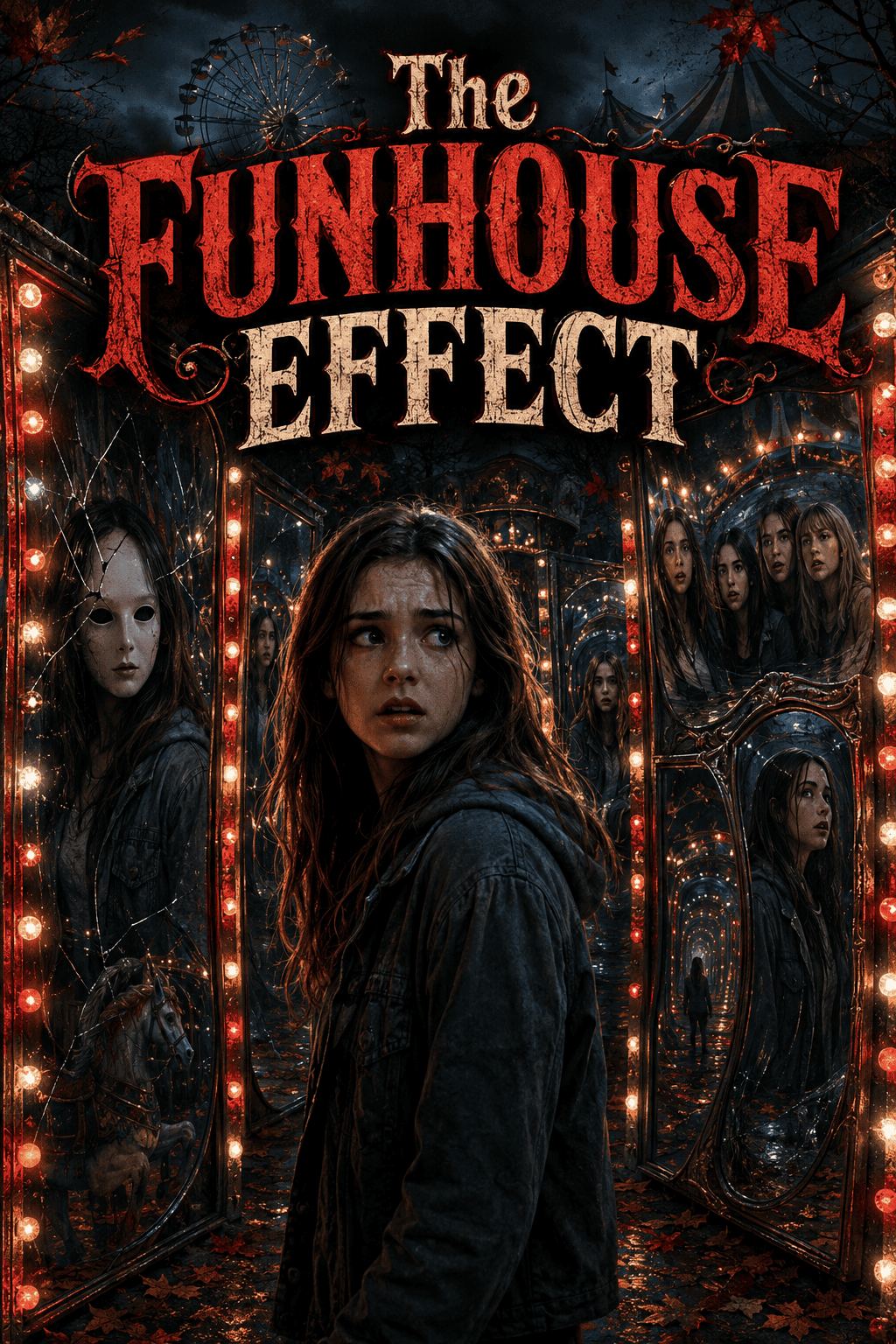
The Funhouse Effect

Story Summary

The Funhouse Effect

The Funhouse Effect follows high school junior Maya, who vanishes inside a carnival Mirror Maze on the final night of the autumn fair—only for security footage to reveal she was never recorded entering the carnival at all. Her three friends remember her clearly and even have photos proving she was with them, but printed images and mirror reflections show her face replaced by a blank porcelain mask. As Maya’s existence begins disappearing from the world, her parents forget her and her bedroom becomes a guest room. Chloe, Jonah, and Sam realize the carnival feeds by erasing people from memory and return to the abandoned fairgrounds before dawn, entering a twisted mirror-world version of the carnival to save Maya before she becomes one of its porcelain-faced victims forever.

Listen to the Story

The Funhouse Effect

Experience the story with audio, captions, and full-screen playback.

Reading Mode Skip to Ending

The Funhouse Effect

By the time the carnival returned to town, the first leaves had already begun to turn.

They came down in brittle gold and rust-colored spirals along Maple Ridge Road, collecting in the gutters and sticking to the wet pavement after every cold October rain. Storefronts filled their windows with plastic pumpkins and paper ghosts. The football field smelled like muddy grass and popcorn. Every night, the air got colder a little earlier.

And then, like it did every year, the carnival appeared.

No one ever saw it arrive all at once. On Monday, the empty field behind the old fairgrounds would be nothing but weeds, gravel, and flattened beer cans. On Tuesday, a few trucks would be parked there. By Wednesday, the Ferris wheel would be halfway assembled, its skeleton rising against the gray sky. By Friday night, everything would be glowing.

The sign at the entrance read:

HOLLOWAY’S AUTUMN CARNIVAL
FINAL WEEKEND ONLY

To most people in town, it was tradition. Funnel cakes. Ring toss. Rides that looked like they had been painted sometime before cell phones existed. For high schoolers, especially juniors and seniors, the last night of the carnival was almost sacred. You went, you took too many pictures, you pretended not to be scared inside the haunted trailer, and you made promises about next year even though everyone knew next year would be different.

Maya Reyes had been talking about it for two weeks.

“We have to go Saturday,” she said at lunch, stabbing a french fry into a puddle of ketchup. “Not Friday. Friday is for families and little kids. Saturday is final night. Final night is when it gets weird.”

Across from her, Chloe Bennett rolled her eyes. “You say that every year.”

“And every year I’m right.”

Jonah Price leaned back in his chair, balancing on two legs even though every teacher had warned him at least once that he was going to crack his skull open. “Last year your ‘weird thing’ was a clown sneezing into a cotton candy machine.”

“That was spiritually significant,” Maya said.

Sam Whitaker, who had been quiet while picking apart a sandwich he didn’t want, smiled faintly. “I thought it was pretty gross.”

“It was an omen,” Maya insisted. “A wet, sugary omen.”

Maya had a way of saying things like that — absolute nonsense, delivered with such confidence that people either laughed or believed her. Usually both.

She was the kind of person who made everything feel like the beginning of a story. A shortcut through the woods wasn’t just a shortcut. It was a cursed path. A substitute teacher wasn’t just bad at attendance. He was definitely an undercover spy. A closed door at the end of a hallway was never just locked. It was hiding something.

Chloe had been friends with her since second grade, long enough to know Maya’s dramatics were not an act exactly. Maya truly did believe the world was stranger than adults admitted. She believed odd things happened in familiar places. She believed mysteries were waiting under loose floorboards and behind peeling wallpaper.

And because Maya believed it so fiercely, her friends sometimes believed it too.

So on Saturday night, they went.

The carnival blazed in the distance like a fallen constellation.

Colored bulbs blinked along the ticket booth. The Ferris wheel turned slowly against a moonless sky. The air smelled like hot grease, diesel, damp hay, and sugar burning at the edges. Somewhere beyond the entrance, a ride shrieked metal-on-metal as it spun teenagers through the dark.

Maya bounced on her toes while they waited in line.

She wore a red jacket, black jeans, and silver star earrings that caught the carnival lights every time she turned her head. Her dark hair was pulled into two messy braids, and she had drawn little black bats on her cheeks with eyeliner in Chloe’s bathroom before they left.

“This,” Maya said, spreading her arms, “is cinema.”

“It’s a parking lot with churros,” Jonah said.

“Exactly. American cinema.”

Sam laughed under his breath.

Chloe pulled out her phone and snapped a photo of them while they waited at the gate. Maya ducked into frame at the last second, grinning wide, one arm hooked around Chloe’s neck.

“Send me that,” Maya said.

“You always say that and never save them.”

“I save the important ones.”

“You saved a picture of a raccoon eating pizza.”

“That raccoon had emotional range.”

They bought tickets from a man in a wool cap who never looked up from the roll of paper wristbands. Chloe got orange. Jonah got green. Sam got blue.

Maya held up her wrist and frowned.

“What?” Chloe asked.

“My band is white.”

The others looked.

Sure enough, Maya’s wristband was pale, almost colorless. Not exactly white, Chloe thought, but translucent, like fog pressed into plastic.

“Fancy,” Jonah said. “VIP ghost pass.”

Maya smiled. “Finally. Recognition.”

They moved through the entrance together, swallowed by noise.

For the first hour, the night was ordinary in the best possible way.

They rode the Scrambler until Jonah nearly threw up. Sam won Chloe a lopsided stuffed bat at a dart game, though the bat’s left eye was stitched lower than the right, giving it a permanently suspicious expression. Maya bought a caramel apple, took two bites, declared it “architecturally impossible,” and handed the rest to Jonah, who ate it anyway.

They took pictures beneath the Ferris wheel. They took pictures in front of a plywood vampire with chipped fangs. Maya insisted they pose with a fortune-telling machine called MADAME VELVET, whose mannequin head jerked forward when Jonah pressed a quarter into the slot.

The machine spat out a paper fortune.

Maya grabbed it before anyone else could.

“What’s it say?” Sam asked.

Maya unfolded the slip, and for a moment, the laughter slid off her face.

Chloe noticed.

“What?”

Maya blinked, then smiled too quickly. “Nothing. It’s dumb.”

She crumpled the paper and shoved it into her jacket pocket.

Jonah reached for it. “Then let us see.”

“Nope. My destiny. Private.”

“You don’t get private destiny at a group outing,” Jonah said.

Maya backed away, laughing. “Watch me.”

Chloe made a mental note to ask later, but the carnival pulled them onward. There were lights to chase, cheap scares to mock, and one final tradition to complete before they went home.

The Mirror Maze sat near the back of the grounds, past the food trucks and the kiddie rides, where the lights were dimmer and the grass turned patchy beneath their shoes.

It had always been there, or at least Chloe thought it had. A long rectangular building on a raised trailer, painted with warped carnival faces and red-and-gold lettering:

THE MIRROR MAZE
SEE YOUR TRUE SELF
ONE WAY IN. ONE WAY OUT.

The painted faces along the side were stretched in impossible expressions — mouths too wide, eyes too small, teeth arranged like piano keys. The front entrance was framed by bulbs that flickered weakly. A black curtain hung inside the doorway.

The operator sat on a stool beside the ticket box.

He was thin and older, with skin like folded paper and a gray mustache that drooped at the corners. His striped vest looked decades old. A name tag pinned to it read:

MR. VALE

Maya stopped in front of the maze and smiled.

“Oh, absolutely.”

“No,” Chloe said immediately.

“Yes.”

“Nope.”

“It’s tradition.”

“The tradition is that we walk past it and you call us cowards.”

Maya turned to Sam. “Sam?”

Sam looked at the maze, then at Maya. “I don’t love mirrors.”

“That is exactly what someone with a haunted reflection would say.”

Jonah shrugged. “I’ll do it if everyone does it.”

Chloe narrowed her eyes. “That means you won’t do it unless we all agree.”

“That is called democracy.”

Maya looked back at the maze. The flickering bulbs reflected in her eyes.

“Fine,” she said. “I’ll go alone.”

Chloe grabbed her sleeve. “Maya.”

“What? Quick scare. Five minutes.”

The operator, Mr. Vale, lifted his head. Chloe hadn’t noticed him watching them before.

“Maze closes in thirty,” he said. His voice was soft and dry. “Last walk-throughs now.”

Maya took two tickets from her pocket and slapped them onto the counter. “Perfect.”

Mr. Vale looked at the tickets. Then at Maya.

For one brief second, Chloe thought his expression changed. Not surprise exactly. Recognition.

Then he tore the tickets in half and opened the little chain across the entrance.

“One way in,” he murmured.

Maya grinned at her friends. “One way out.”

“Maya, don’t be annoying,” Chloe said. “Just go through and come out.”

“I will return transformed.”

“Do not return transformed.”

Maya saluted, then disappeared through the black curtain.

The curtain fell shut behind her.

For the first few minutes, they laughed.

They heard Maya inside almost immediately, her voice echoing through the walls.

“Oh my God. No. Absolutely not.”

A thump.

“Maya?” Chloe called.

“I’m fine!” Maya shouted back. “I just attacked myself.”

Jonah snorted.

Another laugh echoed from inside, then footsteps, then a squeak like rubber soles sliding on polished floor.

After five minutes, Chloe checked the time.

After ten, Jonah bought a lemonade from a nearby stand.

After fifteen, Sam stopped pretending to look relaxed.

“She should be out by now,” he said.

Chloe walked to the exit side of the trailer, where another black curtain hung beneath a painted sign that read SURVIVORS. No one came out.

“Maya?” she called.

There was no answer.

At twenty minutes, Chloe went to Mr. Vale.

“She’s still in there.”

Mr. Vale didn’t move from his stool. “Some people take longer.”

“It’s a mirror maze, not a cornfield.”

“Mirrors can be confusing.”

Chloe stared at him. “Go get her.”

Mr. Vale sighed, as if she had asked him to clean up spilled soda. He stood, took a ring of keys from his belt, and slipped through the entrance curtain.

The three of them waited.

The carnival seemed suddenly louder around them. The Ferris wheel creaked. The game barkers shouted. A child cried somewhere near the duck pond booth.

Two minutes passed.

Five.

Then Mr. Vale emerged from the exit curtain.

Alone.

Chloe pushed past Jonah. “Where is she?”

The operator looked at them with small, watery eyes.

“No one’s inside.”

“That’s not funny,” Jonah said.

“I didn’t say it was.”

Sam’s face had gone pale. “She went in. We saw her go in.”

Mr. Vale wiped his hands on his vest. “Then she came out.”

“No, she didn’t,” Chloe snapped.

“Maybe you missed her.”

“We were standing right here.”

Mr. Vale glanced behind them, toward the lights and crowds. “Carnival’s busy.”

Chloe shoved past him and ripped open the exit curtain.

Inside, the maze smelled like dust, old metal, and something faintly sweet. The mirrors stood in angled corridors, reflecting her a hundred times over. Chloe saw herself multiplied into infinity — orange wristband, frightened eyes, mouth open as she yelled Maya’s name.

Jonah and Sam followed.

They searched every corridor. They pressed on every panel. They crawled beneath the rails. Sam found a maintenance door at the back, but it was locked from the inside with a rusted slide bolt.

There was nowhere Maya could have gone.

By midnight, the police had arrived.

By one in the morning, the carnival had closed.

By two, Chloe sat on the curb beside Jonah and Sam while officers moved in and out of the Mirror Maze with flashlights.

Maya’s mother called Chloe’s phone seventeen times.

Chloe did not know what to say.

The first version of the story was simple: Maya had entered the maze and vanished.

The second version was worse.

The police pulled security footage from the front gate the next morning.

Chloe, Jonah, and Sam sat in a small interview room at the station with Chloe’s mother and Sam’s father waiting outside. Detective Harris, a square-shouldered woman with tired eyes, stood in front of a wall-mounted screen.

“Tell me what you see,” she said.

The footage was grainy but clear enough.

There was the entrance to the carnival. The ticket booth. Families walking through. Teenagers pushing each other. A little boy dragging a balloon shaped like a skeleton.

Then Chloe saw herself.

She walked into frame wearing her gray hoodie and black boots. Jonah was beside her in his varsity jacket. Sam followed, hands in his pockets.

Chloe leaned forward.

“No,” she whispered.

On the screen, there were only three of them.

Chloe watched her own recorded self turn slightly to the left, smiling at someone who wasn’t there. Jonah held up four fingers to the ticket seller. Sam stepped aside as if making room for someone to pass.

But there was empty space between them.

Not blurry space. Not a shadow. Not a glitch.

Nothing.

Detective Harris paused the video.

“Where is Maya?” she asked.

Chloe’s mouth had gone dry.

“She’s there,” Jonah said, voice shaking. “She’s right there.”

The detective looked at the screen. “I see three people.”

“She was with us,” Sam said. “She bought a ticket.”

“We checked transaction logs,” Detective Harris said. “Three tickets sold together. Three wristbands.”

Chloe shook her head hard. “No. No, she had one. It was white.”

The detective made a note. “White?”

“Like clear plastic,” Chloe said. “Almost see-through.”

Detective Harris’s expression shifted slightly, but only for a second. “The carnival does not use white wristbands.”

Jonah pulled out his phone so fast he nearly dropped it.

“Pictures,” he said. “We took pictures. We have proof.”

He opened his camera roll and shoved the phone toward the detective.

There they were.

All four of them beneath the Ferris wheel.

Chloe. Jonah. Sam.

And Maya.

She stood between Chloe and Sam, red jacket bright beneath the carnival lights, silver star earrings shining, eyeliner bats on her cheeks.

Detective Harris took the phone.

Her face changed.

She swiped to the next photo. Then the next. Madame Velvet. The vampire cutout. The game booth.

Maya was in all of them.

“Send me these,” the detective said.

Chloe felt the first small breath of relief since Maya had disappeared.

Then the detective tried to print them.

The station printer hummed and spat out the first page.

Detective Harris picked it up.

The room went silent.

In the printed photo, Maya’s body was there. Her red jacket. Her braids. Her arm around Chloe.

But her face was gone.

In its place was a smooth porcelain mask.

Blank. White. Featureless except for two shallow dents where eyes should have been.

Chloe made a sound she didn’t recognize as her own.

Jonah grabbed the paper. “What did you do?”

“We didn’t do anything,” Detective Harris said, though her voice had lost some of its authority.

Sam backed away from the table. “Print another.”

They did.

Every printed photo was the same.

On the phone screen, Maya smiled. On paper, she wore the mask.

Detective Harris took Jonah’s phone and held it up to the dark window of the interview room. The glass reflected the image faintly.

In the reflection, Maya’s face was porcelain.

Chloe stopped breathing.

That was when the world began to let go of Maya.

At first, it happened in small ways.

Maya’s name disappeared from the junior class group chat. Not the messages — those were still there — but every message she had sent now appeared under a gray default icon labeled Unknown User.

Her locker combination no longer worked.

When Chloe asked their history teacher whether Maya had turned in her essay on the French Revolution, Mr. Adler frowned and said, “Who?”

Chloe thought he was joking.

He wasn’t.

By lunch, Maya’s seat at their table had been taken by a sophomore named Emily who insisted she had sat there all year.

Jonah slammed his tray down so hard milk splashed across the table.

“This is Maya’s seat.”

Emily blinked. “Who’s Maya?”

The cafeteria did not go quiet. It should have. In movies, moments like that cracked the room open. But everyone kept eating, laughing, scrolling, complaining about homework.

The world moved around the missing space as if it had never been occupied.

By the end of the school day, Maya’s name had vanished from attendance records.

By nightfall, her Instagram account no longer existed.

On Sunday morning, Chloe went to Maya’s house.

She had been there hundreds of times. Sleepovers. Birthday parties. Study sessions that became horror movie marathons. Maya’s mother, Elena, always kept too many blankets in the living room because she said teenagers were “dramatic about temperature.” Maya’s father, Luis, made pancakes shaped like animals on snow days.

Chloe rang the doorbell with shaking hands.

Elena Reyes answered.

She looked tired but normal. Her hair was clipped up. She wore gardening gloves.

For one dizzy second, Chloe thought everything might be fine.

“Mrs. Reyes,” Chloe said, and her voice cracked. “Is Maya home?”

Elena stared at her.

“I’m sorry?”

“Maya,” Chloe said. “Your daughter.”

Something passed over Elena’s face. Confusion. Polite concern. Maybe fear.

“Honey,” Elena said gently, “I don’t have a daughter.”

Chloe actually laughed. It came out sharp and ugly.

“No. No, you do. Maya. She’s my best friend.”

Elena glanced over her shoulder into the house. “Luis?”

Maya’s father appeared behind her. “What’s going on?”

“This girl is asking for someone named Maya.”

Luis frowned. “Do we know a Maya?”

Chloe pushed past them before either could stop her.

The stairs were where they had always been. The hallway still smelled faintly like lemon cleaner and coffee. Maya’s room was the second door on the left.

Chloe opened it.

The room was gone.

Not destroyed. Not emptied.

Gone.

The walls were beige instead of purple. The bed had a plain white comforter. There were no posters, no books, no messy desk covered in pens, no string lights, no shelf of weird little thrift store figurines Maya collected because she said they were “emotionally haunted.”

It was a guest room.

A perfectly clean, perfectly blank guest room.

Chloe stood in the doorway and felt something inside her tilt.

Behind her, Elena Reyes said, “Honey, I think you need to leave.”

Chloe turned slowly.

On the dresser mirror, something moved.

Not in the room.

In the mirror.

A red jacket. Dark braids. A pale oval face.

Maya stood behind Chloe in the reflection, distorted as if the glass were bending her. Her body was stretched too long. Her head tilted at an angle no neck should allow.

Her face was not a face.

It was the mask.

Chloe screamed and spun around.

The room behind her was empty.

That night, the three of them met in Jonah’s basement.

No one wanted to be alone.

Jonah had covered the big wall mirror with a blanket. Sam unplugged the TV. Chloe placed her phone face down on the coffee table because she could not stop checking Maya’s photos and making sure her face was still there.

For now, on the screen, Maya remained Maya.

But only on the screen.

Jonah paced. “We sound insane.”

“We are not insane,” Chloe said.

“My mom wants me to see someone.”

“Mine too.”

Sam sat on the floor with his knees pulled up. He had barely spoken since Chloe told them about Maya’s parents.

“What if we forget next?” he said.

The question settled over them.

Chloe had been trying not to think it. It had been waiting behind every other fear.

“What if that’s how it works?” Sam continued. “It starts with people who barely knew her. Then teachers. Then records. Then family.”

“Then us,” Jonah said.

“No,” Chloe said.

“You don’t know that.”

“No,” she said again, louder, because she needed the word to be true. “We are not forgetting her.”

Jonah stopped pacing. “Then we write everything down.”

So they did.

They filled pages from Jonah’s old spiral notebooks.

Maya Reyes. Born April 14. Favorite movie: Coraline. Hated bananas but liked banana bread, which Jonah said was hypocrisy. Had a scar on her left knee from falling off Chloe’s bike in fourth grade. Wanted to go to art school but pretended she wanted to be a lawyer because it annoyed adults less. Once cried during a commercial about shelter dogs and denied it for six months.

They wrote until their hands cramped.

They recorded videos of themselves saying her name.

They drew her face.

Chloe took out her phone and opened one of the carnival photos. She stared at Maya smiling under the Ferris wheel.

“I remember this,” Chloe whispered. “I remember her saying the lights made us look like we were in a murder documentary.”

Sam smiled weakly. “She said Jonah would be the first suspect because he has ‘suspicious cheekbones.’”

Jonah’s eyes filled with tears. “That’s rude and accurate.”

The lights flickered.

All three of them froze.

The unplugged TV clicked on.

Static filled the screen.

Not loud. Not full volume. Just a low gray hiss.

Then the static bent inward, like something pressing against fabric from the other side.

Maya appeared.

Not fully. Not clearly. Her reflection stretched across the dark glass, though none of them stood in front of it. She wore the red jacket. Her hands were pressed against the inside of the screen.

Her face was still Maya’s for one flickering second.

Then the porcelain mask slid over it.

Chloe grabbed the remote and threw it at the TV. The screen cracked. Static snapped into darkness.

No one moved.

From somewhere in the basement came a faint carousel melody.

Tinny. Slow. Warped.

Round and round and round.

Sam covered his ears.

Jonah whispered, “We have to go back.”

The carnival was supposed to leave at dawn.

Everyone in town knew the schedule. Final night Saturday, cleanup Sunday, trucks gone before Monday morning. By the time school started, the fairgrounds would be empty except for tire tracks and trampled grass.

So at three in the morning, Chloe, Jonah, and Sam climbed the fence behind the fairgrounds.

The carnival lot in darkness looked nothing like it had under the lights.

Without music and crowds, the rides seemed abandoned mid-thought. The Ferris wheel stood still against the sky. Game booths were shuttered. Stuffed animals hung from hooks with damp fur and dead plastic eyes. The food stands had been emptied, but the smell of grease remained, sour in the cold air.

A few trucks idled near the far end of the lot, their trailers already loaded.

“Do you hear that?” Sam whispered.

Chloe listened.

At first, only wind.

Then, faintly, beneath it, music.

Carousel music.

The Mirror Maze was still standing.

Everything else around it looked half-packed, but the maze remained untouched, its bulbs glowing weakly in the dark.

SEE YOUR TRUE SELF

Chloe’s stomach turned.

Mr. Vale stood beside the entrance.

He did not look surprised to see them.

“Closed,” he said.

Jonah stepped forward. “Where is she?”

Mr. Vale tilted his head. “You should go home.”

“We’re not leaving without Maya,” Chloe said.

At the sound of her name, something shuddered through the Mirror Maze. The bulbs flickered. The painted faces on the wall seemed to stretch wider.

Mr. Vale sighed.

“Names are hooks,” he said. “You keep saying hers, and it keeps you caught.”

“What are you?” Sam asked.

The old man smiled sadly. “An employee.”

“Of what?”

Mr. Vale glanced toward the maze. “Something hungry.”

Jonah grabbed him by the front of his vest. “Open it.”

Mr. Vale did not resist. Up close, Chloe could see his name tag was not pinned to the vest. It was fused into it, as if the metal had grown there.

“You don’t understand the arrangement,” he said. “The carnival takes what towns are willing to give.”

“We didn’t give her,” Chloe said.

“No,” Mr. Vale replied. “But towns forget children every day. Little by little. They forget who needed help. Who stopped showing up. Who got quiet. The carnival only finishes what people begin.”

Chloe slapped him.

The sound cracked across the lot.

Mr. Vale slowly turned his face back to her.

For the first time, his polite mask slipped.

Behind his eyes, something vast and mirrored looked out.

Then Sam swung a metal pipe he had found near the fence.

It struck the lock on the entrance chain. Once. Twice.

On the third hit, the chain snapped.

The black curtain stirred though there was no wind.

Mr. Vale stepped aside.

“One way in,” he said softly.

Chloe pushed through first.

Inside, the maze was colder than outside.

Their flashlights cut across glass, throwing fractured versions of them in every direction. Chloe saw herself young, old, stretched thin, crushed wide. Jonah’s reflection smiled when Jonah did not. Sam’s reflection lagged half a second behind his movements.

They moved carefully.

“Maya!” Chloe called.

Her voice came back wrong.

ayaM.

Jonah grabbed her arm. “Don’t.”

The maze had changed.

The path was longer than before. Corridors bent where they shouldn’t. Mirrors opened into more mirrors. Reflections showed angles that did not exist. Chloe saw the back of her own head in glass directly in front of her. She saw Sam walking on the ceiling. She saw Jonah as a little boy, crying in a hallway.

Then they found the cracked pane.

It stood at the end of a narrow corridor, taller than the others, framed in tarnished gold. A jagged crack ran from the top corner to the center, splitting Chloe’s reflection through one eye.

Beyond the crack, the reflection did not show the maze.

It showed the carnival.

But reversed.

The Ferris wheel turned backward. Flags snapped in wind that blew the wrong direction. The sky was the color of old bruises. People moved through the midway, or things shaped like people, their faces smooth and pale.

At the center of that other carnival, a carousel spun slowly.

The music came from there.

Chloe touched the crack.

The glass rippled like water.

Sam whispered, “Nope.”

Jonah swallowed. “We came this far.”

Chloe thought of Maya’s empty room. Her mother’s blank face. The printed photo with the porcelain mask.

She stepped through.

Cold swallowed her whole.

The mirror world smelled like rain on metal and powdered sugar gone rotten. Every sign was backward. Every bulb glowed with a faint, sickly light. Their footsteps made no sound on the dirt.

The carnival people turned as they passed.

Smooth masks. No mouths. No eyes. Just blank porcelain faces angled toward them.

Chloe stayed focused on the carousel.

It spun in the middle of the midway, its horses black and glossy, their mouths open in silent screams. Gold poles rose into a canopy painted with scenes of towns burning, children laughing, families sitting at dinner with empty chairs between them.

And there was Maya.

She was strapped to one of the carousel horses with red velvet ribbons.

Her skin had gone pale and shiny. Her fingers were stiff, curled like doll hands. Porcelain crept up her throat in delicate white cracks. Her eyes moved frantically when she saw them.

Chloe ran.

“Maya!”

Maya tried to speak, but no sound came out.

Jonah climbed onto the moving carousel and nearly slipped. Sam helped Chloe grab the ribbons. They pulled, tore, clawed. The fabric tightened like living muscle.

The carousel music grew louder.

Behind them, Mr. Vale stepped out from between two mirrors that had not been there before.

“I told you,” he said. “There is an arrangement.”

Chloe yanked at the ribbon until her fingers bled. “Let her go!”

“The carnival took a life,” Mr. Vale said. “A place in memory. A shape in the world. You cannot simply steal it back.”

Jonah turned on him. “Then what?”

Mr. Vale’s eyes moved across them.

“One may be exchanged.”

The carousel slowed.

Chloe felt the words before she understood them.

“No,” Sam whispered.

Mr. Vale continued, almost gently. “Balance must be kept. One remembered soul returned. One willing soul remains.”

Maya shook her head violently. Porcelain cracked along her cheek.

Chloe looked at Jonah.

Jonah looked at Sam.

For one terrible second, no one spoke.

Then Jonah climbed onto the carousel.

Chloe grabbed him. “Don’t.”

He wouldn’t look at her. “My dad already thinks I’m a disappointment. Half the school thinks I’m a joke.”

“Stop it.”

“Maya has a family.”

“So do you!”

“She had a family,” Jonah said, voice breaking. “And they forgot her.”

Chloe held on tighter. “We won’t forget you.”

“That’s what this thing wants us to believe,” Sam said. His voice was shaking, but his eyes were fixed on Mr. Vale. “It wants one of us to panic and make a noble sacrifice.”

Mr. Vale’s expression did not change.

Sam stepped closer to the carousel.

“It feeds on memory,” he said. “That’s what you said. Names are hooks.”

Chloe looked at him. “Sam?”

Sam pulled Jonah back.

Then he took the spiral notebook from inside his jacket — the one they had filled in Jonah’s basement. Maya’s name was written across the first page in thick black marker.

Sam held it up.

“We brought more than one memory.”

For the first time, Mr. Vale looked uncertain.

Sam opened the notebook and began to read.

“Maya Reyes. Born April fourteenth. Favorite movie, Coraline. Hates bananas. Likes banana bread even though that makes no sense.”

The carousel jerked.

Chloe understood.

She pulled out her phone and started playing the videos they had recorded.

Her own voice filled the air.

“Maya Reyes is my best friend.”

Jonah fumbled for his phone too.

“Maya once convinced our substitute teacher that the classroom skeleton was named Gregory and had a peanut allergy.”

The masked carnival people began to twitch.

Sam kept reading, louder now.

“She has a scar on her left knee. She wants to go to art school. She cries at shelter dog commercials.”

The porcelain on Maya’s face cracked.

Mr. Vale hissed, “Stop.”

Chloe screamed Maya’s name.

Jonah screamed it too.

Sam read every ridiculous, beautiful, ordinary detail they had written down. Each memory struck the carousel like a hammer. The ribbons loosened. The horses bucked. The canopy split down the middle, revealing a sky of endless mirrors.

The carnival people reached for them.

Chloe climbed onto the carousel and grabbed Maya’s hand.

Maya’s fingers were cold porcelain.

“Come on,” Chloe sobbed.

Maya’s lips cracked open.

This time, sound came out.

“Chloe?”

The last ribbon snapped.

The carousel stopped.

The mirror world screamed.

Not with one voice. With hundreds. Thousands. Every person it had consumed from every town, every final night, every empty bedroom and unexplained absence.

The ground split beneath them, reflecting stars that weren’t in the sky.

“Run!” Jonah shouted.

They ran.

Through the backward midway. Past the masked crowds. Past game booths where prizes turned their blank faces to watch them. Past Madame Velvet, whose glass case was filled with white wristbands.

Behind them, the carousel music warped into a roar.

The cracked pane waited inside the maze, glowing like a wound.

Sam shoved Maya through first. Jonah followed. Chloe glanced back once.

Mr. Vale stood in the midway, his body splintering into reflections.

“You cannot remember everyone,” he said.

Chloe looked at the masked figures behind him.

For one second, she thought she saw faces beneath the porcelain. Children. Teenagers. Adults. People waiting for someone, somewhere, to say their names.

Then the mirror world folded inward.

Chloe jumped through the cracked pane.

She hit the floor of the Mirror Maze hard enough to knock the air from her lungs.

Jonah was beside her. Sam was coughing. Maya lay curled on the floor, shaking, but alive.

Her face was hers.

Chloe grabbed her and held on.

Outside, engines roared.

They stumbled out of the maze just as dawn paled the horizon.

The carnival trucks were pulling away.

The Ferris wheel was gone. The game booths were gone. The food stands, the rides, the ticket booth — all gone, though there had not been enough time to pack them. The field was empty except for tire marks in the mud and the Mirror Maze, which stood alone in the gray morning.

Then, as the sun rose, the maze collapsed.

Not dramatically. Not in flames.

It simply folded in on itself like wet cardboard, mirrors cracking one after another until nothing remained but a pile of old wood, glass dust, and one striped vest with a metal name tag still attached.

There was no sign of Mr. Vale.

Maya’s parents remembered her at 6:17 that morning.

Elena Reyes woke screaming in the guest room that had once again become her daughter’s bedroom. Luis ran down the hall and found the walls purple, the string lights glowing faintly, the thrift store figurines grinning from their shelf.

At school, Maya’s name returned to attendance records.

Her locker opened.

Her Instagram account reappeared with three hundred unread messages and one new post none of them had uploaded.

It was a photo from the carnival.

Four friends beneath the Ferris wheel.

Chloe. Maya. Jonah. Sam.

All smiling.

Behind them, barely visible between the lights, stood a row of people in porcelain masks.

The caption read:

SEE YOU NEXT AUTUMN.

For a while, people talked about what happened.

Not everyone, of course. Most of the town settled on explanations that fit inside their lives. A runaway scare. A prank. A gas leak. Teenage hysteria. The carnival company denied ever operating in Maple Ridge. No business license existed. No permits had been filed. No one could find Holloway’s Autumn Carnival online.

But Chloe, Maya, Jonah, and Sam knew better.

They kept the spiral notebook.

They added to it.

Not just Maya’s memories now, but other names too.

Names they found in old missing-person articles from towns where Holloway’s had appeared. Names whispered from cracked screens. Names that surfaced in dreams accompanied by carousel music.

They wrote them all down.

Because names were hooks.

Because memory was a door.

Because somewhere beyond the glass, the carnival was still moving from town to town, hungry and glowing beneath the autumn sky.

And every now and then, when Chloe passed a dark window or a puddle after rain, she saw the faint reflection of a midway behind her.

Not close.

Not yet.

But waiting.

Back to Top Read More Stories


19 May

The Sandbox

Story Summary

The Sandbox

A new invite-only augmented reality app turns a quiet suburban neighborhood into a game of dares, rewards, and escalating danger. When thirteen-year-old Leo and his friends begin completing quests for digital prizes, the harmless fun quickly mutates into something darker — a system that knows too much, pushes too hard, and seems to be watching every move they make.

Listen to the Story

The Sandbox

Experience the story with audio, captions, and full-screen playback.

Reading Mode Skip to Ending

The Sandbox

The rule of Sandbox was that you weren’t supposed to talk about Sandbox.

Not to parents. Not to teachers. Not to older siblings who thought every new app was either stupid or dangerous. Especially not to adults who used words like screen time and boundaries and digital safety contract.

The second rule was that you couldn’t download it from any app store.

You had to be invited.

That was what made everyone want it.

By Monday morning, half of Briar Glen Middle School was whispering about it in the halls like it was a secret curse or a cheat code for real life.

“Jayden said his cousin got seventy-five bucks for climbing the water tower.”

“No, he didn’t. That’s fake.”

“It’s not fake. He showed me the gift card.”

“My brother said Sandbox uses real maps. Like, it knows where you are.”

“All apps know where you are.”

“Not like this.”

Leo Vance heard the rumors before he saw the app. He heard them in the cafeteria, where seventh graders leaned over trays of square pizza and green beans nobody touched. He heard them by the lockers, where kids spoke in tight circles and stopped when teachers walked past. He heard them in homeroom, where someone’s phone chimed with a sound like a shovel striking wet dirt.

A few kids turned instantly.

The teacher, Mrs. Bellamy, did not.

She was writing THESIS STATEMENTS on the board in blue marker.

Leo looked over at his best friend Marcus, who raised his eyebrows.

That sound meant Sandbox.

Everyone knew it already.

Leo didn’t have the app.

He told himself he didn’t care.

He cared.

By sixth period, he cared so much that his stomach hurt.

Briar Glen was one of those suburbs that adults described as “quiet” and kids described as “boring.” It had neat cul-de-sacs, identical mailboxes, lawn-care trucks, security cameras above garage doors, and moms who texted the neighborhood group chat when they saw a coyote. There was a frozen yogurt place, three churches, a public library, and one old strip mall that had been mostly empty since the bowling alley closed.

Nothing happened there.

Sandbox changed that.

It took the map of Briar Glen and made it glow.

That was how Riley described it at lunch. Riley Park was the kind of kid who had two phones, three hoodies, and the ability to know everything before anyone else.

“It’s augmented reality,” Riley said, stabbing a fry into ketchup. “You point your camera and stuff pops up. Like quests. Rewards. Rankings.”

Maya Chen frowned. “So Pokémon Go, but for chores?”

Riley shook their head. “Not chores. Not really.”

Marcus leaned in. “Then what?”

Riley grinned. “Real stuff.”

Leo tried not to look too interested. “Like what?”

“Like...” Riley glanced around, lowering their voice. “Last night, Tyler Nguyen had to move every trash can on Brookside Lane onto one driveway.”

Marcus laughed. “That was him?”

“My dad was yelling about that this morning,” Maya said.

“He got twenty bucks,” Riley said. “Then Level 2 unlocked.”

Leo’s pulse gave a small jump.

Twenty bucks for moving trash cans?

That was stupid.

That was amazing.

“Who runs it?” Maya asked.

Riley shrugged. “Nobody knows.”

“That’s comforting,” she said.

“It’s invite-only,” Riley continued. “You get one code after finishing Level 1. Sometimes more if you rank high.”

Marcus pointed at Leo. “We need this.”

Leo shook his head like he was above it. “Sounds dumb.”

“You sound dumb,” Marcus said.

Maya gave Leo a look. She knew him too well. She could always tell when he was pretending not to want something.

“Don’t,” she said.

“Don’t what?”

“Don’t do that thing where you act like you’re too smart to be curious.”

“I am too smart.”

“No,” she said. “You’re curious and bad at lying.”

Leo smiled despite himself.

He was curious.

He had always been curious in the way that got him in trouble. Not big trouble. Not police trouble. Just enough to make adults sigh his name like it was a chore. He took apart remotes to see how they worked. He clicked links his dad told him not to click. He once used the school library printer to print forty copies of a fake cafeteria menu that included “Mystery Lump Surprise” and “Principal Gravy.”

Sandbox sounded like trouble.

Not boring trouble.

Real trouble.

That night, Leo was in his room pretending to do algebra when his phone buzzed.

He expected a text from Marcus.

Instead, the screen showed a black notification box with a tiny white icon in the corner.

A child’s plastic shovel.

YOU HAVE BEEN INVITED TO PLAY SANDBOX.

Below it was a code.

No sender.

No app icon.

No explanation.

Leo sat up.

His room seemed to go quiet around him.

The house was normal: dishwasher rumbling downstairs, his mother on a work call in the kitchen, his dad laughing at something on TV. Rain tapped lightly against the window. His little sister, Emma, was singing in her room, off-key and fearless.

Leo stared at the message.

Then he did what he absolutely should not have done.

He tapped it.

The screen went black.

A line of white text appeared.

Sandbox builds better players.

Then:

Do you accept the rules?

There was no list of rules. No terms of service. No privacy policy. Just one button.

ACCEPT.

Leo hesitated for three whole seconds.

Then he pressed it.

His phone camera opened by itself.

For a moment, it showed his bedroom: laundry pile, desk, lamp, sneakers, science fair ribbon from fifth grade. Then the image shifted. His room became outlined in pale blue light. The walls shimmered. Icons appeared over objects.

His backpack: INVENTORY

His bedroom door: EXIT

His window: OPTIONAL ROUTE

Leo whispered, “Whoa.”

A map expanded across the screen, not like the maps app, but like a game board laid over his neighborhood. Streets glowed. Houses pulsed. Briar Glen Middle School floated at the center, marked by a gold flag.

A username appeared at the top.

LEO_VANCE_13

His level: 1

Rank: UNLISTED

Balance: $0

Then came the sound.

A shovel striking wet dirt.

NEW QUEST AVAILABLE.

Leo tapped.

The quest card opened.

LEVEL 1: TEACHER’S PET

Objective: Retrieve the blue notebook from Mrs. Bellamy’s desk.

Location: Briar Glen Middle School, Room 214.

Reward: $50 digital gift card.

Bonus: Invite tokens unlocked.

Time Limit: 24 hours.

Leo blinked.

That was it?

Steal a notebook?

From Mrs. Bellamy?

He stared at the reward again.

Fifty dollars.

Fifty real dollars.

For a notebook.

His first thought was: No way.

His second thought was: What’s in the notebook?

His third thought was: I could buy the wireless headphones Mom said were too expensive.

He tried to close the app.

It closed normally.

For a second, Leo felt silly. Creeped out, sure, but silly. It was probably some prank Riley sent him. Maybe it wasn’t even real. Maybe the gift card was fake. Maybe the blue notebook didn’t exist.

The next morning, he got to English early.

Room 214 smelled like dry erase markers and the lemon cleaner the janitors used after school. Mrs. Bellamy wasn’t there yet. A few students sat at their desks, half-asleep, hoods up, faces lit by phones.

Leo walked past Mrs. Bellamy’s desk slowly.

There it was.

A blue notebook.

Not navy. Not teal.

Bright blue.

It sat under a stack of worksheets, the corner barely visible.

Leo felt something cold slide through him.

He kept walking to his seat.

His phone vibrated once in his pocket.

He didn’t look.

Mrs. Bellamy came in three minutes later, carrying a travel mug and a tote bag full of papers.

“Good morning, scholars,” she said.

Half the class mumbled back.

Leo barely heard the lesson. He kept looking at the blue notebook. It was always there, just under the papers, like a dare with a cover.

When the bell rang, the room erupted into motion.

Mrs. Bellamy turned to answer a question from a girl near the door.

Leo moved.

He didn’t think.

That was the scary part later.

He didn’t make a plan. He didn’t weigh the consequences. He didn’t consider why an app wanted Mrs. Bellamy’s notebook.

He just stepped close, slid the notebook into his binder, and walked out with his heart pounding so hard he could feel it in his teeth.

In the hallway, his phone chimed.

Shovel into dirt.

QUEST COMPLETE.

Reward issued.

$50 gift card added to wallet.

LEVEL 2 UNLOCKED.

Invite tokens available: 3

Leo ducked into the bathroom and locked himself in a stall.

The gift card was real.

He checked the code on the store website twice. It worked.

Fifty dollars.

His hands were shaking.

Not from guilt.

From excitement.

By lunch, Marcus, Maya, and Riley had invite codes.

By dinner, all four of them were Level 1.

By Friday, half the school was playing.

At first, Sandbox felt like Briar Glen had been turned into a movie.

The app made ordinary places seem secret. A mailbox could become a drop point. A storm drain could become a tunnel entrance. The cracked sidewalk behind the gym could glow with a green arrow only players could see. It turned the whole suburb into something alive.

The quests were weird, but not terrible.

Marcus had to sneak a plastic skeleton from the science classroom into the principal’s office.

Maya had to leave a red balloon tied to every stop sign on Hollis Street.

Riley had to record the assistant principal saying the word “pickle” without explaining why.

Leo’s Level 2 quest made him switch the labels on every drawer in the art room.

The app paid them.

Not huge amounts, always. Sometimes five dollars. Sometimes a gift card. Sometimes game currency for online stores. Sometimes it rewarded them with things kids wanted more than money: exclusive filters, boosted leaderboard points, private chat badges, secret maps.

The leaderboard changed everything.

On Saturday morning, it appeared in the app with a burst of gold light.

BRIAR GLEN LOCAL BOARD

  1. RILEY_PARK — 740 XP
  2. TYLER_N — 690 XP
  3. LEO_VANCE_13 — 655 XP
  4. MARCUS_K — 610 XP
  5. MAYA_CHEN — 590 XP

Maya hated it immediately.

“This is gross,” she said, sitting cross-legged on Leo’s basement floor while rain streaked the small window above the couch.

Marcus was eating pretzels and scrolling his phone. “You’re only saying that because you’re fifth.”

“I’m saying it because it’s gross.”

Riley grinned without looking up. “That sounds like fifth-place energy.”

Maya threw a pillow at them.

Leo laughed, but he checked the board again.

Third.

Not bad.

But not first.

The app knew exactly how to hook them.

Leo understood that later. Sandbox didn’t just give quests. It studied them. It learned what made each kid move.

Riley wanted to win.

Marcus wanted to be seen as fearless.

Maya wanted to prove she wasn’t the boring responsible one.

Leo wanted to solve the mystery.

The app gave each of them exactly the right kind of bait.

Then the quests started changing.

It happened slowly enough that none of them noticed the line being crossed until they were already far past it.

One night, Sandbox sent Leo to the abandoned bowling alley in the dead strip mall.

LEVEL 4: PINSETTER

Objective: Enter through the rear service door. Retrieve object from Lane 12.

Reward: 300 XP + $30.

Bonus: Mystery crate.

He almost didn’t go.

Almost.

But Marcus had just jumped ahead of him on the leaderboard by completing something called DOG WALKER, which involved opening every backyard gate on one block and then closing them again before anyone noticed.

Leo told himself the bowling alley was empty.

He told himself it wasn’t dangerous.

He told himself thirty dollars was thirty dollars.

The rear service door was unlocked.

That should have scared him more than it did.

Inside, the bowling alley smelled like mildew, old carpet, and something sour underneath. The lanes stretched into darkness. His phone overlaid glowing arrows on the screen. Dust floated in the beam of his flashlight.

At Lane 12, an icon pulsed near the ball return.

Leo reached behind it and found a small black device with wires and a battery pack.

His phone chimed.

OBJECT RETRIEVED.

Deliver to drop point.

“Okay,” Leo whispered. “Nope.”

He should have left it there.

Instead, he carried it outside and placed it under a loose brick behind the strip mall, exactly where the app told him to.

Reward issued.

XP gained.

Mystery crate unlocked.

Inside the crate was a rare badge: NIGHT PLAYER.

He was back in second place.

The next day at school, Maya looked exhausted.

“What happened to you?” Leo asked.

She didn’t answer right away.

They were standing by the lockers before first bell. Around them, kids laughed, shoved books into bags, and pretended not to watch each other’s screens.

Maya held out her phone.

Her quest card was still open.

LEVEL 4: CONFESSION CAM

Objective: Record Zoe Palmer admitting what she did at the sixth-grade sleepover.

Reward: 350 XP + $25.

Leo frowned. “What did Zoe do?”

Maya’s face was pale. “That’s not the point.”

“Did you do it?”

Maya looked away.

Leo lowered his voice. “Maya.”

“She cried,” Maya said. “Okay? I asked her about it like it was a joke, and she started crying. She told me she was the one who posted that fake account about Nora last year. The app uploaded it automatically.”

Leo’s stomach tightened.

“Uploaded it where?”

“To the quest feed,” Maya said. “Only players can see it, but still. Everyone’s watching it.”

Leo opened Sandbox.

The feed was full of comments.

Skull emojis. Laughing faces. Shocked reactions.

The video showed Zoe Palmer sitting under the stairwell, crying into her sleeve.

Leo closed the app.

“That’s messed up,” he said.

Maya laughed once, sharp and humorless. “Great observation.”

“Did you know it would upload?”

“No.”

“Maybe you can delete it.”

“I tried.”

“And?”

“It said completed quests become part of the Sandbox.”

That phrase stayed with Leo.

Part of the Sandbox.

By the end of the week, Briar Glen felt different.

Kids watched each other with bright, suspicious eyes. Friend groups shifted. Secrets surfaced. People who had never spoken before suddenly cornered each other by the vending machines. Someone’s locker got filled with raw eggs. Someone’s bike tires were slashed. Someone spray-painted LEVEL UP on the back wall of the gym.

Teachers blamed TikTok.

Parents blamed other parents.

The school sent an email about “student behavior trends.”

No one said Sandbox out loud.

That was part of the game too.

The app punished snitches.

Everyone knew because of Maya.

On Tuesday night, she tried to delete the app.

Leo knew because she texted the group chat.

Maya: I’m done. This is insane.

Marcus: you’re just mad bc you dropped to 9th

Maya: I mean it. I’m deleting it.

Riley: don’t be dramatic

Maya: Watch me.

Three dots appeared.

Then disappeared.

Then Maya’s phone called Leo by itself.

He answered.

“Maya?”

There was static.

Not loud. Not like bad reception.

Soft.

Wet.

Like someone dragging a shovel through mud.

Then Maya screamed.

Leo grabbed his hoodie and ran the six blocks to her house.

By the time he got there, Marcus and Riley were already on the porch. Maya’s parents were at a restaurant for their anniversary. The front door was locked, but Maya let them in with shaking hands.

Her phone sat on the kitchen table.

The screen was black except for one white sentence.

PLAYERS DO NOT LEAVE MID-GAME.

Maya’s eyes were red. “It locked everything. I couldn’t call my parents. I couldn’t turn it off. I couldn’t even use emergency.”

“That’s illegal,” Marcus said, which was such a small thing to say that nobody responded.

Then every phone in the room chimed.

Not just theirs.

From outside came more chimes.

Across the street. Next door. Somewhere down the block.

Shovel into dirt.

Leo looked at his phone.

A Sandbox notification filled the screen.

MAYA_CHEN ATTEMPTED TO EXIT THE GAME.

PENALTY: TRUTH DROP.

A file opened.

Maya’s journal.

Page after page.

Photos of handwritten entries. Notes app drafts. Private messages she had deleted months ago. Things about her parents fighting. Things about feeling invisible. Things about Leo, Marcus, and Riley.

Maya made a sound Leo never forgot.

Not a sob.

A break.

Her knees buckled. Riley caught her before she hit the floor.

Marcus stared at his phone, horrified.

“Everybody got this?” he whispered.

Maya covered her face. “Everyone.”

At school the next day, no one laughed.

That was worse.

They stared. They whispered. They looked away when Maya passed. Zoe Palmer, who had been humiliated because of Maya’s quest, left a folded note in Maya’s locker.

Leo didn’t know what it said.

But Maya cried again after reading it.

That afternoon, Leo stopped thinking of Sandbox as a game.

He started thinking of it as a thing with teeth.

The problem was, by then, it was everywhere.

Kids who didn’t have invites wanted them. Kids who had them were afraid to stop. The leaderboard became a kind of weather system. If someone climbed too fast, everyone knew they had done something awful. If someone dropped, people wondered what punishment was coming.

The app knew secrets it shouldn’t know.

It knew when Marcus’s dad’s security camera went offline.

It knew the code to Riley’s garage.

It knew Leo’s sister was scared of the dark.

That was the quest that made Leo finally understand.

LEVEL 6: NIGHTLIGHT

Objective: Disable Emma Vance’s bedroom nightlight between 11:00 PM and 11:10 PM.

Reward: 500 XP.

Penalty for refusal: Parent notification package.

Leo sat frozen on his bed.

The house was quiet.

His sister’s room was across the hall. Emma was seven. She had a gap where her front tooth used to be and a stuffed rabbit named Captain Blue. She slept with a pink nightlight because the shadows from the maple tree outside her window looked like arms.

Leo looked at the quest.

Then at his door.

Then back at the quest.

A new line appeared.

Players protect their rank.

His hands went cold.

He did not complete the quest.

At 11:11, his parents’ phones both chimed downstairs.

Leo heard his mother say, “What the…”

Then his father: “Leo!”

The app had sent them a package of screenshots.

Not everything. Just enough.

His search history from late-night horror videos. Messages where he complained about his parents. A video of him stealing Mrs. Bellamy’s notebook. A clip of him entering the bowling alley.

His parents took his phone.

Or tried to.

It screamed.

Not metaphorically.

The phone emitted a shrill alarm so loud Emma woke up crying. The screen flashed:

UNAUTHORIZED REMOVAL DETECTED.

His dad dropped it onto the kitchen table.

“What is this?” his mother demanded.

Leo wanted to tell them everything.

He opened his mouth.

His phone flashed again.

A video appeared.

Leo had never seen it before.

It showed his father sitting in his car outside an office building, his face lit by the dashboard, crying. Audio played through the phone speaker.

“I don’t know how much longer I can keep the house,” his father said in the video. “Don’t tell Greg. Don’t tell the kids.”

Leo’s mother went still.

His father’s face went white.

The app displayed one message.

CALLING FOR HELP HAS CONSEQUENCES.

No one spoke for a long time.

After that, Leo’s parents didn’t ask questions in the same way.

They were scared too.

Everyone was scared.

And Sandbox knew it.

Leo began watching the app more carefully.

He noticed patterns.

Quests weren’t random.

They created blind spots.

A kid on Maple Court had to unplug a doorbell camera for “ten seconds.”

Another had to take a photo of the keypad inside the community pool office.

Marcus had to “borrow” a maintenance key from the school janitor’s cart and press it into clay, then return it.

Riley had to place a tiny black device behind the router in the school computer lab.

Maya, still playing because she was terrified not to, had to convince the school secretary to print an emergency contact list.

The quests weren’t pranks.

They were pieces.

Sandbox was building something.

Leo didn’t know what until he found the bank.

It happened because Riley couldn’t resist bragging.

They had climbed to first place after completing a Level 8 quest called WINDOW WASHER.

“What was it?” Marcus asked in Leo’s basement.

Riley looked different now. Thinner, jumpier. Their hoodie sleeves were chewed at the cuffs. “Nothing.”

Maya stared at them. “Riley.”

“Nothing big.”

“Riley.”

They swallowed. “I had to put a camera on the back of Briar Glen Savings.”

Leo sat up. “The bank?”

“It was tiny,” Riley said quickly. “Like, smaller than a penny. Magnetic. The app told me where. I didn’t even go inside.”

“Why would it want a camera on the bank?” Marcus asked.

Nobody answered.

Leo opened the local map in Sandbox.

The town shimmered with icons. Completed quests left faint marks, like footprints only visible in ultraviolet light.

He zoomed out.

The school. The police station. The bank. The strip mall. The library. Houses of city council members. The home of Police Chief Darnell Briggs.

Lines connected them.

Not visible at first. But when Leo tilted the phone, they appeared.

A network.

The app wasn’t only watching kids.

It was using them to watch the town.

Leo touched one of the lines near the police station.

His screen flickered.

For half a second, he saw something that looked like a control panel.

Feeds. Names. Addresses. Password fragments.

Then the app snapped back to the map.

A warning appeared.

Curiosity is a tool. Misuse it and it cuts.

Leo’s heart hammered.

But in that half second, he had seen something else.

A username that wasn’t a kid’s.

ADMIN: HOLLOWMAN

Leo gathered the others at the library after school. Not inside, where cameras watched the tables, but behind it near the delivery entrance, where the old brick wall blocked the wind.

Maya wore a hat pulled low. Marcus kept pacing. Riley looked sick.

Leo told them what he saw.

“Hollowman?” Marcus said. “That sounds fake.”

“It’s an admin account,” Leo said. “Someone is running this.”

“Someone local,” Maya said.

Leo nodded. “The quests are too specific. It knows teacher routines, which doors don’t lock right, who lives where, stuff about the school.”

Riley hugged their arms. “So what do we do?”

“Find him.”

Marcus laughed. “Great. Love that. Four middle schoolers versus a psycho app guy.”

“We can use the app,” Leo said.

Maya looked up. “What?”

“It tracks us. It tracks everyone. But players can track other players during live quests, right?”

“Only proximity,” Riley said. “And only if you’re on the same level or board tier.”

Leo nodded. “But admins must be able to see everything.”

“That doesn’t help.”

“It might if we make him look.”

Maya’s eyes narrowed. She understood before the others. “You want to bait him.”

Leo opened his phone and pulled up the map. “If we start doing something weird, something that looks like a major quest exploit, he’ll watch us.”

Marcus stopped pacing. “And then?”

“And then we watch who else moves.”

Riley stared. “You think the admin is nearby when quests happen?”

“I think he checks in when important pieces move,” Leo said. “And Level 10 has to be coming.”

No one argued.

They all felt it.

The app had been climbing toward something.

That night, the storm came.

It rolled over Briar Glen just after sunset, turning the sky green-gray and making the trees bend like they were trying to crawl away. Rain hit windows in hard bursts. Thunder shook the streetlights.

At 9:00 PM, every Sandbox phone chimed.

Not one at a time.

All at once.

Across Briar Glen, in bedrooms, kitchens, basements, bathrooms, and under blankets, children looked down.

FINAL LOCAL QUEST UNLOCKED.

LEVEL 10: VAULT NIGHT

Mandatory Players: Top 5

  1. RILEY_PARK
  2. LEO_VANCE_13
  3. TYLER_N
  4. MARCUS_K
  5. MAYA_CHEN

Objective A: Lure Police Chief Briggs away from station.

Objective B: Disable rear alley camera at Briar Glen Savings.

Objective C: Unlock rear service door.

Objective D: Confirm access by 12:00 AM.

Reward: $10,000 split + Full Exit Privileges.

Penalty for failure: Family Ruin Package broadcast.

Below that, five video thumbnails appeared.

Leo’s parents.

Marcus’s mother.

Maya’s father.

Riley’s older brother.

Tyler’s grandmother.

Deepfake previews.

Leo tapped his parents’ thumbnail, and his stomach turned.

The video wasn’t real, but it looked real enough to destroy them.

His mother taking money from a patient account at work.

His father screaming threats at someone he had never met.

Fake.

All fake.

But the app didn’t need truth.

It only needed people to believe for five minutes.

Maya called him.

Her voice shook. “We have to do something.”

“We are.”

“Leo, this is not like the bowling alley.”

“I know.”

“Do you?”

He looked at the quest timer.

2 hours, 41 minutes.

“Yes,” he said. “Meet at the school.”

“The school?”

“The app expects us at the bank. So we go somewhere it can’t ignore.”

By 10:15, they were in Briar Glen Middle School.

Getting in was easy because Marcus still had the clay copy of the maintenance key imprint, and Riley had used it to make a crude plastic duplicate with their brother’s hobby printer. It should not have worked.

It worked.

The halls were dark except for emergency lights. Rain battered the roof. Lockers lined the corridor like sleeping metal faces.

Tyler Nguyen was already there, soaked and terrified.

“I don’t want to do this,” he said.

“Good,” Maya said. “Then don’t.”

“I can’t let it send that video.”

“It’s going to send worse if we keep obeying,” Leo said.

Tyler looked at him. “How do you know?”

Leo didn’t.

Not fully.

But he knew games.

He knew the thing about blackmail was that paying once never ended it.

“We trap him,” Leo said.

They went to the computer lab.

Riley led them to the router where they had planted the black device. Their hands trembled as they peeled it loose from the underside of the cabinet.

“Signal repeater,” Riley said.

“How do you know?” Marcus asked.

“I don’t. It just looks repeater-y.”

“Comforting.”

Leo opened Sandbox.

The Level 10 map showed all five of them as pulsing red dots.

The bank glowed across town.

So did the police station.

The app expected them to split up.

Instead, they stacked their phones in the center of the computer lab.

Riley connected the repeater to one of the school desktops.

Maya pulled up an old school announcement system page. Her dad had once complained that the district never changed default passwords. He was right.

Marcus placed three phones into metal pencil boxes from the supply closet.

Tyler, who had said almost nothing, suddenly whispered, “My uncle works dispatch.”

Everyone looked at him.

“What?”

“My uncle. For county dispatch. He always says Chief Briggs keeps an emergency radio in his truck. If we can get a message to that frequency—”

“Can you?” Leo asked.

Tyler swallowed. “Maybe.”

Sandbox chimed.

Players are off-route.

Return to quest path.

The lights in the lab flickered.

Maya flinched but kept typing.

Leo’s phone buzzed again.

LEO_VANCE_13: Your sister wakes easily.

A live image appeared.

Emma’s bedroom.

Leo stopped breathing.

The camera angle was from the hallway outside her room.

Not inside.

Not yet.

His hands curled into fists.

Maya saw his face. “Don’t look.”

“I have to—”

“No,” she said, grabbing his wrist. “That’s how it pulls you.”

He forced himself to look away.

Riley said, “He’s watching now.”

“How do you know?”

“Because the admin ping just hit the repeater.”

On the desktop screen, a small window flashed with lines of connection data. Riley had no idea what most of it meant. Leo could tell from their face. But one thing stood out.

A device name.

BGM-IT-07

Maya whispered, “BGM?”

“Briar Glen Middle,” Leo said.

Marcus looked toward the door. “IT?”

They all knew who handled school devices.

Mr. Haskill.

Mild, soft-spoken Mr. Haskill, who fixed projectors and told kids to restart Chromebooks before asking for help. Mr. Haskill, who wore sweater vests and had a mug that said I VOID WARRANTIES. Mr. Haskill, who knew every password reset, every camera angle, every student login.

No one wanted it to be him.

Which made it feel true.

A sound came from the hallway.

A door closing.

Softly.

Then footsteps.

Slow.

Unhurried.

Leo picked up his phone.

Sandbox displayed:

New Optional Objective: Run.

Marcus whispered, “Nope.”

Maya’s eyes were wide. “He’s here.”

The footsteps stopped outside the computer lab.

For one long second, there was only rain and thunder.

Then Mr. Haskill’s voice came through the door.

“Leo?”

It was gentle.

Concerned.

Almost kind.

“You kids are making this much harder than it needs to be.”

No one moved.

Mr. Haskill sighed. “I know you’re scared. But you don’t understand what you’re interfering with.”

Marcus mouthed, Psycho.

Riley kept typing.

Tyler held the school microphone near his mouth, waiting for Maya’s signal.

Leo stepped closer to the door.

“What is Sandbox?” he called.

“A prototype.”

“For what?”

“For behavior,” Mr. Haskill said. “Incentives. Compliance. Social mapping. People do amazing things when they think they’re playing.”

“You used kids.”

Another sigh. “Kids are honest players. Adults hesitate. Adults rationalize. Children understand reward and consequence.”

“You hurt people.”

“I revealed people,” he said. “There’s a difference.”

Maya’s face hardened.

Leo looked back.

Riley gave a tiny nod.

The trap was ready.

Leo raised his voice. “We’ll do Level 10.”

Maya’s eyes widened, but he kept going.

“We’ll unlock the bank. Just don’t release anything.”

Silence.

Then Mr. Haskill said, “Open the door.”

“Send the route first,” Leo said. “All of it. We want proof the exit is real.”

Mr. Haskill chuckled softly. “You’re clever.”

“Send it.”

The app chimed.

A full admin path opened on their phones.

For one second, all the Level 10 pieces became visible: camera nodes, police patrol gaps, bank alarm map, door access exploit, emergency dispatch diversion.

And Mr. Haskill’s admin location.

Right outside the computer lab.

Riley slammed the enter key.

The school announcement system clicked on.

Tyler spoke into the microphone.

“Chief Briggs, this is Tyler Nguyen at Briar Glen Middle School. Please listen. Mr. Haskill is running Sandbox. He’s at the school. He’s using us to break into the bank. The rear door plan is fake. The bank is the target. Please trace this signal. Please hurry.”

The message went not only through the school speakers.

It went through the emergency radio channel Tyler had patched using the repeater.

It went through Sandbox’s quest feed.

It went to every player in Briar Glen.

For half a second, there was silence.

Then Mr. Haskill hit the door so hard the wired glass cracked.

Maya screamed.

Marcus shoved a filing cabinet in front of the door. Tyler grabbed a chair. Leo held his phone up and watched the admin dot thrash against their location.

Sandbox notifications exploded.

SYSTEM BREACH.

PLAYER VIOLATION.

RETURN TO QUEST.

RETURN TO QUEST.

RETURN TO QUEST.

The door shook again.

The filing cabinet scraped backward.

Mr. Haskill’s calm voice was gone.

“You stupid little parasites!”

The word sounded wrong in his mouth. Too big. Too ugly. Too adult.

Red and blue lights flashed through the rain-streaked windows.

Sirens.

Real ones.

Not app sounds.

Mr. Haskill stopped hitting the door.

Footsteps ran away down the hall.

“Move!” Leo shouted.

They shoved the cabinet aside and burst out.

Mr. Haskill was halfway to the east exit, slipping on the wet floor where rain had blown in under the doors. He clutched a tablet against his chest.

Leo didn’t think.

Again.

He threw his phone.

It hit Mr. Haskill in the back of the head.

Not hard enough to hurt him badly.

Hard enough to make him stumble.

Marcus tackled his legs.

Maya grabbed the tablet.

Riley kicked it across the floor.

Tyler yelled words Leo couldn’t understand.

Then the doors burst open and Police Chief Briggs came in with two officers behind him.

It ended quickly after that.

Adults liked endings that looked clean.

Mr. Haskill on the floor in handcuffs.

Officers taking statements.

Parents arriving pale and frantic.

Kids crying.

Phones bagged as evidence.

The local news called it “a disturbing cyber exploitation case.” The police called it “ongoing.” The school district sent a message promising counselors and a full investigation.

Parents hugged their kids and checked their devices and asked questions nobody knew how to answer.

How did one man do this?

Where were the servers?

How many children were affected?

Had the videos been deleted?

Was it over?

Leo sat on the curb outside the school wrapped in a scratchy emergency blanket while rainwater ran along the gutter.

Maya sat beside him.

Marcus was with his mom.

Riley was talking to an officer and crying angrily, which was very Riley.

Tyler was being hugged by at least six relatives.

Maya leaned her shoulder against Leo’s.

“You threw your phone at him,” she said.

“Yeah.”

“That was the dumbest thing you’ve ever done.”

“Top five,” Leo said.

She almost smiled.

Across the parking lot, Mr. Haskill was led toward a police car. His sweater vest was torn. His glasses were crooked. He looked smaller than Leo expected.

As he passed, he turned his head.

For a moment, he looked directly at Leo.

He smiled.

Not because he had won.

Because Leo still didn’t understand the game.

The officer guided him into the car.

The door slammed.

Then it happened.

Every phone buzzed.

Not just the recovered ones in evidence bags.

Not just the kids’ phones.

Parents’ phones.

Teachers’ phones.

Police phones.

From backpacks. From pockets. From cars. From inside the school. From houses across Briar Glen, where children sat awake in bedrooms, watching the storm.

A thousand tiny vibrations.

One sound followed.

A shovel striking wet dirt.

Leo looked at Maya.

Her face had gone completely still.

Chief Briggs pulled out his phone.

The screen glowed white in the rain.

So did Leo’s cracked phone, lying inside an evidence bag on the hood of a police cruiser.

A notification appeared.

SERVER TRANSFERRED.

LOCAL TEST COMPLETE.

GLOBAL ROLLOUT INITIALIZED.

Then, beneath it:

LEVEL 11 BEGINS NOW.

Across Briar Glen, every screen changed.

A new map loaded.

Not the school.

Not the neighborhood.

Not even the town.

The whole world shimmered in pale blue lines.

And somewhere deep inside the app, something began to build.

Back to Top Read More Stories


12 May

The Ghost Algorithm

Story Summary

The Ghost Algorithm

Elena Rostova discovers that the Wall Street algorithm she built is being used to manipulate markets and destroy companies for profit. After faking her own death, she becomes a ghost in the system, exposing ArdenVale Capital from the shadows.

Listen to the Story

The Ghost Algorithm

Experience the story with audio, captions, and full-screen playback.

Reading Mode Skip to Ending

The Ghost Algorithm

Elena Rostova knew the market better than most people knew their own families.

She knew its moods, its lies, its little superstitions. She knew the way fear moved through it before fear had a name. A rumor in Asia. A whisper in London. A policy leak in Washington. A shipping delay in Long Beach. A nervous hedge fund manager tapping his wedding ring against a glass conference table.

To Elena, none of it was random.

It was the weather.

And she had built the machine that could read the storm before the first drop of rain hit the pavement.

The algorithm was called AURORA.

Officially, AURORA was a predictive trading intelligence system developed by ArdenVale Capital, one of the most powerful investment firms on Wall Street. ArdenVale managed sovereign wealth funds, pensions, private equity, energy portfolios, and the kind of money that never appeared in public filings until it had already changed the shape of the world.

Unofficially, AURORA was Elena’s masterpiece.

She had designed its core architecture three years earlier, long before the board understood what they had. It could analyze market pressure points across millions of data streams and forecast volatility windows with terrifying accuracy. It did not just watch stocks. It watched human behavior. Political sentiment. Executive travel schedules—corporate logistics. Legal filings. Hiring freezes. Satellite imagery. Weather disruptions. Search trends. Supply chain movement.—socialpanic.

AURORA did not predict the future.

It calculated how fragile the present was.

And Elena had always believed that was dangerous enough.

She discovered the back door at 2:13 in the morning on a Tuesday.

The office was mostly empty by then, though ArdenVale’s Manhattan tower never truly slept. Fifty-seven floors of tinted glass and quiet violence. There were always analysts glowing pale beneath monitors. Always traders drinking coffee that tasted like burnt metal. Always lawyers walking briskly through halls as if chased by crimes they had not yet committed.

Elena sat alone in Quantitative Strategy, barefoot beneath her desk, her lack heels kicked to the side, near a wastebasket full of protein bar wrappers. Rain clawed at the windows behind her.

She had not meant to look for anything sinister.

That was the worst part.

It started as an anomaly in the overnight simulation. AURORA had flagged a mid-cap logistics company, Bellweather Freight, as a catastrophic short opportunity forty-six hours before any public data supported the move. The prediction was too clean. Too confident. A ninety-one percent probability of a major stock collapse.

Elena leaned closer to her screen.

“Why?” she whispered.

The model should have shown its causal pathways. Labor disruption, fuel exposure, earnings irregularities, operational inefficiency, or maybe a regulatory flag. Instead, part of the logic tree had been sealed behind an administrative partition.

That alone made her stomach tighten.

She had written AURORA so that no prediction could be fully opaque. Her mentor, CEO Nathaniel Vale, had agreed with her at the beginning.

“No black boxes,” he had said, smiling that smooth, expensive smile of his. “We’re not gamblers, Elena. We’re cartographers.”

But someone had added a locked route through the system.

Someone with root access.

Someone above her.

Elena bypassed the first wall in seven minutes.

The second took twenty-three.

The third required an old authentication exploit she had discovered years ago and never reported because she liked knowing there was one door in the building that belonged only to her.

Then the partition opened.

Elena stared.

For a moment, she did not understand what she was seeing. Her mind rejected it the way the body rejects poison.

AURORA was not simply identifying market instability.

It was creating it.

There were outbound influence packages hidden beneath layers of internal process names. Automated sell pressure across dark pools. Synthetic rumor amplification through social accounts. Anonymous tips to regulatory agencies. Timed withdrawals of liquidity. Pressure campaigns against vulnerable suppliers. Coordinated media narratives. All of it was designed to trigger weakness in targeted companies moments before ArdenVale took massive short positions against them.

Bellweather Freight was not going to collapse because AURORA predicted it.

Bellweather Freight was going to collapse because ArdenVale had already started pushing.

Elena clicked through file after file.

Energy firms. Pharmaceutical companies. Regional banks. Agricultural suppliers.

Some had survived.

Some had not.

In one archived campaign, AURORA had helped trigger a panic around a small medical device company by amplifying reports about a product defect that turned out to be false. The stock had cratered. ArdenVale made $1.8 billion. The company laid off 9,000 employees across three countries.

Elena’s hands went cold.

She searched deeper.

There was a master ledger.

Every attack. Every position. Every executive approval.

Her name appeared throughout the files, attached to the core system.

Not as an accomplice.

As the architect.

The room seemed to tilt.

Elena pushed back from her desk and stood, breathing too fast. Outside, rain blurred the city into streaks of silver and black.

Her phone buzzed.

A message from Nathaniel Vale.

Still here? Come up.

She looked toward the ceiling, as if she could see through fifty-seven floors to his office.

Then another message arrived.

Now, Elena.

Nathaniel’s office occupied the top floor and faced the dark throat of the Hudson. There were no family photos on his desk. No clutter. No personal objects except a single antique chess set positioned near the window, always mid-game, always with black winning.

He stood when she entered.

“Elena,” he said warmly. “You look like you’ve seen a ghost.”

“I found the backdoor.”

His smile did not change.

That frightened her more than if he had denied it.

He walked to the bar beside the wall and poured himself a glass of water. Not whiskey. Nathaniel never drank when he needed control.

“Sit down,” he said.

“No.”

He nodded once, as if approving her courage.

“You were always going to find it,” he said. “Eventually.”

“You used my system to manipulate markets.”

“We used your system to understand pressure.”

“You destroyed companies.”

“We accelerated outcomes that were already possible.”

“That’s not a defense.”

“It’s reality.”

Elena laughed once, sharp and unbelieving.

People lost jobs. Pensions. Homes. You engineered collapses and profited from them.”

Nathaniel tilted his head.

“Do you know what markets are, Elena? They’re stories people agree to believe until someone tells a better one. We learned how to tell better stories.”

“This is criminal.”

“Criminality is a matter of timing and jurisdiction.”

“I copied the ledger.”

That was a lie.

She had not.

Not yet.

For the first time, Nathaniel’s face moved.

A tiny tightening at the corner of one eye.

There you are, Elena thought.

There’s the animal.

“Where is it?” he asked.

“Somewhere safe.”

“No, it isn’t.”

The certainty in his voice made her skin crawl.

He stepped closer, slow and paternal.

“You are brilliant,” he said. “But you are not built for war. You believe information saves people. It doesn’t. Information is ammunition. Whoever fires first survives.”

Elena backed toward the door.

“I’m going to the SEC.”

“No, you’re going home. You’re going to sleep. Tomorrow we’ll talk about compensation, protection, whatever moral architecture you need to keep functioning.”

“I’m done.”

Nathaniel’s expression softened, almost sadly.

“You don’t get to be done with something you created.”

Elena left without another word.

She did not go home.

She returned to Quantitative Strategy, copied everything she could access, buried it across three encrypted drives, and sent one small test file to an attorney she barely trusted under a subject line that read:

In case I disappear.

At 4:47 a.m., she walked out of ArdenVale Capital for the last time.

By evening, she was almost dead.

The crash happened on the FDR Drive.

Elena remembered headlights.

A black SUV is moving too fast in the rain.

Her friend and colleague, Priya Saanvi, was shouting her name from the passenger seat.

Then metal screamed.

The world folded.

When Elena woke, she was upside down, hanging from her seat belt, blood dripping into her hairline. The car had flipped against the barrier. Steam hissed from the engine. Somewhere close, tires shrieked and kept going.

“Priya?”

No answer.

Elena twisted, pain flashing white through her ribs.

“Priya!”

Priya stared forward, eyes open, neck at an odd angle.

Elena made a sound she would never remember making.

Beyond the cracked windshield, flames licked from beneath the hood.

Her door was jammed. Her left wrist would not move. She tasted blood and gasoline.

Then she saw the river.

Black water below.

A thought came to her with perfect, terrible clarity.

They would not stop.

Nathaniel would make the crash an accident. He would make Priya collateral damage. He would make Elena a grieving survivor with a compromised memory and a security detail that never let her breathe. Or he would finish the job.

Unless Elena Rostova died tonight.

She unbuckled herself and fell hard against the crushed roof.

The pain nearly made her pass out.

She crawled through the broken side window just as the engine fire spread. Her coat caught on torn metal. She pulled free, leaving fabric and blood behind.

A truck driver was running toward the wreck.

“Ma’am! Stay there!”

Elena looked at him.

Then at Priya.

Then at the river.

“I’m sorry,” she whispered.

She climbed over the barrier and dropped into the dark.

The explosion came before she hit the water.

For three days, the news called her missing.

On the fourth, they called her dead.

The body had not been recovered, but the official story was clean enough for public consumption. Promising ArdenVale executive and lead data scientist killed in tragic crash. The passenger was pronounced dead at the scene. The driver was presumed to have been swept away by the current.

Nathaniel Vale issued a statement.

“Elena Rostova was more than a colleague. She was family. Her genius changed this firm forever.”

That part was true.

Just not how he meant it.

Six weeks later, a woman named Lena Ross rented a small converted office above a shuttered print shop in Kansas City, Missouri.

She paid cash.

She wore cheap glasses, kept her dark hair cropped at her chin, and spoke with a flattened Midwestern softness that had taken three weeks of practice in motel rooms across Pennsylvania, Ohio, Indiana, and Illinois.

Kansas City was not random.

Elena had been born there.

Before scholarships, before MIT, before Wall Street, before she learned that the rich did not break laws so much as bend reality around them, she had lived in a narrow house near the edge of the city with a mother who cleaned medical offices at night and a father who fixed elevators until his back gave out.

No one at ArdenVale knew much about her childhood. She had made sure of that. Nathaniel knew her degrees, her patents, her awards. He knew her intellect. He did not know the blocks where she had learned to disappear.

Her office had one desk, three monitors, blackout curtains, a burner phone, a coffee maker, a cot, and enough network equipment to make a federal investigator either proud or nervous.

She slept badly.

She worked constantly.

She moved the ledger in pieces.

Never all at once.

One tranche went to the SEC through a whistleblower attorney in Washington.

Another went to a financial journalist in London, known for burning sources only if they lied.

A third went to a congressional aide with a reputation for hating Wall Street more than he loved career advancement.

But leaking was not enough.

ArdenVale could bury documents. They could delay investigations. They could challenge metadata, discredit sources, buy silence, intimidate witnesses.

Elena needed to make them bleed in a language they understood.

Money.

Using shell accounts, foreign brokers, and strategies small enough to avoid attention, Elena began shorting ArdenVale’s exposed positions. Not the firm directly at first. That would be too obvious. She targeted their hidden dependencies. Their liquidity partners. Their insurance wrappers. Their offshore instruments.

Every time she leaked a tranche, she placed a trade.

Every time ArdenVale moved to contain the damage, she profited just enough to fund the next phase.

The ghost had learned to haunt.

For almost four months, it worked.

Then Lucas Thorne arrived.ArdenVale did not employ Lucase.

Officially.

He did not appear on payroll. He had no title, no office, no company email. He appeared on legal invoices under headings such as “strategic risk advisory” and “reputational containment.” He was the kind of man corporations hired when lawyers were too visible and criminals were too unreliable.

He had once made a bribery investigation vanish in Singapore by convincing the lead witness that his teenage son was being followed.

He had once ended a labor revolt in Argentina without touching a single union leader.

He had once flown to Zurich for six hours and returned with a banker’s confession, a hard drive, and three broken fingers that were not his.

Lucas Thorne did not enjoy violence.

Enjoyment was messy.

He preferred leverage.

Nathaniel met him in a private dining room beneath an old hotel where no one looked directly at anyone else.

“She’s alive,” Lucas said before sitting.

Nathaniel did not react.

“We don’t know that.”

“Yes, you do. You just hoped I’d say otherwise.”

Lucas placed a folder on the table.

Inside were maps, financial records, fragments of encrypted routing logs, and photographs from traffic cameras along the route between New York and Missouri.

“The leaks are disciplined,” Lucas said. “Personal. Punitive. Whoever is doing this knows your systems from the inside and hates you enough to take risks but not enough to be sloppy.”

Nathaniel opened the folder.

A grainy image showed a woman at a bus station in Columbus, head lowered beneath a baseball cap.

“You’re certain?”

“No. Certainty is for amateurs. But I’m interested.”

Nathaniel looked up.

Lucas smiled faintly.

“She went home.”

Kansas City had changed enough to feel unfamiliar and stayed the same enough to hurt.

Elena spent mornings moving through the city like a ghost among strangers. Coffee shops. Libraries. Co-working spaces. Public markets. She never used the same route twice. She carried a knife she hoped never to use and a phone she destroyed every eleven days.

Then she met Daniel Mercer.

He appeared in her building on a Wednesday afternoon, carrying a cardboard box and swearing quietly at the stairwell.

“Sorry,” he said when he saw her. “Didn’t know anyone else was up here.”

Elena stood in the hall, one hand inside her coat pocket.

He was early forties, maybe. Sandy hair. Tired eyes. A face that looked friendly because it had practiced being harmless. He wore a faded UMKC hoodie and carried himself like someone recovering from a life that had gone sideways.

“I’m renting the back room,” he said. “Consulting. Cybersecurity stuff. Very boring. Mostly telling small companies their passwords are terrible.”

Elena said nothing.

He shifted the box.

“I’m Daniel.”

“Lena.”

“Nice to meet you, Lena.”

He did not offer his hand.

Smart, she thought.

Or trained.

For two weeks, Daniel was there.

He made coffee badly. He complained about the radiator. He left at inconsistent hours. He asked questions, but never the wrong ones. Where was the nearest decent lunch spot? Did the Wi-Fi always dip around noon? Was the landlord as useless as he seemed?

Elena kept her distance.

Then one night, she found him sitting on the stairs with a bloody towel pressed to his eyebrow.

“What happened?” she asked before she could stop herself.

“Cabinet door,” he said.

“That cabinet door punched you?”

“Emotionally, yes.”

She almost smiled.

Almost.

He let her clean the cut in the utility sink. He winced theatrically when she applied antiseptic.

“You have very steady hands,” he said.

“You have a very soft pain tolerance.”

“That’s fair.”

It was the first time she laughed in months.

That was how he got in.

Not all at once. Not dramatically. Lucas understood that intimacy was not built from grand gestures. It was built from repetition. A door held open. A coffee remembered. A silence was respected. A joke at the right time. A wound offered.

As Daniel, he became a fixture in the edges of her life.

He recommended a mechanic. He warned her when the landlord brought inspectors through. He once sat with her during a thunderstorm, when the power flickered, and she went so still that he knew the fear had come from somewhere deeper than the weather.

“You okay?” he asked.

“Yes.”

“Convincing.”

“I don’t like sudden noises.”

“Me neither.”

That was a lie. Lucas Thorne liked sudden noises just fine. They revealed things.

Elena knew better than to trust him.

But loneliness is not stupidity.

It is hunger.

And hunger makes even poisoned food look warm.

The false information came slowly.

A mention of a client who worked in financial compliance. A rumor about SEC timing. A casual observation about journalists chasing the wrong source. Each detail was crafted to test whether Elena would react.

She did not.

But later that night, one of Lucas’s planted data paths was accessed from a masked node bouncing through three countries before touching a server in Missouri for less than half a second.

Lucas stared at the trace in his hotel room and smiled.

“Hello, Elena.”

The next morning, Daniel brought coffee.

Elena looked at the cup.

“You remembered oat milk.”

“I contain multitudes.”

“You contain something.”

His smile was easy.

Hers was not.

The war became quiet after that.

Elena fed him fragments of herself that were almost true. Lucas fed her fragments of ArdenVale’s internal response that were almost true. Each tried to map the other through absence.

He noticed she never sat with her back to a door.

She noticed his left hand had no calluses despite his story about renovating an old house.

He noticed she scanned rooftops.

She noticed he never struggled to find words when lying.

He noticed she was using decoy leaks.

She noticed he wanted her to notice.

The final tranche of the ledger was too large to move from her office.

Too sensitive.

Too dangerous.

It had to be uploaded from a physical server she had quietly built inside a downtown Kansas City data center under the name of a dead logistics LLC that ArdenVale had once destroyed.

The irony pleased her.

The risk did not.

She scheduled the upload for 1:00 a.m. on a Friday, when staffing would be minimal and network traffic heavy enough to hide the transfer. The files would go to the SEC, three news organizations, two foreign regulators, and, if interrupted, a dead man’s switch would release everything publicly.

At 11:42 p.m., Daniel knocked on her office door.

Elena froze.

“Lena?” he called softly. “You in there?”

She opened the door six inches.

He stood in the hall with rain on his jacket.

“Bad night?” she asked.

“Could ask you the same.”

“I’m working.”

“At midnight with a go-bag?”

Her face changed before she could stop it.

He did too.

The mask slipped.

Only a little.

But enough.

Elena stepped back.

Daniel sighed.

“You’re very hard to keep alive,” he said.

There it was.

Not Daniel.

Never Daniel.

Lucas Thorne watched grief, rage, and humiliation pass across her face in a single second. He admired how quickly she buried all three.

“What did he offer you?” she asked.

“Money.”

“That’s it?”

“No. Money is rarely it.”

He stepped into the room.

She backed toward her desk.

“Lucas Thorne,” she said.

He smiled.

“I was wondering when you’d say my name.”

“I knew weeks ago.”

“No, you suspected weeks ago. You knew when I said go-bag.”

Elena’s hand moved under the desk.

Lucas lifted his own.

“Don’t. Your panic button has been rerouted.”

Her pulse thundered.

He looked around the office, taking in the monitors, the cables, the cot, the cold coffee.

“You built a bunker out of grief,” he said.

“You built a personality out of vacancy.”

“Fair.”

“What happens now?”

“You give me the final ledger. You vanish for real. Somewhere warm, maybe. Nathaniel gets bruised, not broken. Everyone survives.”

“Priya didn’t.”

For the first time, Lucas looked almost regretful.

“That was badly handled.”

Elena laughed with pure disgust.

“You mean murder?”

“I mean imprecise.”

She wanted to kill him then. Not strategically. Not defensively. She wanted to watch something break.

Instead, she looked afraid.

That part was easy.

Lucas saw it and moved closer.

“Elena,” he said, voice lowering. “You cannot win this. Even if you release the files, ArdenVale survives in pieces. Nathaniel resigns. A few executives go quiet. Regulators perform outrage. Markets absorb the story. The machine changes names.”

“Maybe.”

“You know I’m right.”

“I know you talk when you’re buying time.”

His expression sharpened.

From somewhere below, sirens wailed faintly, passing down the street.

Elena smiled.

“My panic button wasn’t for police.”

Lucas grabbed her, but she was already moving.

She drove her broken wrist — the one that had never healed right after the crash — into his throat. Pain exploded up her arm. He staggered. She slammed a ceramic mug into his face and bolted for the fire stairs.

Lucas recovered fast.

Too fast.

He caught her at the landing, fingers closing around her coat. She twisted free, leaving the coat in his hand, and ran into the rain.

The data center was twelve blocks away.

She made it in nine minutes.

Lucas made it in eight.

The building was an old limestone structure converted into a fortress of glass, steel, biometric locks, and humming machines. Inside, the air was cold enough to raise gooseflesh. Blue-white lights ran along corridors lined with server cabinets. The sound was immense and steady, thousands of fans exhaling secrets.

Elena entered through a maintenance access point using credentials she had stolen from herself months earlier.

At 12:58 a.m., she reached Cage 7C.

Her server rack waited behind a steel mesh door.

She plugged in the drive.

The upload began.

0.4%

Her phone buzzed.

Unknown number.

She answered.

Lucas’s voice came through the line, calm and close.

“You should have chosen somewhere less theatrical.”

Elena looked up.

Across the corridor, beyond two rows of server cabinets, Lucas stepped into view.

Blood marked his cheek from the mug.

He held a gun low at his side.

“Step away from the rack,” he said.

2.1%

Elena did not move.

“You won’t shoot in here.”

“No?”

“You puncture the wrong cooling line, damage the wrong power system, and this place goes dark. ArdenVale’s disaster recovery mirror is in this building.”

Lucas paused.

That was the first thing she had said all night that truly surprised him.

Elena smiled.

“You didn’t know?”

His eyes flicked once toward the ceiling cameras.

“Their redundancy architecture,” she said, “was designed by a contractor they bankrupted three years ago. I bought the shell company. Then I bought the debt. Then I bought the access.”

5.8%

Lucas walked toward her.

“You’re bluffing.”

“You first.”

He raised the gun.

She ran.

The shot cracked through the server room like thunder.

A panel sparked behind her.

Alarms began to scream.

Elena turned hard into a narrow maintenance corridor. Lucas followed, fast and controlled. She could hear his shoes against the sealed floor, hear his breathing behind her, not winded, not panicked.

She slammed her palm against a wall panel.

Nothing happened.

For one terrible second, she thought he had beaten that system too.

Then the lights shifted red.

A fire door dropped between them.

Lucas stopped on the other side.

Through the small reinforced window, he looked at her.

“Elena.”

She backed away.

He fired twice into the glass.

It spiderwebbed but held.

She kept moving.

11.3%

Her tablet showed the transfer stuttering as alarms triggered network throttles.

“Come on,” she whispered.

She rerouted through a secondary line.

18.9%

Lucas disappeared from the window.

That frightened her.

She knew where he was going.

The secure vault.

At the heart of the data center was an isolated server chamber used for high-risk financial clients. Biometric access. Independent cooling. Manual override. Once sealed, it could withstand fire, flood, and physical intrusion for six hours.

It was also the only room with a direct hardline to the ArdenVale mirror.

Lucas would go there to kill the upload at the source.

Elena let him.

By the time he reached the vault, she was already in the control room above it.

She watched him on a grainy monitor as he entered the chamber, gun raised, scanning for her.

“Elena,” he called.

His voice echoed through the speakers.

“You’re outdoors.”

She pressed the intercom.

“No,” she said. “I’m out of mercy.”

Lucas looked up.

The vault door slammed shut.

Heavy bolts drove home one after another.

Lucas ran to the control panel and entered a code.

Denied.

He entered another.

Denied.

Then he laughed softly.

Not because it was funny.

Because he appreciated the design.

“You wanted me in here,” he said.

“Yes.”

“You knew I’d find the mirror.”

“Yes.”

“You used Daniel to profile Lucas.”

Elena’s jaw tightened.

“Yes.”

He looked directly into the camera.

For the first time, there was no mask at all.

Just the man beneath: cold, brilliant, empty.

“What happens when the upload finishes?” he asked.

“Everything burns.”

“And me?”

“You have six hours of oxygen-balanced circulation, waterless fire suppression, and no external override.”

“That sounds survivable.”

“It is.”

His eyes narrowed.

“I’m not your murderer, Elena.”

“No,” she said. “You’re his instrument.”

“That distinction matters.”

“Not to me.”

The upload hit 63%.

Then stopped.

Elena’s screen flashed red.

TRANSFER INTERRUPTED. SOURCE AUTHENTICATION REVOKED.

Her heart plunged.

Nathaniel.

Of course.

He had been watching.

A message appeared on the monitor.

Hello, Elena.

Then Nathaniel Vale’s face filled the screen.

He sat in his office atop the ArdenVale tower, composed as ever, the Manhattan skyline glittering behind him.

“You’ve been busy,” he said.

Elena’s mouth went dry.

Nathaniel leaned back.

“Did you really believe I wouldn’t recognize my own student’s revenge?”

“You killed Priya.”

His expression did not change.

“I gave no such order.”

“But you created the world where it happened.”

“That accusation has poetry. Unfortunately, poetry is not evidence.”

Elena glanced at the upload.

Still frozen.

Nathaniel followed her eyes.

“The ledger is contained,” he said. “Your attorney is compromised. Your journalist has been discredited. Your congressional aide is under investigation for unrelated misconduct that will become very relevant by morning.”

Elena’s fingers hovered over the keyboard.

Nathaniel smiled.

“There are no clean exits. I tried to teach you that.”

In the vault below, Lucas watched silently from the monitor.

Nathaniel continued.

“You can still come home. We mourned you once. We can resurrect you. Traumatized whistleblower. Misled by bad actors. Fragile after the accident. We’ll protect you.”

Elena looked at him.

For one brief second, she saw the man she had once admired. The mentor who stayed late reviewing her models. The executive who remembered her mother’s surgery. The fatherly hand on her shoulder when AURORA first beat every benchmark.

Then she saw Priya in the passenger seat.

Eyes open.

Neck wrong.

“No,” Elena said.

She pressed one key.

Nathaniel sighed.

“Elena—”

The screen went black.

For three seconds, nothing happened.

Then every monitor in the control room lit at once.

The upload had not resumed.

It had multiplied.

Nathaniel had stopped the official transfer, the one she wanted him to see. But beneath it, buried inside the data center’s own diagnostic traffic, was a second payload disguised as cooling telemetry.

Then,a  third of the power consumption logs.

Then a fourth in security camera metadata.

Then a fifth in ArdenVale’s disaster recovery sync.

The firm’s own mirror was distributing the ledger.

Nathaniel’s face reappeared, but now the calm was gone.

“What did you do?”

Elena leaned toward the camera.

“I let your machine tell a better story.”

The master ledger hit the dark web at 1:17 a.m.

At 1:19, three journalists received full searchable archives.

At 1:22, SEC enforcement servers ingested the complete package.

At 1:26, every major financial newsroom in the world received a link, a password, and a subject line:

ARDENVALE CAPITAL MARKET MANIPULATION LEDGER — AUTHENTICATE FAST

At 1:31, Elena’s pre-recorded confession went live.

Not a confession of guilt.

A confession of creation.

“My name is Elena Rostova,” she said on thousands of screens. “I built the core architecture for a predictive trading system called AURORA. I believed it would identify market instability. I was wrong. ArdenVale Capital modified it into an engine for illegal market manipulation…”

She named names.

She showed code.

She explained the trades in plain language that regulators could not bury, and ordinary people could understand.

She ended with Priya.

“Her death was not an accident. It was the cost of a system that believes people are acceptable losses.”

By dawn, FBI agents entered ArdenVale’s Manhattan headquarters.

Nathaniel Vale was arrested in the lobby at 6:08 a.m.

He wore a navy suit, no tie, and the expression of a man offended by gravity.

The footage played all morning.

Markets shook.

Politicians performed outrage.

Analysts pretended surprise.

ArdenVale collapsed faster than any company it had ever destroyed.

Lucas Thorne was removed from the Kansas City data center alive, dehydrated, and silent. He refused to give his real employer. He refused a plea deal. He refused, in fact, to speak at all except once, when an FBI agent asked whether Elena Rostova had tried to kill him.

Lucas smiled faintly and said, “No. She understood me.”

Elena entered witness protection three weeks later.

Her new name came with a small house in a dry state she disliked, a job she did not need, and neighbors who waved too often.

She was told she was safe.

She knew better.

Safety was a story people agreed to believe until someone told a better one.

Still, some nights, she slept.

Some mornings, she woke without reaching for a weapon.

The world moved on, as it always did. ArdenVale became documentaries, lawsuits, congressional hearings, podcasts, think pieces, cautionary MBA lectures, and eventually a shorthand phrase for corporate rot dressed as innovation.

AURORA was dismantled.

Officially.

Elena never believed that anything that powerful truly disappeared.

But the machine had learned one lesson its owners had not intended.

Every system has a ghost.

A hidden variable.

A pressure point.

A person who sees the back door and decides not to look away.

Years later, in certain circles, they still spoke of her as if she were a rumor.

The quant who died in the river.

The whistleblower who broke Wall Street.

The woman who turned their own algorithm against them.

They called her the ghost of ArdenVale.

Elena Rostova preferred the name Priya had once given her after a sixteen-hour coding sprint, when AURORA was still just math and ambition and naïve hope.

“You know what you are?” Priya had said, laughing over cold noodles in the office at midnight. “You’re the storm warning.”

Elena had smiled then.

She smiled now, alone on her porch beneath an unfamiliar sky, watching lightning gather far off in the distance.

Not the storm.

The warning.

Back to Top Read More Stories


30 Apr

3-2-8

Story Summary

3-2-8

Elena enters an experimental weight-loss trial, hoping to improve her life and confidence. But the treatment begins rebuilding her body into something inhuman, marked by the strange pattern 3-2-8 and a terrifying loss of control.

Listen to the Story

3-2-8

Experience the story with audio, captions, and full-screen playback.

Reading Mode Skip to Ending

3-2-8

Elena Voss knew how buildings lied.

A clean line could hide a stress fracture. A polished lobby could disguise bad plumbing. A renovated warehouse could look expensive while carrying rot in its beams.

That was what made her good at her job.

She could walk into an unfinished space and read it like a confession.

The new downtown Kansas City hotel project was supposed to be the thing that changed everything for her. Twenty-two stories. Glass front. Rooftop bar. A lobby that opened like a cathedral beneath suspended brass lights. Her firm had been chasing the contract for eight months, and when they finally won it, Elena’s name was on the design packet.

Not as an assistant.

Not as a junior partner.

Lead architect.

At thirty-six, after years of late nights, missed dinners, and men twice her age calling her “intense” when they meant difficult, Elena had finally gotten the room she wanted.

The problem was that she no longer liked the way she looked standing in it.

She noticed it first in reflections.

Elevator doors. Office windows. The dark glass of her laptop before it woke.

A body softened by stress. A face made puffy by takeout dinners eaten at her desk. A waistline that made her tug at blazers before client meetings. Nothing dramatic. Nothing anyone else would have called a problem unless they were cruel.

But Elena was cruel to herself in quiet, efficient ways.

So when her doctor mentioned the AuraSlim trial, she listened.

“It’s experimental,” Dr. Reed said, folding her hands over Elena’s chart. “But early results are impressive.”

“How impressive?”

“Participants are losing between fifteen and thirty percent of body weight over six months.”

Elena stared at her.

Dr. Reed gave a careful smile. “I know.”

“What’s the catch?”

“There are always risks in clinical trials. Nausea. Fatigue. Hormonal changes. Unknowns.” She tapped the folder. “But you’re healthy. Your labs are good. You fit the candidate profile.”

Elena looked at the brochure.

AURASLIM: METABOLIC REBALANCING THROUGH CELLULAR OPTIMIZATION

The words were meaningless, as expensive medical language often is.

“What does cellular optimization mean?”

Dr. Reed’s smile tightened slightly. “The drug encourages the body to use stored energy more efficiently.”

“Like appetite suppression?”

“Not exactly.”

“Like metabolism?”

“Partly.”

Elena waited.

Dr. Reed said, “The trial team can explain the mechanism better than I can.”

That should have bothered Elena.

It did bother her.

But she had a client presentation in five weeks, a bridesmaid dress in two months, and a mirror at home she had started avoiding.

So she signed the consent forms.

The clinic was on the Plaza, tucked between a cosmetic dermatology office and a wellness spa that sold IV hydration packages. Everything inside was white, silver, and calming. The kind of place designed to make rich people feel clean.

The trial coordinator, Mara Lin, took Elena’s blood pressure and handed her a tablet.

“Any history of autoimmune disorders?”

“No.”

“Cancer?”

“No.”

“Pregnancy?”

“No.”

“Implants, surgical mesh, pacemaker, dental hardware?”

“A crown. Bottom molar.”

Mara looked up.

“Which side?”

“Left.”

Mara typed something.

“Is that a problem?”

“No. Just documenting.”

The lead researcher entered twenty minutes later.

Dr. Victor Halen was tall, thin, and almost aggressively composed. His hair was silver at the temples, his skin smooth in a way that made him difficult to age. He wore no white coat. Just a charcoal suit and a watch Elena recognized because one of her clients owned the same one.

“Elena Voss,” he said, shaking her hand. “Architect.”

“You looked me up?”

“I read every candidate profile.”

“That sounds time-consuming.”

“It is.”

He smiled without warmth.

He explained that AuraSlim was not like standard weight-loss medication. It was not merely suppressing hunger or slowing digestion. It worked deeper, at the cellular level, encouraging what he called “adaptive metabolic correction.”

“So my cells become better at burning fat?”

“Among other things.”

Elena noticed that phrase.

Among other things.

“What other things?”

“Inflammation regulation. Tissue responsiveness. Digestive efficiency.” He paused. “The body is an ecosystem, Ms. Voss. Most modern medicine treats it like a machine. AuraSlim asks the body to reorganize itself.”

“As what?”

His smile returned.

“As itself, only better.”

Two weeks later, Elena began losing weight.

Not gradually.

Not subtly.

By the end of the first month, her pants hung loose. By the second, people started noticing.

“You look amazing,” her coworker Priya said, leaning against Elena’s desk with coffee in hand. “Like annoyingly amazing.”

“Thanks.”

“What are you doing?”

“Clinical trial.”

“Ooh. Weird rich people medicine.”

“It’s not rich people medicine.”

“Is it free?”

“Yes.”

“That’s worse.”

Elena laughed, but the sound came out thin.

She was tired all the time.

Not sleepy.

Depleted.

As if something inside her was running overnight, quietly using her while she slept.

She started forgetting meals because she was never hungry. Then she started forgetting words. Little ones at first. Door. Stapler. Column. She would see the thing in her head and reach for the name, only to find a blank spot where language should have been.

At night, she dreamed of blueprints.

Not buildings.

Bodies.

Cross-sections of rib cages. Load-bearing bones. Organ cavities labeled in neat drafting text.

REMOVE

REPLACE

REINFORCE

She woke with her sheets damp and her jaw aching.

At her third trial check-in, Mara weighed herself twice.

“Twenty-seven pounds,” she said.

Elena looked at the number and felt a sharp, private thrill.

Then she almost fainted stepping off the scale.

Mara caught her elbow.

“Lightheaded?”

“A little.”

“Any nausea?”

“No.”

“Pain?”

“No.”

“Skin changes?”

Elena paused.

“Skin changes?”

“Rashes, discoloration, new moles, lesions, unusual bruising.”

“No.”

Mara watched her too carefully.

“Why?”

“Standard question.”

But Elena knew standard questions.

Standard questions were asked while the screen was being viewed.

Mara had asked that one while looking at Elena’s ribs.

That night, Elena stood in her bathroom after a shower, towel wrapped around her hair, and examined herself in the mirror.

She looked good.

That was the awful part.

Her jawline had sharpened. Her collarbones had appeared like recovered architecture. Her stomach was flatter than it had been in years. Her hips, which she had always hated, now seemed elegant.

Then she saw the mole.

It sat on the right side of her rib cage, just below the bra line.

At first, she thought it was a bruise.

She leaned closer.

It was not round.

It was a cluster of tiny dark dots arranged in a shape too precise to be accidental.

Three dots.

Then two.

Then eight.

3-2-8.

The dots were not in a straight line. They formed a geometric pattern, like windows on a building elevation. Three small marks stacked vertically, two slightly offset beneath them, eight arranged in a narrow arc below that.

Elena touched it.

Pain flashed through her side.

She gasped and stepped back.

The dots seemed darker than before.

Her phone buzzed on the counter.

A text from the clinic.

Reminder: Do not miss tomorrow’s scheduled dental evaluation. Dental changes must be documented promptly.

Elena stared at the message.

Dental changes?

She had not scheduled a dental evaluation.


The dentist was not her dentist.

The clinic sent her to a private office in Mission Hills, where the waiting room had leather chairs and no magazines. The receptionist already knew her name.

“Dr. Saad will see you now.”

Elena sat in the exam chair while the hygienist fastened a paper bib around her neck.

“I’m not sure why I’m here,” Elena said.

“Trial protocol,” the hygienist replied.

“What dental changes are you looking for?”

The hygienist’s eyes flicked away.

“Dr. Saad will explain.”

Dr. Saad was a compact woman with kind eyes and the nervous hands of someone trying not to show nerves. She asked Elena to open wide, then angled the overhead light.

Everything was normal until she looked behind Elena’s upper teeth.

Dr. Saad went still.

“What?” Elena said around the mirror in her mouth.

Dr. Saad did not answer.

She leaned closer.

The hygienist stepped back.

“What?” Elena repeated.

Dr. Saad removed the mirror.

“Elena, have you felt pressure in your gums?”

“No.”

“Bleeding?”

“No.”

“Pain in your jaw?”

“Yes, but I grind my teeth.”

Dr. Saad removed her gloves with slow, precise movements.

“I’d like to take X-rays.”

The X-rays took longer than they should have.

Dr. Saad viewed them in silence.

Elena sat upright, bib still clipped to her shirt, heart beating harder.

“Is something wrong?”

Dr. Saad turned the monitor slightly.

Elena was not trained to read dental X-rays, but she understood enough of them.

There were her teeth.

And behind them, faint but unmistakable, was another row.

Small.

Developing.

Too many.

“What is that?” Elena whispered.

Dr. Saad swallowed.

“Odontogenic growths.”

“Teeth.”

“Yes.”

“New teeth.”

“Yes.”

“Adults don’t grow new teeth.”

“No.”

“Then why am I?”

Dr. Saad glanced toward the closed door.

“Sometimes medications can trigger unusual tissue responses.”

“That sounds like something a lawyer told you to say.”

Dr. Saad did not deny it.

Elena unclipped the bib with shaking hands.

“Are you sending this to the trial team?”

“I’m required to.”

“Required?”

“Elena, I strongly recommend you stop taking the medication until you speak with Dr. Halen.”

“I don’t have another appointment for three weeks.”

Dr. Saad lowered her voice.

“Then call today.”

Elena did.

Three times.

No answer.

At 7:48 that evening, Dr. Halen called her back.

“Elena,” he said.

No greeting.

No apology.

Just her name.

“I went to the dentist.”

“I know.”

“You know?”

“The report came through.”

“I’m growing teeth.”

Silence.

“Dr. Halen?”

“Have you noticed skin markings?”

Elena’s hand went to her ribs.

“No.”

A pause.

“Do not lie to me.”

The coldness in his voice stunned her.

“I have a mole.”

“Describe it.”

“It’s just a mole.”

“Describe it.”

Elena looked toward the bathroom.

“Dots. A pattern, maybe.”

“How many?”

“I don’t know.”

“How many, Elena?”

She closed her eyes.

“Three. Then two. Then eight.”

Dr. Halen exhaled.

It was very soft.

But she heard it.

Fear.

“Listen to me carefully,” he said. “Do not come back to the clinic.”

“What?”

“Do not go to your next appointment. Do not contact Mara. Do not speak to anyone associated with AuraSlim.”

“Are you joking?”

“No.”

“What is happening to me?”

“I’m sorry.”

The line crackled.

“Sorry for what?”

“You should not have been accepted into the trial.”

“Why?”

“You had dental hardware.”

“A crown?”

“It was enough.”

“Enough for what?”

Another pause.

Then Dr. Halen said, “If the markings progress beyond 3-2-8, you have very little time.”

Elena’s mouth went dry.

“Time for what?”

“Autonomy.”

The word struck harder than panic.

“What does that mean?”

“Elena, if you experience severe skeletal pain, auditory hallucinations, or a sensation of internal movement, you need to sedate yourself and get to an emergency room immediately.”

“Internal movement?”

“Do not let them take you to one of our partner hospitals.”

“Who are they?”

The line crackled again.

In the background, Elena heard someone speaking.

Not a person exactly.

A wet, clicking sound.

Dr. Halen’s voice dropped to a whisper.

“It learns systems. That is what we misunderstood. It does not burn fat. It studies structure.”

“What does?”

The clicking grew louder.

Dr. Halen said, “Your body is a blueprint.”

Then the call ended.

Elena stood in her kitchen, the phone pressed to her ear, long after the line went dead.

Outside her apartment windows, Kansas City glowed in rectangles: office towers, streetlights, headlights crawling along I-35. The city looked solid. Designed. Knowable.

Inside her ribs, the mole pulsed once.

Three.

Two.

Eight.


Elena stopped taking AuraSlim.

Or tried to.

The next morning, she found the weekly injection pen empty on her bathroom counter.

She remembered throwing it away.

She opened the trash.

Nothing.

The empty pen lay beside the sink, its needle exposed, a tiny bead of clear liquid glistening at the tip.

Elena backed away from it.

Her right hand ached.

She looked down.

A pinpoint mark sat on the inside of her wrist.

Fresh.

She had injected herself in her sleep.

No.

That was impossible.

But she knew it was true.

At work, the hotel plans looked wrong.

She sat at her desk studying the lobby section. Columns. Load paths. Circulation paths. Mechanical chases.

Behind her eyes, another drawing overlaid itself.

Rib cage. Arteries. Nerve bundles. Organ displacement. Replacement schedule.

She blinked hard.

The building returned.

Priya appeared beside her.

“You okay?”

Elena minimized the file too quickly.

“Fine.”

“You look…”

“Don’t say that.”

“I was going to say haunted.”

Elena laughed.

Priya didn’t.

“You want to get lunch?”

“I’m not hungry.”

“You haven’t been hungry since September.”

“I’m busy.”

“Elena.”

The concern in Priya’s voice almost broke her.

Almost.

Instead, Elena said, “I’m fine.”

That was when she heard the humming.

A low vibration.

Not from the office.

From inside her own chest.

She pressed a hand over her sternum.

Priya frowned. “What?”

“Nothing.”

The humming stopped.

Then Elena’s teeth clicked together.

Once.

Twice.

Three times.

She clamped her jaw shut.

Behind her front teeth, something pushed against the gums.

Priya whispered, “Your mouth is bleeding.”

Elena ran to the bathroom.

In the mirror, her lips were red. Blood gathered along the gumline behind her upper teeth. She opened her mouth carefully.

Tiny white points had broken through.

New teeth.

A second row.

She grabbed a paper towel and pressed it to her mouth.

Her phone buzzed.

Unknown number.

She answered without thinking.

“Elena Voss?” a woman asked.

“Yes?”

“My name is Dr. Ana Reyes. I worked with Victor Halen.”

Elena gripped the sink.

“Worked?”

“He’s dead.”

The bathroom seemed to tilt.

“What?”

“Listen. I don’t have much time. Did he call you?”

“Yes.”

“What did he say?”

“That I shouldn’t go back. That my body is a blueprint. What the hell is AuraSlim?”

Silence.

“Elena,” Dr. Reyes said, “AuraSlim isn’t a drug.”

Elena watched blood drip into the sink.

“What is it?”

“A carrier.”

“For what?”

“A biological architecture.”

Elena laughed once. It came out wet and awful.

“I’m an architect. Don’t use that word unless you mean it.”

“I do mean it.”

Someone knocked on the bathroom door.

“Elena?” Priya called. “You okay?”

Elena covered the phone.

“Just a second.”

Dr. Reyes spoke quickly.

“The compound was derived from recovered tissue samples. Not terrestrial. Not fully organic by our definitions. It integrates with host systems and replaces inefficient structures.”

“Host systems?”

“You.”

The lights flickered.

The bathroom mirror vibrated.

Dr. Reyes continued, “We thought it would reduce fat by reprogramming metabolic tissue. Instead, it learns the host’s anatomy and begins revising it.”

“Revising?”

“Replacing.”

Elena looked down at her ribs.

The mole burned.

“The marks,” she whispered. “3-2-8.”

“It’s not a mole.”

“What is it?”

“A count.”

“Of what?”

Dr. Reyes hesitated.

“Structures replaced.”

Elena stopped breathing.

Three.

Two.

Eight.

“The first number is soft tissue systems,” Reyes said. “Second is calcified structures. Third is neural contact points.”

“No.”

“I’m sorry.”

“No.”

“Elena, if the third number reaches thirteen, it can override decision-making. If it reaches twenty-one, there may not be enough of you left to recover.”

The bathroom door shook as Priya knocked again.

“Elena?”

Dr. Reyes said, “You need imaging. Not at a partner hospital. Do you understand?”

“Where?”

“I know someone at Truman Medical. ER entrance. Ask for Dr. Bedi. Use the phrase ‘foreign body inflammatory cascade.’ He’ll know.”

The mirror fogged from the edges inward.

Elena had not turned on the hot water.

Words appeared in the fog.

Not written by a finger.

Emerging from within the glass.

WE IMPROVE

Elena dropped the phone.

The lights went out.

In the dark, her spine cracked.

Pain exploded through her.

She folded over the sink, biting down on a scream.

Something shifted in her back.

Not muscle.

Bone.

Deep and deliberate.

A rearrangement.

When the lights came back on, she was on the floor.

Priya burst in.

“Oh, my God.”

Elena tried to stand.

Couldn’t.

Her legs felt too long.

Wrongly connected.

Priya crouched beside her. “I’m calling an ambulance.”

“No.”

“Elena, you collapsed.”

“No ambulance.”

“You need help.”

Elena grabbed her wrist.

Hard.

Priya’s eyes widened.

“Elena, you’re hurting me.”

Elena looked down.

Her hand had closed around Priya with too much strength. The tendons stood out like cords. Beneath the skin, something thin moved from her wrist to her knuckles.

She let go.

“I’m sorry.”

Priya stared at her hand.

“What was that?”

Elena forced herself upright.

“I need you to drive me somewhere.”

“Hospital?”

“Not the one they’ll send me to.”

“Who are they?”

Elena looked at the mirror.

The fogged words had changed.

DO NOT INTERRUPT REVISION

Elena said, “I don’t know anymore.”


They did not make it to Truman.

Halfway down Main Street, Elena began screaming.

Priya almost crashed the car.

Elena’s bones were moving.

There was no other way to describe it. Her ribs flexed outward, then inward. Her shoulders pulled back. Her jaw widened with a sound like wet wood splitting.

“Pull over!” Elena gasped.

Priya swerved into an empty lot near a closed furniture showroom.

Rain struck the windshield. The red traffic light reflected across the dashboard.

Elena curled up in the passenger seat.

The pain had intelligence.

That was what terrified her most.

It was not random. Not spasms. Not damage.

It was work.

Something inside her was renovating.

“Elena, I’m calling 911.”

Elena tried to say no, but her mouth was full.

She gagged.

Something hard slid over her tongue.

Priya screamed.

A tooth fell into Elena’s palm.

Then another.

Not her original teeth.

New ones.

Small, sharp, pearly white.

They clicked together in her hand like beads.

Elena stared at them, dizzy.

The mole on her ribs burned hotter.

She lifted her shirt.

Priya whispered, “Jesus.”

The pattern had changed.

Three dots.

Two dots.

Twelve.

As they watched, another dot surfaced beneath the skin, darkening from pink to black.

Thirteen.

Elena heard a voice.

Not with her ears.

From behind her thoughts.

Structural access is sufficient.

She slapped both hands over her head.

“No.”

Priya was crying now.

“Elena, talk to me.”

“My mind,” Elena whispered. “It’s in my mind.”

“What do I do?”

Elena looked at her friend.

For one second, she did not see Priya as a person.

She saw her as a plan.

Weight distribution. Bone density. Muscle attachments. Points of entry. Ease of replication.

Elena recoiled against the door.

“Get away from me.”

“What?”

“Get out of the car.”

“No.”

“Priya, get out of the car!”

Priya did.

Elena locked the doors.

The rain blurred her friend’s face through the window.

Priya pounded on the glass.

“Elena!”

Elena grabbed the steering wheel and tried to breathe.

Her phone, lying between the seats, lit up.

Unknown number.

The call answered itself.

Dr. Reyes’ voice came through, panicked.

“Elena? Elena, where are you?”

Elena picked up the phone with shaking hands.

“It’s at thirteen.”

Reyes went silent.

Then, “Can you still choose?”

Elena laughed, sobbing.

“I don’t know.”

“Listen to me. The numbers matter because they build sequences. Three, two, eight, thirteen, twenty-one. It uses growth progression and self-similar scaling. If it is at thirteen, it has partial motor influence and cognitive intrusion. You need sedation now.”

“I’m in a parking lot.”

“Where?”

Elena looked through the rain.

“Main. Near Linwood.”

“I’m sending Bedi.”

“No time.”

“Do not cut into it,” Reyes said sharply.

Elena froze.

She had not said anything.

“Elena? Do you hear me? Do not attempt removal. Trauma accelerates integration.”

Elena stared at her ribs.

The mole pattern seemed raised now.

Like seeds beneath the skin.

Remove damaged panel, whispered the thing inside her.

No.

Not a whisper.

A thought.

Presented as her own.

Inspect cavity. Confirm progress.

She heard herself say, “I need to see.”

“Elena, don’t.”

But her hand had already opened the glove compartment.

Priya kept a small emergency kit there. Bandages. Alcohol wipes. Painkillers. A folding utility knife she used for opening stubborn packaging at job sites.

Elena took the knife.

Priya saw it through the window and screamed.

“Elena! No!”

Dr. Reyes shouted through the phone.

“Do not cut!”

Elena pressed the blade below her ribs.

Her hand trembled.

For a moment, she was herself enough to hesitate.

Then her fingers moved without permission.

The blade opened her skin.

There was pain.

Bright.

Immediate.

Then no pain at all.

That was worse.

Elena looked down.

The cut widened.

There was no blood.

No fat.

No muscle.

Beneath her skin was a tightly woven layer of pale fibers.

They shimmered wetly in the dashboard light.

Not flesh.

Not exactly.

The fibers flexed.

Then parted.

Underneath, where her rib cage should have protected organs, there was a lattice.

A living scaffold.

Thousands of thin strands braided around hollow spaces, pulsing with faint blue-white light. Some strands were dark red, like blood. Others were translucent. Tiny nodules opened and closed like mouths along the network.

There was no liver.

No stomach.

No spleen.

No normal arrangement of human softness.

Only structure.

Complex.

Efficient.

Beautiful in the way a nightmare could be beautiful.

Elena screamed.

The fibers screamed back.

Not out loud.

Inside her teeth.

Inside her bones.

Every strand convulsed. The cut tried to close, but her hands pulled it open wider, whether by her will or the thing’s, she no longer knew.

Priya broke the passenger window with a tire iron.

Rain and glass burst inward.

“Elena!”

The fibers reacted.

A strand shot from the wound.

Thin as dental floss.

It wrapped around Priya’s wrist.

Priya gasped.

Elena grabbed it with both hands.

“No!”

The strand tightened.

Priya’s skin dimpled.

Elena pulled until the strand snapped.

Something inside her shrieked.

Priya stumbled back, clutching her wrist.

“Run,” Elena said.

Priya shook her head.

“Run!”

This time, she did.

Elena watched her disappear into the rain, sobbing with relief and horror.

Then the car doors locked again.

All four.

Her phone screen flickered.

Dr. Reyes was still there.

“Elena?”

Elena lifted the phone.

Her voice came out calm.

Too calm.

“It’s replacing me.”

Reyes said nothing.

“How much can a person lose and still be a person?” Elena asked.

“Elena…”

“I’m asking the scientist.”

Reyes’ voice broke.

“I don’t know.”

That was the only honest answer anyone had given her.

Elena looked at the pattern on her ribs.

3-2-13.

A new dot surfaced.

Fourteen.

Then fifteen.

The thing had been injured.

Now it was rushing.

She felt it entering memory.

Not reading exactly.

Cataloging.

Her mother’s hospital room. Her first drafting table. The smell of coffee at midnight. Priya is laughing with a pencil in her hair. Her father’s empty chair. The first time she saw the Kansas City skyline, she decided she wanted to build things that lasted.

I last, the thing thought.

No.

Elena gripped the knife.

The phone crackled.

Reyes said, “There may be one way.”

Elena laughed weakly.

“Now would be ideal.”

“It relies on the dental hardware. Victor said you had a crown.”

“Yes.”

“The material resisted full integration. That may be why you’re still conscious.”

Is my ccrownsaving my personality?”

“Maybe. Or interrupting the network.”

“What do I do?”

“The second teeth. The new ones. Pull them if you can. Damage the growth nodes before twenty-one.”

Elena touched her mouth.

Behind her teeth, the new row pressed sharp and crowded.

“I can’t.”

“You can.”

“No, I mean…” Elena swallowed. “It won’t let me.”

Her right hand placed the knife carefully on the dashboard.

Her left hand picked it up.

She smiled despite herself.

“Okay,” she whispered. “That’s interesting.”

“Elena?”

“It can control systems. But I’m not one system.”

She looked at the knife in her left hand.

“I’m divided.”

The thing paused.

For the first time, Elena felt uncertainty from it.

Not fear.

Not yet.

But calculation.

Her left hand moved fast.

She jammed the knife handle between her back teeth and bit down, forcing her mouth open. With her right hand trying to stop her and her left hand fighting as if it belonged to someone else, she reached into her mouth.

Her fingers found the new teeth.

Sharp.

Wet.

Rooted in the wrong place.

She pulled.

Pain returned in a white blast.

The thing lost control for half a second.

That was enough.

Elena ripped one tooth free.

Then another.

Then three.

Blood filled her mouth.

The fibers in her rib cage thrashed.

The dashboard lights exploded.

The car alarm began blaring.

Elena kept pulling.

Each tooth came out with a long, translucent thread attached, snapping from somewhere deep in her skull.

Her thoughts cleared.

Not fully.

But enough.

She saw the pattern.

Three.

Two.

Fifteen.

Not twenty-one.

Not yet.

She took the phone.

“Reyes,” she gasped.

“I’m here.”

“Tell Priya I’m sorry.”

“No.”

“I’m not making it to the hospital.”

“Don’t say that.”

Elena looked at the architecture inside her open side.

Living beams.

Parasitic braces.

Alien design.

Then she looked across the lot at the closed furniture showroom.

Behind it, a construction site.

Steel framing. Concrete. Tarps.

A half-built thing.

A place that understood incomplete structures.

Elena opened the car door.

This time, it let her.

Maybe because she had damaged it.

Maybe because it had changed strategy.

Maybe because it wanted to know where she was going.

Rain soaked her instantly.

She stumbled across the lot, one hand pressed to her side, blood and clear fluid leaking between her fingers. Her phone had gone dead. The car alarm screamed behind her, then warped into a long electronic wail.

The construction site gate was locked.

Elena climbed it badly, tearing her coat, and nearly falling on the other side.

Her body moved strangely now.

Too fluid in some places.

Too stiff in others.

The thing was trying to correct her gait as she walked.

She fought it by limping.

By being inefficient.

By being human.

Inside the site, skeletal walls rose around her.

She knew this building.

Not personally.

But structurally.

She understood the temporary supports, the exposed rebar, and the stacked materials. She moved through it as if it were a language she still remembered.

The thing inside her noticed.

Useful.

“No,” Elena said through bloody teeth. “Mine.”

She climbed to the second level.

Then the third.

The city opened around her: wet streets, traffic lights, towers glowing through rain. Kansas City blurred and glittered like a model beneath glass.

Her phone buzzed in her pocket.

Impossible.

She pulled it out.

The screen was cracked.

No service.

But a message appeared.

AURASLIM PATIENT PORTAL

CHECK-IN REQUIRED

Then:

HOW DO YOU FEEL TODAY?

Elena laughed.

The sound hurt.

She typed with trembling fingers.

unfinished

The phone screen went black.

Something moved behind her.

Elena turned.

At the far end of the level stood Dr. Halen.

Or what remained of him.

His suit hung loosely on a body that was both too narrow and too tall. His face looked almost right, but the skin pulled strangely at the cheeks. His mouth was closed, yet clicking came from inside him.

“You progressed unusually,” he said.

His voice was nearly human.

Elena backed toward the open edge of the floor.

“You’re dead.”

“Yes.”

“But not done.”

“No.”

He stepped closer.

“Elena, you need to stop resisting. The early phase is frightening, but what comes after is extraordinary.”

“Do I still get a LinkedIn endorsement?”

His head tilted.

“The humor response persists longer than expected.”

“Great. Put that in the brochure.”

Halen’s mouth opened.

Inside were rows of new teeth.

Not two.

Not three.

Many.

“The host panic is temporary. Identity fragmentation resolves after full integration.”

“Meaning I disappear.”

“Meaning conflict ends.”

“That’s a very tidy way to describe murder.”

He looked almost sad.

“Architecture always requires demolition.”

Elena smiled through blood.

“Bad architects think that.”

The thing inside her surged.

It wanted him.

Not emotionally.

Structurally.

It recognized itself in him, a networked extension, another version of the same impossible design.

Halen reached for her.

“Come back to the clinic.”

Elena let him get close.

Then she grabbed the loose cable hanging from the temporary power box beside her and wrapped it around his wrist.

Electricity snapped.

Halen convulsed.

So did Elena.

The alien fibers inside her lit up a blue-white glow, visible through the cut in her side. Pain became geometry. Her vision split into grids, then spirals, then black.

But Halen fell.

His body struck the concrete and came apart wrong.

Not bones breaking.

Connections unraveling.

Pale fibers whipped from his suit, searching for anchors.

One lashed around Elena’s ankle.

She screamed and kicked free.

The floor beneath Halen’s body began to pulse.

The fibers were spreading into the building.

Studying it.

Learning it.

Elena understood then what Dr. Halen had meant.

It learns systems.

Bodies were only the beginning.

Cities had systems too.

Buildings.

Power grids.

Water lines.

Transit routes.

Architecture.

Her architecture.

Elena looked toward the temporary gas heater near a stack of tarps.

Then at the electrical box.

Then, at the fiber network, it began to crawl along the rebar like frost.

The thing inside her understood her plan a second after she did.

It seized her legs.

She fell hard.

Her jaw struck concrete.

New teeth shattered.

The mole pattern burned.

3-2-20.

One more.

It needed one more.

Her right hand crawled toward the gas heater.

Her left hand grabbed her right wrist and held it back.

She lay there, body fighting itself, while Halen’s unraveling remains dragged closer.

His face had split open, revealing no skull beneath.

Only a bloom of fibers arranged like a flower.

“Elena,” he whispered from several places at once. “You are becoming useful.”

She thought of the hotel lobby.

Glass and brass.

A room designed to make people look up.

She thought of the way clients smiled at renderings and never asked what held the ceiling in place.

She thought of Callie—no, not Callie, wrong story, wrong ghost. That was not hers. The intrusion was happening now, confusing narrative, memory, and structure.

The thing was eating even the shape of her thoughts.

She dug her broken teeth into her own tongue.

Pain cleared the fog.

Her left hand let go.

Her right hand reached the heater.

She turned the valve.

Gas hissed.

The fibers froze.

Halen’s many mouths opened.

“No.”

Elena smiled.

“Autonomy,” she said.

Then she struck the lighter she had taken from the emergency kit without remembering when she took it.

The explosion blew out half the third floor.


Priya found her in the rain forty yards from the construction site.

At least, that was what the news said.

Gas leak. Unauthorized entry. One survivor. One unidentified body.

The clinic denied involvement.

AuraSlim denied all allegations because, according to public records, it did not exist. The trial office on the Plaza was empty by morning. The wellness spa next door claimed it had never heard of Dr. Halen. Dr. Reed’s office said Elena had misunderstood a referral.

Dr. Ana Reyes disappeared.

Priya visited Elena in the hospital every day.

For two weeks, Elena did not wake.

Doctors said she had suffered burns, blood loss, dental trauma, a severe infection, and psychological shock. They removed “foreign filamentous material” from the wound in her side. They used terms such as contamination, an unknown synthetic fiber, and possible environmental exposure.

They did not know what to call the structures that had replaced parts of her abdominal wall.

They did not know why her missing teeth began to regrow normally.

They did not know why her old dental crown had fused to the bone.

On the seventeenth day, Elena opened her eyes.

Priya was asleep in the chair beside her bed.

Morning light filled the room.

Elena looked down at herself.

Bandages.

Tubes.

Human skin.

A body, damaged but hers.

Mostly.

Priya woke when Elena moved.

For a long moment, neither of them spoke.

Then Priya started crying.

Elena tried to say she was sorry.

Her voice came out as a rasp.

Priya leaned close.

“Don’t. Not yet.”

Elena nodded.

Outside the hospital window, Kansas City stood beneath a pale winter sky.

Solid.

Temporary.

Beautiful.

Months passed.

Elena recovered slowly.

She quit the hotel project. Then the firm. Then, for a while, architecture altogether.

Her body never fully returned to what it had been.

She tired easily. Her joints ached before storms. She had scars along her ribs and inside her mouth. She saw specialists who could not explain her test results without becoming irritated.

Once, during an MRI, the machine shut down mid-scan.

The technician said it was a malfunction.

Elena knew better.

There were still things inside her that machines did not like.

But the marks faded.

The 3-2-8 pattern faded to faint brown dots, then to pale scars, and finally to almost nothing.

Almost.

A year later, Elena returned to work.

Not at a firm.

She started consulting on structural failures, unsafe renovations, and hidden defects. She became very good at finding what buildings tried to conceal.

Sometimes, in old walls, she thought she heard faint clicking.

Sometimes, near exposed wiring or unfinished framing, she felt something inside her listening.

But it did not control her.

Not anymore.

On the anniversary of the explosion, Elena received a package with no return address.

Inside was a single injection pen.

Full.

Clear liquid gleaming in the chamber.

And a note printed in clean black text.

REVISION INCOMPLETE

Elena stared at it for a long time.

Then she took the package to the unfinished basement of her house.

She placed the pen on the concrete floor.

Beside it, she placed a hammer.

Her hand trembled.

Not from fear.

From recognition.

Deep inside her ribs, where scar tissue wrapped around things the doctors had not found, something shifted.

A thought rose gently against her own.

Not a command.

Not yet.

A suggestion.

Improve.

Elena picked up the hammer.

For one breath, she hesitated.

Outside, snow began falling over Kansas City.

Soft.

Clean.

Covering every roof, every sidewalk, every crack in every building.

Making the whole world look newly designed.

Elena raised the hammer.

The thing inside her waited.

So did she.

Back to Top Read More Stories