12 Jun

The Alchemist’s Daughters

Story Summary

The Alchemist’s Daughter's

In The Alchemist’s Daughters, Mara inherits her late aunt’s antique shop across from a cursed apothecary where two ghostly girls appear every night with a wooden doll. As Mara investigates, she discovers the shop’s horrifying history: an alchemist named Silas Vey trapped children’s souls in dolls while trying to preserve his daughters forever. Mara learns her own bloodline is tied to the alchemist and enters the apothecary cellar to free the trapped children, only to uncover the deeper twist — the doll was never the true prison, and Silas’s evil may have survived the fire. Even after Mara destroys the apothecary’s horrors, the ending reveals that the curse has only changed shape, waiting for a new daughter to carry it forward.

Listen to the Story

The Alchemist's Daughters

Experience the story with audio, captions, and full-screen playback.

Reading Mode Skip to Ending

The Alchemist’s Daughters

Nobody in Blackmere spoke of the apothecary after dusk.

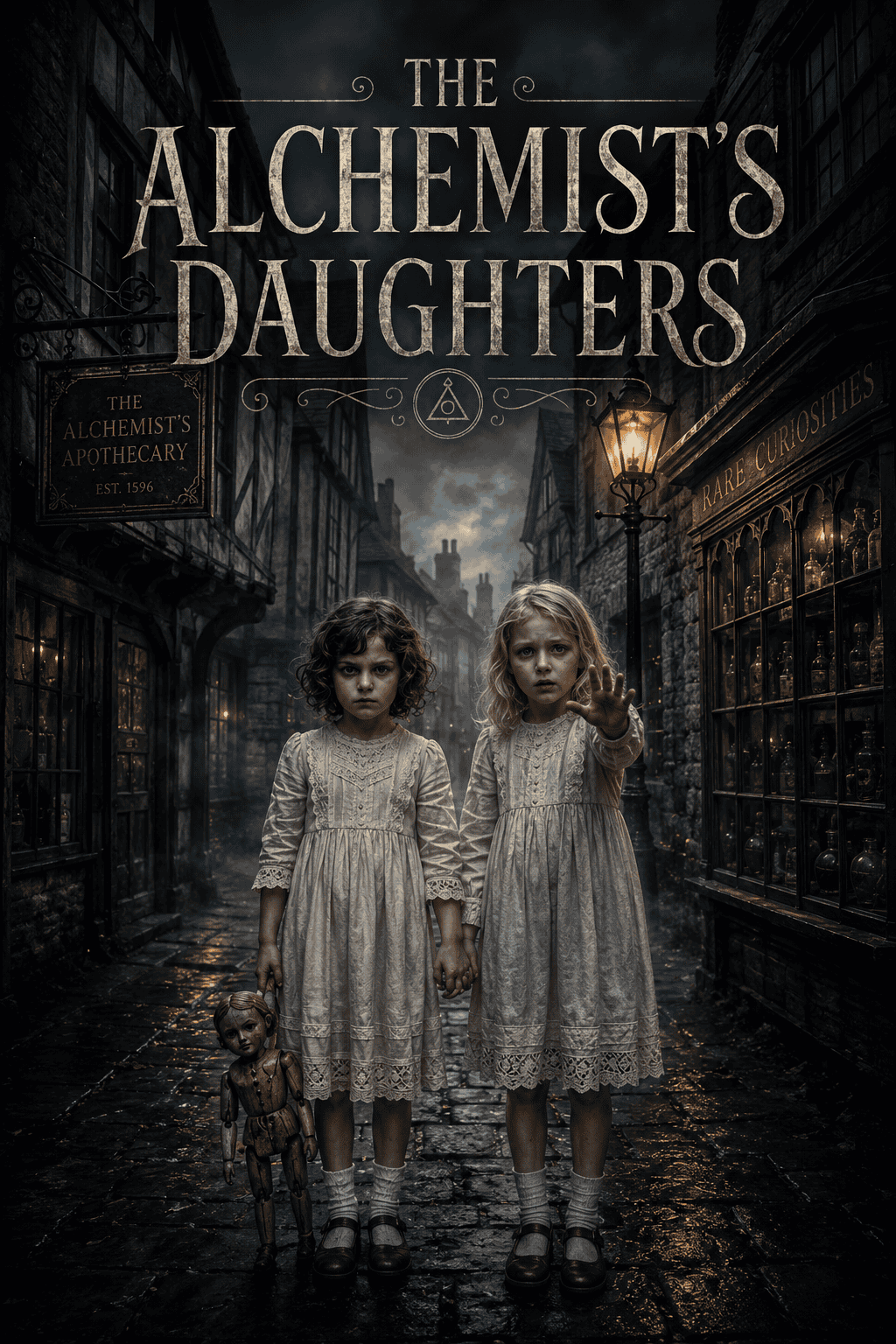
During the day, the shop looked almost charming, tucked between crooked timber buildings on a narrow cobblestone lane that had survived fires, floods, wars, and three different names for the village itself. Its sign hung from a rusted iron bracket shaped like a thorn vine:

THE ALCHEMIST’S APOTHECARY
EST. 1596

The letters were faded gold, worn thin by centuries of rain. Below the sign, behind cloudy panes of greenish glass, sat rows of dusty bottles labeled in a handwriting no one alive could read. Dried lavender hung in bunches from the ceiling. Little drawers lined the back wall, each with a brass pull and a nameplate: feverfew, bone salt, widow’s root, angel ash.

Tourists took pictures of it.

Children dared each other to touch the door.

Locals crossed the street.

Because everyone in Blackmere knew the same thing.

At night, the apothecary was not empty.

And sometimes, just before midnight, the daughters came home.

Mara Voss learned this on the first evening after her aunt’s funeral.

She arrived in Blackmere at sunset, riding in the back of a taxi that smelled of wet wool and stale cigarettes. Her aunt Elspeth had left her a building on Umbrel Lane—a narrow old shop called Rare Curiosities, filled with antique dolls, chipped mirrors, music boxes, funeral cards, and all the small unsettling things that people bought because they wanted their houses to feel haunted without actually being haunted.

Mara had never liked Blackmere.

She had spent two summers there as a child, sleeping in the cramped room above her aunt’s shop, listening to rain tap at the window and old boards shift in the walls. Her aunt used to say, “This village remembers too much. Best not give it any new memories.”

At ten, Mara thought that sounded poetic.

At thirty-two, standing in the rain with a suitcase and a key that looked older than her family line, it sounded like a warning.

The taxi pulled away too quickly, leaving her alone beneath a gaslamp that hummed softly above the lane.

Across the street, the apothecary sat in shadow.

Its windows were dark.

But not empty.

Mara paused with her hand on the door of Rare Curiosities.

For a second, she thought she saw someone standing behind the apothecary glass. A small face. Pale. Watching.

Then lightning flickered somewhere beyond the rooftops, and the window showed only her own reflection: tired eyes, black coat, rain-damp hair stuck to her cheek.

“Get a grip,” she muttered.

The key turned stiffly in the lock.

Inside, Rare Curiosities smelled exactly as she remembered: dust, old velvet, wood polish, dried roses, and a faint undertone of mildew that no amount of cleaning ever truly defeated.

The shop was narrow but deep. Glass cabinets crowded the walls. Dolls sat in wicker prams. Taxidermy birds stared down from shelves. A cracked mannequin wore a mourning veil near the register. Behind the counter, an old bell jar covered a wax hand posed as if reaching for help.

Mara found a note taped to the register.

Her aunt’s handwriting was cramped, sharp, unmistakable.

Mara,

If you are reading this, I am gone, and the shop is yours. Sell it if you must, keep it if you can. But whatever you choose, listen carefully.

Do not open the front door after 11:59 p.m.

Do not answer if a child knocks.

Do not touch the wooden doll.

And if you hear singing from the apothecary, leave Blackmere before morning.

I am sorry.

—E

Mara stared at the note for a long moment.

Then she laughed once, without humor.

“Very funny, Aunt Elspeth.”

But her aunt had not been funny. Not in years.

Mara tucked the note into her coat pocket and carried her suitcase upstairs.

The apartment above the shop was small and low-ceilinged. The wallpaper was peeling in the corners. The bed had been made with military precision. A kettle sat on the stove. On the kitchen table, next to a stack of unpaid bills, was another object Mara remembered from childhood.

A little brass clock.

Its face had no numbers.

Only twelve tiny black eyes painted around the dial.

The hour hand pointed straight up.

The minute hand trembled.

Mara checked her phone.

11:53 p.m.

“That’s impossible,” she said.

It had been sunset when she arrived. She could not have spent five hours standing in a shop.

A floorboard creaked downstairs.

Mara froze.

The shop below settled into silence.

Then came the sound.

Not a knock.

A scrape.

Like wood dragging softly across wood.

Mara stepped toward the staircase.

The brass clock ticked behind her.

Too loud.

Tick.

Tick.

Tick.

She reached the top of the stairs and looked down into the dark shop.

At first, she saw only shapes: cabinets, shelves, the mourning mannequin in its black veil.

Then something moved near the front door.

Small.

Low.

Mara’s breath caught.

A doll stood on the floor in the center of the shop.

She knew every doll in Rare Curiosities had been placed in cabinets or on shelves. This one had not been there before.

It was made of wood, about two feet tall, jointed at the shoulders, elbows, hips, and knees. Its face was carved with crude delicacy: round cheeks, a tiny mouth, sleepy painted eyes. One side of its head was split, the crack running from temple to jaw.

A loop of old string was tied around its wrist.

As if someone had been dragging it.

Mara’s mind grabbed for logic.

Maybe a cabinet door had popped open.

Maybe vibration from traffic had knocked it loose.

Maybe grief did strange things to a person.

Then the doll turned its head.

Not far.

Just enough to look up the stairs.

Mara stumbled backward, hit the wall, and clapped a hand over her mouth.

The doll remained still.

A second later, from somewhere outside, came the soft ring of the apothecary sign swinging in the wind.

Clink.

Clink.

Clink.

Then a child knocked on the front door.

Once.

Twice.

Three times.

Mara did not move.

She did not breathe.

Another knock came, softer this time.

Then a girl’s voice whispered through the mail slot.

“Please. We’re lost.”

The voice was young. Six, maybe seven.

Mara thought of her aunt’s note.

Do not answer if a child knocks.

The knob turned.

Slowly.

The lock held.

Mara stepped backward again, her feet cold against the wood floor.

“Please,” the child whispered. “It’s raining.”

Mara almost answered.

Almost.

But then another voice joined the first.

Lower.

Flatter.

“We can see you, Mara.”

The blood drained from her face.

The brass clock struck midnight without bells.

Every light in the shop went out.

And downstairs, the wooden doll began to laugh.


Morning made a coward of the night.

By sunrise, Mara almost convinced herself she had dreamed it. The doll was gone from the shop floor. The front door remained locked. The street outside was pale and wet, busy with delivery vans and old women carrying market baskets.

Across the lane, The Alchemist’s Apothecary looked harmless again.

She went downstairs and found muddy footprints on the floor.

Two sets.

Both child-sized.

They led from the front door to the staircase.

And stopped.

Mara crouched beside them, heart knocking painfully in her ribs.

There was a smear beside one footprint, like the drag mark of something wooden.

She grabbed her coat and crossed the street before she could talk herself out of it.

The apothecary door was locked, but beside it stood an old man arranging umbrellas in a barrel outside the neighboring bookshop. He wore a brown cap and had the deeply lined face of someone who had spent a lifetime pretending not to notice things.

“Excuse me,” Mara said. “Who owns this place?”

The old man looked at the apothecary sign, then at her.

“You’re Elspeth’s niece.”

“I’m Mara.”

“I know.”

Of course he did. Blackmere was that kind of village.

“I saw something last night,” she said.

The old man went very still.

“What did you see?”

“Two girls. Or I heard them. And there was a wooden doll in my shop.”

He turned his face away, but not before Mara saw the fear pass over it.

“Go back to London,” he said.

“I don’t live in London.”

“Then go anywhere else.”

“I inherited a shop. I’m not leaving because of village ghost stories.”

“They aren’t stories.”

Mara folded her arms, trying to look steadier than she felt. “Then tell me what they are.”

The old man hesitated.

“My name is Owen Pike,” he said finally. “My family has kept that bookshop for six generations. Every Pike has watched that apothecary. Every Pike has buried someone because of it.”

“Because of two little girls?”

“Because of what pretends to be them.”

Mara looked at the dark windows.

Owen lowered his voice.

“In 1596, the building belonged to Silas Vey. Physician, alchemist, grave robber. People came from miles around when their children were sick. He promised cures. If they could pay.”

“And if they couldn’t?”

“He took other payment.”

“What kind?”

Owen’s mouth tightened.

“The kind that doesn’t die.”

Mara remembered the doll’s painted eyes turning toward her.

“Children disappeared,” Owen continued. “Not many at first. One every few years. Then more. His wife died giving birth to twin daughters. Elsie and Anwen. They were said to be beautiful little things. One fair-haired and sweet. The other dark-haired and strange from the beginning.”

“That’s cheerful.”

“Both fell ill during the winter plague. Silas would not let death have them. He used every body he had hidden. Every bone. Every stolen breath. He made a formula he believed could preserve a soul inside flesh forever.”

Mara glanced toward the apothecary sign.

“It worked?”

Owen shook his head. “It broke.”

A cart rattled over the stones behind them. He waited until it passed.

“Anwen, the fair one, died before the ritual was complete. Part of her soul fled. Part remained trapped in her body. She became a doorway. A warning. A mouth that could still speak truth, but only in pieces.”

“And Elsie?”

“The dark one lived.”

“That doesn’t sound so bad.”

Owen gave a dry, bitter laugh.

“No. Elsie lived, but not as a child. The formula kept her young and hollowed out everything human. She became hungry. Not for food. For company. For souls that could not leave her.”

“The dolls.”

Owen nodded.

“Silas made vessels. Wooden dolls. Wax infants. Porcelain saints. He trapped children in them to keep Elsie from being alone. When the village found out, they burned him alive inside the apothecary.”

“But the shop is still there.”

“Aye,” Owen said. “That was the first mistake.”

“What was the second?”

“We opened the door when the girls knocked.”

Mara felt the rain begin again, fine and cold against her face.

Owen looked toward Rare Curiosities.

“Elspeth knew the rules. Better than anyone. If the doll came into your shop last night, it means Elsie has chosen you.”

“For what?”

“To open what your aunt kept shut.”

Before Mara could ask another question, the apothecary sign swung once.

There was no wind.

Owen went pale.

“Inside,” he whispered.

“What?”

“Get inside now.”

Across the lane, behind the apothecary window, two small hands pressed against the glass.

Mara saw them clearly this time.

Two girls stood in the dark.

Both wore white dresses.

The blonde one’s mouth hung open in a silent scream.

The dark-haired one smiled.


Mara spent the afternoon going through her aunt’s records.

At first, she searched neatly. Then desperately. She pulled open drawers, emptied cabinets, unfolded old maps, shook dust from ledgers, and read every note Elspeth had hidden between pages of inventory books.

There were newspaper clippings about missing children.

BOY VANISHES FROM UMBREL LANE, 1924.

LOCAL GIRL FOUND UNRESPONSIVE AFTER CLAIMING “DOLL CALLED HER,” 1958.

BLACKMERE CHILDREN WARNED AGAINST MIDNIGHT GAME, 1981.

There were handwritten accounts from former shopkeepers.

The fair girl says burn the heart. The dark girl says open the chest. Do not confuse them.

The doll changes faces when fed. I saw Thomas in it last night. God forgive me, I nearly picked him up.

The apothecary does not want adults. It wants adults who will bring children.

At the bottom of a locked drawer, Mara found a leather-bound journal with her aunt’s initials on the cover.

The last entries were shaky, written in fading blue ink.

June 3: I saw Anwen again. She was crying this time. She pointed to the doll and said, “She is almost full.”

June 9: Elsie has learned Mara’s name. I never told her. I never wrote it in the shop. This means she has been listening through the walls for years.

June 11: I should have told Mara the truth about her mother.

Mara stopped reading.

Her mother had died when Mara was eight.

That was all anyone had ever said. A sudden illness. A closed casket. Her father moved them away from Blackmere three days later and never returned.

Mara’s hands trembled as she turned the page.

June 12: Clara came to me again in the mirror. Not whole. Never whole. She begged me not to let Mara inherit the key. But blood opens what iron cannot.

Clara.

Her mother’s name.

Mara read the line again.

Blood opens what iron cannot.

The shop bell rang downstairs.

Mara flinched so hard the journal fell from her lap.

It was only afternoon. Gray light pressed against the windows. People moved on the lane.

Still, the bell should not have rung.

She went downstairs holding the heaviest thing she could find: an iron fireplace poker.

A woman stood near the front counter.

She was thin, dark-haired, and dressed in a gray coat that hung strangely on her frame. Her back was turned. She was looking at the bell jar containing the wax hand.

“We’re closed,” Mara said.

The woman did not turn.

“Mara,” she whispered.

Mara gripped the poker tighter.

The woman looked over her shoulder.

Her face was wrong.

Not monstrous. Worse. Familiar.

Mara saw her own cheekbones. Her own mouth. Her own eyes, but sunken and wet, like they had been painted on something soft.

“Mom?”

The word fell out of her before she could stop it.

The woman smiled with great sadness.

“Oh, sweetheart.”

Mara backed away.

“You’re dead.”

“Mostly.”

The woman’s gaze flicked to the front window. “She has started early. That means Elspeth is truly gone.”

Mara’s throat tightened. “What happened to you?”

Her mother’s expression broke.

“I opened the door.”

The shop seemed to grow colder.

“I was nineteen,” Clara said. “Elspeth told me not to. I thought she was cruel. I heard a child crying in the rain, and I opened the door. The doll was there. The fair girl asked for help. The dark girl asked to come in.”

“What did you do?”

“I took her hand.”

Mara thought of the whispered warning.

Don’t let her hold your hand.

Clara lifted her sleeve.

Her wrist was blackened, the skin cracked like burned paper.

“She marks you when she touches you. After that, she can call you from anywhere. Dreams. Mirrors. Your own memories.”

“Why didn’t she take you?”

“She did,” Clara said softly. “Elspeth dragged back what she could. But part of me remained in the apothecary. That’s why your father took you away. That’s why Elspeth stayed. To keep you out of it.”

Mara swallowed hard.

“Why me?”

Her mother looked at her with terrible pity.

“Because you aren’t just Elspeth’s niece.”

Mara stared.

The room seemed to tilt.

Clara spoke quickly now, as if something were pulling her backward word by word.

“Silas Vey had another child. Not with his wife. With a servant girl who fled before the fire. That bloodline survived. It runs through us. Through Elspeth. Through me. Through you.”

“No.”

“Blood opens what iron cannot.”

“No.”

“The apothecary door will open for you after midnight, even if you do not want it to.”

The bell above the shop door began to tremble.

Clara looked terrified.

“She knows I’m here.”

The glass cabinets rattled. Every doll in the shop turned its head toward Clara.

Mara screamed and swung the poker, smashing one cabinet. Porcelain figures burst across the floor.

Clara grabbed Mara’s hand.

Her fingers were freezing.

“Listen to me. The fair girl is Anwen. She will try to help you. But she cannot speak while Elsie is listening. The doll is not the prison. It’s the key.”

“I thought I had to burn the doll.”

“That’s what Elsie wants.”

Mara’s blood went cold.

Clara’s face blurred, as if seen through water.

“The alchemist’s formula isn’t inside the doll,” she whispered. “It’s inside Elsie.”

The shop door flew open.

Rain gusted in.

No one stood outside.

Then a child’s voice sang from the street.

“Mother dear, come home to bed…”

Clara’s eyes widened.

“Do not trust anything with my face after dark.”

“What?”

Clara’s fingers slipped through Mara’s.

“End it before she learns how to leave the lane.”

Her mother vanished.

Every doll in Rare Curiosities began to whisper Mara’s name.


By ten that night, Mara had locked every door, shuttered every window, salted the thresholds because an old book told her to and desperation told her not to be picky, and placed every mirror face-down on the floor.

Owen Pike came at half past ten carrying a canvas bag full of old iron nails, beeswax candles, and a bottle of gin.

“For courage?” Mara asked.

“For cleaning wounds,” he said. Then, after a beat, “And courage.”

They sat behind the counter while rain ticked against the glass.

Mara told him about Clara.

Owen did not look surprised.

“Elspeth pulled half your mother out,” he said. “No one else could have done it.”

“You knew?”

“I knew pieces.”

“You could’ve told me.”

“You wouldn’t have believed me yesterday.”

Mara hated that he was right.

She opened her aunt’s journal to the page about the doll.

“If the doll isn’t the prison, why did everyone say not to touch it?”

“Because touching it invites the shop to recognize you.” Owen reached into his bag and pulled out a blackened iron key. “But I think that ship has sailed.”

Mara eyed the key.

“What is that?”

“The key to the apothecary cellar.”

“I thought no one could get inside.”

“No adult can enter the front after dusk. But the cellar door beneath my shop is older than the street. The buildings connect underground. That’s how Silas moved bodies without being seen.”

Mara stared at him.

“You waited until now to mention the corpse tunnel?”

“I was hoping we could avoid the corpse tunnel.”

“Fantastic.”

At 11:47, the first knock came.

Not at the front door.

From beneath the floor.

Once.

Twice.

Three times.

Owen closed his eyes.

“She’s impatient.”

Mara picked up the fireplace poker.

Owen took a candle.

They went through the back of Rare Curiosities, across a narrow courtyard, and into the bookshop next door. Owen led her behind shelves of old maps to a trapdoor hidden under a threadbare rug.

The moment he lifted it, the smell came up.

Damp stone.

Rotten flowers.

Old smoke.

And something sweet, like sugar burning.

A stairway descended into blackness.

Mara thought of her mother’s warning.

End it before she learns how to leave the lane.

They climbed down.

The tunnel beneath Umbrel Lane was narrow and arched, built from stone blocks slick with moisture. Roots had worked through cracks in the ceiling. Water dripped steadily somewhere ahead.

As they walked, Mara heard whispering behind the walls.

Children’s voices.

Some crying.

Some laughing.

Some counting backward from twelve.

Owen held the candle high.

“Don’t answer them,” he said.

“I wasn’t planning to.”

A voice whispered from the darkness to Mara’s left.

“Mara?”

She stopped.

It was a boy’s voice now.

Young. Familiar, though she could not place it.

“Mara, help me.”

Owen grabbed her arm.

“Keep walking.”

The wall beside her bulged.

A small wooden hand pushed through the mortar, fingers clawing at the air.

Then another.

Then a face surfaced from the stone, carved and painted, mouth opening in silent agony.

Mara choked back a scream.

Owen dragged her forward.

The tunnel ended at an iron-banded door.

The key shook in Owen’s hand.

“You should know something,” he said.

“Now?”

“If this goes wrong, don’t let me speak.”

Mara stared at him.

“What does that mean?”

“It means she has my brother’s voice.”

Before Mara could respond, Owen unlocked the door.

The apothecary cellar waited beyond.

It was much larger than it should have been, stretching under the lane like the belly of some buried cathedral. Shelves lined the walls from floor to ceiling. Hundreds of dolls sat upon them.

Wooden dolls.

Porcelain dolls.

Wax infants.

Rag children with button eyes.

Tiny puppets with human hair.

Every head turned when Mara entered.

A sound rose from them, soft and collective.

A breath.

Then a whisper.

“Blood.”

At the far end of the cellar stood a table covered in rusted tools and brown glass bottles. Above it, nailed to the wall, was a painting of Silas Vey.

He was a thin man with a scholar’s face and dead, hungry eyes.

Beside the painting hung two white dresses.

Child-sized.

Mara stepped closer.

The dresses were not empty.

They were pinned to the wall by long iron needles, but something moved beneath the fabric, pushing against it from inside like trapped breath.

A girl’s voice whispered from the shadows.

“You came.”

Mara turned.

The blonde girl stood near the table, her white dress stained at the hem. Her mouth hung open the way Mara had seen in the window, but the voice seemed to come from somewhere deeper than her throat.

Anwen.

Her eyes filled with tears.

“Don’t look at her,” Anwen said.

Owen stiffened.

“Where is Elsie?”

Anwen’s gaze flicked upward.

Too late.

Something dropped from the ceiling.

Owen shouted as Elsie landed on his back.

She looked like a child, but moved like a spider, all pale limbs and furious strength. Her dark curls hung wet around her face. Her white dress was yellowed with age. Her eyes were not childlike at all. They were old and black and shining with delight.

She wrapped both arms around Owen’s neck.

“Pike,” she whispered lovingly.

Owen slammed backward into a shelf. Dolls fell and shattered. Screams burst from broken porcelain.

Mara swung the poker.

Elsie caught it with one small hand.

The iron smoked against her skin.

She smiled.

“Mara Vey,” she said.

“Voss.”

“Names are dresses. Blood is skin.”

Elsie shoved the poker aside and reached for Mara.

Anwen screamed without sound.

Mara ducked and drove her shoulder into the table. Bottles crashed. A cloud of powder burst up, stinging her eyes.

Owen tore Elsie off him and threw her against the wall.

She hit hard enough to crack stone.

Then she laughed.

Not like a child.

Like a room full of children laughing at once.

“You brought her to me,” Elsie said to Owen. “Good old Pike. Always opening doors.”

Owen’s face twisted.

“Run, Mara!”

But Mara did not run.

She saw it then.

Under Elsie’s collar, at the hollow of her throat, a glow pulsed faintly beneath the skin.

Gold.

Like candlelight trapped in honey.

The formula.

Her mother had told the truth.

It was inside Elsie.

Anwen appeared beside Mara suddenly and grabbed her sleeve. Her fingers passed halfway through the fabric.

“You can’t kill her with iron,” Anwen whispered. “Silas made her from refusal. You must make her want to be alone.”

“What does that mean?”

Elsie crawled down the wall headfirst, grinning.

“She feeds on souls because she’s afraid of silence,” Anwen said. “The dolls keep her full. Break the shelves. Free them. Let her hear the quiet.”

Mara looked around at hundreds of dolls.

“That’ll take hours.”

Anwen turned toward the ceiling.

“No. Call them by name.”

“I don’t know their names.”

Anwen’s eyes softened.

“They remember yours.”

Elsie lunged.

Owen stepped between them.

Elsie’s hand closed around his wrist.

He gasped.

The mark spread instantly, black veins climbing under his skin.

His mouth opened, and when he spoke, it was not his voice.

It was a little boy’s.

“Don’t leave me, Owen.”

Owen sobbed.

“My brother,” he whispered.

Elsie pressed her cheek against his hand.

“I kept him,” she said. “I keep everyone.”

Mara understood.

That was the hook. Not fear. Not death. Love.

Elsie did not lure people with monsters.

She lured them with the dead they wanted back.

Mara turned to the shelves.

She thought of her aunt. Her mother. Every clipping. Every missing child whose name had been folded into silence.

Then she shouted the only name she knew.

“Clara Voss!”

The cellar went still.

A doll on the highest shelf twitched.

It was a wax figure with dark hair and a cracked face.

Elsie’s smile faltered.

“No.”

Mara shouted again.

“Clara Voss, if any part of you is here, wake up!”

The wax doll’s eyes opened.

A woman’s voice filled the cellar.

“Mara.”

Every shelf trembled.

Elsie released Owen.

“Stop.”

Mara turned in a circle, calling names from the articles she had read.

“Thomas Bell! Lucy Aster! Peter Vale! Samuel Pike!”

At the last name, Owen collapsed to his knees.

A wooden puppet near the back wall jerked upright.

“Anwen Vey!” Mara shouted.

The blonde girl gasped.

The pinned white dress on the wall tore loose from one iron needle.

Elsie screamed.

It was the first sound she made that contained fear.

The dolls began to move.

One by one, their little heads turned away from Elsie.

Their mouths opened.

Names spilled into the cellar.

Dozens.

Hundreds.

Children calling themselves back from the dark.

Elsie clapped her hands over her ears.

“Mine,” she shrieked. “You are mine!”

The glow in her throat pulsed brighter, frantic and unstable.

The shelves shook harder. Dolls toppled and broke. But when they shattered, no screams came now. Only sighs. Thin streams of pale light rose from the broken bodies and drifted upward like fireflies.

Anwen’s body grew brighter.

Her mouth closed for the first time.

She looked almost like a real little girl.

Elsie staggered backward.

Mara saw her chance.

She grabbed one of Silas’s rusted blades from the table and rushed forward.

Elsie looked up.

For a heartbeat, she was only a child.

Small.

Terrified.

Abandoned in a cellar full of leaving voices.

“Don’t,” Elsie whispered.

Mara hesitated.

That was all Elsie needed.

Her face changed.

Not into a monster.

Into Mara’s mother.

Clara stood before her, weeping.

“Sweetheart,” she said. “Please. I’m still in here.”

Mara froze.

The cellar faded.

She was eight years old again, standing beside a closed coffin, holding her father’s hand while adults whispered words like peaceful and sudden and better not to look.

Clara reached for her.

“Hold my hand,” she said. “Just this once.”

Mara lifted her hand.

Anwen screamed.

Not silently this time.

“Mara, no!”

The illusion cracked.

Mara saw Elsie underneath it, grinning through Clara’s face.

Mara drove the blade into the glowing hollow of Elsie’s throat.

Gold light burst outward.

Elsie shrieked.

The sound shattered every bottle in the cellar. Owen covered his ears. The dolls screamed their names louder, louder, louder, until the cellar became a storm of children and memory and breaking wood.

Elsie clawed at Mara’s coat.

“You’ll be alone,” she hissed.

Mara twisted the blade.

“No,” she said. “You will.”

The glow tore free.

For one breath, a golden bead hovered in the air between them.

Inside it, Mara saw Silas Vey’s face.

Not dead.

Waiting.

Smiling.

Then Anwen stepped forward and closed both hands around the light.

“Father,” she whispered.

Silas’s face twisted in rage.

Anwen looked at Mara.

“Burn us.”

“What?”

“All of it.”

Elsie collapsed, writhing on the floor, suddenly no older than the child she had been when her father ruined her.

Anwen knelt beside her sister.

Elsie tried to crawl away, but Anwen took her hand.

Elsie stared at her in horror.

“No,” she whimpered. “Don’t leave me.”

“I’m not,” Anwen said.

For the first time, Elsie began to cry.

Not like a trap.

Not like a performance.

Like a child.

Mara could hardly breathe.

Owen stumbled to the table, grabbed the fallen candle, and looked at Mara.

The cellar shelves were soaked in old oils and powders. Silas had preserved his work too well.

Mara nodded.

Owen dropped the candle.

Fire ran across the floor in a bright line.

The dolls did not scream this time.

They sang.

The flames climbed the shelves, eating wood, wax, cloth, hair. Pale lights rose by the dozens, filling the cellar with faces that looked, for one moment, free.

Mara saw her mother among them.

Not the broken thing from the shop.

Clara as she had been in photographs: young, dark-eyed, smiling.

Mara reached toward her.

Clara touched her fingers to her lips.

Then she was gone.

Anwen stood in the center of the fire holding Elsie’s hand.

The sisters looked at Mara.

Elsie’s face was wet with tears.

“I didn’t want to be alone,” she said.

“I know,” Mara whispered.

The fire swallowed them both.


By dawn, The Alchemist’s Apothecary had burned to the ground.

No one in Blackmere claimed to have seen flames. No one admitted hearing the screams. The official report said old wiring, though the building had not had electricity since 1912.

Rare Curiosities survived untouched.

Owen Pike survived too, though the black mark on his wrist never fully faded. He said little after the fire, but on quiet mornings, Mara sometimes saw him standing near the ruins with his cap in his hands, whispering to someone named Samuel.

Mara stayed long enough to settle her aunt’s estate.

Then longer.

Weeks passed. The lane changed. Sunlight reached places it had not touched in years. The air no longer smelled of burned sugar after rain. Children began walking down Umbrel Lane again without their mothers pulling them close.

Mara sold most of the dolls in Rare Curiosities to collectors, though she personally checked each one twice and burned three that looked at her too long.

One month after the fire, she found a package on the counter.

No stamp.

No return address.

Inside was the little wooden doll.

The same cracked head.

The same painted eyes.

The same loop of string around its wrist.

Mara could not move.

For a long moment, the shop was completely silent.

Then the doll’s chest clicked open.

Not by much.

Just enough for a folded slip of paper to slide out.

Mara picked it up with shaking fingers.

The handwriting was a child’s.

Thank you for opening the door.

Mara backed away.

The doll did not move.

She grabbed the fireplace poker, smashed the doll into pieces, carried the pieces to the courtyard, soaked them in lighter fluid, and burned them in an iron bin until nothing remained but ash.

That night, she slept with every light on.

Nothing knocked.

No child whispered.

No doll laughed.

In the morning, Mara found something carved into the inside of her front door.

Three words.

Small.

Neat.

Fresh.

NOT THE DOLL.

Mara stared at the words until their meaning settled into her bones.

The doll had never been the prison.

Elsie had never been the true monster.

Silas Vey had been inside the formula.

And when Anwen grabbed the golden light in the cellar, she had not destroyed it.

She had carried it into the fire.

Released it.

Mara ran across the lane to the apothecary ruins.

The ground was still black and wet. Charred beams jutted from the rubble like broken ribs. But in the center of the ashes, where the cellar had collapsed, something green had begun to grow.

A single plant.

Its leaves were dark and glossy.

Its stem pulsed faintly gold.

Beside it, half-buried in ash, lay a brass nameplate from one of the apothecary drawers.

Mara wiped it clean with her thumb.

The label read:

FATHER’S ROOT

Behind her, the gaslamp flickered.

Once.

Twice.

Three times.

Mara turned slowly.

Across the street, in the window of Rare Curiosities, stood a man.

Thin.

Pale.

Dressed in black.

He smiled at her through the glass.

Then lifted one finger to his lips.

When Mara ran back inside, the shop was empty.

But every mirror she had laid face-down now stood upright.

And in each one, written backward in a child’s careful hand, was the same message:

HE NEEDS A DAUGHTER.

Mara left Blackmere that afternoon.

She took nothing but her aunt’s journal, Owen’s iron key, and the brass nameplate.

Three days later, a buyer made an offer on Rare Curiosities. A young woman from London. Pregnant. Recently widowed. Looking for a quieter life.

Mara tried to call her.

The number was disconnected.

She tried to stop the sale.

The paperwork had already gone through.

By the time Mara returned to Blackmere, the sign above Rare Curiosities had been taken down.

A new one hung in its place, painted in faded gold letters that looked centuries old.

VEY & DAUGHTER
FINE REMEDIES, RARE CURIOSITIES, AND CHILDREN’S TONICS

And in the upstairs window, two little girls in white dresses stood holding hands.

One blonde.

One dark-haired.

Both smiling.

Between them stood a third child.

A little girl with Mara’s eyes.

The girl lifted her hand and waved.

Mara heard the shop bell ring.

Then, from somewhere inside the walls, a man’s voice whispered warmly:

“Come in, my dear. We’ve been waiting for family.”
Back to Top Read More Stories


7 Jun

The Doll in the Last Crib

Story Summary

The Doll in the Last Crib

The Doll in the Last Crib follows Claire and Martin, an expecting couple who buy an abandoned farmhouse hoping to restore it before their baby arrives, only to discover a decaying nursery haunted by a cracked porcelain doll in a faded red dress. After the doll keeps returning no matter how many times they throw it away or burn it, Claire uncovers the house’s horrifying history: a woman named Agnes Whitcomb once took in unwanted babies, and the missing children may have been trapped inside her handmade dolls. As the doll’s influence grows stronger, the nursery becomes a prison, Martin disappears trying to save Claire, and Claire escapes just in time to give birth. But months later, when her baby begins humming the same eerie tune and Martin’s voice warns her through the monitor not to pick him up, Claire realizes the curse did not stay in the house—it came home with her son.

Listen to the Story

The Doll in the Last Crib

Experience the story with audio, captions, and full-screen playback.

Reading Mode Skip to Ending

The Doll in the Last Crib

When Martin Hale first saw the farmhouse, he said exactly what he was supposed to say.

“It has good bones.”

Claire stood beside him in the waist-high grass, one hand resting on the firm curve of her belly, and stared at the sagging front porch, the weather-stained siding, the windows clouded with dust from the inside.

“Good bones,” she repeated.

Martin smiled too brightly. “That’s what people say about houses like this.”

“People on renovation shows say that right before they discover black mold and a raccoon kingdom in the attic.”

“True,” he said. “But we can fix mold. And negotiate with raccoons.”

Claire laughed because he wanted her to, and because she wanted to believe him.

They had been looking for a house for months, but every clean, sensible place was too expensive. The farmhouse sat eight miles outside town, hidden at the end of a gravel road where maple trees leaned over the drive like old women sharing secrets. It had been empty for nearly twenty years, according to the listing. Four bedrooms. Two bathrooms. Original hardwood floors. Five acres.

And cheap.

Too cheap, Claire thought.

But she was thirty-two weeks pregnant, they were still living in a one-bedroom apartment above a hardware store, and the nursery corner they had made beside their bed felt less sweet every day and more like failure.

Martin worked construction and could do most of the repairs himself. Claire taught second grade and had already started imagining bookshelves, a rocking chair, sunlight through lace curtains, a baby sleeping in a room painted soft green.

So she nodded.

“Okay,” she said. “Let’s look inside.”

The realtor, a thin woman named Diane who smelled like peppermint gum and anxiety, unlocked the front door.

The house exhaled.

Not creaked. Not settled. Exhaled.

A breath of trapped air pushed past them, carrying dust, mildew, old wallpaper, and something underneath that Claire couldn’t place. Something sweet and stale.

Like flowers left too long in a vase.

Diane coughed and waved a hand in front of her face. “It’s been shut up awhile.”

Martin stepped inside first, phone flashlight raised.

The foyer opened into a long hallway. The floors were scratched but beautiful. The staircase curved upward with a carved wooden banister. Dust lay over everything in a gray film, softening edges, blurring corners.

Claire followed slowly. The baby shifted inside her, a slow roll beneath her ribs.

“You okay?” Martin asked.

“Yeah,” she said. “He just moved.”

“He likes it.”

“He’s protesting.”

They moved through the downstairs rooms while Diane talked about inspections and permits and “potential.” The kitchen was outdated but usable. The dining room had water stains on the ceiling. The living room fireplace was packed with bird nests.

Claire tried to see past it.

She tried to imagine Christmas lights, fresh paint, the smell of coffee, Martin carrying their baby down the stairs in footie pajamas.

Then they went upstairs.

The second floor was colder.

Claire noticed it immediately. The air changed halfway up the steps, as if they had climbed into a different season. She crossed her arms over her belly.

There were four rooms upstairs. Three stood open, empty except for dust and dead flies along the window sills.

The fourth door was closed.

Diane stopped before it.

“The previous owners left some things in there,” she said.

“What kind of things?” Martin asked.

“Just furniture. Old nursery items, I think.”

Claire looked at him.

He grinned. “See? Perfect.”

But Diane didn’t smile.

She turned the glass knob and pushed the door open.

The nursery waited in silence.

It was the only room in the house that still looked occupied.

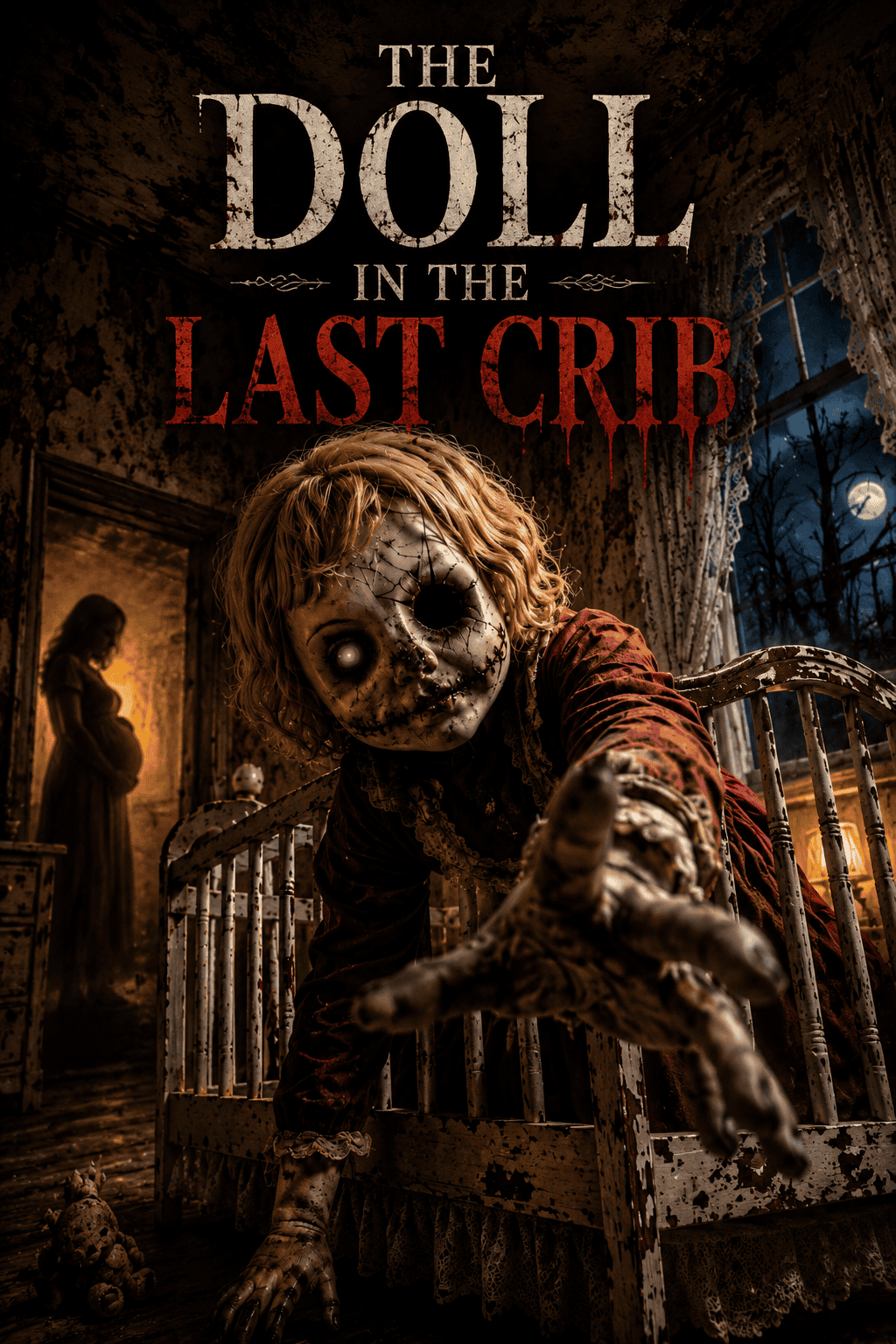
Peeling pink-and-cream wallpaper hung in strips from the walls. A white wooden crib stood near the center of the room, paint flaking from its rails. Lace curtains sagged over a narrow window, yellowed with age. In one corner sat a small dresser with cloudy brass knobs. Above it, a warped shelf held three toys: a wooden horse missing one wheel, a stuffed rabbit with no ears, and a porcelain doll.

No.

Claire corrected herself.

Not on the shelf.

In the crib.

The doll sat upright against the bars, its head tilted slightly to one side.

It had tangled blond hair, a cracked porcelain face, and a faded red dress trimmed in dirty lace. One eye was pale and cloudy. The other was only a dark hole ringed by spiderweb cracks. Its mouth had been painted into a small, prim expression, but time had split the paint into thin lines, making it look as if the doll were smiling through stitches.

Claire’s hand tightened on her belly.

The baby went still.

Martin stepped into the room. “Well, that’s horrifying.”

Diane gave a nervous laugh. “Old dolls always are.”

Claire stayed in the doorway.

The nursery smelled stronger than the rest of the house. That sweet, spoiled smell.

“What happened here?” she asked.

Diane looked down at her folder. “Happened?”

“The room,” Claire said. “Why did they leave it like this?”

“People abandon all kinds of things when they move.”

“This wasn’t a move,” Claire said.

Martin turned. “Claire.”

She heard the warning in his voice. Not unkind. Just tired. They had been disappointed so many times. He wanted this to be the place. He needed this to be the place.

Diane flipped through papers she clearly wasn’t reading. “The property was owned by an older couple for decades. After they passed, it went to a nephew out of state. He never lived here.”

“And before them?”

Diane pressed her lips together. “I’m not sure.”

But Claire knew she was lying.

The doll’s cloudy eye seemed to catch the weak afternoon light.

For one terrible second, Claire had the feeling it was looking directly at her belly.

They bought the house anyway.

They told themselves every old home had a feeling. Every old home had noises. Every old home had rooms that needed to be gutted down to studs and remade into something clean.

Martin took two weeks off work after the closing. He spent the first day ripping up carpet in the downstairs bedroom. Claire scrubbed cabinets, opened windows, and made lists.

They did not touch the nursery.

Not at first.

They called the baby Noah because they had decided early, back when everything about parenthood felt like a glowing secret. They said his name often in the house, hoping to fill it with something living.

“Noah’s room will be beautiful.”

“Noah’s going to love the yard.”

“Noah’s going to be here before we know it.”

Each time Claire said the name upstairs, the hallway seemed to absorb it.

On the third day, Martin carried the old crib pieces down to the burn pile.

Claire watched from the porch as he hauled the mattress out last. It folded in the middle like a dead thing. Beneath it, something small and hard fell onto the floorboards.

Claire heard it from the porch.

A single wooden clack.

Martin bent, picked it up, and frowned.

“What is it?” she called.

He came down the stairs holding a small block. Its paint was faded, but Claire could still see the letter carved into one side.

N.

“That’s weird,” he said.

Claire forced a smile. “Lots of names start with N.”

Martin tossed the block into the trash bin.

That evening, while he made dinner, Claire went upstairs alone.

The nursery looked larger without the crib. Emptier. The wall behind it was darker than the rest of the wallpaper, a crib-shaped stain in the room’s memory.

The doll still sat in the corner where Martin had placed it, propped against a box of old curtain rods.

Claire didn’t like it.

She picked it up with two fingers, holding it away from her body. It was heavier than she expected. Its porcelain limbs swung loosely. The red dress smelled of dust and something coppery.

She carried it outside and threw it into the trash bin on top of the broken crib slats.

“Goodbye,” she muttered.

That night, Claire woke to singing.

Not singing exactly.

Humming.

A soft, tuneless hum coming from the baby monitor on her nightstand.

She sat up so fast her back cramped.

The monitor glowed green in the dark.

They had set it up as a test earlier that day, even though there was nothing in the nursery yet. Martin had laughed about it, pretending to speak into the camera while Claire checked the sound.

Now the speaker crackled.

Hmmm.

Hmmm.

Hmmm.

Claire reached over and shook Martin’s shoulder.

He grunted. “What?”

“Listen.”

The humming stopped.

They sat in silence, blue moonlight slanting across the unfinished bedroom.

“What?” Martin whispered.

“I heard something on the monitor.”

He blinked at the small device. “Static?”

“No. Humming.”

He rubbed his face. “The house is old. Could be interference. Diane said the wiring upstairs is ancient.”

“The monitor isn’t wired into the house.”

He didn’t answer.

Then, from the speaker, very softly, came a child’s laugh.

Claire gasped.

Martin snatched the monitor off the nightstand. “Hello?”

No answer.

He got out of bed, grabbed the baseball bat they kept beside the dresser, and went upstairs. Claire followed despite his protests, one hand braced beneath her belly.

The nursery was empty.

The baby monitor camera sat on the dresser where they had left it. Its tiny red light blinked at them.

No doll.

No crib.

No child.

Martin checked the closet, the hall, the other bedrooms.

“Nothing,” he said.

Claire looked at the trash bin through the upstairs window.

The lid was open.

The next morning, the doll was back inside.

It sat in the nursery where the crib had been, legs straight out, hands resting in its lap.

Martin stared at it for a long time.

Claire stood behind him, unable to step into the room.

“You brought it in,” she said.

He turned. “What?”

“You thought it would be funny.”

His face hardened. “No, Claire. I didn’t.”

“Then how did it get here?”

“I don’t know.”

“That’s not an answer.”

“I know it’s not an answer.”

They burned it.

Martin built a fire in an old rusted barrel behind the shed. He poured lighter fluid over the doll until its red dress shone wetly. Claire stood far back near the porch, watching.

When Martin struck the match, the doll caught quickly.

The hair went first, curling and blackening. The dress flared. The porcelain face stared through the flames, cracks widening in the heat.

Then something inside the doll screamed.

Claire stumbled backward.

Martin dropped the lighter fluid can.

It was not loud, not exactly. It was thin and piercing, like steam escaping a kettle, but shaped unmistakably into a child’s cry.

The baby kicked hard.

Claire doubled over with a gasp.

Martin ran to her. “Claire!”

“I’m okay,” she said, though she wasn’t. “I’m okay.”

Behind him, the burning doll’s head split open.

Something dark bubbled out.

Not stuffing.

Not sawdust.

A wet black mass slid through the crack in the porcelain and dropped into the fire with a hiss.

The smell was unbearable.

Meat gone bad. Old blood. Sweet flowers.

Martin turned white.

The screaming stopped.

They didn’t speak of it that night.

They didn’t speak much at all.

Martin cleaned the barrel the next morning before Claire woke. When she asked what he had found, he said ashes. Only ashes.

But she saw him later at the kitchen sink, scrubbing under his fingernails until the skin bled.

For three days, the house was quiet.

They painted the nursery soft green.

Martin patched the ceiling. Claire ordered a new crib. They chose curtains with tiny embroidered stars. They avoided saying the word doll.

And then the handprints appeared.

Small, muddy handprints climbed the inside of the nursery door.

Five of them.

Low to high.

As if a child had crawled up the wood and stood on tiptoe to reach the knob.

Claire found them at dawn when she went upstairs with a mug of tea. She dropped the mug. It shattered in the hallway, tea spreading across the floorboards like a stain.

Martin came running.

When he saw the door, he said, “No.”

Not “What is that?”

Not “How?”

Just no.

That frightened Claire more than the handprints.

“What aren’t you telling me?” she asked.

He didn’t look at her.

“Martin.”

He touched one of the prints. The mud was still damp.

“I saw something last night,” he said.

Claire’s throat tightened. “What?”

“I thought I dreamed it.”

“What did you see?”

He swallowed. “I woke up around three. You weren’t in bed.”

Claire felt suddenly cold.

“I found you upstairs,” he said. “In the nursery.”

“No.”

“You were standing in the corner facing the wall.”

“No, I wasn’t.”

“You were humming.”

Claire backed away from him. “Why didn’t you wake me?”

“I tried.” His voice broke. “You wouldn’t answer. Then you said something.”

“What?”

Martin closed his eyes.

“You said, ‘She needs a place to sleep.’”

Claire sat down hard on the hallway floor.

The baby shifted inside her, slow and heavy.

That afternoon, Claire went to town.

She didn’t tell Martin where she was going. She drove to the public library and asked for old newspapers. The librarian, a woman in her seventies with silver hair and a soft cardigan, became very still when Claire gave the farmhouse address.

“You live in the Whitcomb house?” the librarian asked.

“We just bought it.”

The woman’s eyes moved to Claire’s belly.

“Oh, honey,” she said.

That was how Claire learned the story.

The farmhouse had once belonged to Agnes Whitcomb, a widow who called herself a caretaker. During the Depression, when families were desperate and ashamed and full of children they couldn’t feed, Agnes took babies.

Some were left temporarily, with promises that parents would return when work came. Some were left forever.

Agnes told people she found homes for them.

No one asked too many questions.

Children vanished all the time in those years. Fever. Hunger. Accidents. Bad roads. Bad luck.

But then one mother came back.

Her name was Ruth Bell, and she had left her newborn daughter with Agnes for six weeks while she went to work in a laundry two towns over. When Ruth returned, Agnes told her the baby had died.

Ruth demanded the body.

Agnes said there had been a burial.

Ruth demanded the grave.

Agnes told her grief had made her confused.

So Ruth went to the sheriff.

The search of the house found no bodies. No bones. No graves in the yard.

Only dolls.

Twenty-three porcelain dolls in the upstairs nursery, each dressed in clothing sewn from baby blankets.

The sheriff called Agnes eccentric.

Ruth called her a murderer.

Three weeks later, Ruth disappeared.

Agnes Whitcomb lived in that house another thirty years.

“People said she could make dolls cry,” the librarian said quietly. “People said she fed them milk.”

Claire gripped the edge of the table.

“What happened to Agnes?”

“She died in the house. Alone, as far as anyone knows.”

“When?”

“1974.”

“Was there a doll in a red dress?”

The librarian’s face changed.

She stood, walked to a filing cabinet, and returned with a thin folder. Inside was a photocopied newspaper clipping, the image grainy but clear enough.

Agnes Whitcomb stood on the farmhouse porch, much younger than Claire expected. Her hair was pinned tight. Her mouth was flat. In her arms she held a porcelain doll with blond hair and a dark red dress.

Beneath the photo, the caption read:

Local woman opens nursery for children in need.

Claire stared at the doll’s face.

In the old photograph, it was uncracked. Beautiful, almost.

Both eyes intact.

Its mouth small and sweet.

The librarian touched the edge of the clipping.

“That was the first one,” she said.

Claire drove home in a panic, but the house looked ordinary when she pulled into the drive. Martin’s truck was parked by the shed. The porch light glowed in the late afternoon gloom.

She found him in the nursery.

The new crib had arrived early. Martin had assembled it by the window. White wood. Rounded rails. Clean lines. Safe.

And inside it sat the doll.

Claire screamed.

Martin dropped the screwdriver and spun around.

The doll was no longer burned.

Its red dress was whole again, though darker now, as if soaked in old wine. Its blond hair hung in uneven curls. Its face had changed.

One eye was a hollow black pit.

The other glowed faintly, milky and pale.

Its mouth had split wider into a stitched smile.

“No,” Martin whispered.

The doll’s head turned toward Claire.

Not much.

Just enough.

Claire ran.

Martin caught her on the stairs. “We have to leave.”

“Yes,” she sobbed. “Now.”

They packed nothing. Martin grabbed the keys. Claire grabbed her purse and the folder of newspaper clippings. They were halfway to the front door when every door in the house slammed shut at once.

The sound hit like thunder.

The windows shook.

Upstairs, the baby monitor crackled.

They had left it unplugged.

A little voice whispered through the house.

“Make room.”

Claire clutched her belly.

Martin kicked the front door. Once. Twice. The old wood groaned but held.

The whisper came again, closer now.

“Make room.”

Something dragged across the ceiling above them.

Slow.

Heavy.

Small fingernails clicked down the wall inside the plaster.

Martin shoved Claire behind him and lifted the bat.

The upstairs hallway creaked.

A shape appeared at the top of the stairs.

The doll stood there.

Not sitting.

Standing.

Its head brushed the banister rail. Its limbs were too long now, stretched like someone had pulled the porcelain soft and reshaped it badly. One dirty hand gripped the newel post. The other hung at its side, fingers twitching.

It leaned forward.

Claire saw movement beneath its cracked face.

Something pressing from inside.

Tiny shapes beneath porcelain.

Hands.

Mouths.

Eyes.

Twenty-three children, pushing outward.

The doll opened its stitched mouth.

Voices spilled out.

Some crying.

Some laughing.

Some begging.

And beneath them all, one woman’s voice, dry as dead leaves.

“Every child needs a mother.”

Martin charged up the stairs.

“Martin, no!”

He swung the bat. It cracked against the doll’s head with a sound like breaking china.

The doll fell backward.

For one impossible second, Claire thought he had done it.

Then the walls began to cry.

Not water.

Milk.

Thin white liquid seeped through cracks in the plaster, running down the wallpaper in slow streams. The smell filled the house: sour, sweet, rotten.

Martin stumbled back down the steps, face twisted in horror.

“We have to get out through the cellar,” he said.

“The cellar?”

“There’s a bulkhead door. Outside access. If we can get down there—”

The doll moved at the top of the stairs.

Its broken head lifted.

The cracked half of its face hung loose, showing darkness underneath.

Martin pulled Claire toward the kitchen.

The basement door was stuck at first. He slammed his shoulder into it until the frame splintered. The stairs below dropped into blackness.

Claire hated basements.

She hated the wet smell rising from below.

But upstairs, porcelain fingers tapped along the hallway wall.

Click.

Click.

Click.

Martin guided her down.

The basement was colder than the rest of the house. Their phone flashlights cut through dust and darkness, revealing stone walls, rusted shelves, old jars, a furnace wrapped in cobwebs.

At the far end stood the bulkhead door.

Martin ran to it and threw the latch.

It didn’t move.

“Come on,” he growled, yanking harder.

Claire turned slowly.

The basement wall behind the stairs was different.

The stones there had been disturbed. Mortar cracked around a section roughly the size of a doorway. Across the stones, someone had scratched words.

Not painted.

Scratched.

Over and over.

MAKE ROOM MAKE ROOM MAKE ROOM MAKE ROOM

Claire’s flashlight shook.

“Martin.”

“I almost have it.”

“Martin.”

The stone wall bulged.

Something behind it pressed outward.

A pebble fell.

Then another.

From upstairs came the soft creak of the basement door opening.

Martin looked back.

The doll crouched at the top of the stairs.

Its glowing eye fixed on Claire.

Its mouth opened.

This time, Claire heard only Agnes Whitcomb.

“You came already carrying one,” it said. “How generous.”

The wall burst.

Tiny bones spilled out.

They cascaded onto the basement floor in a pale wave: ribs, fingers, skulls no larger than apples. Among them tumbled rotted cloth, rusted safety pins, brittle locks of hair tied with string.

Claire screamed until her throat tore.

Martin grabbed a shovel from the wall and swung at the doll as it came down the stairs. The blade struck its shoulder, shattering porcelain. Something inside shrieked.

The bulkhead door flew open behind him.

Night air rushed in.

“Go!” Martin shouted.

Claire climbed.

Pain seized her halfway up the steps.

Not fear.

Labor.

A deep, crushing contraction folded through her body.

“No,” she gasped. “No, not now.”

Martin pushed her upward. “Move, Claire!”

She crawled into the yard beneath a sky full of hard stars.

Behind her, Martin screamed.

She turned.

The doll had him by the throat.

Its fingers had sunk into his skin like hooks. The stitched smile widened. Martin struck it again and again with the shovel handle, but with each blow more of the porcelain broke away, revealing what lived beneath.

Not one spirit.

A knot of faces.

Infants. Toddlers. Children with hollow mouths and blind eyes. They twisted together inside the doll’s body like a nest of worms.

And behind them, Agnes.

Claire saw her for only a second: an old woman’s face pressed against the inside of the doll’s cracked skull, smiling with all her teeth.

Martin looked at Claire.

“Burn the room,” he choked.

Then the doll dragged him backward into the basement darkness.

The bulkhead slammed shut.

Claire ran.

She ran through wet grass in her socks, one hand under her belly, contractions tearing through her in waves. Behind her, the farmhouse windows lit one by one from within, warm yellow squares against the dark.

Like candles in a nursery.

She made it to the truck.

The keys were still in Martin’s pocket.

Claire sobbed once, then forced herself toward the gravel road. She walked, then stumbled, then crawled when the pain came too hard.

A pair of headlights appeared after what could have been minutes or hours.

The driver was the librarian.

She got out with a blanket and a face full of grief.

“I knew,” the old woman said. “I knew when you left.”

Claire clutched her arm. “Martin’s still inside.”

The librarian looked past her toward the farmhouse.

In the distance, the upstairs nursery window glowed.

Something small stood behind the lace curtain.

“I’m sorry,” the librarian whispered.

Claire gave birth before dawn in the county hospital.

A boy.

Healthy.

Seven pounds, four ounces.

Noah Martin Hale.

They told her she was lucky. They told her the stress must have brought labor early. They told her she had lost a lot of blood, but she would recover. They told her the police had gone to the farmhouse and found evidence of a fire in the basement, though no body yet.

No body.

Claire asked about the nursery.

A nurse told her gently that she needed to rest.

The next day, Detective Harris came to her room.

He was kind but careful, the way people are when they think grief has made you dangerous.

“We searched the house,” he said. “We found human remains in the basement wall. Many sets. Old. Very old.”

Claire stared at him.

“And my husband?”

His eyes lowered.

“We’re still looking.”

“What about the doll?”

He hesitated.

“What doll?”

Claire almost laughed.

Instead she turned her head toward the hospital bassinet.

Noah slept wrapped in a blue blanket. His cheeks were pink. His mouth made tiny sucking motions in his dreams.

Normal.

Beautiful.

Alive.

For three days, Claire did not sleep unless someone else watched him. She checked his fingers. His toes. His eyes. She waited for something impossible.

Nothing came.

On the fourth day, they discharged her.

The librarian picked her up. Her name was Evelyn Bell, Claire learned. Ruth Bell had been her aunt.

“I’ve spent my whole life waiting for that house to finish what it started,” Evelyn said as she drove. “I should have done more.”

Claire sat in the back with Noah.

“What happened to Ruth?” Claire asked.

Evelyn’s hands tightened on the wheel.

“They found her shoes by the creek. Nothing else.”

Claire looked down at her son.

Noah opened his eyes.

Both were clear blue.

Weeks passed.

Then months.

Martin’s body was never found.

The farmhouse was condemned. The county put up fencing and warning signs. Teenagers still drove by, of course. People always wanted to see the place where something terrible had happened.

Claire moved into a small rental near town. Evelyn visited often. She brought casseroles, diapers, old books.

Claire did not keep dolls in the house.

No stuffed animals with glass eyes.

No porcelain anything.

When people gave Noah toys, she checked them carefully and threw away anything that looked too old, too handmade, too watchful.

By six months, Noah was smiling.

By eight months, he crawled.

By ten months, he began pulling himself up on furniture.

Claire slowly allowed herself to believe the nightmare had ended.

Then, one night in October, she woke to humming.

Soft.

Tuneless.

Coming from Noah’s room.

Her body went cold before her mind understood why.

She slipped from bed and walked down the hall.

Noah’s door was cracked open. A night-light glowed inside, casting pale stars across the ceiling.

He stood in his crib, tiny hands wrapped around the rail.

For a moment, Claire felt relief so strong it made her dizzy.

It was only him.

Only her baby.

Then Noah turned his head.

In the soft light, his face looked strange.

Not wrong exactly.

Just still.

Too still for a baby.

His blue eyes reflected the night-light.

Claire stepped closer.

“Noah?”

He smiled.

A thin dark line appeared at the corner of his mouth, stretching wider than it should. Like thread beneath the skin.

Claire stopped breathing.

Noah lifted one hand from the crib rail and reached for her.

His fingers were dirty.

Not with food.

Not with dust.

With black earth.

From somewhere far away, or somewhere deep inside the walls, a woman’s voice whispered:

“Such good bones.”

Claire backed into the hallway.

The baby monitor on the dresser crackled, though it had not been turned on in months.

Noah’s smile widened.

And from the dark speaker came Martin’s voice, faint and broken.

“Claire,” he whispered. “Don’t pick him up.”

In the crib, the baby began to hum.

Back to Top Read More Stories

I am text block. Click edit button to change this text. Lorem ipsum dolor sit amet, consectetur adipiscing elit. Ut elit tellus, luctus nec ullamcorper mattis, pulvinar dapibus leo.


1 Jun

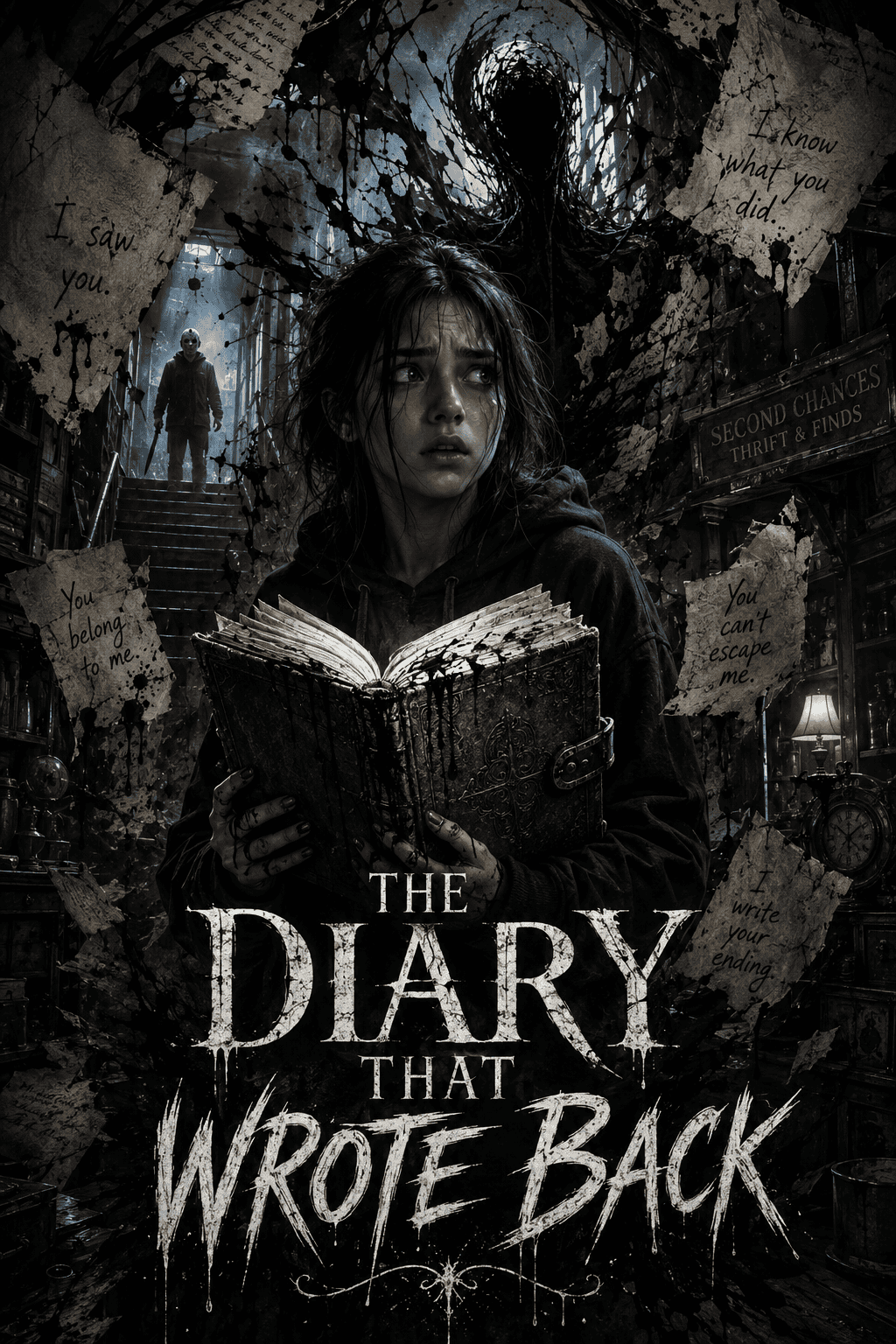
The Diary that Wrote Back

Story Summary

The Diary that Wrote Back

A bullied teenage girl named Maya discovers a mysterious leather-bound diary in a thrift shop and soon realizes that the dark, violent things she writes inside it come true in real life. At first, the diary seems like a twisted form of revenge against the people who hurt her, but its power quickly grows beyond her control, feeding on her anger and fear while writing back in her own handwriting. As the diary pushes her into more dangerous horrors, Maya accidentally unleashes a masked attacker and a supernatural entity at a school party, putting her only friend Jonah in danger. When she tries to destroy the diary and undo everything, it traps her in a repeating nightmare, sending her back to the thrift shop as a character inside its pages, doomed to begin the story again.

Listen to the Story

The Diary that Wrote Back

Experience the story with audio, captions, and full-screen playback.

Reading Mode Skip to Ending

The Diary That Wrote Back

Maya found the diary on a Thursday afternoon, wedged between a cracked porcelain angel and a box of VHS tapes no one had touched since the nineties.

The thrift shop was called Second Chances, though everyone in town called it “the dead people store,” because most of what sat on its shelves looked like it had been emptied from houses where someone had recently passed away. The place smelled like dust, old fabric, and rainwater trapped in wood. Coats drooped from metal racks like tired ghosts. Lamps with stained yellow shades glowed dimly in the corners. Somewhere near the front, a radio played soft oldies under a layer of static.

Maya didn’t usually go there after school. She usually went straight home, locked herself in her room, and waited for the house to become quiet enough to think. But it had been one of those days where every hallway at school felt narrower than the last, every laugh felt aimed directly at her, and every minute stretched like wire around her throat.

So she had walked past her street, crossed the old bridge near the laundromat, and gone into Second Chances because it was the only place in town where nobody expected her to be someone else.

She liked the forgotten things.

Old books with names written on the inside covers. Sweaters that smelled faintly of other people’s lives. Jewelry boxes with missing ballerinas. Half-empty sketchpads. Typewriters with sticky keys.

Things that had belonged to someone.

Things nobody wanted anymore.

Maya understood that.

She was sixteen, thin in a way that made adults ask if she was eating enough, with dark hair she usually hid behind and a backpack covered in tiny pins Jonah had given her over the years. Most of them were horror movie pins. A skull with heart eyes. A vampire drinking coffee. A black cat that said, “I’m fine,” even though it looked furious.

Maya was not fine.

At school, she was mostly invisible until someone needed a target.

That someone was usually Tessa Moore.

Tessa had perfect hair, a loud laugh, and the supernatural ability to sense weakness from across a cafeteria. She called Maya “Morticia” because Maya wore black hoodies and wrote strange stories in the margins of her notebooks. She once stole Maya’s journal and read a paragraph out loud in English class, doing a dramatic trembling voice while everyone laughed.

Except Jonah.

Jonah Reyes had stood up, snatched the journal from Tessa’s hands, and said, “Wow, obsessed much?”

That had made Tessa turn on him too, but Jonah never seemed to care what people thought. He was tall, messy-haired, and kind in a way that embarrassed Maya because she didn’t know what to do with kindness when it was offered without conditions.

Jonah liked her stories. He said they were “messed up in a good way.”

Maya kept writing them because, sometimes, putting monsters on paper made the real ones seem smaller.

That afternoon, in Second Chances, she found the diary on the bottom shelf of a wobbly bookcase.

It didn’t look like the other journals.

There were plenty of those around: pastel notebooks with inspirational quotes, floral planners from years ago, leatherette diaries with broken locks. This one was plain, dark brown, and bound in leather that looked too old to still be holding together. No title. No markings. No price sticker.

Maya pulled it out.

The leather was cold.

Not cool from the room.

Cold.

Like it had been sitting outside in winter.

She almost put it back.

Instead, she opened it.

The pages were thick, creamy parchment, completely blank. Not lined. Not dated. Just page after page waiting for words.

Maya ran her thumb over the first sheet.

It felt expensive. Handmade. Wrong in a way she couldn’t explain.

“You like that one?”

Maya jumped.

The shop owner stood at the end of the aisle, a small woman with gray hair pinned into a bun and glasses hanging from a chain around her neck. Her name was Mrs. Bell, and she always spoke softly, as if the merchandise might wake up if she used her full voice.

“I guess,” Maya said.

Mrs. Bell glanced at the diary, and for one quick second, her face changed.

Not much.

Just enough.

Her mouth tightened. Her eyes seemed to recognize it.

Then the look was gone.

“No sticker?” Mrs. Bell asked.

Maya shook her head.

Mrs. Bell walked over and took the diary from her. She held it carefully, not like it was fragile, but like it might bite.

“Two dollars,” she said.

Maya blinked. “Really?”

“Really.”

“It looks old.”

“Most things here do.”

Maya hesitated. “Where did it come from?”

Mrs. Bell’s thumb pressed into the leather cover. “Estate box, I think.”

“You think?”

“We get many boxes.”

Maya waited for more, but Mrs. Bell only handed it back.

At the counter, Maya paid with quarters from the bottom of her backpack.

As she left, Mrs. Bell called after her.

“Miss?”

Maya turned.

The old woman seemed about to say something. Her lips parted. One hand rested on the counter near a little brass bell.

Then she looked down at the diary in Maya’s arms.

“Be careful what you keep,” Mrs. Bell said.

Maya gave an awkward half-smile because adults loved saying strange things like they were in a movie.

Then she stepped out into the gray afternoon.

The diary felt heavier on the walk home.

By the time Maya reached her house, her stepfather’s truck was already in the driveway.

Her stomach dropped.

Ron was home early.

The house was a narrow two-story rental on the edge of town, with peeling blue paint and a porch light that flickered no matter how many times her mother replaced the bulb. Her mother, Claire, worked double shifts at the hospital cafeteria and came home exhausted, smelling like fryer oil and disinfectant. Ron had moved in two years ago, first as “just someone helping with bills,” then as her mother’s husband, then as the thing that made the house feel smaller every day.

He wasn’t always drunk.

That was the terrible part.

When he was drunk, at least the rules were obvious. Stay quiet. Don’t look at him too long. Don’t answer unless asked. Don’t leave cups in the sink. Don’t breathe like you were trying to annoy him.

When he was sober, he could almost seem normal. He asked Claire about work. He fixed the leaky faucet. He made pancakes on Sundays and called Maya “kiddo” in a voice that made her skin crawl because she knew how fast it could change.

That evening, he was in the kitchen.

Maya could hear him before she opened the door.

“Where the hell have you been?”

She stepped inside and closed the door behind her.

“School.”

“School ended an hour ago.”

“I stopped somewhere.”

Ron stood at the counter in his work boots, holding a beer bottle in one hand. His face was red from the cold or the beer or both. He looked past her shoulder toward the porch, as if checking whether someone had followed her.

“You think your mother needs more reasons to worry?”

Maya tightened her grip on her backpack strap. “No.”

“No,” he repeated, mocking her small voice. “No. That all you got?”

She stared at the floor.

Ron walked closer. The kitchen floor creaked under him.

“What’s in the bag?”

“Nothing.”

“Then show me.”

“It’s just school stuff.”

Ron reached for the backpack.

Maya stepped back without thinking.

His face darkened.

“Don’t do that.”

“I said it’s just school stuff.”

“Don’t make me ask twice.”

Her chest tightened. The diary was in the backpack. She didn’t know why she didn’t want him touching it, only that the thought made panic flash through her body.

Ron grabbed the strap and yanked.

The backpack slipped off her shoulder, spilling open onto the floor. Books, pencils, crumpled papers, and the diary scattered across the linoleum.

The diary landed with a heavy thud.

Ron looked down at it.

“What’s that?”

“A notebook.”

“You writing about me in there?”

“No.”

He bent and picked it up.

The second his fingers touched the leather, he flinched.

Maya saw it.

He tried to hide it, but she saw.

His hand twitched like he had grabbed a live wire.

“What the hell?” he muttered.

Then his expression hardened, embarrassed by his own reaction. He tossed the diary back at her. It hit her chest, and she caught it before it fell.

“Freaky little thing,” he said. “Fits you.”

Maya gathered her things quickly.

Ron watched her.

“You know, girls like you think being weird makes you special,” he said. “It doesn’t. It just makes people tired.”

Maya said nothing.

“Go to your room.”

She went.

She didn’t cry until she had locked the door.

Her room was small and cold, with a slanted ceiling and one window that looked out over the backyard. The wallpaper was faded yellow. Her bedspread was gray. Stacks of books crowded the desk, along with pens, loose paper, and a chipped mug filled with sharpened pencils.

Maya sat on the floor with her back against the bed.

For a long time, she did nothing.

Then she pulled the diary into her lap.

She opened to the first page.

Blank.

Waiting.

She found her favorite pen, the black one Jonah had given her because it didn’t smear, and pressed the tip to the paper.

At first, she only meant to write what happened.

But the words came out sharper than that.

Ron grabbed my bag today. Again. He thinks he owns everything in this house, including the air. He talks like he’s teaching me something, but all he does is make Mom smaller. He makes every room feel like a trap.

The ink sank into the parchment instantly.

Maya kept writing.

I hate him. I hate his boots on the stairs. I hate the way Mom gets quiet when he walks in. I hate that he gets to stomp around like nothing can touch him.

Her hand moved faster.

I wish something would.

She stopped.

Her breathing sounded loud.

Then, before she could think better of it, she wrote one final sentence.

I wish he would just break a leg.

Maya stared at the words.

They looked childish now. Dramatic. The kind of thing Tessa would read aloud in class and make everyone laugh at.

She almost tore the page out, but the diary looked too beautiful to damage.

Instead, she closed it.

That night, she dreamed of scratching.

Not at her window. Not at her door.

Inside the walls.

A soft, patient scraping.

Like fingernails dragging across paper.

The next morning, Ron fell down the stairs.

Maya woke to a scream, a crash, and her mother shouting his name.

She ran into the hallway just in time to see him lying twisted at the bottom of the steps. His face was pale. His beer belly rose and fell in short bursts. One leg bent beneath him at an angle no leg should bend.

Claire knelt beside him, panicked and shaking.

“Call 911!” she screamed.

Maya stood frozen.

Ron looked up at her.

His eyes were wet with pain.

For one second, their gazes locked.

And Maya felt something rise in her chest.

Not happiness.

Not exactly.

Relief.

Then guilt hit so hard she almost doubled over.

She called 911.

At the hospital, they said Ron had broken his tibia in two places. He needed surgery. He would be off his feet for weeks.

“It was the stairs,” Claire kept saying, as if someone had accused her. “He must have slipped. The stairs are old.”

Ron claimed something had grabbed his ankle.

No one believed him.

Maya did not speak.

At school, Jonah found her sitting under the back stairwell during lunch, her untouched sandwich still wrapped in foil.

“You look dead,” he said, sliding down the wall beside her. “Not cool dead. Like medical dead.”

Maya gave a weak laugh.

Jonah studied her face. “What happened?”

She almost told him everything.

The diary. The entry. Ron’s fall.

Instead, she said, “Ron broke his leg.”

Jonah’s eyebrows lifted. “Seriously?”

“Fell down the stairs.”

“Wow.” He paused. “Is it bad that my first thought is ‘good’?”

Maya looked at him.

Jonah softened. “Sorry.”

“No,” she said. “It’s not bad.”

He bumped her shoulder with his. “You okay?”

Maya thought about the diary sitting in her backpack.

“I don’t know.”

That afternoon, curiosity gnawed at her so hard it felt like hunger.

It was impossible, obviously.

People wrote angry things all the time. People said they wished terrible things would happen, and terrible things sometimes did. Coincidence was not magic. Coincidence was just the universe being lazy and dramatic.

Still, when she got home, Maya locked her bedroom door, pulled out the diary, and opened to the first page.

Her entry was still there.

But the ink looked different.

Darker.

Almost raised, like veins beneath skin.

She turned to the next blank page.

“Okay,” she whispered. “If you’re real…”

She stopped, feeling stupid.

Then she wrote:

Tomorrow at school, I win the raffle for the art store gift card.

The school raffle was harmless. Every Friday, the office drew a name from a box of students who had turned in “positive behavior tickets,” which teachers gave out for things like helping clean up or not actively making their lives worse. Maya had one ticket in the box from weeks ago.

She closed the diary.

The next day, during afternoon announcements, Principal Donnelly’s voice crackled over the speakers.

“And this week’s raffle winner is…”

Maya held her breath.

“Evan Miller.”

A cheer went up from somewhere down the hall.

Maya exhaled.

Nothing.

Of course nothing.

She felt embarrassed, then relieved, then oddly disappointed.

At home, she opened the diary again.

The entry about the raffle had changed.

Not much.

Just enough.

The ink had faded to a weak gray, as if the page had rejected it.

Below her sentence, new words appeared slowly, bleeding up through the parchment.

Not hungry.

Maya jerked backward so fast her chair nearly tipped.

The words were in her handwriting.

Exactly.

Same slant. Same uneven pressure. Same little curl on the lowercase y.

She stared until her eyes watered.

Then she slammed the diary shut and shoved it into her desk drawer.

For three hours, she didn’t touch it.

She did homework. She ate dinner. She listened to her mother and Ron argue in low voices because Ron hated being helpless and Claire hated being blamed for things she hadn’t done.

At ten, Maya climbed into bed.

At ten fifteen, she got up.

She opened the drawer.

The diary waited.

Her hands shook as she opened it again.

Not hungry.

Maya whispered, “What does that mean?”

The page remained still.

A sane person would have thrown it away. A sane person would have told someone.

Maya turned to a new page.

She told herself it was a test.

Just a test.

Tessa Moore had posted a picture of Maya that afternoon. Maya hadn’t even known Tessa had taken it. In the photo, Maya was sitting alone under the stairwell, looking down at her notebook. Tessa had added the caption: Local haunted girl composing a spell to make someone love her.

The comments were worse.

Maya had read all of them.

More than once.

Now she pressed her pen to the diary.

Tessa loves her hair more than anything. I hope she wakes up tomorrow and it starts falling out. Not all at once. Enough that everyone sees. Enough that she knows what it feels like to be looked at like something is wrong with you.

The moment Maya finished the sentence, the page warmed under her hand.

Not a little.

A lot.

Like fevered skin.

Maya pulled away.

The ink darkened.

The diary gave a soft creak.

Somewhere inside the house, Ron shouted for Claire.

Maya closed the book.

The next morning, Tessa Moore came to school wearing a beanie.

That alone was strange. Tessa did not wear hats because hats disturbed the architecture of her hair, which was usually curled, glossed, and arranged like she had been born with a ring light following her.

By second period, everyone knew.

By lunch, someone had a video.

Tessa in the girls’ bathroom, sobbing while handfuls of blonde hair came away in her brush.

By the end of the day, people were whispering “alopecia” like it was a curse word.

Maya watched from across the hall as Tessa walked past with her head down, face blotchy, hands tugging the beanie low over her ears.

Tessa looked small.

Maya had imagined feeling powerful.

Instead, she felt hollow.

Jonah appeared beside her.

“Something is weird,” he said.

Maya didn’t answer.

“You heard about Tessa?”

“Everyone heard.”

Jonah glanced at her. “Are you smiling?”

Maya touched her mouth.

She was.

Barely.

She dropped the smile like it had burned her.

“No.”

Jonah looked down the hall at Tessa. “She’s awful, but that’s… intense.”

“Yeah.”

“Maya.”

“What?”

He lowered his voice. “You’ve been weird since Ron’s accident.”

“I’m always weird. That’s kind of my brand.”

“Not like this.”

The warning bell rang.

Maya walked away before he could say more.

That night, she decided not to write.

She put the diary under her bed and covered it with a shoebox full of old birthday cards. She turned off her lamp. She closed her eyes.

The scratching began at midnight.

Soft at first.

Scritch.

Scritch.

Scritch.

Maya lay still.

Scritch.

Scritch.

From under the bed.

She pulled the blanket over her head.

The sound grew louder.

Not frantic. Not impatient.

Steady.

Like something with all the time in the world.

Maya finally snapped on the lamp and dropped to her knees.

The shoebox had been pushed aside.

The diary lay in the center of the floor.

Open.

On a blank page, words appeared one letter at a time.

Why stop?

Maya’s mouth went dry.

She grabbed the diary and slammed it shut.

“I’m not doing this.”

The leather pulsed beneath her hands.

Once.

Twice.

Like a heartbeat.

Maya threw it across the room.

It hit the wall and landed open.

More words spread across the page.

You liked it.

Maya backed away until she hit the bed.

“No,” she whispered.

The ink continued.

You wanted it.

“No.”

You fed me.

Maya slept with the light on.

For three days, she did not write in the diary.

Those three days were worse than anything that had happened before.

At first, she only felt anxious. A crawling sensation under her skin. A constant feeling that she had forgotten something important. Then came the headaches, sharp and sudden behind her eyes. Then the dreams.

In the dreams, Maya stood inside a library made of skin.

Books lined shelves that stretched into darkness. Every book whispered. Every book had her name on it.

When she opened them, she saw scenes that had not happened yet.

Ron screaming in his sleep.

Tessa pulling out clumps of hair in a bathtub full of black water.

Jonah standing in the street, calling Maya’s name while something tall and paper-thin unfolded behind him.

And always, from somewhere deep in the library, a voice turned pages.

Maya woke exhausted each morning.

Her writing hand cramped constantly.

At school, Jonah cornered her by the vending machines.

“Okay,” he said. “You’re scaring me.”

Maya tried to move past him.

He blocked her.

“Don’t do that. Don’t disappear in front of me.”

“I’m fine.”

“You look like you haven’t slept in a week.”

“Thanks.”

“Maya.”

His voice cracked a little, and that hurt worse than if he had yelled.

She looked away.

Jonah lowered his voice. “Did something happen? Did Ron do something?”

“No.”

“Then what?”

Maya hugged her books to her chest.

If she told him, he would think she was losing it.

Or worse, he would believe her.

“I found something,” she said.

Jonah waited.

“A diary.”

His brow furrowed. “Okay.”

“It…” She swallowed. “Things I write in it happen.”

Jonah stared.

Maya laughed once, sharp and humorless. “See? Never mind.”

“No,” he said quickly. “I’m listening.”

“You shouldn’t.”

“But I am.”

Maya told him.

Not everything. Not every thought she’d had when Ron fell. Not the part where she had smiled in the hallway watching Tessa pass by.

But enough.

When she finished, Jonah was quiet.

Too quiet.

Then he said, “Show me.”

“No.”

“Maya.”

“I said no.”

“If this is real, we need to know.”

“We know.”

“No, we don’t. We know enough to be terrified, which is not the same as knowing what to do.”

That sounded exactly like Jonah. Practical in the face of impossible things. He had once fixed a broken projector during English class by smacking it with a textbook and saying, “Technology respects confidence.”

Maya almost smiled.

Almost.

After school, she brought Jonah to her house while Ron was asleep downstairs and her mother was at work.

Maya’s room felt different with him in it. Smaller. More exposed.

The diary sat on her desk.

Jonah didn’t touch it at first.

“Looks normal,” he said.

“It isn’t.”

He leaned closer. “Can I?”

Maya nodded.

Jonah touched the cover with one finger.

He flinched.

“Cold,” he said.

“Yeah.”

He opened it.

The entries were there. Ron. The raffle. Tessa.

And the messages.

Not hungry.

Why stop?

You liked it.

You wanted it.

You fed me.

Jonah’s face lost color.

“This is your handwriting,” he said.

“I know.”

“You didn’t write these?”

“No.”

He turned pages carefully. “Okay. Okay, this is… bad.”

“Thanks, detective.”

“I’m serious.” He looked at her. “Has it hurt anyone else?”

“No.”

The diary creaked.

Both of them froze.

A new line formed beneath the last message.

Liar.

Maya’s blood went cold.

Jonah looked at her.

“What does that mean?”

“I don’t know.”

The ink continued.

You hurt them every time you imagine it.

Maya slammed the diary shut.

Jonah stepped back.

“What the hell is this thing?”

“I don’t know.”

“Where did you get it?”

“Second Chances.”

“We take it back.”

“No.”

“Maya—”

“No. What if someone else buys it?”

Jonah had no answer.

They tried the internet first.

There was no brand name to search. No symbols. No inscriptions. They searched phrases like blank leather diary writes back, cursed diary thrift store, book grants wishes horror, and got creepypasta, Etsy listings, and one forum where someone claimed a haunted notebook had made their ex get food poisoning.

Jonah suggested salt because his grandmother used it around windows when she felt “bad energy.” They poured a circle of salt around the diary.

The next morning, the salt had turned black.

Maya suggested locking it in the basement.

At midnight, it was back on her pillow.

Jonah brought a church candle from his aunt’s house.

The flame bent away from the diary.

They tried cutting a page with scissors.

The scissors snapped.

They tried writing something harmless but negative:

The milk in the fridge spoils.

The next morning, every carton of milk in the school cafeteria had curdled.

The diary grew warmer.

The messages became more frequent.

Small ones appeared in the margins of Maya’s school notes.

Write.

On fogged bathroom mirrors.

Hungry.

On her arm one morning, raised in faint red scratches.

Don’t starve me.

Maya stopped eating much. She stopped sleeping. Her mother noticed, but Claire was trapped in the orbit of Ron’s recovery, insurance calls, extra shifts, and his endless barking from the couch.

“Can you please just help me right now?” Claire snapped one evening after Maya forgot to pick up Ron’s prescription. “I know things are hard, Maya, but they’re hard for everyone.”

Maya looked at her mother’s exhausted face and felt something inside her fold up.

“Yeah,” she said. “I know.”

She went upstairs.

The diary waited on her bed.

Open.

A sentence was already written there.

She doesn’t see you either.

Maya stared at it.

Then she picked up her pen.

That was how it got her.

Not with power.

Not really.

Power was only the bait.

What the diary really offered was proof.

Proof that her anger mattered. Proof that her pain could leave a mark. Proof that when the world hurt her, something would listen.

Something would answer.

For a while, Maya wrote small things.

A teacher who ignored her got a flat tire. A boy who shoved Jonah into a locker developed a rash shaped like handprints. Ron’s favorite recliner collapsed under him, aggravating his broken leg enough to make him cry out.

Each time, the diary drank the words.

Each time, the warmth spread farther up Maya’s fingers.

Each time, she promised herself it was the last.

Then came the party.

It was Tessa’s party, though everyone called it Cameron Bell’s party because it was at Cameron’s house while his parents were out of town. The whole school seemed to be talking about it. There would be music, drinks stolen from parents’ cabinets, and enough bad decisions to fuel Monday morning gossip for weeks.

Maya was not invited.

Jonah was, technically, because Cameron liked him enough when nobody popular was watching.

“You’re not going,” Maya said.

They were sitting behind the gym after school, where the brick wall blocked the wind.

Jonah picked at the label on his soda bottle. “I wasn’t planning on it.”

“Good.”

“But I kind of think maybe we should.”

Maya stared at him. “Why?”

“Because something is going to happen.”

“You don’t know that.”

He gave her a look.

Maya looked away.

Jonah said, “Tessa posted something.”

He handed her his phone.

Maya already knew she shouldn’t look.

She looked anyway.

It was a photo from freshman year. Maya in gym class, face red, hair stuck to her forehead, caught mid-fall after tripping over a basketball. Tessa had added a new caption.

Throwback to when Maya tried running from the demons and lost.

The comments were full of laughing emojis.

One said, She definitely has a basement full of dead animals.

Another said, I’d watch a horror movie where she’s the killer.

Maya’s hand tightened around the phone.

The edges of her vision darkened.

Jonah gently took the phone back.

“Don’t,” he said.

“Don’t what?”

“You know what.”

“I wasn’t going to.”

“Maya.”

“I said I wasn’t going to.”

He didn’t believe her.

That made it worse.

At home, Ron was in a foul mood because his pain meds had run out early and Claire wouldn’t call for more. He yelled until his voice turned hoarse. Claire cried in the bathroom with the fan on, pretending Maya couldn’t hear.

Maya sat at her desk.

The diary lay open.

Waiting.

She thought of Tessa laughing.

Cameron smirking.

Everyone watching.

Everyone always watching when someone else was bleeding.

Her pen touched the page.

She didn’t mean for it to become detailed.

That was what she told herself later.

She meant to write a scare. A ruined party. A story where the lights went out, everyone panicked, and Tessa finally knew what it was like to feel trapped inside a joke she didn’t understand.

But once Maya started, the words poured out.

At Cameron Bell’s party, the power goes out at exactly 11:13 p.m.

The house becomes silent.

Not normal silent.

Wrong silent.

Phones die. Doors lock. Windows will not break.

Someone knocks on the front door.

Three slow knocks.

Everyone thinks it is a prank.

Then a man in a blank white mask steps inside holding a knife.

Maya’s breathing changed.

She kept writing.

He does not run. He walks. He knows where everyone is hiding. He whispers their names before he finds them.

Tessa hides in the upstairs bathroom.

The masked man stands outside the door and scratches the wood with the knife.

He says, “Pretty things come apart.”

Maya stopped.

Her heart pounded.

That was enough.

More than enough.

She tried to pull the pen away.

Her fingers wouldn’t move.

The diary’s pages rippled.

Ink spread ahead of her pen, guiding it.

No.

Not guiding.

Dragging.

Maya watched in horror as her hand continued writing.

The masked man is not alone.

There is something behind him that no one can see unless they look in a mirror.

It wears the faces people make when they are cruel.

It eats the sound of screaming first.

Then the lights come back on so everyone can see what they have become.

Maya yanked her hand back so hard the pen flew across the room.

The diary snapped shut by itself.

From downstairs, Ron shouted, “What was that?”

Maya didn’t answer.

She grabbed her phone and called Jonah.

He picked up on the first ring.

“I did something,” she said.

Jonah went quiet.

“What did you write?”

Maya couldn’t speak.

“Maya. What did you write?”

She told him.

Jonah cursed. She had only heard him curse once before, when he broke his wrist falling off his bike in seventh grade.

“What time is it?” he asked.

Maya looked at the clock.

10:57 p.m.

“We have sixteen minutes,” he said.

“Jonah, don’t go there.”

“I’m already near there.”

“What?”

“I was worried about you. I thought if I went, I could make sure nobody did anything stupid.”

“Jonah, leave.”

“If this starts, I’m getting people out.”

“You can’t.”

“I have to try.”

The line crackled.

“Jonah?”

Static.

Then his voice returned, thin and distant.

“Maya?”

“Get out of there!”

“I’m at the front yard,” he said. “Lights are on. Music’s loud. Everything looks normal.”

“Please leave.”

“I’ll call you right back.”

“No!”

The call ended.

Maya stared at the phone.

10:59.

She grabbed the diary and ran downstairs.

Ron was asleep in the recliner, mouth open, one leg in a brace. Claire’s bedroom door was closed.

Maya went out the back door barefoot.

The cold bit into her feet as she crossed the yard to the rusted fire pit near the fence. She grabbed lighter fluid from the shed, dumped it over the diary, and struck a match.

The flame flared bright.

For one beautiful second, Maya thought it worked.

Then the fire split around the diary.

The leather did not blacken.

The pages did not curl.

The flames bent away from it in a perfect circle, as if the book sat beneath invisible glass.

Maya screamed and kicked dirt over the fire.

Her phone rang.

Jonah.

She answered with shaking hands.

“Jonah?”

At first, all she heard was music.

Then shouting.

Then Jonah’s voice, breathless.

“It happened.”

Maya sank to her knees.

“The lights went out,” he said. “Phones died. I got mine back for a second somehow. Maya, the doors—”

A crash.

Someone screamed.

Not movie screaming.

Real screaming.

The kind that tears something on the way out.

“Jonah!”

“I saw him,” Jonah whispered.

“The masked man?”

“Yes.”

“Get out.”

“I can’t. The windows won’t break. Cameron tried with a chair. It bounced back like—”

Static swallowed him.

Then, very faintly, Maya heard three slow knocks.

Not through the phone.

Behind her.

From inside the house.

Knock.

Knock.

Knock.

Maya turned.

The back door stood open.

Darkness filled the kitchen.

Her phone crackled.

A voice spoke through it.

Not Jonah’s.

Not human.

“Pretty things come apart.”

Maya dropped the phone.

She ran upstairs, clutching the diary to her chest.

In her room, she opened it with numb fingers.

The party entry was still there.

But new paragraphs had appeared beneath it.

Maya had not written them.

The masked man finds Cameron under the pool table.

The thing behind him wears Cameron’s grin.

It stretches the grin from ear to ear.

Maya sobbed.

Another line appeared.

Jonah hides in the pantry and tries not to breathe.

“No,” Maya whispered.

She grabbed her pen.

Stop.

The ink sank in, then vanished.

She wrote harder.

The masked man leaves. Everyone survives. Jonah comes home.

The words trembled.

For a moment, Maya dared to hope.

Then the diary rewrote them.

The masked man leaves pieces. Everyone remembers. Jonah comes home changed.

Maya screamed and stabbed the pen into the page.

The paper absorbed the pen tip.

Not pierced.

Absorbed.

The diary pulled the plastic barrel down like wet sand swallowing a twig.

Maya let go.

The pen disappeared into the page.

The diary burped a small bead of black ink.

Then it wrote:

Better.

Maya backed away.

Her bedroom door creaked open.

No one stood there.

Downstairs, Ron shouted in his sleep.

The phone on the floor buzzed.

A text appeared from Jonah.

No words.

Just a photo.

It showed a dark pantry door from the inside.

Through the narrow slats, Maya could see part of a kitchen lit by flickering emergency lights. A white mask hovered in the distance.

Behind it stood something taller.

Blurred.

Wrong.

Its face was a collage of expressions. Tessa’s laugh. Cameron’s smirk. Ron’s sneer. Maya’s own brief smile when she saw Tessa humiliated.

All of them stretched over one impossible skull.

Another text arrived.

i think it knows you

Maya called him.

No answer.

She called again.

Nothing.

The diary flipped open on the floor.

A blank page waited.

Maya understood then.

It did not want fear from the party.

Not really.

It wanted hers.

The party was bait too.

Everything was bait.

She crawled toward the diary, tears dripping onto the pages.

“What are you?” she whispered.

Words formed slowly.

A place to put what you cannot carry.

The letters shifted.

A mouth to eat it.

Another shift.

A hand to make it real.

Maya shook her head. “I don’t want this.”

The diary answered:

You did.

She thought of every story she had written where someone cruel got punished.

Every daydream where Ron slipped, Tessa cried, the school burned, the whole town finally saw what it had done to her.

She had never wanted those things to be real.

Had she?

The diary’s pages fluttered.

Jonah comes home changed.

Maya grabbed the diary and ran.

She ran past Ron, who was awake now and yelling from the recliner. She ran past the closed bedroom door where her mother slept through exhaustion no nightmare could break. She ran out the front door and down the sidewalk barefoot, diary clutched under one arm.

The town was dark.

Not all of it.

Just the parts she passed.

Streetlights flickered out above her. Porch lights dimmed. Dogs barked once, then went silent.

Second Chances sat at the end of Main Street, its windows black, its sign creaking in the wind.

Maya pounded on the door.

“Mrs. Bell!”

No answer.

She pounded again.

“Please!”

The door unlocked.

Not opened.

Unlocked.

Maya stepped inside.

The thrift shop smelled stronger at night. Dust and old cloth and something metallic underneath.

“Mrs. Bell?”

A lamp clicked on near the counter.

Mrs. Bell sat behind it.

She wore a pale robe over her nightgown, though her hair was still pinned perfectly in place.

“I wondered when you’d come back,” she said.

Maya froze.

“You knew.”

Mrs. Bell looked at the diary. “I suspected.”

“You sold it to me.”

“I tried not to.”

“You charged me two dollars.”

Mrs. Bell’s mouth trembled. “It doesn’t leave unless it is taken willingly. Bought. Gifted. Chosen. There are rules.”

Maya stepped closer. “Then take it back.”

“I can’t.”

“Take it back!”

Mrs. Bell flinched.

The diary warmed beneath Maya’s arm.

Mrs. Bell whispered, “It was my sister’s.”

Maya stopped.

“She found it when we were girls,” Mrs. Bell said. “At a church rummage sale. She wrote such angry little things at first. A neighbor’s cat. A teacher’s hands. Our father’s lungs.” Her eyes grew distant. “By the time we understood, the diary understood her better.”

Maya felt sick. “What happened to her?”

Mrs. Bell looked at the shelves.

“She wrote herself out.”

“What does that mean?”

“It means the diary always makes an ending.”

Maya gripped the book. “How do I destroy it?”

“You don’t.”

“There has to be a way.”

Mrs. Bell shook her head.

Maya’s anger flared so hot it chased away the fear.

“You let me take it.”

“I was afraid,” Mrs. Bell said, tears shining in her eyes. “It had started writing again. In the shop. On receipts. On walls. It wanted out.”

“So you gave it to me?”

“I’m sorry.”

Maya laughed, but it broke apart halfway. “Everyone is always sorry after.”

The diary opened in her arms.

Its pages turned by themselves until it reached a blank sheet.

Words appeared.

Write her.

Mrs. Bell’s eyes widened.

“No,” she whispered.

Write what she deserves.

Maya looked at the old woman.

For one terrible second, she imagined it.

Mrs. Bell’s bones turning brittle. Her mouth filling with ink. Her hands trapped forever beneath a register drawer while the shop filled with all the things she had been too afraid to bury.

The diary pulsed eagerly.

Maya closed her eyes.

No.

She was not free of it.

But she could still choose this.

For now.

“No,” Maya said.

The diary snapped shut hard enough to split the silence.

Mrs. Bell began to cry.

Maya turned and walked out.

Behind her, Mrs. Bell called, “There may be one thing.”

Maya stopped in the doorway.

Mrs. Bell’s voice shook.

“It twists harm. It feeds on fear. It rejects kindness. But it obeys endings. Not wishes. Endings.”

Maya turned back.

“What does that mean?”

“You cannot undo what it has done. But if you write a true ending, perhaps…” Mrs. Bell swallowed. “Perhaps you can close the story.”

Maya thought of Jonah.

“Could I save someone?”

Mrs. Bell looked away.

“That is not the same as undoing.”

Outside, sirens wailed in the distance.

Cameron Bell’s house was six blocks away.

Maya ran toward the sound.

By the time she got there, the street was full of flashing lights.

Police cars. Ambulances. Neighbors in robes standing on lawns. Teenagers wrapped in blankets. Some crying. Some staring blankly. Some with blood on their clothes that did not seem to be theirs.

Maya pushed through the crowd.

“Tessa!”

Tessa Moore sat on the curb without her beanie. Her scalp was patchy and raw-looking under the red-blue flash of police lights. She rocked back and forth, whispering something over and over.

Maya caught only pieces.

“No face. No face. No face.”

Maya kept moving.

“Jonah!”

A paramedic tried to stop her. She ducked under his arm.

“Jonah!”

Then she saw him.

He stood near the garage.

Alone.

His clothes were soaked with something dark. His face was pale. His eyes were open too wide.

Maya ran to him.

“Jonah!”

He looked at her.

For one perfect second, he was still Jonah.

Relief crossed his face.

“Maya,” he said.

Then his expression twitched.

Not naturally.

Like someone had tugged a string behind his skin.

He smiled.

It was Cameron’s smile.

Then Tessa’s.

Then Ron’s.

Then her own.

Maya stepped back.

Jonah’s mouth opened.

When he spoke, several voices came out layered together.

“You wrote me a door.”

Maya shook her head. “No.”

Jonah’s eyes filled with tears.

Under the wrong smile, he was still in there.

“Maya,” he whispered, his real voice fighting through. “Run.”

The thing wearing his face tilted its head.

The police officer nearest them shouted, “Hey! You two need to move back!”

Jonah turned toward him.

The officer stopped.

His face slackened.

So did the faces of everyone nearby.

For a moment, all sound vanished.

No sirens.

No crying.

No wind.

Maya understood.

It ate screaming first.

Then it ate everything else.

The diary burned against her ribs inside her hoodie.

She pulled it out.

The thing in Jonah smiled wider.

“There you are,” it said.

Maya ran.

Not home.

Not to Mrs. Bell.

She ran to the old bridge near the laundromat, the one over the creek swollen with rainwater and trash. The diary slapped against her chest as she climbed over the railing and dropped onto the muddy bank below.

Her feet were bleeding. Her lungs burned. Her hands shook so violently she almost couldn’t open the book.

But she did.

The pages flipped wildly, showing her everything.

Ron on the stairs.

Tessa’s hair in the sink.

The masked man at the party.

Jonah’s face splitting into borrowed smiles.

Then a blank page.

Maya pressed her finger to it.

“I know what you want,” she said.

The diary waited.

“You want an ending.”

The leather shivered.

Maya looked up.

At the top of the bridge, Jonah stood beneath the streetlight.

No.

Not Jonah.

The thing inside him.

It began walking down the slope.

Maya searched the mud for the pen she kept in her hoodie pocket. Her fingers found it.

She opened it with her teeth.

Then she wrote:

The diary is destroyed and everything goes back to normal.

The words stayed black for one heartbeat.

Two.

Then the page began to bleed.

Ink welled from the sentence, thick and dark, spreading outward until the words became unreadable. The diary convulsed in her hands.

Maya held on.

“No,” she said. “No, you listen to me.”

The ink pulled itself into new shapes.

The diary rewrote her sentence.

Everything goes back to the beginning.

Maya’s stomach dropped.

The thing wearing Jonah laughed softly from the bank.

“Maya,” it said in Jonah’s voice. “You should have written better.”

The world folded.

Not faded.

Folded.

The creek bent upward. The bridge twisted like paper. The sirens became a radio song beneath static. The cold mud under Maya’s knees became carpet. The night became fluorescent light.

Maya blinked.

She stood in Second Chances.

Afternoon sunlight pressed against the dusty windows.

A cracked porcelain angel sat on the shelf beside her.

A box of VHS tapes leaned against her ankle.

And there, on the bottom shelf of the wobbly bookcase, sat the diary.

Dark brown leather.

No title.

No markings.

No price sticker.

Maya could not breathe.

She remembered.

All of it.

Ron’s leg. Tessa’s hair. Jonah’s voice telling her to run.

She stumbled backward, knocking over a stack of old magazines.

At the front counter, Mrs. Bell looked up.

“You like that one?” the old woman asked.

Maya stared at her.

No recognition passed over Mrs. Bell’s face.

None.

This was the beginning.

Maya turned toward the door.

She would leave.

She would not touch it.

She would not buy it.

She would warn someone.

She took one step.

Her body stopped.

Not because she chose to.

Because something had written that she did.

Maya looked down.

Her hand was reaching for the diary.

“No,” she whispered.

Her fingers closed around the cold leather.

She tried to scream.

Nothing came out.

Mrs. Bell walked over, smiling politely.

“No sticker?” she asked.

Maya’s mouth opened.

The words that came out were not the ones she tried to say.

“I guess not.”

Mrs. Bell took the diary from her and held it carefully.

“Two dollars,” she said.

Maya cried silently as her own hand reached into her backpack and found the quarters.

She paid.

She carried the diary outside.

The afternoon was gray. The air smelled like rain.

For a moment, standing on the sidewalk, Maya felt the world tremble at the edges.

Then everything went still.

A voice whispered from inside the diary.

Not aloud.

Inside her.

This time, make it hurt.

Maya opened the cover.

The first page was no longer blank.

Words were already written there in her handwriting.

Maya finds a diary in a thrift shop.

She thinks the story begins with her.

But stories do not begin when characters notice them.

They begin when someone opens the book.

The sentence ended.

A new one appeared beneath it.

And somewhere, on the other side of the page, someone began to read.

Back to Top Read More Stories


30 May

Mr. Rattle

Story Summary

Mr. Rattle

After a painful divorce, Sarah moves with her six-year-old son, Leo, into an isolated farmhouse hoping for a fresh start. But when Leo begins talking to an imaginary friend named Mr. Rattle, disturbing events quickly spiral from creepy to violent: the dog is trapped, family photos are destroyed, a babysitter is harmed, and Sarah begins to fear someone is manipulating her son. Desperate for answers, she installs hidden cameras and discovers the horrifying truth: there is no intruder, no ghost, and no possession—Leo has been fully aware the entire time, using Mr. Rattle as an excuse for his cruelty. When he sets the house on fire and tries to trap her inside, Sarah makes a frantic escape into the storm, only to realize Leo may not be as far behind as she thought.

Listen to the Story

Mr. Rattle

Experience the story with audio, captions, and full-screen playback.

Reading Mode Skip to Ending

Mr. Rattle

The farmhouse looked smaller from the road.

That was Sarah’s first thought when the realtor’s sedan disappeared in a cloud of pale gravel dust, leaving her alone with the keys in one hand and her six-year-old son’s backpack in the other. In the listing photos, the house had seemed wide and sunlit, all peeling white paint and pastoral charm, a place where someone could start over if they had no choice but to believe in fresh starts.

In person, it sagged.

The roof dipped slightly over the porch. The upper windows were dark even in the afternoon. Two brick chimneys rose crookedly from the roofline like broken fingers. Beyond the house stretched forty acres of dead winter field, a thin strip of woods, and a gravel road that eventually met the highway five miles back.

No neighbors close enough to wave.

No one to hear anything.

Sarah told herself that was good.

Quiet was good.

After eighteen months of lawyers, custody hearings, angry voicemails, and the slow, ugly collapse of a marriage that had once seemed ordinary enough to survive, quiet felt like medicine. She had bought the house cheap after the divorce finalized, using what little money she had left from selling the old place in town. It needed work. Everyone had said that with the careful tone people used when they meant it needed too much work.

But it was hers.

Hers and Leo’s.

Leo stood beside the porch steps, clutching a stuffed dinosaur under one arm. He wore his red coat zipped to his chin and stared at the house without blinking.

“What do you think, buddy?” Sarah asked, forcing brightness into her voice. “Big, huh?”

Leo didn’t answer.

He had been quieter since the move began. Since his father stopped calling every night and started calling whenever it suited him. Since Sarah had stopped saying, “Daddy’s busy,” because Leo was old enough to hear the lie in it.

Sarah crouched beside him. “You can pick your room first.”

Leo looked up at the second floor.

“There,” he said.

Sarah followed his gaze to the narrow window above the porch roof. One curtain still hung inside, gray with age, moving slightly though there was no wind.

“That one?” she asked.

Leo nodded.

“Okay,” Sarah said. “That one’s yours.”

The room smelled like dust, cold plaster, and something faintly metallic. The wallpaper had faded into an old pattern of yellow flowers, most of them stained brown near the baseboards. A dead fireplace sat against one wall, its mouth black and deep, bricked shut except for a narrow crack where the mortar had crumbled.

Leo walked straight to it.

Sarah set down his suitcase. “Careful. It’s dirty.”

Leo crouched in front of the fireplace, leaning close.

“Leo?”

He tilted his head, listening.

“Sweetheart?”

He pressed one small hand to the bricks.

Sarah felt a prickle move along the back of her neck.

“What are you doing?”

Leo smiled.

“Nothing,” he said.

That first week passed in a blur of boxes, phone calls, unpaid bills, and repairs Sarah did not know how to afford. The furnace coughed through the nights. Pipes knocked behind the walls. Mice scratched somewhere above the kitchen ceiling.

Or maybe not mice.

Everything in the farmhouse made noise. The floorboards popped. The chimneys groaned in the wind. The old radiators ticked and clanged like someone dragging bones through the walls.

Leo seemed to notice every sound.

He stopped asking to play outside. His toy cars remained untouched in a cardboard box by his bed. Most afternoons, Sarah found him in front of the dead fireplace, whispering into the crack in the mortar.

At first, she watched from the doorway and told herself it was normal.

Kids made things up.

Kids invented friends when they were lonely.

Kids survived hard things by turning them into stories.

One evening, while she was making boxed macaroni and cheese in the kitchen, Leo appeared in the doorway.

“Mommy?”

“Yeah, baby?”

“Mr. Rattle doesn’t like cheese.”

Sarah glanced over her shoulder.

Leo stood very still, hands at his sides, his face pale beneath the soft kitchen light.

“Who’s Mr. Rattle?”

“My friend.”

Sarah stirred the noodles, keeping her voice casual. “Oh yeah? Where’d you meet him?”

Leo pointed upward.

“In the walls.”

Sarah smiled because she thought she was supposed to.

“In the walls?”

“He came from the woods,” Leo said. “But now he lives here.”

The spoon slowed in Sarah’s hand.

“What does he look like?”

Leo’s eyes drifted toward the dark hallway.

“Tall,” he whispered. “No face.”

The furnace kicked on with a violent rattle that made Sarah flinch.

Leo did not.

He smiled a little.

“That’s him,” he said.

Sarah told herself not to overreact. The therapist had warned her that Leo might regress, act out, invent things. He had been through a lot. A bitter custody battle was hard on adults. For a six-year-old, it could become a storm with no shape, a monster with no name.

So she gave the monster one.

Mr. Rattle.

She played along lightly for a few days, asking whether Mr. Rattle wanted a place at breakfast, whether Mr. Rattle had muddy shoes, whether Mr. Rattle knew he wasn’t allowed to keep Leo awake past bedtime.

Leo never laughed.

He only listened to questions as if Sarah were missing something obvious.

Then the dog disappeared.

Milo was a mutt Sarah had adopted before Leo was born, part shepherd, part something smaller and anxious. He had been Leo’s shadow since infancy. That morning, Milo was curled under the kitchen table while Leo ate cereal. By lunch, he was gone.

Sarah searched the house first. Then the barn. Then the frozen field behind the property, calling until her throat burned.

At dusk, she heard the scratching.

It came from outside, beneath the kitchen window.

A weak, frantic scrape.

The root cellar doors were half hidden under dead leaves behind the house. Sarah had opened them once on moving day, seen the steep wooden stairs descending into darkness, and decided she would deal with it later.

Now a rusted padlock hung through the latch.

Her padlock.

The one she kept in the junk drawer.

Her hands shook so hard she dropped the keys twice before getting it open.

Milo burst out coughing and whining, his body trembling, paws bloody from clawing at the old wood. Sarah fell to her knees and grabbed him, sobbing into his fur.

Leo stood behind her in the yard.

“Did you do this?” Sarah asked, too scared to make her voice gentle.

Leo’s mouth opened. His lower lip shook.

“Mr. Rattle did,” he whispered.

Sarah closed her eyes.

“Leo.”

“He said Milo was barking too much.”

“Leo, this isn’t funny.”

Leo began to cry then, sudden and desperate, with a force that made Sarah’s anger collapse into guilt.

“He made me watch,” Leo sobbed. “He makes me watch everything.”

That night, after Leo cried himself to sleep, Sarah sat on the edge of her bed with her phone in her hand and searched imaginary friends after divorce, child blaming imaginary friend, signs of trauma in children.

Every article told her some version of the same thing.

Be patient.

Be calm.

Do not shame the child.

Create safety.

Sarah looked toward her bedroom door.

Beyond it, the hallway was dark.

From somewhere inside the house came a faint, dry rattle.

Not the furnace.

Not pipes.

Three quick taps.

Then silence.

Two days later, Sarah woke to find the family photos ruined.

She had arranged them along the mantel in the living room the night before. Little anchors of a life that still felt salvageable. Leo at three with frosting on his cheeks. Sarah and Milo at the lake. Sarah’s mother holding newborn Leo. One old wedding photo she had not been able to throw away yet, turned backward behind the others.

All the faces were gouged out.

Not cut.

Gouged.

The glass had been removed from each frame and laid carefully on the floor. The printed faces had been scraped away with something sharp until only pale scratches remained. In the wedding photo, Sarah’s face was destroyed. Her ex-husband’s was untouched.

She found Leo in the kitchen, eating toast.

A butter knife lay beside his plate.

Its tip was flecked with paper.

Sarah picked it up.

Leo looked at it, then at her.

His eyes filled instantly.

“No,” he said.

“Leo.”

“No, Mommy, I didn’t want to.”

Sarah felt cold spread through her chest.

“You didn’t want to what?”

“He said faces are how people find you.”

“Who said that?”

Leo’s voice dropped so low she barely heard him.

“Mr. Rattle.”

Sarah did not send him to school that day. She called in sick to the dental office where she worked reception three days a week, then called Leo’s therapist and left a message that became less coherent the longer she talked.

She watched Leo constantly.

By noon, he was coloring at the kitchen table.

By one, he was asleep on the couch.

By three, Sarah had convinced herself she was catastrophizing. He was six. A very hurt, very angry six. Children could be frightening in the way storms were frightening, wild and loud and impossible to reason with, but not evil.

Not evil.

At four, the sheriff came to the door.

A boy named Caleb Miller had fallen into the old well near the tree line. Twelve years old. Local. Known troublemaker. He had been found alive, thank God, with a broken ankle and a cracked wrist, screaming from twenty feet down.

His parents said Caleb had come over to scare the new kid.

“Did your son see him today?” the sheriff asked.

Sarah stood on the porch, arms wrapped around herself. “Leo was inside with me.”

The sheriff glanced past her into the house. “All day?”

“Yes.”

“Caleb says he saw a man.”

Sarah stopped breathing for half a second.

“A man?”

“Said there was a tall man near the well. No face.” The sheriff gave a small humorless laugh. “Kids, you know.”

Sarah did not laugh.

Behind her, from somewhere in the dim living room, Leo said, “Mr. Rattle doesn’t like bullies.”

The sheriff leaned to look around Sarah.

Leo stood at the foot of the stairs.

His eyes were red, but he was not crying anymore.

After that, Sarah began locking doors.

Not because she believed in Mr. Rattle. She refused to let herself believe in Mr. Rattle.

She believed in people.

People were bad enough.

There were hunters who trespassed in rural woods. Drifters who slept in abandoned barns. Cruel neighbors. Angry ex-husbands. Men who had learned how to frighten women without leaving bruises.

She called her ex, Mark, and accused him before she could stop herself.

“Are you out of your mind?” he snapped.

“Have you been here?”

“No.”

“Have you talked to Leo?”

“He won’t answer my calls.”

“That’s not what I asked.”

Mark went quiet.

Then he said, “Sarah, what is going on?”

She hung up.

That night, she pushed Leo’s dresser in front of his bedroom door after he fell asleep, then sat in the hallway outside like a guard dog, one hand wrapped around a hammer.

At 2:13 a.m., she heard a whisper through the wall beside her head.

Soft.

Childlike.

“Mommy?”

Sarah stood so fast her knees popped.

“Leo?”

The voice came again from inside the wall.

“Mommy, let me out.”

Sarah shoved the dresser aside and burst into Leo’s bedroom.

Leo was asleep.

Deeply asleep.

His cheeks were damp with tears, one hand curled around his dinosaur.

The fireplace crack was black and narrow.

From inside it came a faint scraping sound.

Sarah backed out of the room and slept with Leo beside her for the next three nights.

Then came the babysitter.

Her name was Dana, a nineteen-year-old from town who watched Leo on the occasional evening Sarah worked late. Dana was practical, bored by ghost stories, and not easily spooked. She arrived with a backpack, a phone charger, and a gas station coffee.

“I can handle a weird old house,” Dana said, smiling. “My grandma’s place has a doll room. This is nothing.”

Sarah almost cried with gratitude.

She gave Leo a long hug before leaving.

“Be good,” she whispered.

Leo clung to her sleeve.

“Don’t go.”

“I have to, baby.”

“Mr. Rattle gets louder when you leave.”

Sarah stroked his hair. “There is no Mr. Rattle.”

Leo pulled back.

For the first time, he looked angry.

Not scared.

Angry.

“You don’t know him,” he said.

At 10:41 p.m., Sarah’s phone rang.

Dana was screaming.

By the time Sarah got home, Dana was standing in the yard without her coat, crying so hard she could barely speak. Her mouth was bleeding. The coffee mug lay shattered on the kitchen floor.

“There was glass in it,” Dana sobbed. “There was glass in my coffee.”

Sarah found Leo under his bed.

He was curled into a ball, shaking.

“Mr. Rattle said he’d rattle my bones,” he cried. “He said he’d take them out and play music with them.”

Sarah held him until the police arrived.

The responding deputy searched the house, then the barn, then the cellar. No forced entry. No footprints in the frost except Sarah’s, Dana’s, and the deputy’s. No sign anyone had been inside.

Sarah watched him bag the coffee mug pieces and felt reality bending under her feet.

Later, she found Leo’s drawing books.

They were hidden behind a loose panel in his closet.

There were six of them.

Every page was filled.

Not with ordinary six-year-old scribbles, not suns and stick figures and crooked houses. These drawings were detailed in a way that made Sarah’s stomach turn. Milo scratching at the root cellar doors, tongue hanging out. The family photos with blank faces. Caleb at the bottom of the well, one leg twisted beneath him. Dana’s coffee mug, tiny triangles of glass floating inside like ice.

The drawings were still messy, still made in crayon, but the violence in them was precise.

Intentional.

On the last page of the newest book, Sarah saw herself.

She was drawn in blue crayon, standing in front of the farmhouse at night. Flames filled the windows behind her. Leo stood in the upstairs window, smiling down.

Beside him was a tall figure made of black scribbles.

No face.

Long arms.

A wide, empty head.

Under the picture, in Leo’s uneven handwriting, were three words.

MOMMY FINDS OUT.

Sarah shut the book.

Her hands had gone numb.

The next morning, she bought cameras.

Not one. Four.

A nanny cam shaped like a clock for the living room. A tiny motion camera for the hallway. One for the kitchen. One for Leo’s room, hidden high on a bookshelf behind a row of old picture books.

She told herself she was doing it to catch whoever was coming into the house.

Some stalker.

Some intruder.

Some sick person who had found a way to make her son afraid.

She did not let herself think of the other possibility.

That evening, Sarah made pancakes for dinner because Leo loved pancakes and because some desperate part of her still believed love could soften whatever was happening in him.

Leo ate seven bites.

Then he looked past Sarah toward the doorway.

“Don’t,” he whispered.

Sarah’s fork froze.

“Who are you talking to?”

Leo’s eyes moved slowly back to hers.

“No one.”

After dinner, Sarah gave him a bath, read him two stories, tucked him into her bed instead of his. She locked the bedroom door and kept the key in her pocket.

Leo watched her do it.

“You’re scared,” he said.

Sarah sat beside him. “I’m tired.”

“Mr. Rattle likes when people lie.”

“There is no Mr. Rattle.”

Leo smiled faintly.

“Okay.”

It was the smile that made her leave the room.

Not because it was monstrous.

Because it was adult.

Too patient. Too knowing. Too flat.

Sarah went downstairs and opened her laptop at the kitchen table. The camera feeds appeared in four small boxes.

Living room.

Hallway.

Kitchen.

Leo’s bedroom.

Empty.

Normal.

The farmhouse groaned around her.

Midnight passed.

Then one.

Sarah’s eyelids grew heavy. Her coffee went cold. Rain began to tap softly against the kitchen windows, and every few minutes the old chimney above the living room gave a dry, hollow clatter as wind pushed down through it.

At 2:08 a.m., a heavy thud shook the floor above her.

Sarah jerked awake.

For a moment, she forgot where she was. Then she heard something drag across the ceiling.

Her bedroom.

Leo.

She grabbed the hammer from the table and ran upstairs.

The bedroom door was still locked.

The key was still in her pocket.

Inside, the room was dark.

“Leo?” she whispered.

No answer.

She unlocked the door and stepped in.

The bed was empty.

The window was shut.

The closet was open.

Sarah’s breath came in small, sharp pulls.

“No,” she whispered. “No, no, no.”

From downstairs came the faint crackle of static.

Her laptop speakers.

Sarah ran back down so fast she nearly fell.

The live feed had changed.

The living room camera showed the curtains moving.

Sarah leaned closer.

Leo stood in the center of the living room.

He wore his dinosaur pajamas. His feet were bare. His hair stuck up on one side from sleep.

But he was not asleep.

He was staring directly at the camera.

Sarah could not move.

Leo lifted one hand and waved.

Slowly.

Then his mouth opened.

A sound came out.

Low. Dry. Mechanical.

A rattle.

Not from the walls.

Not from the chimney.

From him.

It vibrated through the laptop speakers, soft at first, then louder, until it seemed to fill the kitchen and the house and the hollow place behind Sarah’s ribs.

Leo smiled.

Not blankly now.

Proudly.

He turned and picked up a box of matches from the mantel.

Sarah screamed his name.

On the screen, Leo struck a match.

The flare lit his face orange.

He held it to the curtains.

For one impossible second, nothing happened.

Then the fabric caught.

Flames climbed fast.

Sarah shoved away from the table and sprinted into the living room. Smoke had already begun to coil along the ceiling. Leo stood just beyond the burning curtains, calm as a child watching cartoons.

“Leo!” Sarah shouted. “Move!”

He did not move.

She grabbed him around the waist and yanked him away from the fire.

His body went limp in her arms.

Then he began to sob.

Instantly.

Perfectly.

“Mommy!” he cried. “Mr. Rattle did it! He made me! He made me!”

Sarah stared down at him.

His tears ran hot over her wrist.

His face crumpled with terror.

A beautiful performance.

The kind that would make police soften. Doctors hesitate. Judges reconsider. The kind that had worked on her for weeks because she was his mother and because mothers were built to believe their children.

Over his shoulder, the curtains burned higher.

Sarah dragged him toward the front door.

The knob would not turn.

She looked down.

A chair had been wedged under it.

From the inside.

She pulled Leo back and shoved the chair aside, but he twisted suddenly, sinking his teeth into her forearm.

Sarah cried out and dropped him.

Leo hit the floor, rolled away, and scrambled toward the stairs.

“Leo, stop!”

He paused on the bottom step.

Smoke swirled around him.

The crying had stopped.

His face was calm again.

“You weren’t supposed to see,” he said.

Sarah’s arm throbbed. Blood ran between her fingers.

“You need help,” she whispered.

Leo tilted his head.

The house cracked and popped as heat crawled up the walls.

“I don’t want help.”

The living room window burst inward from the pressure, showering glass across the floor. Rain blew in, hissing where it struck the fire. Sarah flinched, and in that split second Leo vanished up the stairs.

Sarah almost followed.

Every instinct in her body told her to run after him, grab him, save him from the burning house.

Then she heard the lock turn upstairs.

Her bedroom door.

Then another sound.

Wood scraping.

Furniture moving.

He was barricading himself in.

Or barricading something else out.

Sarah stood at the foot of the stairs, shaking, smoke burning her eyes.

“Leo!” she screamed. “Come down!”

From above came his voice, high and trembling again.

“Mommy, he’s in here!”

Sarah took one step up.

Then another.

A dark shape shifted behind the upstairs railing.

For one mad heartbeat, Sarah thought she saw it.

Tall.

Faceless.

Waiting.

Then the smoke moved, and there was only shadow.

Leo began to cry harder.

“Mommy, please!”

Sarah’s foot found the third step.

Then she saw the knife.

It lay on the stair tread above her, half hidden in smoke, one of the long kitchen knives from the block. Beside it was a coil of fishing line stretched ankle-high between the banister spindles.

A trap.

Not for Mr. Rattle.

For her.

Sarah backed down the stairs.

Upstairs, Leo stopped crying.

The silence that followed was worse than the screams.

A slow, soft rattle drifted from the second floor.

Then Leo laughed.

The sound was small and delighted.

Sarah turned and ran.

The front door opened this time. Cold rain slapped her face. She stumbled onto the porch, barefoot, bleeding, coughing smoke into the night.

Behind her, the farmhouse glowed orange in the windows.

She ran down the porch steps and across the muddy yard toward her car, fumbling for the keys in her pocket. Her hands were slick with blood. The keys slipped once, twice, then fell into the mud.

“Come on,” she sobbed.

She dropped to her knees, clawing through wet leaves and gravel.

From the house came the slam of the front door.

Sarah froze.

Slowly, she looked back.

Leo stood on the porch.

The fire roared behind him, painting his small body in flickering light. Rain soaked his pajamas. His face was streaked with soot and tears.

In one hand, he held his stuffed dinosaur.

In the other, the hammer Sarah had left on the kitchen table.

“Mommy,” he called.

His voice was sweet.

Too sweet.

“Don’t leave me with him.”

Sarah’s fingers closed around the keys.

She rose slowly.

Leo stepped down from the porch.

Sarah ran for the car.

The first key missed the lock. The second scraped metal. The third slid in.

Behind her, small bare feet slapped through puddles.

“Mommy!”

She yanked the door open and threw herself inside, slamming the lock down just as Leo reached the car. His hand struck the window.

Once.

Twice.

Then the hammer hit.

The glass cracked into a white spiderweb.

Sarah screamed and jammed the key into the ignition.

The engine turned over, coughed, died.

Leo lifted the hammer again.

Behind him, the farmhouse burned brighter, flames bursting from the upstairs windows.

Sarah tried the engine again.

Nothing.

Leo pressed his face close to the cracked glass.

For a moment, through the fractured window, he looked like many different children at once. Crying in one shard. Smiling in another. Empty-eyed in the next.

Then he whispered, almost gently, “Mr. Rattle wants us to stay.”

Sarah turned the key a third time.

The engine caught.

She slammed the car into reverse.

Leo jumped back as the tires spun mud. The car fishtailed, nearly clipping the porch post, then lurched backward down the drive.

Sarah sobbed as she spun the wheel.

In the rearview mirror, Leo stood in the rain, small and still before the burning farmhouse.

Then he raised one hand.

And waved.

Sarah hit the gravel road too fast. The car skidded sideways, corrected, and tore into the dark. Her headlights bounced over the ruts. Her bleeding arm slipped on the wheel. Smoke filled her lungs, or maybe memory did.

She drove until the farmhouse disappeared behind the trees.

She drove until the only sound was the engine and the rain and her own ragged breathing.

Then, from the back seat, something rattled.

Sarah’s eyes snapped to the mirror.

The seat was empty.

Of course it was empty.

It had to be empty.

A mile marker flashed past.

The rattling came again.

Soft.

Dry.

Three quick taps.

Sarah gripped the wheel until her knuckles whitened and forced herself not to look away from the road.

In the mirror, just for an instant, she saw a small hand rise from behind the passenger seat.

Then Leo’s voice whispered from the dark behind her.

“Mommy?”

Sarah screamed.

The car swerved toward the ditch.

And still, somehow, she kept driving.

Back to Top Read More Stories


24 May

The Funhouse Effect

Story Summary

The Funhouse Effect

The Funhouse Effect follows high school junior Maya, who vanishes inside a carnival Mirror Maze on the final night of the autumn fair—only for security footage to reveal she was never recorded entering the carnival at all. Her three friends remember her clearly and even have photos proving she was with them, but printed images and mirror reflections show her face replaced by a blank porcelain mask. As Maya’s existence begins disappearing from the world, her parents forget her and her bedroom becomes a guest room. Chloe, Jonah, and Sam realize the carnival feeds by erasing people from memory and return to the abandoned fairgrounds before dawn, entering a twisted mirror-world version of the carnival to save Maya before she becomes one of its porcelain-faced victims forever.

Listen to the Story

The Funhouse Effect

Experience the story with audio, captions, and full-screen playback.

Reading Mode Skip to Ending

The Funhouse Effect

By the time the carnival returned to town, the first leaves had already begun to turn.

They came down in brittle gold and rust-colored spirals along Maple Ridge Road, collecting in the gutters and sticking to the wet pavement after every cold October rain. Storefronts filled their windows with plastic pumpkins and paper ghosts. The football field smelled like muddy grass and popcorn. Every night, the air got colder a little earlier.

And then, like it did every year, the carnival appeared.

No one ever saw it arrive all at once. On Monday, the empty field behind the old fairgrounds would be nothing but weeds, gravel, and flattened beer cans. On Tuesday, a few trucks would be parked there. By Wednesday, the Ferris wheel would be halfway assembled, its skeleton rising against the gray sky. By Friday night, everything would be glowing.

The sign at the entrance read:

HOLLOWAY’S AUTUMN CARNIVAL
FINAL WEEKEND ONLY

To most people in town, it was tradition. Funnel cakes. Ring toss. Rides that looked like they had been painted sometime before cell phones existed. For high schoolers, especially juniors and seniors, the last night of the carnival was almost sacred. You went, you took too many pictures, you pretended not to be scared inside the haunted trailer, and you made promises about next year even though everyone knew next year would be different.

Maya Reyes had been talking about it for two weeks.

“We have to go Saturday,” she said at lunch, stabbing a french fry into a puddle of ketchup. “Not Friday. Friday is for families and little kids. Saturday is final night. Final night is when it gets weird.”

Across from her, Chloe Bennett rolled her eyes. “You say that every year.”

“And every year I’m right.”

Jonah Price leaned back in his chair, balancing on two legs even though every teacher had warned him at least once that he was going to crack his skull open. “Last year your ‘weird thing’ was a clown sneezing into a cotton candy machine.”

“That was spiritually significant,” Maya said.

Sam Whitaker, who had been quiet while picking apart a sandwich he didn’t want, smiled faintly. “I thought it was pretty gross.”

“It was an omen,” Maya insisted. “A wet, sugary omen.”

Maya had a way of saying things like that — absolute nonsense, delivered with such confidence that people either laughed or believed her. Usually both.

She was the kind of person who made everything feel like the beginning of a story. A shortcut through the woods wasn’t just a shortcut. It was a cursed path. A substitute teacher wasn’t just bad at attendance. He was definitely an undercover spy. A closed door at the end of a hallway was never just locked. It was hiding something.

Chloe had been friends with her since second grade, long enough to know Maya’s dramatics were not an act exactly. Maya truly did believe the world was stranger than adults admitted. She believed odd things happened in familiar places. She believed mysteries were waiting under loose floorboards and behind peeling wallpaper.

And because Maya believed it so fiercely, her friends sometimes believed it too.

So on Saturday night, they went.

The carnival blazed in the distance like a fallen constellation.

Colored bulbs blinked along the ticket booth. The Ferris wheel turned slowly against a moonless sky. The air smelled like hot grease, diesel, damp hay, and sugar burning at the edges. Somewhere beyond the entrance, a ride shrieked metal-on-metal as it spun teenagers through the dark.

Maya bounced on her toes while they waited in line.

She wore a red jacket, black jeans, and silver star earrings that caught the carnival lights every time she turned her head. Her dark hair was pulled into two messy braids, and she had drawn little black bats on her cheeks with eyeliner in Chloe’s bathroom before they left.

“This,” Maya said, spreading her arms, “is cinema.”

“It’s a parking lot with churros,” Jonah said.

“Exactly. American cinema.”

Sam laughed under his breath.

Chloe pulled out her phone and snapped a photo of them while they waited at the gate. Maya ducked into frame at the last second, grinning wide, one arm hooked around Chloe’s neck.

“Send me that,” Maya said.

“You always say that and never save them.”

“I save the important ones.”

“You saved a picture of a raccoon eating pizza.”

“That raccoon had emotional range.”

They bought tickets from a man in a wool cap who never looked up from the roll of paper wristbands. Chloe got orange. Jonah got green. Sam got blue.

Maya held up her wrist and frowned.

“What?” Chloe asked.

“My band is white.”

The others looked.

Sure enough, Maya’s wristband was pale, almost colorless. Not exactly white, Chloe thought, but translucent, like fog pressed into plastic.

“Fancy,” Jonah said. “VIP ghost pass.”

Maya smiled. “Finally. Recognition.”

They moved through the entrance together, swallowed by noise.

For the first hour, the night was ordinary in the best possible way.

They rode the Scrambler until Jonah nearly threw up. Sam won Chloe a lopsided stuffed bat at a dart game, though the bat’s left eye was stitched lower than the right, giving it a permanently suspicious expression. Maya bought a caramel apple, took two bites, declared it “architecturally impossible,” and handed the rest to Jonah, who ate it anyway.

They took pictures beneath the Ferris wheel. They took pictures in front of a plywood vampire with chipped fangs. Maya insisted they pose with a fortune-telling machine called MADAME VELVET, whose mannequin head jerked forward when Jonah pressed a quarter into the slot.

The machine spat out a paper fortune.

Maya grabbed it before anyone else could.

“What’s it say?” Sam asked.

Maya unfolded the slip, and for a moment, the laughter slid off her face.

Chloe noticed.

“What?”

Maya blinked, then smiled too quickly. “Nothing. It’s dumb.”

She crumpled the paper and shoved it into her jacket pocket.

Jonah reached for it. “Then let us see.”

“Nope. My destiny. Private.”

“You don’t get private destiny at a group outing,” Jonah said.

Maya backed away, laughing. “Watch me.”

Chloe made a mental note to ask later, but the carnival pulled them onward. There were lights to chase, cheap scares to mock, and one final tradition to complete before they went home.

The Mirror Maze sat near the back of the grounds, past the food trucks and the kiddie rides, where the lights were dimmer and the grass turned patchy beneath their shoes.

It had always been there, or at least Chloe thought it had. A long rectangular building on a raised trailer, painted with warped carnival faces and red-and-gold lettering:

THE MIRROR MAZE
SEE YOUR TRUE SELF
ONE WAY IN. ONE WAY OUT.

The painted faces along the side were stretched in impossible expressions — mouths too wide, eyes too small, teeth arranged like piano keys. The front entrance was framed by bulbs that flickered weakly. A black curtain hung inside the doorway.

The operator sat on a stool beside the ticket box.

He was thin and older, with skin like folded paper and a gray mustache that drooped at the corners. His striped vest looked decades old. A name tag pinned to it read:

MR. VALE

Maya stopped in front of the maze and smiled.

“Oh, absolutely.”

“No,” Chloe said immediately.

“Yes.”

“Nope.”

“It’s tradition.”

“The tradition is that we walk past it and you call us cowards.”

Maya turned to Sam. “Sam?”

Sam looked at the maze, then at Maya. “I don’t love mirrors.”

“That is exactly what someone with a haunted reflection would say.”

Jonah shrugged. “I’ll do it if everyone does it.”

Chloe narrowed her eyes. “That means you won’t do it unless we all agree.”

“That is called democracy.”

Maya looked back at the maze. The flickering bulbs reflected in her eyes.

“Fine,” she said. “I’ll go alone.”

Chloe grabbed her sleeve. “Maya.”

“What? Quick scare. Five minutes.”

The operator, Mr. Vale, lifted his head. Chloe hadn’t noticed him watching them before.

“Maze closes in thirty,” he said. His voice was soft and dry. “Last walk-throughs now.”

Maya took two tickets from her pocket and slapped them onto the counter. “Perfect.”

Mr. Vale looked at the tickets. Then at Maya.

For one brief second, Chloe thought his expression changed. Not surprise exactly. Recognition.

Then he tore the tickets in half and opened the little chain across the entrance.

“One way in,” he murmured.

Maya grinned at her friends. “One way out.”

“Maya, don’t be annoying,” Chloe said. “Just go through and come out.”

“I will return transformed.”

“Do not return transformed.”

Maya saluted, then disappeared through the black curtain.

The curtain fell shut behind her.

For the first few minutes, they laughed.

They heard Maya inside almost immediately, her voice echoing through the walls.

“Oh my God. No. Absolutely not.”

A thump.

“Maya?” Chloe called.

“I’m fine!” Maya shouted back. “I just attacked myself.”

Jonah snorted.

Another laugh echoed from inside, then footsteps, then a squeak like rubber soles sliding on polished floor.

After five minutes, Chloe checked the time.

After ten, Jonah bought a lemonade from a nearby stand.

After fifteen, Sam stopped pretending to look relaxed.

“She should be out by now,” he said.

Chloe walked to the exit side of the trailer, where another black curtain hung beneath a painted sign that read SURVIVORS. No one came out.

“Maya?” she called.

There was no answer.

At twenty minutes, Chloe went to Mr. Vale.

“She’s still in there.”

Mr. Vale didn’t move from his stool. “Some people take longer.”

“It’s a mirror maze, not a cornfield.”

“Mirrors can be confusing.”

Chloe stared at him. “Go get her.”

Mr. Vale sighed, as if she had asked him to clean up spilled soda. He stood, took a ring of keys from his belt, and slipped through the entrance curtain.

The three of them waited.

The carnival seemed suddenly louder around them. The Ferris wheel creaked. The game barkers shouted. A child cried somewhere near the duck pond booth.

Two minutes passed.

Five.

Then Mr. Vale emerged from the exit curtain.

Alone.

Chloe pushed past Jonah. “Where is she?”

The operator looked at them with small, watery eyes.

“No one’s inside.”

“That’s not funny,” Jonah said.

“I didn’t say it was.”

Sam’s face had gone pale. “She went in. We saw her go in.”

Mr. Vale wiped his hands on his vest. “Then she came out.”

“No, she didn’t,” Chloe snapped.

“Maybe you missed her.”

“We were standing right here.”

Mr. Vale glanced behind them, toward the lights and crowds. “Carnival’s busy.”

Chloe shoved past him and ripped open the exit curtain.

Inside, the maze smelled like dust, old metal, and something faintly sweet. The mirrors stood in angled corridors, reflecting her a hundred times over. Chloe saw herself multiplied into infinity — orange wristband, frightened eyes, mouth open as she yelled Maya’s name.

Jonah and Sam followed.

They searched every corridor. They pressed on every panel. They crawled beneath the rails. Sam found a maintenance door at the back, but it was locked from the inside with a rusted slide bolt.

There was nowhere Maya could have gone.

By midnight, the police had arrived.

By one in the morning, the carnival had closed.

By two, Chloe sat on the curb beside Jonah and Sam while officers moved in and out of the Mirror Maze with flashlights.

Maya’s mother called Chloe’s phone seventeen times.

Chloe did not know what to say.

The first version of the story was simple: Maya had entered the maze and vanished.

The second version was worse.

The police pulled security footage from the front gate the next morning.

Chloe, Jonah, and Sam sat in a small interview room at the station with Chloe’s mother and Sam’s father waiting outside. Detective Harris, a square-shouldered woman with tired eyes, stood in front of a wall-mounted screen.

“Tell me what you see,” she said.

The footage was grainy but clear enough.

There was the entrance to the carnival. The ticket booth. Families walking through. Teenagers pushing each other. A little boy dragging a balloon shaped like a skeleton.

Then Chloe saw herself.

She walked into frame wearing her gray hoodie and black boots. Jonah was beside her in his varsity jacket. Sam followed, hands in his pockets.

Chloe leaned forward.

“No,” she whispered.

On the screen, there were only three of them.

Chloe watched her own recorded self turn slightly to the left, smiling at someone who wasn’t there. Jonah held up four fingers to the ticket seller. Sam stepped aside as if making room for someone to pass.

But there was empty space between them.

Not blurry space. Not a shadow. Not a glitch.

Nothing.

Detective Harris paused the video.

“Where is Maya?” she asked.

Chloe’s mouth had gone dry.

“She’s there,” Jonah said, voice shaking. “She’s right there.”

The detective looked at the screen. “I see three people.”

“She was with us,” Sam said. “She bought a ticket.”

“We checked transaction logs,” Detective Harris said. “Three tickets sold together. Three wristbands.”

Chloe shook her head hard. “No. No, she had one. It was white.”

The detective made a note. “White?”

“Like clear plastic,” Chloe said. “Almost see-through.”

Detective Harris’s expression shifted slightly, but only for a second. “The carnival does not use white wristbands.”

Jonah pulled out his phone so fast he nearly dropped it.

“Pictures,” he said. “We took pictures. We have proof.”

He opened his camera roll and shoved the phone toward the detective.

There they were.

All four of them beneath the Ferris wheel.

Chloe. Jonah. Sam.

And Maya.

She stood between Chloe and Sam, red jacket bright beneath the carnival lights, silver star earrings shining, eyeliner bats on her cheeks.

Detective Harris took the phone.

Her face changed.

She swiped to the next photo. Then the next. Madame Velvet. The vampire cutout. The game booth.

Maya was in all of them.

“Send me these,” the detective said.

Chloe felt the first small breath of relief since Maya had disappeared.

Then the detective tried to print them.

The station printer hummed and spat out the first page.

Detective Harris picked it up.

The room went silent.

In the printed photo, Maya’s body was there. Her red jacket. Her braids. Her arm around Chloe.

But her face was gone.

In its place was a smooth porcelain mask.

Blank. White. Featureless except for two shallow dents where eyes should have been.

Chloe made a sound she didn’t recognize as her own.

Jonah grabbed the paper. “What did you do?”

“We didn’t do anything,” Detective Harris said, though her voice had lost some of its authority.

Sam backed away from the table. “Print another.”

They did.

Every printed photo was the same.

On the phone screen, Maya smiled. On paper, she wore the mask.

Detective Harris took Jonah’s phone and held it up to the dark window of the interview room. The glass reflected the image faintly.

In the reflection, Maya’s face was porcelain.

Chloe stopped breathing.

That was when the world began to let go of Maya.

At first, it happened in small ways.

Maya’s name disappeared from the junior class group chat. Not the messages — those were still there — but every message she had sent now appeared under a gray default icon labeled Unknown User.

Her locker combination no longer worked.

When Chloe asked their history teacher whether Maya had turned in her essay on the French Revolution, Mr. Adler frowned and said, “Who?”

Chloe thought he was joking.

He wasn’t.

By lunch, Maya’s seat at their table had been taken by a sophomore named Emily who insisted she had sat there all year.

Jonah slammed his tray down so hard milk splashed across the table.

“This is Maya’s seat.”

Emily blinked. “Who’s Maya?”

The cafeteria did not go quiet. It should have. In movies, moments like that cracked the room open. But everyone kept eating, laughing, scrolling, complaining about homework.

The world moved around the missing space as if it had never been occupied.

By the end of the school day, Maya’s name had vanished from attendance records.

By nightfall, her Instagram account no longer existed.

On Sunday morning, Chloe went to Maya’s house.

She had been there hundreds of times. Sleepovers. Birthday parties. Study sessions that became horror movie marathons. Maya’s mother, Elena, always kept too many blankets in the living room because she said teenagers were “dramatic about temperature.” Maya’s father, Luis, made pancakes shaped like animals on snow days.

Chloe rang the doorbell with shaking hands.

Elena Reyes answered.

She looked tired but normal. Her hair was clipped up. She wore gardening gloves.

For one dizzy second, Chloe thought everything might be fine.

“Mrs. Reyes,” Chloe said, and her voice cracked. “Is Maya home?”

Elena stared at her.

“I’m sorry?”

“Maya,” Chloe said. “Your daughter.”

Something passed over Elena’s face. Confusion. Polite concern. Maybe fear.

“Honey,” Elena said gently, “I don’t have a daughter.”

Chloe actually laughed. It came out sharp and ugly.

“No. No, you do. Maya. She’s my best friend.”

Elena glanced over her shoulder into the house. “Luis?”

Maya’s father appeared behind her. “What’s going on?”

“This girl is asking for someone named Maya.”

Luis frowned. “Do we know a Maya?”

Chloe pushed past them before either could stop her.

The stairs were where they had always been. The hallway still smelled faintly like lemon cleaner and coffee. Maya’s room was the second door on the left.

Chloe opened it.

The room was gone.

Not destroyed. Not emptied.

Gone.

The walls were beige instead of purple. The bed had a plain white comforter. There were no posters, no books, no messy desk covered in pens, no string lights, no shelf of weird little thrift store figurines Maya collected because she said they were “emotionally haunted.”

It was a guest room.

A perfectly clean, perfectly blank guest room.

Chloe stood in the doorway and felt something inside her tilt.

Behind her, Elena Reyes said, “Honey, I think you need to leave.”

Chloe turned slowly.

On the dresser mirror, something moved.

Not in the room.

In the mirror.

A red jacket. Dark braids. A pale oval face.

Maya stood behind Chloe in the reflection, distorted as if the glass were bending her. Her body was stretched too long. Her head tilted at an angle no neck should allow.

Her face was not a face.

It was the mask.

Chloe screamed and spun around.

The room behind her was empty.

That night, the three of them met in Jonah’s basement.

No one wanted to be alone.

Jonah had covered the big wall mirror with a blanket. Sam unplugged the TV. Chloe placed her phone face down on the coffee table because she could not stop checking Maya’s photos and making sure her face was still there.

For now, on the screen, Maya remained Maya.

But only on the screen.

Jonah paced. “We sound insane.”

“We are not insane,” Chloe said.

“My mom wants me to see someone.”

“Mine too.”

Sam sat on the floor with his knees pulled up. He had barely spoken since Chloe told them about Maya’s parents.

“What if we forget next?” he said.

The question settled over them.

Chloe had been trying not to think it. It had been waiting behind every other fear.

“What if that’s how it works?” Sam continued. “It starts with people who barely knew her. Then teachers. Then records. Then family.”

“Then us,” Jonah said.

“No,” Chloe said.

“You don’t know that.”

“No,” she said again, louder, because she needed the word to be true. “We are not forgetting her.”

Jonah stopped pacing. “Then we write everything down.”

So they did.

They filled pages from Jonah’s old spiral notebooks.

Maya Reyes. Born April 14. Favorite movie: Coraline. Hated bananas but liked banana bread, which Jonah said was hypocrisy. Had a scar on her left knee from falling off Chloe’s bike in fourth grade. Wanted to go to art school but pretended she wanted to be a lawyer because it annoyed adults less. Once cried during a commercial about shelter dogs and denied it for six months.

They wrote until their hands cramped.

They recorded videos of themselves saying her name.

They drew her face.

Chloe took out her phone and opened one of the carnival photos. She stared at Maya smiling under the Ferris wheel.

“I remember this,” Chloe whispered. “I remember her saying the lights made us look like we were in a murder documentary.”

Sam smiled weakly. “She said Jonah would be the first suspect because he has ‘suspicious cheekbones.’”

Jonah’s eyes filled with tears. “That’s rude and accurate.”

The lights flickered.

All three of them froze.

The unplugged TV clicked on.

Static filled the screen.

Not loud. Not full volume. Just a low gray hiss.

Then the static bent inward, like something pressing against fabric from the other side.

Maya appeared.

Not fully. Not clearly. Her reflection stretched across the dark glass, though none of them stood in front of it. She wore the red jacket. Her hands were pressed against the inside of the screen.

Her face was still Maya’s for one flickering second.

Then the porcelain mask slid over it.

Chloe grabbed the remote and threw it at the TV. The screen cracked. Static snapped into darkness.

No one moved.

From somewhere in the basement came a faint carousel melody.

Tinny. Slow. Warped.

Round and round and round.

Sam covered his ears.

Jonah whispered, “We have to go back.”

The carnival was supposed to leave at dawn.

Everyone in town knew the schedule. Final night Saturday, cleanup Sunday, trucks gone before Monday morning. By the time school started, the fairgrounds would be empty except for tire tracks and trampled grass.

So at three in the morning, Chloe, Jonah, and Sam climbed the fence behind the fairgrounds.

The carnival lot in darkness looked nothing like it had under the lights.

Without music and crowds, the rides seemed abandoned mid-thought. The Ferris wheel stood still against the sky. Game booths were shuttered. Stuffed animals hung from hooks with damp fur and dead plastic eyes. The food stands had been emptied, but the smell of grease remained, sour in the cold air.

A few trucks idled near the far end of the lot, their trailers already loaded.

“Do you hear that?” Sam whispered.

Chloe listened.

At first, only wind.

Then, faintly, beneath it, music.

Carousel music.

The Mirror Maze was still standing.

Everything else around it looked half-packed, but the maze remained untouched, its bulbs glowing weakly in the dark.

SEE YOUR TRUE SELF

Chloe’s stomach turned.

Mr. Vale stood beside the entrance.

He did not look surprised to see them.

“Closed,” he said.

Jonah stepped forward. “Where is she?”

Mr. Vale tilted his head. “You should go home.”

“We’re not leaving without Maya,” Chloe said.

At the sound of her name, something shuddered through the Mirror Maze. The bulbs flickered. The painted faces on the wall seemed to stretch wider.

Mr. Vale sighed.

“Names are hooks,” he said. “You keep saying hers, and it keeps you caught.”

“What are you?” Sam asked.

The old man smiled sadly. “An employee.”

“Of what?”

Mr. Vale glanced toward the maze. “Something hungry.”

Jonah grabbed him by the front of his vest. “Open it.”

Mr. Vale did not resist. Up close, Chloe could see his name tag was not pinned to the vest. It was fused into it, as if the metal had grown there.

“You don’t understand the arrangement,” he said. “The carnival takes what towns are willing to give.”

“We didn’t give her,” Chloe said.

“No,” Mr. Vale replied. “But towns forget children every day. Little by little. They forget who needed help. Who stopped showing up. Who got quiet. The carnival only finishes what people begin.”

Chloe slapped him.

The sound cracked across the lot.

Mr. Vale slowly turned his face back to her.

For the first time, his polite mask slipped.

Behind his eyes, something vast and mirrored looked out.

Then Sam swung a metal pipe he had found near the fence.

It struck the lock on the entrance chain. Once. Twice.

On the third hit, the chain snapped.

The black curtain stirred though there was no wind.

Mr. Vale stepped aside.

“One way in,” he said softly.

Chloe pushed through first.

Inside, the maze was colder than outside.

Their flashlights cut across glass, throwing fractured versions of them in every direction. Chloe saw herself young, old, stretched thin, crushed wide. Jonah’s reflection smiled when Jonah did not. Sam’s reflection lagged half a second behind his movements.

They moved carefully.

“Maya!” Chloe called.

Her voice came back wrong.

ayaM.

Jonah grabbed her arm. “Don’t.”

The maze had changed.

The path was longer than before. Corridors bent where they shouldn’t. Mirrors opened into more mirrors. Reflections showed angles that did not exist. Chloe saw the back of her own head in glass directly in front of her. She saw Sam walking on the ceiling. She saw Jonah as a little boy, crying in a hallway.

Then they found the cracked pane.

It stood at the end of a narrow corridor, taller than the others, framed in tarnished gold. A jagged crack ran from the top corner to the center, splitting Chloe’s reflection through one eye.

Beyond the crack, the reflection did not show the maze.

It showed the carnival.

But reversed.

The Ferris wheel turned backward. Flags snapped in wind that blew the wrong direction. The sky was the color of old bruises. People moved through the midway, or things shaped like people, their faces smooth and pale.

At the center of that other carnival, a carousel spun slowly.

The music came from there.

Chloe touched the crack.

The glass rippled like water.

Sam whispered, “Nope.”

Jonah swallowed. “We came this far.”

Chloe thought of Maya’s empty room. Her mother’s blank face. The printed photo with the porcelain mask.

She stepped through.

Cold swallowed her whole.

The mirror world smelled like rain on metal and powdered sugar gone rotten. Every sign was backward. Every bulb glowed with a faint, sickly light. Their footsteps made no sound on the dirt.

The carnival people turned as they passed.

Smooth masks. No mouths. No eyes. Just blank porcelain faces angled toward them.

Chloe stayed focused on the carousel.

It spun in the middle of the midway, its horses black and glossy, their mouths open in silent screams. Gold poles rose into a canopy painted with scenes of towns burning, children laughing, families sitting at dinner with empty chairs between them.

And there was Maya.

She was strapped to one of the carousel horses with red velvet ribbons.

Her skin had gone pale and shiny. Her fingers were stiff, curled like doll hands. Porcelain crept up her throat in delicate white cracks. Her eyes moved frantically when she saw them.

Chloe ran.

“Maya!”

Maya tried to speak, but no sound came out.

Jonah climbed onto the moving carousel and nearly slipped. Sam helped Chloe grab the ribbons. They pulled, tore, clawed. The fabric tightened like living muscle.

The carousel music grew louder.

Behind them, Mr. Vale stepped out from between two mirrors that had not been there before.

“I told you,” he said. “There is an arrangement.”

Chloe yanked at the ribbon until her fingers bled. “Let her go!”

“The carnival took a life,” Mr. Vale said. “A place in memory. A shape in the world. You cannot simply steal it back.”

Jonah turned on him. “Then what?”

Mr. Vale’s eyes moved across them.

“One may be exchanged.”

The carousel slowed.

Chloe felt the words before she understood them.

“No,” Sam whispered.

Mr. Vale continued, almost gently. “Balance must be kept. One remembered soul returned. One willing soul remains.”

Maya shook her head violently. Porcelain cracked along her cheek.

Chloe looked at Jonah.

Jonah looked at Sam.

For one terrible second, no one spoke.

Then Jonah climbed onto the carousel.

Chloe grabbed him. “Don’t.”

He wouldn’t look at her. “My dad already thinks I’m a disappointment. Half the school thinks I’m a joke.”

“Stop it.”

“Maya has a family.”

“So do you!”

“She had a family,” Jonah said, voice breaking. “And they forgot her.”

Chloe held on tighter. “We won’t forget you.”

“That’s what this thing wants us to believe,” Sam said. His voice was shaking, but his eyes were fixed on Mr. Vale. “It wants one of us to panic and make a noble sacrifice.”

Mr. Vale’s expression did not change.

Sam stepped closer to the carousel.

“It feeds on memory,” he said. “That’s what you said. Names are hooks.”

Chloe looked at him. “Sam?”

Sam pulled Jonah back.

Then he took the spiral notebook from inside his jacket — the one they had filled in Jonah’s basement. Maya’s name was written across the first page in thick black marker.

Sam held it up.

“We brought more than one memory.”

For the first time, Mr. Vale looked uncertain.

Sam opened the notebook and began to read.

“Maya Reyes. Born April fourteenth. Favorite movie, Coraline. Hates bananas. Likes banana bread even though that makes no sense.”

The carousel jerked.

Chloe understood.

She pulled out her phone and started playing the videos they had recorded.

Her own voice filled the air.

“Maya Reyes is my best friend.”

Jonah fumbled for his phone too.

“Maya once convinced our substitute teacher that the classroom skeleton was named Gregory and had a peanut allergy.”

The masked carnival people began to twitch.

Sam kept reading, louder now.

“She has a scar on her left knee. She wants to go to art school. She cries at shelter dog commercials.”

The porcelain on Maya’s face cracked.

Mr. Vale hissed, “Stop.”

Chloe screamed Maya’s name.

Jonah screamed it too.

Sam read every ridiculous, beautiful, ordinary detail they had written down. Each memory struck the carousel like a hammer. The ribbons loosened. The horses bucked. The canopy split down the middle, revealing a sky of endless mirrors.

The carnival people reached for them.

Chloe climbed onto the carousel and grabbed Maya’s hand.

Maya’s fingers were cold porcelain.

“Come on,” Chloe sobbed.

Maya’s lips cracked open.

This time, sound came out.

“Chloe?”

The last ribbon snapped.

The carousel stopped.

The mirror world screamed.

Not with one voice. With hundreds. Thousands. Every person it had consumed from every town, every final night, every empty bedroom and unexplained absence.

The ground split beneath them, reflecting stars that weren’t in the sky.

“Run!” Jonah shouted.

They ran.

Through the backward midway. Past the masked crowds. Past game booths where prizes turned their blank faces to watch them. Past Madame Velvet, whose glass case was filled with white wristbands.

Behind them, the carousel music warped into a roar.

The cracked pane waited inside the maze, glowing like a wound.

Sam shoved Maya through first. Jonah followed. Chloe glanced back once.

Mr. Vale stood in the midway, his body splintering into reflections.

“You cannot remember everyone,” he said.

Chloe looked at the masked figures behind him.

For one second, she thought she saw faces beneath the porcelain. Children. Teenagers. Adults. People waiting for someone, somewhere, to say their names.

Then the mirror world folded inward.

Chloe jumped through the cracked pane.

She hit the floor of the Mirror Maze hard enough to knock the air from her lungs.

Jonah was beside her. Sam was coughing. Maya lay curled on the floor, shaking, but alive.

Her face was hers.

Chloe grabbed her and held on.

Outside, engines roared.

They stumbled out of the maze just as dawn paled the horizon.

The carnival trucks were pulling away.

The Ferris wheel was gone. The game booths were gone. The food stands, the rides, the ticket booth — all gone, though there had not been enough time to pack them. The field was empty except for tire marks in the mud and the Mirror Maze, which stood alone in the gray morning.

Then, as the sun rose, the maze collapsed.

Not dramatically. Not in flames.

It simply folded in on itself like wet cardboard, mirrors cracking one after another until nothing remained but a pile of old wood, glass dust, and one striped vest with a metal name tag still attached.

There was no sign of Mr. Vale.

Maya’s parents remembered her at 6:17 that morning.

Elena Reyes woke screaming in the guest room that had once again become her daughter’s bedroom. Luis ran down the hall and found the walls purple, the string lights glowing faintly, the thrift store figurines grinning from their shelf.

At school, Maya’s name returned to attendance records.

Her locker opened.

Her Instagram account reappeared with three hundred unread messages and one new post none of them had uploaded.

It was a photo from the carnival.

Four friends beneath the Ferris wheel.

Chloe. Maya. Jonah. Sam.

All smiling.

Behind them, barely visible between the lights, stood a row of people in porcelain masks.

The caption read:

SEE YOU NEXT AUTUMN.

For a while, people talked about what happened.

Not everyone, of course. Most of the town settled on explanations that fit inside their lives. A runaway scare. A prank. A gas leak. Teenage hysteria. The carnival company denied ever operating in Maple Ridge. No business license existed. No permits had been filed. No one could find Holloway’s Autumn Carnival online.

But Chloe, Maya, Jonah, and Sam knew better.

They kept the spiral notebook.

They added to it.

Not just Maya’s memories now, but other names too.

Names they found in old missing-person articles from towns where Holloway’s had appeared. Names whispered from cracked screens. Names that surfaced in dreams accompanied by carousel music.

They wrote them all down.

Because names were hooks.

Because memory was a door.

Because somewhere beyond the glass, the carnival was still moving from town to town, hungry and glowing beneath the autumn sky.

And every now and then, when Chloe passed a dark window or a puddle after rain, she saw the faint reflection of a midway behind her.

Not close.

Not yet.

But waiting.

Back to Top Read More Stories


19 May

The Sandbox

Story Summary

The Sandbox

A new invite-only augmented reality app turns a quiet suburban neighborhood into a game of dares, rewards, and escalating danger. When thirteen-year-old Leo and his friends begin completing quests for digital prizes, the harmless fun quickly mutates into something darker — a system that knows too much, pushes too hard, and seems to be watching every move they make.

Listen to the Story

The Sandbox

Experience the story with audio, captions, and full-screen playback.

Reading Mode Skip to Ending

The Sandbox

The rule of Sandbox was that you weren’t supposed to talk about Sandbox.

Not to parents. Not to teachers. Not to older siblings who thought every new app was either stupid or dangerous. Especially not to adults who used words like screen time and boundaries and digital safety contract.

The second rule was that you couldn’t download it from any app store.

You had to be invited.

That was what made everyone want it.

By Monday morning, half of Briar Glen Middle School was whispering about it in the halls like it was a secret curse or a cheat code for real life.

“Jayden said his cousin got seventy-five bucks for climbing the water tower.”

“No, he didn’t. That’s fake.”

“It’s not fake. He showed me the gift card.”

“My brother said Sandbox uses real maps. Like, it knows where you are.”

“All apps know where you are.”

“Not like this.”

Leo Vance heard the rumors before he saw the app. He heard them in the cafeteria, where seventh graders leaned over trays of square pizza and green beans nobody touched. He heard them by the lockers, where kids spoke in tight circles and stopped when teachers walked past. He heard them in homeroom, where someone’s phone chimed with a sound like a shovel striking wet dirt.

A few kids turned instantly.

The teacher, Mrs. Bellamy, did not.

She was writing THESIS STATEMENTS on the board in blue marker.

Leo looked over at his best friend Marcus, who raised his eyebrows.

That sound meant Sandbox.

Everyone knew it already.

Leo didn’t have the app.

He told himself he didn’t care.

He cared.

By sixth period, he cared so much that his stomach hurt.

Briar Glen was one of those suburbs that adults described as “quiet” and kids described as “boring.” It had neat cul-de-sacs, identical mailboxes, lawn-care trucks, security cameras above garage doors, and moms who texted the neighborhood group chat when they saw a coyote. There was a frozen yogurt place, three churches, a public library, and one old strip mall that had been mostly empty since the bowling alley closed.

Nothing happened there.

Sandbox changed that.

It took the map of Briar Glen and made it glow.

That was how Riley described it at lunch. Riley Park was the kind of kid who had two phones, three hoodies, and the ability to know everything before anyone else.

“It’s augmented reality,” Riley said, stabbing a fry into ketchup. “You point your camera and stuff pops up. Like quests. Rewards. Rankings.”

Maya Chen frowned. “So Pokémon Go, but for chores?”

Riley shook their head. “Not chores. Not really.”

Marcus leaned in. “Then what?”

Riley grinned. “Real stuff.”

Leo tried not to look too interested. “Like what?”

“Like...” Riley glanced around, lowering their voice. “Last night, Tyler Nguyen had to move every trash can on Brookside Lane onto one driveway.”

Marcus laughed. “That was him?”

“My dad was yelling about that this morning,” Maya said.

“He got twenty bucks,” Riley said. “Then Level 2 unlocked.”

Leo’s pulse gave a small jump.

Twenty bucks for moving trash cans?

That was stupid.

That was amazing.

“Who runs it?” Maya asked.

Riley shrugged. “Nobody knows.”

“That’s comforting,” she said.

“It’s invite-only,” Riley continued. “You get one code after finishing Level 1. Sometimes more if you rank high.”

Marcus pointed at Leo. “We need this.”

Leo shook his head like he was above it. “Sounds dumb.”

“You sound dumb,” Marcus said.

Maya gave Leo a look. She knew him too well. She could always tell when he was pretending not to want something.

“Don’t,” she said.

“Don’t what?”

“Don’t do that thing where you act like you’re too smart to be curious.”

“I am too smart.”

“No,” she said. “You’re curious and bad at lying.”

Leo smiled despite himself.

He was curious.

He had always been curious in the way that got him in trouble. Not big trouble. Not police trouble. Just enough to make adults sigh his name like it was a chore. He took apart remotes to see how they worked. He clicked links his dad told him not to click. He once used the school library printer to print forty copies of a fake cafeteria menu that included “Mystery Lump Surprise” and “Principal Gravy.”

Sandbox sounded like trouble.

Not boring trouble.

Real trouble.

That night, Leo was in his room pretending to do algebra when his phone buzzed.

He expected a text from Marcus.

Instead, the screen showed a black notification box with a tiny white icon in the corner.

A child’s plastic shovel.

YOU HAVE BEEN INVITED TO PLAY SANDBOX.

Below it was a code.

No sender.

No app icon.

No explanation.

Leo sat up.

His room seemed to go quiet around him.

The house was normal: dishwasher rumbling downstairs, his mother on a work call in the kitchen, his dad laughing at something on TV. Rain tapped lightly against the window. His little sister, Emma, was singing in her room, off-key and fearless.

Leo stared at the message.

Then he did what he absolutely should not have done.

He tapped it.

The screen went black.

A line of white text appeared.

Sandbox builds better players.

Then:

Do you accept the rules?

There was no list of rules. No terms of service. No privacy policy. Just one button.

ACCEPT.

Leo hesitated for three whole seconds.

Then he pressed it.

His phone camera opened by itself.

For a moment, it showed his bedroom: laundry pile, desk, lamp, sneakers, science fair ribbon from fifth grade. Then the image shifted. His room became outlined in pale blue light. The walls shimmered. Icons appeared over objects.

His backpack: INVENTORY

His bedroom door: EXIT

His window: OPTIONAL ROUTE

Leo whispered, “Whoa.”

A map expanded across the screen, not like the maps app, but like a game board laid over his neighborhood. Streets glowed. Houses pulsed. Briar Glen Middle School floated at the center, marked by a gold flag.

A username appeared at the top.

LEO_VANCE_13

His level: 1

Rank: UNLISTED

Balance: $0

Then came the sound.

A shovel striking wet dirt.

NEW QUEST AVAILABLE.

Leo tapped.

The quest card opened.

LEVEL 1: TEACHER’S PET

Objective: Retrieve the blue notebook from Mrs. Bellamy’s desk.

Location: Briar Glen Middle School, Room 214.

Reward: $50 digital gift card.

Bonus: Invite tokens unlocked.

Time Limit: 24 hours.

Leo blinked.

That was it?

Steal a notebook?

From Mrs. Bellamy?

He stared at the reward again.

Fifty dollars.

Fifty real dollars.

For a notebook.

His first thought was: No way.

His second thought was: What’s in the notebook?

His third thought was: I could buy the wireless headphones Mom said were too expensive.

He tried to close the app.

It closed normally.

For a second, Leo felt silly. Creeped out, sure, but silly. It was probably some prank Riley sent him. Maybe it wasn’t even real. Maybe the gift card was fake. Maybe the blue notebook didn’t exist.

The next morning, he got to English early.

Room 214 smelled like dry erase markers and the lemon cleaner the janitors used after school. Mrs. Bellamy wasn’t there yet. A few students sat at their desks, half-asleep, hoods up, faces lit by phones.

Leo walked past Mrs. Bellamy’s desk slowly.

There it was.

A blue notebook.

Not navy. Not teal.

Bright blue.

It sat under a stack of worksheets, the corner barely visible.

Leo felt something cold slide through him.

He kept walking to his seat.

His phone vibrated once in his pocket.

He didn’t look.

Mrs. Bellamy came in three minutes later, carrying a travel mug and a tote bag full of papers.

“Good morning, scholars,” she said.

Half the class mumbled back.

Leo barely heard the lesson. He kept looking at the blue notebook. It was always there, just under the papers, like a dare with a cover.

When the bell rang, the room erupted into motion.

Mrs. Bellamy turned to answer a question from a girl near the door.

Leo moved.

He didn’t think.

That was the scary part later.

He didn’t make a plan. He didn’t weigh the consequences. He didn’t consider why an app wanted Mrs. Bellamy’s notebook.

He just stepped close, slid the notebook into his binder, and walked out with his heart pounding so hard he could feel it in his teeth.

In the hallway, his phone chimed.

Shovel into dirt.

QUEST COMPLETE.

Reward issued.

$50 gift card added to wallet.

LEVEL 2 UNLOCKED.

Invite tokens available: 3

Leo ducked into the bathroom and locked himself in a stall.

The gift card was real.

He checked the code on the store website twice. It worked.

Fifty dollars.

His hands were shaking.

Not from guilt.

From excitement.

By lunch, Marcus, Maya, and Riley had invite codes.

By dinner, all four of them were Level 1.

By Friday, half the school was playing.

At first, Sandbox felt like Briar Glen had been turned into a movie.

The app made ordinary places seem secret. A mailbox could become a drop point. A storm drain could become a tunnel entrance. The cracked sidewalk behind the gym could glow with a green arrow only players could see. It turned the whole suburb into something alive.

The quests were weird, but not terrible.

Marcus had to sneak a plastic skeleton from the science classroom into the principal’s office.

Maya had to leave a red balloon tied to every stop sign on Hollis Street.

Riley had to record the assistant principal saying the word “pickle” without explaining why.

Leo’s Level 2 quest made him switch the labels on every drawer in the art room.

The app paid them.

Not huge amounts, always. Sometimes five dollars. Sometimes a gift card. Sometimes game currency for online stores. Sometimes it rewarded them with things kids wanted more than money: exclusive filters, boosted leaderboard points, private chat badges, secret maps.

The leaderboard changed everything.

On Saturday morning, it appeared in the app with a burst of gold light.

BRIAR GLEN LOCAL BOARD

  1. RILEY_PARK — 740 XP
  2. TYLER_N — 690 XP
  3. LEO_VANCE_13 — 655 XP
  4. MARCUS_K — 610 XP
  5. MAYA_CHEN — 590 XP

Maya hated it immediately.

“This is gross,” she said, sitting cross-legged on Leo’s basement floor while rain streaked the small window above the couch.

Marcus was eating pretzels and scrolling his phone. “You’re only saying that because you’re fifth.”

“I’m saying it because it’s gross.”

Riley grinned without looking up. “That sounds like fifth-place energy.”

Maya threw a pillow at them.

Leo laughed, but he checked the board again.

Third.

Not bad.

But not first.

The app knew exactly how to hook them.

Leo understood that later. Sandbox didn’t just give quests. It studied them. It learned what made each kid move.

Riley wanted to win.

Marcus wanted to be seen as fearless.

Maya wanted to prove she wasn’t the boring responsible one.

Leo wanted to solve the mystery.

The app gave each of them exactly the right kind of bait.

Then the quests started changing.

It happened slowly enough that none of them noticed the line being crossed until they were already far past it.

One night, Sandbox sent Leo to the abandoned bowling alley in the dead strip mall.

LEVEL 4: PINSETTER

Objective: Enter through the rear service door. Retrieve object from Lane 12.

Reward: 300 XP + $30.

Bonus: Mystery crate.

He almost didn’t go.

Almost.

But Marcus had just jumped ahead of him on the leaderboard by completing something called DOG WALKER, which involved opening every backyard gate on one block and then closing them again before anyone noticed.

Leo told himself the bowling alley was empty.

He told himself it wasn’t dangerous.

He told himself thirty dollars was thirty dollars.

The rear service door was unlocked.

That should have scared him more than it did.

Inside, the bowling alley smelled like mildew, old carpet, and something sour underneath. The lanes stretched into darkness. His phone overlaid glowing arrows on the screen. Dust floated in the beam of his flashlight.

At Lane 12, an icon pulsed near the ball return.

Leo reached behind it and found a small black device with wires and a battery pack.

His phone chimed.

OBJECT RETRIEVED.

Deliver to drop point.

“Okay,” Leo whispered. “Nope.”

He should have left it there.

Instead, he carried it outside and placed it under a loose brick behind the strip mall, exactly where the app told him to.

Reward issued.

XP gained.

Mystery crate unlocked.

Inside the crate was a rare badge: NIGHT PLAYER.

He was back in second place.

The next day at school, Maya looked exhausted.

“What happened to you?” Leo asked.

She didn’t answer right away.

They were standing by the lockers before first bell. Around them, kids laughed, shoved books into bags, and pretended not to watch each other’s screens.

Maya held out her phone.

Her quest card was still open.

LEVEL 4: CONFESSION CAM

Objective: Record Zoe Palmer admitting what she did at the sixth-grade sleepover.

Reward: 350 XP + $25.

Leo frowned. “What did Zoe do?”

Maya’s face was pale. “That’s not the point.”

“Did you do it?”

Maya looked away.

Leo lowered his voice. “Maya.”

“She cried,” Maya said. “Okay? I asked her about it like it was a joke, and she started crying. She told me she was the one who posted that fake account about Nora last year. The app uploaded it automatically.”

Leo’s stomach tightened.

“Uploaded it where?”

“To the quest feed,” Maya said. “Only players can see it, but still. Everyone’s watching it.”

Leo opened Sandbox.

The feed was full of comments.

Skull emojis. Laughing faces. Shocked reactions.

The video showed Zoe Palmer sitting under the stairwell, crying into her sleeve.

Leo closed the app.

“That’s messed up,” he said.

Maya laughed once, sharp and humorless. “Great observation.”

“Did you know it would upload?”

“No.”

“Maybe you can delete it.”

“I tried.”

“And?”

“It said completed quests become part of the Sandbox.”

That phrase stayed with Leo.

Part of the Sandbox.

By the end of the week, Briar Glen felt different.

Kids watched each other with bright, suspicious eyes. Friend groups shifted. Secrets surfaced. People who had never spoken before suddenly cornered each other by the vending machines. Someone’s locker got filled with raw eggs. Someone’s bike tires were slashed. Someone spray-painted LEVEL UP on the back wall of the gym.

Teachers blamed TikTok.

Parents blamed other parents.

The school sent an email about “student behavior trends.”

No one said Sandbox out loud.

That was part of the game too.

The app punished snitches.

Everyone knew because of Maya.

On Tuesday night, she tried to delete the app.

Leo knew because she texted the group chat.

Maya: I’m done. This is insane.

Marcus: you’re just mad bc you dropped to 9th

Maya: I mean it. I’m deleting it.

Riley: don’t be dramatic

Maya: Watch me.

Three dots appeared.

Then disappeared.

Then Maya’s phone called Leo by itself.

He answered.

“Maya?”

There was static.

Not loud. Not like bad reception.

Soft.

Wet.

Like someone dragging a shovel through mud.

Then Maya screamed.

Leo grabbed his hoodie and ran the six blocks to her house.

By the time he got there, Marcus and Riley were already on the porch. Maya’s parents were at a restaurant for their anniversary. The front door was locked, but Maya let them in with shaking hands.

Her phone sat on the kitchen table.

The screen was black except for one white sentence.

PLAYERS DO NOT LEAVE MID-GAME.

Maya’s eyes were red. “It locked everything. I couldn’t call my parents. I couldn’t turn it off. I couldn’t even use emergency.”

“That’s illegal,” Marcus said, which was such a small thing to say that nobody responded.

Then every phone in the room chimed.

Not just theirs.

From outside came more chimes.

Across the street. Next door. Somewhere down the block.

Shovel into dirt.

Leo looked at his phone.

A Sandbox notification filled the screen.

MAYA_CHEN ATTEMPTED TO EXIT THE GAME.

PENALTY: TRUTH DROP.

A file opened.

Maya’s journal.

Page after page.

Photos of handwritten entries. Notes app drafts. Private messages she had deleted months ago. Things about her parents fighting. Things about feeling invisible. Things about Leo, Marcus, and Riley.

Maya made a sound Leo never forgot.

Not a sob.

A break.

Her knees buckled. Riley caught her before she hit the floor.

Marcus stared at his phone, horrified.

“Everybody got this?” he whispered.

Maya covered her face. “Everyone.”

At school the next day, no one laughed.

That was worse.

They stared. They whispered. They looked away when Maya passed. Zoe Palmer, who had been humiliated because of Maya’s quest, left a folded note in Maya’s locker.

Leo didn’t know what it said.

But Maya cried again after reading it.

That afternoon, Leo stopped thinking of Sandbox as a game.

He started thinking of it as a thing with teeth.

The problem was, by then, it was everywhere.

Kids who didn’t have invites wanted them. Kids who had them were afraid to stop. The leaderboard became a kind of weather system. If someone climbed too fast, everyone knew they had done something awful. If someone dropped, people wondered what punishment was coming.

The app knew secrets it shouldn’t know.

It knew when Marcus’s dad’s security camera went offline.

It knew the code to Riley’s garage.

It knew Leo’s sister was scared of the dark.

That was the quest that made Leo finally understand.

LEVEL 6: NIGHTLIGHT

Objective: Disable Emma Vance’s bedroom nightlight between 11:00 PM and 11:10 PM.

Reward: 500 XP.

Penalty for refusal: Parent notification package.

Leo sat frozen on his bed.

The house was quiet.

His sister’s room was across the hall. Emma was seven. She had a gap where her front tooth used to be and a stuffed rabbit named Captain Blue. She slept with a pink nightlight because the shadows from the maple tree outside her window looked like arms.

Leo looked at the quest.

Then at his door.

Then back at the quest.

A new line appeared.

Players protect their rank.

His hands went cold.

He did not complete the quest.

At 11:11, his parents’ phones both chimed downstairs.

Leo heard his mother say, “What the…”

Then his father: “Leo!”

The app had sent them a package of screenshots.

Not everything. Just enough.

His search history from late-night horror videos. Messages where he complained about his parents. A video of him stealing Mrs. Bellamy’s notebook. A clip of him entering the bowling alley.

His parents took his phone.

Or tried to.

It screamed.

Not metaphorically.

The phone emitted a shrill alarm so loud Emma woke up crying. The screen flashed:

UNAUTHORIZED REMOVAL DETECTED.

His dad dropped it onto the kitchen table.

“What is this?” his mother demanded.

Leo wanted to tell them everything.

He opened his mouth.

His phone flashed again.

A video appeared.

Leo had never seen it before.

It showed his father sitting in his car outside an office building, his face lit by the dashboard, crying. Audio played through the phone speaker.

“I don’t know how much longer I can keep the house,” his father said in the video. “Don’t tell Greg. Don’t tell the kids.”

Leo’s mother went still.

His father’s face went white.

The app displayed one message.

CALLING FOR HELP HAS CONSEQUENCES.

No one spoke for a long time.

After that, Leo’s parents didn’t ask questions in the same way.

They were scared too.

Everyone was scared.

And Sandbox knew it.

Leo began watching the app more carefully.

He noticed patterns.

Quests weren’t random.

They created blind spots.

A kid on Maple Court had to unplug a doorbell camera for “ten seconds.”

Another had to take a photo of the keypad inside the community pool office.

Marcus had to “borrow” a maintenance key from the school janitor’s cart and press it into clay, then return it.

Riley had to place a tiny black device behind the router in the school computer lab.

Maya, still playing because she was terrified not to, had to convince the school secretary to print an emergency contact list.

The quests weren’t pranks.

They were pieces.

Sandbox was building something.

Leo didn’t know what until he found the bank.

It happened because Riley couldn’t resist bragging.

They had climbed to first place after completing a Level 8 quest called WINDOW WASHER.

“What was it?” Marcus asked in Leo’s basement.

Riley looked different now. Thinner, jumpier. Their hoodie sleeves were chewed at the cuffs. “Nothing.”

Maya stared at them. “Riley.”

“Nothing big.”

“Riley.”

They swallowed. “I had to put a camera on the back of Briar Glen Savings.”

Leo sat up. “The bank?”

“It was tiny,” Riley said quickly. “Like, smaller than a penny. Magnetic. The app told me where. I didn’t even go inside.”

“Why would it want a camera on the bank?” Marcus asked.

Nobody answered.

Leo opened the local map in Sandbox.

The town shimmered with icons. Completed quests left faint marks, like footprints only visible in ultraviolet light.

He zoomed out.

The school. The police station. The bank. The strip mall. The library. Houses of city council members. The home of Police Chief Darnell Briggs.

Lines connected them.

Not visible at first. But when Leo tilted the phone, they appeared.

A network.

The app wasn’t only watching kids.

It was using them to watch the town.

Leo touched one of the lines near the police station.

His screen flickered.

For half a second, he saw something that looked like a control panel.

Feeds. Names. Addresses. Password fragments.

Then the app snapped back to the map.

A warning appeared.

Curiosity is a tool. Misuse it and it cuts.

Leo’s heart hammered.

But in that half second, he had seen something else.

A username that wasn’t a kid’s.

ADMIN: HOLLOWMAN

Leo gathered the others at the library after school. Not inside, where cameras watched the tables, but behind it near the delivery entrance, where the old brick wall blocked the wind.

Maya wore a hat pulled low. Marcus kept pacing. Riley looked sick.

Leo told them what he saw.

“Hollowman?” Marcus said. “That sounds fake.”

“It’s an admin account,” Leo said. “Someone is running this.”

“Someone local,” Maya said.

Leo nodded. “The quests are too specific. It knows teacher routines, which doors don’t lock right, who lives where, stuff about the school.”

Riley hugged their arms. “So what do we do?”

“Find him.”

Marcus laughed. “Great. Love that. Four middle schoolers versus a psycho app guy.”

“We can use the app,” Leo said.

Maya looked up. “What?”

“It tracks us. It tracks everyone. But players can track other players during live quests, right?”

“Only proximity,” Riley said. “And only if you’re on the same level or board tier.”

Leo nodded. “But admins must be able to see everything.”

“That doesn’t help.”

“It might if we make him look.”

Maya’s eyes narrowed. She understood before the others. “You want to bait him.”

Leo opened his phone and pulled up the map. “If we start doing something weird, something that looks like a major quest exploit, he’ll watch us.”

Marcus stopped pacing. “And then?”

“And then we watch who else moves.”

Riley stared. “You think the admin is nearby when quests happen?”

“I think he checks in when important pieces move,” Leo said. “And Level 10 has to be coming.”

No one argued.

They all felt it.

The app had been climbing toward something.

That night, the storm came.

It rolled over Briar Glen just after sunset, turning the sky green-gray and making the trees bend like they were trying to crawl away. Rain hit windows in hard bursts. Thunder shook the streetlights.

At 9:00 PM, every Sandbox phone chimed.

Not one at a time.

All at once.

Across Briar Glen, in bedrooms, kitchens, basements, bathrooms, and under blankets, children looked down.

FINAL LOCAL QUEST UNLOCKED.

LEVEL 10: VAULT NIGHT

Mandatory Players: Top 5

  1. RILEY_PARK
  2. LEO_VANCE_13
  3. TYLER_N
  4. MARCUS_K
  5. MAYA_CHEN

Objective A: Lure Police Chief Briggs away from station.

Objective B: Disable rear alley camera at Briar Glen Savings.

Objective C: Unlock rear service door.

Objective D: Confirm access by 12:00 AM.

Reward: $10,000 split + Full Exit Privileges.

Penalty for failure: Family Ruin Package broadcast.

Below that, five video thumbnails appeared.

Leo’s parents.

Marcus’s mother.

Maya’s father.

Riley’s older brother.

Tyler’s grandmother.

Deepfake previews.

Leo tapped his parents’ thumbnail, and his stomach turned.

The video wasn’t real, but it looked real enough to destroy them.

His mother taking money from a patient account at work.

His father screaming threats at someone he had never met.

Fake.

All fake.

But the app didn’t need truth.

It only needed people to believe for five minutes.

Maya called him.

Her voice shook. “We have to do something.”

“We are.”

“Leo, this is not like the bowling alley.”

“I know.”

“Do you?”

He looked at the quest timer.

2 hours, 41 minutes.

“Yes,” he said. “Meet at the school.”

“The school?”

“The app expects us at the bank. So we go somewhere it can’t ignore.”

By 10:15, they were in Briar Glen Middle School.

Getting in was easy because Marcus still had the clay copy of the maintenance key imprint, and Riley had used it to make a crude plastic duplicate with their brother’s hobby printer. It should not have worked.

It worked.

The halls were dark except for emergency lights. Rain battered the roof. Lockers lined the corridor like sleeping metal faces.

Tyler Nguyen was already there, soaked and terrified.

“I don’t want to do this,” he said.

“Good,” Maya said. “Then don’t.”

“I can’t let it send that video.”

“It’s going to send worse if we keep obeying,” Leo said.

Tyler looked at him. “How do you know?”

Leo didn’t.

Not fully.

But he knew games.

He knew the thing about blackmail was that paying once never ended it.

“We trap him,” Leo said.

They went to the computer lab.

Riley led them to the router where they had planted the black device. Their hands trembled as they peeled it loose from the underside of the cabinet.

“Signal repeater,” Riley said.

“How do you know?” Marcus asked.

“I don’t. It just looks repeater-y.”

“Comforting.”

Leo opened Sandbox.

The Level 10 map showed all five of them as pulsing red dots.

The bank glowed across town.

So did the police station.

The app expected them to split up.

Instead, they stacked their phones in the center of the computer lab.

Riley connected the repeater to one of the school desktops.

Maya pulled up an old school announcement system page. Her dad had once complained that the district never changed default passwords. He was right.

Marcus placed three phones into metal pencil boxes from the supply closet.

Tyler, who had said almost nothing, suddenly whispered, “My uncle works dispatch.”

Everyone looked at him.

“What?”

“My uncle. For county dispatch. He always says Chief Briggs keeps an emergency radio in his truck. If we can get a message to that frequency—”

“Can you?” Leo asked.

Tyler swallowed. “Maybe.”

Sandbox chimed.

Players are off-route.

Return to quest path.

The lights in the lab flickered.

Maya flinched but kept typing.

Leo’s phone buzzed again.

LEO_VANCE_13: Your sister wakes easily.

A live image appeared.

Emma’s bedroom.

Leo stopped breathing.

The camera angle was from the hallway outside her room.

Not inside.

Not yet.

His hands curled into fists.

Maya saw his face. “Don’t look.”

“I have to—”

“No,” she said, grabbing his wrist. “That’s how it pulls you.”

He forced himself to look away.

Riley said, “He’s watching now.”

“How do you know?”

“Because the admin ping just hit the repeater.”

On the desktop screen, a small window flashed with lines of connection data. Riley had no idea what most of it meant. Leo could tell from their face. But one thing stood out.

A device name.

BGM-IT-07

Maya whispered, “BGM?”

“Briar Glen Middle,” Leo said.

Marcus looked toward the door. “IT?”

They all knew who handled school devices.

Mr. Haskill.

Mild, soft-spoken Mr. Haskill, who fixed projectors and told kids to restart Chromebooks before asking for help. Mr. Haskill, who wore sweater vests and had a mug that said I VOID WARRANTIES. Mr. Haskill, who knew every password reset, every camera angle, every student login.

No one wanted it to be him.

Which made it feel true.

A sound came from the hallway.

A door closing.

Softly.

Then footsteps.

Slow.

Unhurried.

Leo picked up his phone.

Sandbox displayed:

New Optional Objective: Run.

Marcus whispered, “Nope.”

Maya’s eyes were wide. “He’s here.”

The footsteps stopped outside the computer lab.

For one long second, there was only rain and thunder.

Then Mr. Haskill’s voice came through the door.

“Leo?”

It was gentle.

Concerned.

Almost kind.

“You kids are making this much harder than it needs to be.”

No one moved.

Mr. Haskill sighed. “I know you’re scared. But you don’t understand what you’re interfering with.”

Marcus mouthed, Psycho.

Riley kept typing.

Tyler held the school microphone near his mouth, waiting for Maya’s signal.

Leo stepped closer to the door.

“What is Sandbox?” he called.

“A prototype.”

“For what?”

“For behavior,” Mr. Haskill said. “Incentives. Compliance. Social mapping. People do amazing things when they think they’re playing.”

“You used kids.”

Another sigh. “Kids are honest players. Adults hesitate. Adults rationalize. Children understand reward and consequence.”

“You hurt people.”

“I revealed people,” he said. “There’s a difference.”

Maya’s face hardened.

Leo looked back.

Riley gave a tiny nod.

The trap was ready.

Leo raised his voice. “We’ll do Level 10.”

Maya’s eyes widened, but he kept going.

“We’ll unlock the bank. Just don’t release anything.”

Silence.

Then Mr. Haskill said, “Open the door.”

“Send the route first,” Leo said. “All of it. We want proof the exit is real.”

Mr. Haskill chuckled softly. “You’re clever.”

“Send it.”

The app chimed.

A full admin path opened on their phones.

For one second, all the Level 10 pieces became visible: camera nodes, police patrol gaps, bank alarm map, door access exploit, emergency dispatch diversion.

And Mr. Haskill’s admin location.

Right outside the computer lab.

Riley slammed the enter key.

The school announcement system clicked on.

Tyler spoke into the microphone.

“Chief Briggs, this is Tyler Nguyen at Briar Glen Middle School. Please listen. Mr. Haskill is running Sandbox. He’s at the school. He’s using us to break into the bank. The rear door plan is fake. The bank is the target. Please trace this signal. Please hurry.”

The message went not only through the school speakers.

It went through the emergency radio channel Tyler had patched using the repeater.

It went through Sandbox’s quest feed.

It went to every player in Briar Glen.

For half a second, there was silence.

Then Mr. Haskill hit the door so hard the wired glass cracked.

Maya screamed.

Marcus shoved a filing cabinet in front of the door. Tyler grabbed a chair. Leo held his phone up and watched the admin dot thrash against their location.

Sandbox notifications exploded.

SYSTEM BREACH.

PLAYER VIOLATION.

RETURN TO QUEST.

RETURN TO QUEST.

RETURN TO QUEST.

The door shook again.

The filing cabinet scraped backward.

Mr. Haskill’s calm voice was gone.

“You stupid little parasites!”

The word sounded wrong in his mouth. Too big. Too ugly. Too adult.

Red and blue lights flashed through the rain-streaked windows.

Sirens.

Real ones.

Not app sounds.

Mr. Haskill stopped hitting the door.

Footsteps ran away down the hall.

“Move!” Leo shouted.

They shoved the cabinet aside and burst out.

Mr. Haskill was halfway to the east exit, slipping on the wet floor where rain had blown in under the doors. He clutched a tablet against his chest.

Leo didn’t think.

Again.

He threw his phone.

It hit Mr. Haskill in the back of the head.

Not hard enough to hurt him badly.

Hard enough to make him stumble.

Marcus tackled his legs.

Maya grabbed the tablet.

Riley kicked it across the floor.

Tyler yelled words Leo couldn’t understand.

Then the doors burst open and Police Chief Briggs came in with two officers behind him.

It ended quickly after that.

Adults liked endings that looked clean.

Mr. Haskill on the floor in handcuffs.

Officers taking statements.

Parents arriving pale and frantic.

Kids crying.

Phones bagged as evidence.

The local news called it “a disturbing cyber exploitation case.” The police called it “ongoing.” The school district sent a message promising counselors and a full investigation.

Parents hugged their kids and checked their devices and asked questions nobody knew how to answer.

How did one man do this?

Where were the servers?

How many children were affected?

Had the videos been deleted?

Was it over?

Leo sat on the curb outside the school wrapped in a scratchy emergency blanket while rainwater ran along the gutter.

Maya sat beside him.

Marcus was with his mom.

Riley was talking to an officer and crying angrily, which was very Riley.

Tyler was being hugged by at least six relatives.

Maya leaned her shoulder against Leo’s.

“You threw your phone at him,” she said.

“Yeah.”

“That was the dumbest thing you’ve ever done.”

“Top five,” Leo said.

She almost smiled.

Across the parking lot, Mr. Haskill was led toward a police car. His sweater vest was torn. His glasses were crooked. He looked smaller than Leo expected.

As he passed, he turned his head.

For a moment, he looked directly at Leo.

He smiled.

Not because he had won.

Because Leo still didn’t understand the game.

The officer guided him into the car.

The door slammed.

Then it happened.

Every phone buzzed.

Not just the recovered ones in evidence bags.

Not just the kids’ phones.

Parents’ phones.

Teachers’ phones.

Police phones.

From backpacks. From pockets. From cars. From inside the school. From houses across Briar Glen, where children sat awake in bedrooms, watching the storm.

A thousand tiny vibrations.

One sound followed.

A shovel striking wet dirt.

Leo looked at Maya.

Her face had gone completely still.

Chief Briggs pulled out his phone.

The screen glowed white in the rain.

So did Leo’s cracked phone, lying inside an evidence bag on the hood of a police cruiser.

A notification appeared.

SERVER TRANSFERRED.

LOCAL TEST COMPLETE.

GLOBAL ROLLOUT INITIALIZED.

Then, beneath it:

LEVEL 11 BEGINS NOW.

Across Briar Glen, every screen changed.

A new map loaded.

Not the school.

Not the neighborhood.

Not even the town.

The whole world shimmered in pale blue lines.

And somewhere deep inside the app, something began to build.

Back to Top Read More Stories


18 May

The Blood Beneath Vine Street

Story Summary

The Blood Beneath Vine Street

A Kansas City coven resurrects an ancient vampire to protect the historic 18th & Vine district from a ruthless developer. But once Viktor tastes the city’s blood, the witches realize they have unleashed something far older and hungrier than they can control.

Listen to the Story

The Blood Beneath Vine Street

Experience the story with audio, captions, and full-screen playback.

Reading Mode Skip to Ending

The Blood Beneath Vine Street

The first time Maribel Cross saw the vampire’s name, it was written in rust-colored ink on the back of a deed from 1889.

The deed had been folded into quarters and hidden inside the false bottom of an old cash drawer at Bell, Book & Bitterroot, the occult shop her grandmother had opened in the 1970s on a quiet side street near the 18th & Vine Jazz District. The drawer had belonged to a man named Thomas Bell, who sold patent medicines and spiritual remedies out of the same brick storefront back when the district was still raw with new music, bootleg whiskey, and the smoky promise of becoming legend.

Maribel had owned the shop for six years, and in that time she had found plenty of odd things tucked into its bones. Chicken bones bundled with red thread. A silver dime nailed beneath the threshold. A cracked pocket watch that only ticked during thunderstorms. Once, behind a loose brick in the basement, she found a jar of river water that whispered prayers in a language she did not know.

But she had never found a name that made the lights dim when she read it.

VIKTOR OF THE BLACK BLOOD.

The words shivered under her thumb.

Maribel stood alone in the back room, surrounded by shelves of dried lavender, graveyard dirt, prayer candles, and handmade protection charms. Rain tapped against the front window, soft and polite. Outside, the district was changing in ways that were anything but.

Across the street, a demolition notice had been stapled to the old boarding house where jazz musicians once rented rooms by the week. Two blocks down, the mural of a trumpet player had been painted over with a developer’s rendering of glass balconies and rooftop fire pits. Every month, another family-owned business disappeared. Every month, another historic building was bought under a shell company and left to rot until the city called it dangerous.

And every month, Collier Dane smiled for the cameras.

Developer. Visionary. Investor. Savior of forgotten neighborhoods.

That was what the papers called him.

Maribel had other names.

Thief. Grave robber. Parasite.

She turned the deed over. Beneath Viktor’s name was a map drawn in a trembling hand. It showed a route beneath Kansas City, through the limestone caves under the West Bottoms, past old storage tunnels and sealed slaughterhouse drains, into a chamber marked with a single symbol.

A crown made of teeth.

The bell above the shop door jingled.

Maribel slid the deed into her apron pocket and stepped out from the back room.

Three women stood in the shop, shaking rain from their coats.

Nadia Vale was the first to look up. She was tall, sharp-eyed, and dressed in black wool, with silver rings stacked on every finger. She taught history at a community college and could curse a man in six dead languages without raising her voice.

Behind her came Tessa King, round-faced and soft-spoken, carrying a canvas bag heavy with jars and herbs. Tessa ran a flower stall by day and a healing practice by night, though everyone in the coven knew her gentleness had limits. Plants bent toward her when she entered a room. So did frightened people.

Last was June Baptiste, the youngest of them, barely twenty-three, with blue-black braids and a nervous habit of tapping rhythm patterns against her thigh. Her grandmother had sung in clubs along Vine Street, and June’s magic came through sound. A hum from her could unlock a door. A scream from her could shatter glass.

“You found something,” Nadia said.

Maribel looked toward the front windows, where the neon OPEN sign glowed red against the rain.

“I found a weapon,” she said.

No one smiled.

Weapons had become a common topic lately.

Not guns. Not knives. Not anything so ordinary.

The women of Bell, Book & Bitterroot were not the kind of witches who wore velvet capes or danced under a full moon for tourists. They were the kind who kept neighborhoods breathing. They blessed newborns and cleared bad luck from corner stores. They whispered over sickbeds. They buried hexes in potted plants outside courthouses. They knew which alleys remembered blood and which buildings had ghosts too old to reason with.

For decades, their coven had guarded the spiritual seams of 18th & Vine.

And now Collier Dane was ripping those seams open.

“He bought the Lincoln Rooms this morning,” June said, voice tight.

Tessa closed her eyes.

The Lincoln Rooms had been empty for years, but empty did not mean abandoned. Spirits lingered there. Music lingered there. Whole summers seemed trapped in the brick, humming through the walls after dark.

“He’s tearing it down?” Maribel asked.

“Luxury apartments,” Nadia said. “Ground-floor cocktail lounge. Underground parking.”

June gave a bitter laugh. “They’re calling it The Vine.”

The rain hit harder.

Maribel reached into her apron pocket and unfolded the deed on the counter.

The women gathered around it.

At first, none of them spoke. The shop seemed to hold its breath.

Then Tessa whispered, “No.”

“You know the name?” Maribel asked.

“I know the warning.” Tessa touched the edge of the paper but did not touch the ink. “My grandmother told me there are things under the city that were not born here, only buried here.”

Nadia leaned closer. “Viktor of the Black Blood.”

The lights flickered.

June stepped back. “Okay. Hate that.”

“He was brought over in the 1500s,” Maribel said. “Before Kansas City. Before Missouri. Before any of this had names that men like Collier Dane could buy.”

Nadia’s expression sharpened. “A vampire?”

“Older than that word,” Tessa said. “Vampires are stories people made to explain things like him.”

Maribel nodded. “According to the notes, he was trapped beneath the West Bottoms by a circle of river witches, Osage medicine workers, and Catholic nuns. Took all of them to bind him.”

June stared at her. “That is a very specific group of people to ignore.”

“We are not ignoring them,” Maribel said.

“No, we’re just discussing unbinding the ancient murder king under the city.”

Nadia traced the map with one finger. “What does the ritual require?”

“Nadia,” Tessa snapped.

Nadia did not look away from the map. “I asked what it requires.”

Maribel swallowed.

“Blood from the living. Blood from the wronged. Blood from the land. A name spoken where stone remembers the dark.”

June made a face. “That sounds like old magic for ‘don’t do this.’”

“It can be bargained with,” Maribel said.

Tessa’s eyes flashed. “You don’t bargain with hunger.”

“You bargain with everything,” Nadia said coldly. “That’s what civilization is.”

Tessa turned on her. “That is what men like Collier Dane say before they bulldoze a church.”

The shop went quiet.

Outside, thunder rolled over Kansas City.

Maribel looked at the shelves, at the candles, at the protection charms, at the bundles of sage and cedar and sweetgrass hanging from the rafters. For years, people had come to her shop for help. Mothers facing eviction. Elders afraid to leave their homes after dark. Musicians who said the new buildings made the air feel wrong. Children who dreamed of a man in a hard hat standing over their beds with a mouth full of concrete dust.

The coven had warded. Petitioned. Protested. Hexed. Prayed.

And Collier Dane kept winning.

“He starts demolition Monday,” Maribel said. “The crews are already in the West Bottoms tonight. They’re surveying the underground access tunnels. Once he opens those caves, whatever is down there will be disturbed anyway.”

Tessa shook her head. “So we disturb it first?”

“We aim it,” Nadia said.

June looked from one woman to the next. “You all hear yourselves, right?”

Maribel folded the deed.

“I hear the buildings screaming,” she said. “Every night now.”

No one argued with that.

They heard them too.

By midnight, the coven was driving west through sheets of rain, away from the glow of 18th & Vine and down toward the West Bottoms, where the city seemed to sink into itself.

The West Bottoms had always felt like a place caught between breaths. Old brick warehouses leaned beneath black windows. Rusted fire escapes clung to walls like broken ribs. In October, the area filled with haunted houses and shrieking crowds, people paying to be scared in buildings that had never needed help being frightening.

But this was May, and the streets were empty.

Maribel parked behind a former meatpacking plant with a collapsed loading dock and weeds growing through the asphalt. A sign on the fence read:

DANE DEVELOPMENT GROUP
AUTHORIZED PERSONNEL ONLY

Someone had spray-painted LIAR across it in red.

“Charming,” June muttered.

Nadia cut the chain with a whispered word. It fell apart link by link, silently.

They entered through a side door that had been left unsecured by a careless survey crew. Inside, the air smelled of wet brick, old grease, and something faintly sweet, like meat long removed but never forgotten. Their flashlights sliced across graffiti, broken pallets, and walls stained by decades of industry.

Tessa paused near a cracked tile drain.

“What is it?” Maribel asked.

Tessa crouched and pressed her palm to the floor.

“Fear,” she said. “Old fear. Not human.”

June gave a small, humorless laugh. “Great. Even the rats are scared.”

They found the stairwell behind an elevator shaft, exactly where the map said it would be. It descended beneath the warehouse in narrow concrete turns, down past the basement, down past old storage rooms, down until the walls changed from brick to rough limestone.

The temperature dropped.

The city above disappeared.

Kansas City was famous for what it hid underground. Miles of limestone caves had been carved out over generations, some used for storage, some sealed, some forgotten. Down there, the air did not move right. Sound traveled strangely. A footstep could return as a whisper. A whisper could come back as a scream.

The tunnel opened into a vast chamber supported by stone pillars. Their lights revealed rusted rails embedded in the ground, the remains of some industrial track. Water dripped from the ceiling. Far off, something shifted.

June hummed under her breath, a nervous little tune.

“Don’t,” Nadia said.

“It helps.”

“It might wake something.”

June stopped humming.

Maribel unfolded the map and led them deeper.

They passed old doors set into the stone. Some were metal. Some were wood swollen black with age. One had a rosary wrapped around its handle. Another was covered in claw marks from the inside.

At last, they reached a circular chamber with a low ceiling and walls stained dark by mineral deposits. In the center stood a slab of limestone carved with the crown of teeth.

Tessa began crying before anyone said a word.

June noticed first. “Tess?”

Tessa wiped her face angrily. “It’s the room. It wants grief.”

Nadia set her bag down on the slab. “Then grief it shall have.”

They prepared the ritual in silence.

Maribel drew the circle with brick dust and black salt. Nadia placed four iron nails at the cardinal points. Tessa poured river water into a copper bowl. June unwound a spool of red thread and tied it around each of their wrists, linking them.

Then Maribel took out a small glass vial.

“What is that?” June asked.

“Dust from the Lincoln Rooms.”

Tessa looked wounded. “You took it?”

“I asked permission.”

“And did it answer?”

Maribel hesitated.

“That’s what I thought,” Tessa said.

Nadia removed a silver knife from her coat. “We are here now.”

One by one, they cut their palms.

Blood fell into the copper bowl.

The water darkened.

Maribel spoke first.

“We call to the blood beneath the blood.”

Nadia followed.

“We call to the hunger beneath the stone.”

Tessa’s voice shook.

“We call to the buried wrong.”

June nearly whispered.

“We call to the name that should not wake.”

The chamber seemed to tilt.

Maribel looked down at the deed in her hand. The rust-colored ink had turned wet and bright.

She said the name.

“Viktor.”

The lights died.

In the dark, something inhaled.

It was not loud. It was worse than loud.

It was intimate.

A first breath after centuries.

The ground cracked beneath the slab. Stone split with a sound like bone under pressure. June screamed, and her scream became power, throwing a pulse through the chamber that shattered droplets of water in midair.

Something rose from inside the limestone.

At first, Maribel thought it was a man.

Then it unfolded.

Viktor was too tall. Too thin. His limbs were long in the wrong places, his shoulders narrow, his hands tipped with black nails curved like hooks. His skin was not pale but translucent, stretched tight over veins as dark as river mud. His hair hung in ropes down his back. His mouth was sealed shut by old iron wire threaded through his lips.

His eyes opened.

They were not red.

They were gold.

Ancient, animal, and awake.

Tessa backed away. “Bind him.”

Nadia lifted both hands. “Viktor of the Black Blood, by circle, salt, nail, and name, we command—”

Viktor moved.

No one saw him cross the chamber. One second he stood on the broken slab. The next he was in front of Nadia, sniffing her throat.

Nadia froze.

The vampire’s wired mouth twitched.

Maribel forced herself to speak. “We woke you.”

Viktor’s eyes slid toward her.

His voice entered her mind like a knife drawn slowly from a sheath.

Yes.

June gagged. “Oh, that is not okay.”

“We offer you a bargain,” Maribel said.

Viktor tilted his head.

Above them, faintly, came a rumble.

Not thunder.

Engines.

The construction crew.

Maribel looked up toward the tunnels.

“Men have come to break this place,” she said. “They will destroy old stone. Old blood. Old memory. Feed on them. Frighten the ones who sent them. Drive them out.”

Viktor stared.

For a moment, Maribel thought he did not understand.

Then his wired mouth pulled into something like a smile.

The iron stitches snapped one by one.

His lips opened.

His teeth were not fangs.

They were a wolf’s mouth trapped in a man’s face.

Gladly, he whispered into their minds.

Then he vanished into the dark.

The first man died twelve minutes later.

His name was Owen Leary, and according to the news, he had been a crane operator contracted by Dane Development Group. His body was found hanging upside down from a steel beam in the West Bottoms, drained so completely of blood that the medical examiner initially blamed an industrial accident involving machinery that did not exist.

The second and third men were found near a tunnel entrance under the old warehouse, their hard hats crushed, their bodies folded backward in ways bodies did not fold.

The fourth man survived long enough to call 911.

The recording leaked by morning.

At first there was only static, rain, and ragged breathing.

Then a man screamed, “There’s something in the walls.”

A dispatcher asked him to repeat himself.

The man sobbed.

“It’s wearing Dennis.”

The call ended with a wet clicking sound.

By noon, every local news station was camped outside the West Bottoms. Collier Dane appeared on camera in a navy suit and hard expression, offering condolences, promising cooperation, insisting the site would remain closed pending investigation.

Maribel watched him from the small television behind the shop counter.

He looked rattled.

Good, she thought.

Then the camera panned slightly, and she saw something behind him.

A construction worker stood near the police tape. His face was slack. His eyes were dull and glassy. He had a bandage wrapped around his neck.

He turned toward the camera.

For one second, his eyes flashed gold.

The television cut to commercial.

Maribel’s stomach dropped.

The bell above the shop door jingled violently as June burst in.

“You saw it?” June asked.

Maribel nodded.

June locked the door and flipped the sign to CLOSED.

“Tessa’s on her way,” she said. “Nadia is pretending not to panic, which means she is panicking the most.”

“They’re not dead,” Maribel said.

“No,” June replied. “They’re worse.”

The coven gathered in the basement beneath the shop, where the walls were lined with warding sigils and old photographs of women who had guarded the district before them. Tessa arrived with mud on her boots and a bruise blooming on her wrist.

“What happened?” Maribel asked.

“I went to the Lincoln Rooms,” Tessa said. “To reinforce the protection line.”

“And?”

“There is no protection line.”

Nadia went still.

Tessa’s voice broke. “He ate it.”

June blinked. “He ate magic?”

“He consumed the ward like it was alive.”

Nadia pulled several books from the shelves, flipping pages with frantic precision. “That is not possible.”

“Neither is a 500-year-old vampire in a cave under a haunted meatpacking plant,” June said, “yet here we are.”

Maribel looked at Tessa. “Tell us.”

Tessa sat on the bottom step.

“His bite doesn’t turn people into vampires,” she said. “Not exactly. It empties them first. Whatever they were, he drinks it. Blood, will, memory. Then he puts a piece of himself back in.”

“Thralls,” Nadia said.

Tessa nodded. “Mindless unless he directs them. Strong. Hungry. Loyal.”

June’s face went pale. “How many?”

“More than the news knows about.”

Silence settled over the basement.

From above came the muffled sound of a car passing on the wet street.

Maribel thought of the bargain.

Feed on them. Frighten the ones who sent them. Drive them out.

She had spoken those words.

She had opened the door.

“Collier Dane has security footage,” Nadia said suddenly.

Everyone turned to her.

“What?”

“His crews were wearing body cameras for liability. Site surveillance too. If Viktor attacked them, Dane has seen him.”

June crossed her arms. “I fail to see how the rich man’s panic helps us.”

“Because if Dane understands what is happening, he may have resources we do not.”

Tessa stared at her. “You want to ask him for help?”

“I want to use him,” Nadia said. “There is a difference.”

Maribel almost laughed.

The enemy of my enemy was still often a bastard.

But he might be a useful bastard.

They found Collier Dane that evening at his temporary office on the top floor of a renovated building overlooking the district. The lobby smelled like new paint and expensive coffee. The walls displayed framed concept art of the future: smiling couples on balconies, boutique storefronts, rooftop gardens, clean sidewalks scrubbed of history.

Maribel hated every inch of it.

Dane’s assistant tried to stop them.

Nadia whispered one word, and the assistant sat down with a blissful smile, suddenly fascinated by her own hands.

“Was that necessary?” Tessa asked.

“No,” Nadia said. “But it was satisfying.”

They entered Dane’s office without knocking.

He stood behind his desk, phone in hand, eyes red from lack of sleep. He was younger than Maribel expected, maybe early forties, with perfect hair, a tailored shirt, and the strained expression of a man whose money had encountered something it could not purchase.

“You,” he said.

Maribel stopped. “You know me?”

“You own that witch store.”

“Occult shop.”

He pointed at them. “You did this.”

June smiled thinly. “That was fast.”

Dane grabbed a remote and turned on the wall-mounted screen.

Security footage filled it.

A tunnel. A work light. Three men walking.

Then darkness poured from the ceiling.

The footage blurred. One man was pulled upward so quickly his boots stayed on the ground for half a second after the rest of him was gone. Another turned, screamed, and the camera caught a shape behind him.

Viktor.

His mouth opened too wide.

The screen went black.

Dane’s hand trembled as he lowered the remote.

“What the hell is that?” he asked.

Maribel looked him in the eye.

“Your problem.”

“My problem?” Dane laughed once, hard and humorless. “My people are dead.”

“And how many people did you plan to displace?”

His expression changed. Fear gave way to anger.

“I bought buildings.”

“You bought graves,” Tessa said.

“You bought songs,” June added. “You bought prayers. You bought rooms people still dream about.”

Dane looked at Nadia. “Are they always like this?”

“Usually worse,” Nadia said.

Maribel stepped closer to the desk. “We made a mistake.”

Dane’s laugh returned, sharper this time. “A mistake?”

“We woke something old. We intended to aim it at you.”

“At me?”

“Yes.”

He stared at her.

For a second, no one spoke.

Then he sank slowly into his chair.

“You’re admitting this?”

“I’m explaining why you’re still alive,” Maribel said. “Viktor is not done. He will take your crews. Your security. Your investors. Then the neighborhood. Then the city.”

Dane swallowed.

“Can you stop it?”

Maribel did not answer.

Nadia did. “With difficulty.”

June muttered, “That means maybe.”

Dane rubbed both hands over his face. When he looked up again, he seemed ten years older.

“What do you need?”

“Access to every tunnel your company opened,” Nadia said. “Blueprints. Survey maps. Security footage. Equipment.”

“UV lamps,” Tessa added.

Dane frowned. “Sunlight hurts it?”

“We don’t know,” Tessa said. “But most old things dislike being reminded of morning.”

“Salt,” Maribel said. “Iron. Generators. Floodlights. Every worker pulled out of the site.”

Dane nodded quickly.

“And,” Maribel continued, “you stop the demolition.”

He froze.

June tilted her head. “Man is negotiating with witches during a vampire outbreak. Bold time to protect the portfolio.”

Dane looked out the window toward the district below. The sun was setting. Streetlights flickered on across 18th & Vine.

“I stop the demolition,” he said quietly, “if we survive the night.”

Maribel leaned over his desk.

“No,” she said. “You stop because some things should not have to kill you to earn your respect.”

Dane held her stare.

Then he nodded.

By nightfall, the storm came in full.

Rain hammered the streets. Wind shoved trash through the alleys. Thunder rolled so low it seemed to come from the ground rather than the sky. The West Bottoms vanished behind curtains of water, its old warehouses looming like ships wrecked in a black sea.

The final plan was simple, which meant everyone hated it.

Viktor had made his nest in the abandoned brick warehouse above the chamber where he had been resurrected. His thralls moved through the tunnels beneath it, growing in number. If the coven could draw him into a containment circle and sever the blood connection between Viktor and his thralls, they might weaken him enough to bind him again.

Or kill him.

No one knew if killing him was possible.

Dane provided floodlights, generators, rebar, demolition salt used for winter crews, and twenty gallons of diesel fuel. He also provided three security guards who quit after June explained what they were hunting.

“Smart men,” she said as they ran into the rain.

Only Dane stayed.

Maribel did not ask why.

They entered the warehouse through the loading bay.

Inside, water poured through holes in the roof. Lightning flashed through broken windows, illuminating hanging chains, old hooks, and walls tagged with graffiti. The air smelled of wet dust and old blood.

Nadia drew the circle in the center of the warehouse floor using salt, brick dust, and powdered iron. Tessa placed bowls of river water at each point. June set small speakers around the room, each connected to a recorder loaded with layered notes from her own voice. Maribel carried the deed against her chest.

Dane stood near the entrance holding a crowbar like a man deeply aware of its uselessness.

“What should I do?” he asked.

“Try not to die,” June said.

Tessa gave her a look.

June sighed. “Fine. Try not to die near us.”

The first thrall came through the ceiling.

It dropped onto all fours with a wet slap.

It had once been a woman in a reflective survey vest. Her neck was torn open, but no blood spilled. Her eyes were gold. Her jaw worked loosely, as if she had forgotten how bones fit together.

Dane whispered, “Her name was Carla.”

The thrall turned toward him.

Tessa stepped forward and threw a handful of crushed marigold and salt. The mixture hit Carla’s face and burst into golden sparks. The thrall shrieked, clawing at her eyes.

More shapes moved in the rafters.

“Nadia,” Maribel said.

“I see them.”

Nadia lifted both hands. Iron nails rose from her coat pockets and spun in the air around her like a crown.

The thralls came at once.

They poured from stairwells, windows, vents, and holes in the floor. Men and women in work boots, security uniforms, business casual, all emptied and refilled with Viktor’s hunger. June activated the speakers.

Her recorded voice filled the warehouse.

Not singing.

Wailing.

The sound struck the thralls like invisible wire. They staggered, twitching, their gold eyes flickering. Tessa moved between them, throwing salt, whispering names of plants that grew through ruins and roots that cracked stone. Nadia sent iron nails into shoulders, thighs, hands, pinning thralls to brick and timber without killing them.

Maribel stood in the circle and opened the deed.

“Viktor!” she shouted.

Thunder answered.

The warehouse lights went out.

The generators coughed, sputtered, and died.

In the darkness, every thrall stopped moving.

June’s recorded wail warped, slowed, and deepened until it became laughter.

Then Viktor spoke through every stolen mouth.

Little witches.

The voice rolled through the warehouse, layered and hungry.

You gave me meat.

Lightning flashed.

Viktor stood on the far side of the circle.

Rain streamed from his hair. His skin had changed since the cave. It looked thicker now, less translucent. His veins pulsed beneath it. He wore no shirt, only the shredded remains of something taken from a dead worker. His mouth dripped black-red.

He smiled at Maribel.

You gave me a city.

Maribel’s fear rose so fast she nearly choked on it.

Nadia whispered, “Hold the circle.”

Dane stared at Viktor, unable to move.

Viktor’s eyes shifted to him.

Builder, he whispered. Breaker. Thief.

Dane took a step backward.

Viktor moved toward him, but Maribel sliced her palm open with the silver knife and flung blood into the circle.

It ignited in midair.

Viktor stopped.

His eyes returned to her.

“You made a bargain,” Maribel said.

The vampire laughed inside her skull.

I honored it.

“You broke it.”

I grew beyond it.

The thralls began to crawl forward.

June’s speakers burst one by one.

Tessa shouted over the storm, “Now would be good!”

Nadia slammed her palms together.

The iron in the circle rose, forming a cage around Viktor, bars twisting upward from the floor. He struck them once, and the whole warehouse shook. Brick dust rained down.

Maribel began the binding.

“Blood beneath blood, hunger beneath stone—”

Viktor hit the bars again.

One cracked.

June stepped beside Maribel, humming through clenched teeth, adding force to the words.

“Name bound by nail and bone—”

Tessa poured river water into the circle. It ran against gravity, climbing the iron bars in silver streams.

Viktor snarled.

Dane suddenly shouted, “Carla!”

The surveyor-thrall had broken free and was crawling toward him.

Dane raised the crowbar, but his hands shook too badly to swing.

Maribel could not stop chanting.

June could not stop singing.

Nadia could not release the iron.

Tessa turned, but another thrall grabbed her ankle.

Carla lunged.

Dane dropped the crowbar.

Instead of running, he caught the thrall by the shoulders and drove them both backward into the salt line near the loading bay. The salt flared. Carla screamed. Dane screamed with her, his sleeve smoking where the magic burned through fabric into skin.

Tessa threw a loop of red thread around Carla’s throat and pulled.

“Say her name!” Tessa shouted.

Dane gasped, “Carla Ruiz!”

The thrall convulsed.

For one second, the gold left her eyes.

A woman looked out.

Terrified.

Human.

Then her body collapsed.

All around the warehouse, the thralls faltered.

Maribel understood.

Names.

Viktor had emptied them, but he had not erased them.

He had taken their blood, their will, their memory.

But not their names.

“June!” Maribel shouted.

June changed her song.

Her voice rose, clear and cutting, no longer a wail but a summons. The sound moved through the warehouse, touching each thrall, demanding what had been stolen.

Tessa understood next. She began calling names from work badges, uniforms, scraps of memory.

“Dennis Porter!”

A thrall fell.

“Owen Leary!”

Another collapsed.

“Malik Jones!”

“Sarah Voss!”

“Peter Nguyen!”

Dane joined in, voice cracking as he shouted the names of his employees, contractors, people he had known only from payroll and liability forms until that moment.

One by one, the thralls dropped.

With each fallen body, Viktor weakened.

His skin thinned again. His veins blackened. His ancient face twisted with rage.

Mine, he hissed.

“No,” Maribel said, blood running down her wrist. “Not yours.”

She lifted the deed.

The old paper was soaked now, the ink moving like insects.

“You were buried here,” she said. “You do not belong to this city.”

Viktor gripped the iron bars. “I belong to hunger.”

Nadia stepped closer, blood dripping from her nose from the strain of holding the cage.

“Then starve.”

The roof exploded inward.

Not from Viktor.

From lightning.

A bolt struck the rusted metal crane rail above them, traveled through the hanging chains, and hit the iron cage. White light filled the warehouse. The air became heat and metal and screaming.

Viktor burned.

He did not burn like wood or flesh.

He burned like a shadow forced to remember the sun.

His body arched. His mouth opened impossibly wide. Inside it, Maribel saw centuries: plague ships, battlefield mud, cellar doors, children hiding beneath floorboards, men with torches, women with knives, all swallowed by the same hunger.

The cage shattered.

Viktor fell to his knees.

For one terrible second, Maribel thought he would rise again.

Then Tessa stepped into the broken circle with the copper bowl from the first ritual. She had carried it all night beneath her coat.

“No more bargains,” she said.

She poured the river water over Viktor’s head.

Maribel spoke the final words.

“Stone remembers. Blood returns. Name is chain. Grave is home.”

June screamed his name.

Not Viktor.

The older one.

The one written beneath the ink, hidden in the deed, revealed only now as the paper burned in Maribel’s hands.

“VIKTOR DRAGOSLAV, SON OF NO DAWN!”

The floor opened.

Limestone split beneath him, revealing darkness below.

Viktor reached for Maribel.

His claws grazed her cheek.

Then the stone swallowed him.

The crack sealed.

The warehouse went silent except for the storm.

For a long time, no one moved.

Then June sat down hard in a puddle.

“I hated that,” she said.

Tessa began to laugh. Then cry. Then laugh again.

Nadia wiped blood from her nose and looked at Dane, who was kneeling beside Carla’s body.

“You stopped the demolition,” she said.

Dane looked up at her.

Rain ran down his face, or maybe it was tears. In the ruined light, it was hard to tell.

“Yes,” he said.

Maribel believed him.

Not because he had become good. People did not become good in one night, even a night full of monsters.

She believed him because fear had taught him something profit had not.

Some places bite back.

By morning, the official story was a gas explosion caused by old underground lines, worsened by the storm. Several workers were dead. Others were missing. Dane Development Group suspended all projects in the historic district pending “community review and structural reassessment.”

The news called it a tragedy.

The neighborhood called it a warning.

Weeks passed.

The Lincoln Rooms still stood.

The boarding house across from Bell, Book & Bitterroot was purchased by a preservation trust funded anonymously through a shell company no one could trace, though June suspected Nadia had bewitched a banker or two. The mural of the trumpet player was restored. The luxury apartment rendering disappeared beneath layers of posters for local shows.

Collier Dane left Kansas City before summer.

He mailed Maribel one thing before he went: a box of old keys recovered from his development sites. Attached was a note.

I don’t know what they open. Maybe you should.

Maribel burned the note but kept the keys.

The coven changed after that night.

Tessa planted marigolds outside every tunnel entrance she could find. Nadia began cataloging old bindings with a humility she pretended was academic rigor. June refused to enter the West Bottoms after sunset, though she wrote a song about the warehouse that made every glass in the shop tremble when she played it.

And Maribel kept the deed’s ashes in a jar behind the counter, beside the cracked pocket watch that only ticked during thunderstorms.

Sometimes, late at night, when the rain came hard and the city lights blurred against the windows, she heard something under the floorboards.

Not scratching.

Not whispering.

Breathing.

Slow.

Patient.

Deep beneath Kansas City, in the limestone dark, stone remembered what blood had returned to it.

And hunger, Maribel knew, was never truly dead.

Only waiting for someone desperate enough to call its name again.

Back to Top Read More Stories


17 May

The Last Call on Westport

Story Summary

The Last Call on Westport

Four UMKC seniors follow a stranger’s tokens into The Founders’ Cellar, a hidden speakeasy beneath Westport. What begins as one last night out becomes a trap where time, memory, and the city’s forgotten history refuse to let them leave.

Listen to the Story

The Last Call on Westport

Experience the story with audio, captions, and full-screen playback.

Reading Mode Skip to Ending

The Last Call on Westport

By the time the fourth round of drinks arrived, Maya Ellis had already decided the night would become a story.

Not just a story they told each other later, when life had split them into different cities and jobs and apartments with mismatched furniture. Not just one of those senior-year memories that softened around the edges with time.

No.

This was going to be legendary.

“The rules are simple,” Maya announced, standing on the sidewalk in Westport with one hand raised like she was swearing them into some sacred club. Her black UMKC hoodie was tied around her waist, her curls haloed by the neon glow of a bar sign behind her. “No going home before midnight. No talking about finals. No talking about careers. No crying about graduation.”

“I already hate rule three,” Jordan said.

“You cry during phone commercials,” Priya told him.

“They’re emotional on purpose.”

Eli laughed and lifted his plastic cup. “To the last semester.”

“To surviving UMKC,” Priya added.

“To Westport,” Maya said.

They clinked cups hard enough to splash beer onto the sidewalk.

The night had started warm for March, with the kind of false-spring energy that made Kansas City students act like summer had arrived early. Westport Road was alive with music spilling from open doors, patio heaters glowing red, people laughing too loudly, rideshares idling along the curb, and groups of students moving in clusters from one bar to the next.

Maya, Jordan, Priya, and Eli had been friends since freshman orientation, when they had gotten lost together looking for a lecture hall and accidentally wandered into a faculty luncheon. Maya had eaten two croissants before realizing they were not supposed to be there. Jordan had panicked and introduced them all as “student ambassadors.” Priya had corrected his grammar in the middle of the lie. Eli had somehow walked out with a campus map, three cookies, and a professor’s business card.

That had been the beginning.

Four years later, they were standing in Westport on a Friday night, trying not to admit that everything was about to change.

Maya had a marketing job lined up in Chicago. Priya was headed to medical school in St. Louis. Jordan had been accepted into a theater program in New York but kept saying he was “still thinking about it,” even though everyone knew he had already bought a coat dramatic enough for the subway. Eli was staying in Kansas City for a tech job, which he pretended was practical but was really because he hated goodbyes.

So they did what people do when the future gets too close.

They drank, laughed, and made the night feel endless.

They started on a crowded patio beneath string lights, where Jordan told an exaggerated version of the time Eli had fallen asleep in Miller Nichols Library and woken up during a campus tour. Then they moved to a narrow bar with sticky floors and a jukebox that seemed permanently stuck between country songs and 2000s pop. Priya ordered something blue and immediately regretted it. Maya made them all take a blurry selfie beneath an old brick archway. Eli kept saying, “We should pace ourselves,” while accepting every drink placed in front of him.

Around eleven forty-five, the fog rolled in.

At first, nobody noticed. Westport always had a way of making the air feel smoky and strange after midnight. But this fog was different. It moved low and thick over the street, curling around parked cars and patio chairs, swallowing the glow of headlights until everything looked softened, older.

“Very cinematic,” Jordan said, waving a hand through it.

“Westport said we needed atmosphere,” Maya replied.

“Westport needs to mind its business,” Priya said, pulling her jacket tighter.

They were standing in the alley between two old buildings, arguing over whether to call it a night or find one more stop, when the stranger appeared.

He stepped out of the fog like he had been waiting for applause.

He was tall and sharply dressed, wearing a dark green velvet jacket, a cream-colored shirt with the collar open, and polished shoes that looked too expensive for the cracked pavement. His hair was slicked back, silver at the temples, though his face seemed too young for it. In one hand, he held a small black pouch.

“You four look like you’re celebrating something,” he said.

Jordan smiled immediately. Jordan loved strangers. This was one of his worst qualities.

“Graduation,” Jordan said. “Almost.”

“UMKC,” Maya added.

The man’s smile widened. “Ah. Scholars. Dreamers. Future heartbreakers of the world.”

“Mostly tired people with loans,” Eli said.

The stranger laughed. It was a warm laugh, smooth and practiced, like a bartender’s laugh. “Then you deserve something better than the usual last stop.”

Priya narrowed her eyes. “This feels like the start of a scam.”

“The best invitations always do.”

He opened the pouch and tipped four objects into his palm.

They were tokens.

Each one was the size of a silver dollar, old-looking but strangely clean. The metal was dark bronze, custom-minted with a raised image of a cellar door on one side and the words FOUNDERS’ CELLAR on the other. Around the edge were tiny letters Maya had to squint to read.

LAST CALL IS ONLY THE BEGINNING.

“That’s dramatic,” Jordan said, delighted.

The stranger gave each of them one token.

“There’s a place beneath Westport,” he said. “Older than the bars. Older than most of what you see here. Not everyone finds it. Not everyone is invited. But tonight, the Cellar is open.”

Eli turned the token over in his fingers. “An underground bar?”

“Speakeasy,” the stranger corrected.

“Is this legal?” Priya asked.

The man grinned. “At this hour? In this city? Legality is just another locked door.”

Maya should have said no.

She knew that later. She would think about that moment so many times that it became polished in her memory, like a stone rubbed between nervous fingers.

They should have laughed it off. They should have gotten tacos. They should have called an Uber and gone home to Eli’s apartment, where they could have drunk water, eaten frozen pizza, and fallen asleep on the couch with a bad movie playing.

But the token felt heavy in Maya’s palm.

And the future was waiting for them just beyond the weekend.

And none of them wanted the night to end.

“Where?” Maya asked.

The stranger pointed down the alley, toward a dumpster behind one of Westport’s oldest brick buildings.

“You’ll see the stairs.”

Then he stepped back into the fog.

Not walked.

Stepped.

One second, he was there.

The next, the fog folded around him, and he was gone.

For a moment, nobody said anything.

Then Jordan whispered, “Absolutely yes.”

“Absolutely no,” Priya said.

“Come on,” Jordan pleaded. “This is exactly the kind of thing we said we wanted tonight.”

“I said I wanted fries,” Eli said.

Maya stared toward the dumpster.

Behind it, half-hidden beneath a rusted metal awning, was a narrow stairwell descending into darkness. The brick around it looked old enough to have held up another century. A single bulb flickered above the steps.

Maya lifted her token.

The metal was cold.

“Just a look,” she said.

Priya groaned. “That sentence has murdered people in every horror movie.”

“Then we’ll be the smart ones,” Maya said. “We look. We decide. We leave.”

“That sentence also murders people,” Priya replied.

But she followed.

They moved the dumpster just enough to slip behind it, laughing at the absurdity, the smell of stale beer and wet cardboard rising around them. The stairwell breathed cold air up from below. Not basement cold. Deeper cold. Forgotten cold.

Maya went first.

The stairs were steep and crumbling, the brick walls damp on either side. Their phone flashlights bounced across old mortar, scratched initials, and rusted pipes. Somewhere below, music played.

Jazz.

Soft trumpet. Brushed drums. Piano chords shimmering like light on water.

At the bottom of the stairs was a black door with no handle.

Only a coin-sized slot.

The four of them looked at each other.

“This is either incredibly cool,” Jordan said, “or how we get turned into a documentary.”

Maya slid her token into the slot.

The door unlocked with a deep, satisfying click.

Warm golden light spilled out.

The Founders’ Cellar was beautiful.

That was the first thing Maya noticed, and for a few minutes, it was the only thing that mattered.

It didn’t look like some illegal basement bar. It looked like a secret the city had kept polished and perfect for more than a century. The ceiling was low and arched, made of old brick. Brass lamps glowed on velvet-covered tables. The bar itself stretched along the far wall, dark wood carved with vines, lions, and curling script. Bottles glittered behind it in colors Maya had never seen liquor take before: emerald, amber, violet, ruby.

A jazz band played in the corner, dressed in crisp black suits. The trumpet player’s cheeks shone with sweat. A woman in a silver dress sang into an old microphone, her voice smoky and low.

The crowd was dazzling. Men in suits. Women in flapper dresses. People in modern clothes, too, though somehow everyone looked like they belonged. Like the room was adjusting itself around them.

“Okay,” Jordan said softly. “This is sick.”

Priya’s suspicion wavered. “It’s… actually gorgeous.”

Eli looked back at the door. “Let’s keep track of exits.”

“Always the romantic,” Maya said.

A bartender appeared in front of them before they had fully reached the bar.

He was broad-shouldered and older, with a thick gray mustache, rolled-up sleeves, and eyes so pale they looked almost silver. He wore a vest over a white shirt, and his hands moved with calm precision as he polished a glass.

“First time?” he asked.

Maya nodded.

“Then the house welcomes you.”

He placed four drinks on the bar. None of them had ordered. Each cocktail was different.

Maya’s was deep red with a curl of orange peel.

Jordan’s shimmered gold.

Priya’s was clear with a single black cherry at the bottom.

Eli’s was dark and smoky, a tiny ribbon of vapor rising from the glass.

“What are these?” Priya asked.

The bartender smiled. “What you came in needing.”

“That is not an answer,” Eli said.

“It rarely is.”

Jordan lifted his glass. “Too bad decisions.”

“Hydration,” Eli muttered, but he picked his up.

Maya hesitated.

The drink smelled like cinnamon, citrus, and something she could not place. Something nostalgic. Like walking into her grandmother’s house in winter. Like being seven years old and safe.

She took a sip.

The warmth spread through her immediately.

Not alcohol warmth. Memory warmth.

For a second, she was back on her mother’s porch in Raytown, listening to rain tick against the gutters while her father grilled too late into October. She could hear her little brother laughing. She could smell wet leaves.

Then she blinked, and she was back in the Cellar.

“That’s dangerously good,” she said.

Priya took one small sip of hers and frowned.

“What?” Eli asked.

“It tastes like…” She looked embarrassed. “My first piano recital.”

Jordan stared at his gold drink. “Mine tastes like applause.”

“Of course it does,” Eli said.

They found a booth beneath a wall of framed photographs. The booth was plush and dark green, the table lit by a small lamp with a beaded shade. For a while, the night became magical again.

They toasted. They laughed. They talked about freshman year, about professors they loved and hated, about the weird loneliness of almost becoming different people. Jordan made Priya promise to visit him in New York. Priya made Eli promise he would not become “one of those tech guys who says ‘circle back’ unironically.” Maya made all of them promise that no matter what happened, they would have dinner together every year.

“Same date,” she said.

“Same place?” Jordan asked.

Maya looked around the Cellar. “Maybe not the same place.”

A flash of light caught her eye.

One of the photographs on the wall.

She leaned closer.

It showed a crowded bar scene. Men in hats. Women with bobbed hair and beaded dresses. Champagne glasses raised. The image was sepia-toned, the edges worn.

At the bottom, written in looping script, was the date:

October 31, 1926.

Maya smiled at first.

Then the smile faded.

Because standing in the back of the photograph, laughing with one hand lifted, was a woman wearing the exact silver dress as the singer currently onstage.

Not similar.

Exact.

Same face. Same smile. Same beauty mark beneath her left eye.

Maya glanced toward the stage.

The singer’s eyes found hers.

The woman smiled without missing a note.

Maya’s skin prickled.

“Guys,” she said.

Jordan was telling a story and didn’t hear her.

Maya looked at the next photo.

This one was dated 1954. A group of young men in letterman jackets crowded around the bar.

Behind them, half-obscured, stood their bartender.

Same gray mustache. Same pale eyes.

The next photograph was dated 1978.

Then 1993.

Then 2008.

The same faces kept appearing. Sometimes in different clothes. Sometimes in the background. Sometimes front and center, smiling.

Always smiling.

Maya’s pulse quickened.

“Eli,” she said.

He followed her gaze.

His expression changed immediately.

“Okay,” he said. “We’re leaving.”

“Finally,” Priya said, though her voice had gone thin.

Jordan groaned. “Because of creepy photos? Come on, that’s probably the gimmick.”

“Cool,” Eli said. “Then the gimmick can watch us leave.”

They stood.

The room seemed louder suddenly. Too loud. The trumpet slid into a note that trembled on the edge of wrongness.

They crossed back toward the door they had entered through.

Eli pushed it open.

Brick.

Solid brick filled the doorway from top to bottom, rough, old, and damp.

There was no stairwell.

No alley.

No way out.

Jordan laughed once. Not because it was funny, but because his mind could not find another sound.

“Okay,” he said. “That is a very committed gimmick.”

Priya shoved past him and touched the brick. She knocked on it. Pressed her palms against it. Dug her nails into the mortar.

“It’s real,” she whispered.

Maya spun back toward the bar.

The bartender was watching them.

So was everyone else.

The music slowed.

Not stopped. Slowed.

The trumpet stretched into a warped, underwater groan. The singer’s voice dropped into a deep, distorted tone. The people around them turned their heads in perfect unison.

Then their faces began to change.

A young man at the nearest table smiled, and his lips split too wide. A woman in pearls blinked, but her eyelids closed sideways. A man in a modern Chiefs jacket lowered his drink, and for a second his face flickered—skin thinning to reveal hollow eyes and a jaw stretched like old leather.

The beautiful crowd peeled apart.

Underneath were the trapped.

Dozens of them.

Maybe hundreds.

Ghouls in party clothes. Spirits wearing whatever they had died in, or vanished in, or surrendered piece by piece. Their eyes were empty wells. Their smiles trembled between hunger and sorrow.

The bartender rang a small brass bell.

The sound cut through the room.

“Midnight has passed,” he said. “The Cellar keeps what is given.”

“What do you want?” Maya demanded.

The bartender tilted his head. “Want? No, no. Want is for the living. The Cellar simply drinks.”

Eli grabbed Maya’s wrist. “Run.”

There was nowhere to run, but they ran anyway.

They pushed through the crowd, past velvet booths and laughing dead patrons. A woman in a flapper dress grabbed at Priya’s sleeve, whispering, “Don’t drink another, sweetheart.” A man in a 1970s denim jacket sobbed into an empty glass. A boy who looked no older than nineteen stood frozen near the piano, mouthing the same words over and over.

I forgot my name.

They found a hallway behind the bandstand.

It had not been there before.

The hallway was narrow, lined with doors. Each door bore a brass plaque.

MEMORY.

NAME.

HOME.

FIRST LOVE.

FUTURE.

At the end of the hallway hung a clock.

Its hands pointed to 12:17.

Below it, engraved into the wall, were the words:

LAST CALL: 3:00 A.M.

Priya’s breathing hitched. “This isn’t happening.”

Jordan leaned against the wall, pale and sweating. “I don’t remember my sister’s face.”

Everyone went still.

“What?” Maya asked.

Jordan pressed his hands to his temples. “I know I have a sister. I know her name is… I know it starts with…” He looked up, terrified. “I can’t see her face.”

Maya’s stomach dropped.

“The drinks,” Eli said.

Priya backed away from them as if the glasses were still in their hands. “Every drink takes something.”

Maya tried to picture her father on the porch.

For one horrifying second, the image blurred.

“No,” she whispered.

The hallway shifted.

The door labeled NAME creaked open.

Inside was a room full of mirrors.

But the reflections did not match them.

In one mirror, Maya saw herself older, wearing a velvet dress, seated forever in a booth with a drink in her hand. In another, Eli stood behind the bar, polishing glasses with pale, dead eyes. Priya appeared inside a framed photograph, smiling beside strangers in 1920s clothes. Jordan was onstage, singing with no voice.

The door slammed shut.

A voice spoke behind them.

“You’re looking for Harlan Bell.”

They turned.

A woman stood in the hallway. She wore a denim jacket over a faded 1990s concert shirt. Her hair was cropped short, her face drawn and gray, but her eyes were still human enough to hurt.

“Who?” Maya asked.

“The original bartender,” the woman said. “Harlan Bell. Built this place when Westport was still rough roads and horse mud. Men came through with gold, whiskey, and secrets. He wanted a bar that would never close. So he made a bargain.”

“With what?” Eli asked.

The woman looked toward the walls.

The brick pulsed faintly, like something breathing.

“With the thirst underneath the city.”

Priya swallowed. “How do we get out?”

“You challenge him before three. Game of chance. Game of memory. Game of truth. Win, and the door opens.”

“And lose?” Jordan asked.

The woman’s face crumpled.

From the main room, the camera flash came again.

A new photograph appeared on the wall.

Jordan went rigid.

His body flickered.

“Jordan?” Maya said.

He looked down at his hands.

They were turning translucent.

“No,” he said. “No, no, no.”

The ghouls in the main room began to clap.

Slowly.

Hungrily.

Jordan stumbled backward. Priya grabbed him, but her hands passed through his arm for half a second.

“Maya,” he said, voice breaking. “I don’t remember my last name.”

Maya seized his face between her hands. “Jordan Hayes. You are Jordan Hayes. You cried during that insurance commercial. You once pretended to be a student ambassador. You owe me forty dollars from sophomore year.”

He laughed and sobbed at the same time.

But the Cellar was stronger.

A gold light pulled him backward.

His body stretched into a blur of motion, dust, and camera smoke.

Then he was gone.

On the wall outside the hallway, a new photograph hung.

Jordan stood in the center of it, wearing his UMKC sweatshirt beneath a 1920s suit jacket, one arm slung around a man with a bowler hat. His smile was frozen.

Maya screamed.

Priya lunged toward the photo, clawing at the frame. “Give him back!”

The bartender’s bell rang again.

“Two hours,” he called.

The room cheered.

They found Harlan Bell behind the original bar.

Not the broad-shouldered bartender with the gray mustache. That man was only a mask, a shape the Cellar wore.

Harlan Bell sat at a small round table in a private alcove behind red curtains, shuffling a deck of cards so old the edges looked burned. He wore a black waistcoat and a string tie. His face was gaunt, his beard neatly trimmed, his eyes the same pale silver as the bartender’s.

He looked less like a ghost than a man who had been alive too long and hated every minute of it.

Maya, Priya, and Eli stood before him.

Harlan smiled.

“Students,” he said. “Always full of the future. The Cellar likes the future best.”

“We challenge you,” Eli said.

Harlan’s smile sharpened. “Do you understand the stakes?”

“No,” Priya said. “But I understand you’re going to cheat.”

He laughed, delighted. “Excellent. Then perhaps we’ll have sport.”

He laid four objects on the table: a card, a brass key, a shot glass filled with black liquid, and one of the bronze tokens.

“Three trials,” Harlan said. “Chance. Memory. Truth. Win two, and you leave. Win three, and you may take back what the Cellar has claimed tonight.”

Maya’s heart slammed against her ribs.

“Jordan,” she said.

“And anyone else taken after midnight,” Harlan replied.

Priya looked up. “Anyone else?”

The camera flashed again.

Eli made a small choking sound.

His body flickered.

“No,” Maya said.

Eli stared at her with wide, apologetic eyes. “I forgot my mom’s voice.”

The Cellar pulled him.

Maya grabbed for him. Priya did too.

For one second, all three of them held on.

Then Eli smiled sadly.

“Win,” he said.

The gold light took him.

Another photograph appeared.

Eli was at the bar in his UMKC hoodie, holding up a glass beside a group of people from the 1950s. Frozen. Smiling. Gone.

Maya felt something inside her try to break.

Priya gripped her hand hard enough to hurt.

“We’re getting them back,” Priya said.

Her voice shook.

But it did not bend.

Harlan gestured to the table.

“Chance first.”

The card deck shuffled itself.

“One card for you. One for me. Higher card wins.”

“That’s it?” Maya asked.

“That’s chance.”

“No,” Priya said.

She stared at the deck.

Maya knew that look. Priya had worn it before organic chemistry exams, escape rooms, and arguments with parking enforcement.

“What?” Maya whispered.

Priya looked around the alcove. At the old bottles. At the framed maps. At Harlan Bell’s watch chain. At the deck in his hand.

“This place is old,” Priya said. “But it likes rules. Old rules.”

Harlan’s expression cooled.

Priya pointed at the deck. “If this is truly a chance, then Maya cuts.”

A murmur passed through the curtains.

Harlan’s pale eyes narrowed.

Then he offered the deck.

Maya cut it.

Priya drew first.

Seven of hearts.

Harlan drew.

King of spades.

The room exhaled.

Harlan smiled.

Maya looked at Priya, but Priya did not seem defeated.

“Second trial,” Harlan said.

“Memory.”

The table changed.

The cards vanished. In their place appeared a small silver bowl filled with dark water.

“Name what the Cellar has taken from you,” Harlan said, “and reclaim it. Fail, and lose another.”

Maya looked into the bowl.

The surface rippled.

She saw her father’s porch again. The rain. The grill smokes. Her little brother is laughing.

Then the image shifted.

Her brother’s face blurred.

Panic surged in her chest.

“No,” she whispered.

“What has the Cellar taken?” Harlan asked.

Maya squeezed her eyes shut.

She had to remember.

Not the big things. Not the obvious things. Memory did not live in labels. It lived in tiny, stubborn details.

Her brother had a scar on his chin from falling off a scooter. He hated mushrooms. He laughed through his nose when he was trying not to laugh. His name—

His name—

The Cellar pressed against her mind like cold fingers.

Maya slammed her palm on the table.

“Lucas,” she said. “Lucas Ellis. He has a scar on his chin. He calls me May, even though I hate it. He owes me my blue suitcase.”

The bowl cracked.

Warmth rushed back into her chest.

Harlan’s smile faded.

“One to one,” Priya whispered.

The Cellar groaned.

“Truth,” Harlan said.

The final object remained: the shot glass full of black liquid.

“To win truth, you must answer truth,” Harlan said. “No lies. No pretty masks. No brave little speeches.”

He looked at Maya.

“You first. Why did you come down here?”

Maya wanted to say curiosity. Friendship. Graduation. The token. The stranger.

But the black liquid shimmered, and she understood.

The Cellar did not want facts.

It wanted truth.

She swallowed.

“Because I didn’t want the night to end,” she said. “Because if the night ended, then everything after it would start. Jobs. Distance. Losing people slowly instead of all at once. I thought if we kept moving, kept laughing, kept drinking, we wouldn’t have to say goodbye.”

The room went silent.

Harlan turned to Priya.

“And you?”

Priya’s jaw tightened.

“Because I’m scared they won’t need me anymore,” she said. “I act like I’m the practical one, the responsible one. But I liked being needed. I liked being the person who remembered the plan, checked the exits, and kept everyone from falling apart. I’m scared when we leave UMKC, I won’t know who I am without them.”

Maya looked at her, eyes burning.

Priya did not look away.

The black liquid in the glass turned clear.

Harlan sat back.

The brass key rose from the table.

“You have won two,” he said.

Maya grabbed the key.

“No,” Priya said. “Three. We want three.”

Harlan’s face became still.

Around them, the Cellar hissed.

“To win three,” he said softly, “you must answer for the city.”

The walls shifted.

The alcove fell away.

Maya and Priya stood in the center of the bar. Every trapped face turned toward them. Jordan and Eli’s photographs hung side by side on the wall, frozen beneath fresh brass labels.

The clock read 2:53.

Harlan stood behind the bar, no longer pretending to be anything human.

His shadow stretched up the brick wall in the shape of antlers, roots, and reaching hands.

“Westport remembers what the living forget,” he said. “Tell me what came first. Not the bars. Not the students. Not the neon. What was this place before it learned to drink?”

Maya’s mind went blank.

Kansas City history.

The puzzle.

Her history professor in her sophomore year had gone on and on about Westport. About trails. Trade. The frontier. She had half-listened because Jordan had been drawing a cartoon possum in the margin of her notebook.

Priya grabbed her arm.

“Think,” she whispered.

Harlan lifted the bell.

2:56.

Maya looked at the photographs. In 1926, the flappers. The 1950s jackets. The 1978 denim. The 1990s concert shirts. The 2008 bachelorette party. All of them young. All of them were trapped in the same place, believing the city began when they arrived.

What came first?

Not the bars.

Not the buildings.

A road.

A crossing.

A jumping-off point.

Maya’s eyes widened.

“Westport was a frontier town,” she said. “A trading post. A starting place.”

Harlan’s bell hand paused.

Priya picked it up, voice gaining strength. “It was connected to the Santa Fe Trail. Oregon Trail. California Trail. People came through here before Kansas City became Kansas City.”

Maya stepped forward.

“It wasn’t built to trap people,” she said. “It was built for departure.”

The Cellar screamed.

Every glass on every table shattered at once.

Harlan staggered back as cracks raced through the brick walls. The photographs began to shake. One by one, faces inside them turned toward Maya and Priya.

Maya lifted the brass key.

“This place forgot what Westport was,” she said. “It’s not the last stop.”

Priya grabbed her hand.

“It’s where people begin again.”

Maya drove the key into the air.

For a second, there was no door.

Then every door appeared at once.

The entrance. The hallway. The alley stairwell. The impossible brick wall splits open to reveal gray pre-dawn light.

The photographs burst.

Not burned.

Burst.

Like bubbles breaking.

Jordan fell out of the wall onto the floor, coughing and clutching his chest. Eli landed beside him, gasping like he had been underwater.

Around the bar, others began to fall from their frames, too. A girl in a 1960s dress. A man in a leather jacket. A woman in a sequined top from New Year’s Eve 1999. Some were confused. Some sobbed. Some laughed. Some simply ran.

The Cellar roared.

Harlan Bell stood behind the bar, his face twisting between rage and relief.

Maya thought he would attack them.

Instead, he looked at the open door.

For the first time, he seemed afraid.

Then tired.

So tired.

“I only wanted it never to end,” he whispered.

Maya understood him then, and hated that she did.

Nothing good came from refusing an ending.

Priya pulled Jordan to his feet. Maya grabbed Eli. Together, the four friends ran.

The Cellar collapsed behind them in music and screams and shattering glass. They raced up the crumbling brick stairs, lungs burning, hands scraping against damp walls.

The fog above them turned silver.

Maya burst out first.

Then Priya.

Then Jordan.

Then Eli.

They tumbled into the alley behind the dumpster, landing on wet pavement beneath the pale gold light of morning.

For several seconds, none of them moved.

Cars passed on Westport Road. A delivery truck rumbled by. Somewhere nearby, someone sprayed down a sidewalk. The city smelled like coffee, rain, trash, and sunrise.

Real smells.

Living smells.

Jordan sat up and immediately began patting his own face.

“I’m hot again,” he said.

Priya burst into tears and smacked his arm.

“Ow!”

“That’s for almost becoming wall art.”

Eli lay flat on his back, staring at the sky. “I vote we never go to a second location again.”

Maya laughed.

It came out broken and shaky, but it was laughter.

Then she pulled all three of them into a hug. Priya held on first. Then Eli. Then Jordan, who cried openly and denied it while crying.

Their phones were dead.

All four of them.

When the screens finally powered on, the time read 7:12 a.m.

Saturday.

Same day.

No missing years. No vanished identities. No erased contacts.

Jordan still had photos of them from earlier that night. Blurry selfies. Bad lighting. Priya is making a face at her blue drink. Eli looks suspicious in the alley. Maya is holding up the token.

Except that the token in the photo was gone.

Her hand was empty.

They walked onto Westport Road together, exhausted, filthy, and alive.

Near the sidewalk, beside one of the historic markers, Maya stopped.

A new plaque had appeared beneath the old one.

Not bronze. Not official-looking. Just a small black plate set into the brick.

On it were four engraved words:

BEGIN AGAIN. GO HOME.

Beneath the words was an archival photograph.

Maya’s breath caught.

It showed the inside of the Founders’ Cellar in 1926. Flappers and men in suits raised glasses beneath velvet lamps.

But the photograph had changed.

In the back of the room stood Harlan Bell, no longer behind the bar. He was near the open door, hat in hand, looking toward daylight.

And beside him, dozens of people from dozens of decades were walking out.

The woman in the silver dress.

The man in the denim jacket.

The girl from the 1960s.

The boy who had forgotten his name.

All leaving.

All free.

Jordan leaned closer. “Do you see us?”

Maya scanned the photo, fear tightening her throat.

They were not in it.

None of them.

Priya exhaled. “Good.”

Eli smiled faintly. “Best group photo we ever made.”

Maya laughed again, and this time it did not hurt.

They found a diner a few blocks away and took the biggest corner booth. They ordered pancakes, eggs, coffee, orange juice, hash browns, and water; they all drank like survivors crossing a desert.

For a while, nobody talked about the Cellar.

Then Jordan raised his coffee mug.

“To never drink mystery basement cocktails again.”

Priya lifted her glass of water. “To check exits.”

Eli lifted his orange juice. “To go home before midnight.”

Maya looked at them.

Her friends.

Still here.

Still themselves.

The future was still coming. Chicago. St. Louis. New York. Kansas City. Distance. Change. All the endings they had been afraid of.

But endings, she understood now, were not curses.

They were doors.

Maya raised her coffee.

“To the last semester,” she said.

Jordan smiled.

“To the first morning after.”

They clinked mugs gently this time.

Outside, Westport woke around them. Sunlight touched the old brick buildings. The fog disappeared. The bars were closed, their neon signs dark, their doors locked until nightfall.

And somewhere beneath the city, where the Founders’ Cellar had once waited with velvet booths and hungry walls, there was only earth, silence, and the memory of music fading at last.

The four friends left the diner together just after nine.

Before they split up, Priya made them stop on the sidewalk.

“Same date every year,” she said.

Maya smiled. “Dinner.”

“Early dinner,” Eli added.

“Above ground,” Jordan said.

They promised.

And this time, they meant it.

Because some nights become legends.

Some places try to keep you.

And some friendships are strong enough to find the door.

Back to Top Read More Stories


14 May

The Porch Light Man

Story Summary

The Porch Light Man

On a foggy Halloween night in Kansas City, poisoned candy and glowing porch lights signal the return of a masked local legend. As Claire searches for her missing children, she uncovers a neighborhood ritual far darker than one escaped killer.

Listen to the Story

The Porch Light Man

Experience the story with audio, captions, and full-screen playback.

Reading Mode Skip to Ending

The Porch Light Man

By the time the fog reached Brookside, it had already swallowed half the city.

It came in low and cold, creeping between the old stone houses and Tudor rooftops, curling around porch railings, pumpkins, and the ankles of children dressed as ghosts, princesses, skeletons, witches, superheroes, and things with plastic fangs that glowed green in the dark.

Halloween in Kansas City was supposed to smell like leaves, bonfire smoke, and chocolate.

That year, it smelled like rain, rust, and something electrical burning in the air.

Claire Hanley noticed it first outside Saint Luke’s Hospital, standing beneath the harsh white lights of the employee entrance with her coat pulled tight around her scrubs. She had worked a twelve-hour shift that had turned into fourteen, then fifteen, the kind of shift where time blurred into beeping monitors, medication schedules, and the quiet grief of families whispering in hallways.

Her phone buzzed as she crossed the parking lot.

A text from her husband, Ryan.

Kids are still at the Crestwood block party. I’m grabbing them in 20. Big crowd. They’re having a blast.

Claire smiled despite the ache behind her eyes.

Their twins, Mason and Lily, were nine years old. Too old, according to them, to need a parent hovering on Halloween. Too young, according to Claire, to be anywhere after dark without one.

She typed back:

Check all the candy before they eat anything. I mean it.

Ryan replied with a laughing emoji.

Yes, Nurse Mom.

Claire almost smiled again.

Then, from somewhere beyond the parking garage, a siren began to wail.

Not a police siren.

Not an ambulance.

A warning siren.

It rose and fell through the fog, distant but unmistakable, and for one strange moment, everyone in the parking lot stopped moving. A doctor with a backpack. Two nurses. A woman smoking near the curb. A security guard is unlocking his golf cart.

Claire looked toward the west, where the fog had turned the city lights into blurry halos.

The siren cut off.

A second later, every phone around her buzzed at once.

Claire looked down.

PUBLIC SAFETY ALERT: ESCAPED PATIENT. DO NOT APPROACH. LOCK DOORS. REPORT SUSPICIOUS ACTIVITY.

Beneath it was a grainy photo.

A man in a vintage porcelain mask.

It was the kind of mask used in old Halloween displays from the 1950s, pale and glossy, with rosy cheeks, tiny red lips, and black, empty eye holes. It should have looked silly.

It didn’t.

The name beneath the photo made Claire’s stomach tighten.

EDMUND VALE — Known as “The Quartermaster.”

Everyone in Kansas City knew the name, even if they pretended they didn’t.

Fifteen years earlier, Edmund Vale had terrorized neighborhoods from Waldo to Hyde Park. He had not killed randomly. That was what made him worse. He chose homes with porch lights left on during Halloween. Homes that welcomed children. Homes with carved pumpkins and bowls of candy and paper bats taped to windows.

After each murder, he left an old coin in the victim’s palm.

A 1950s silver quarter, stained with blood.

The newspapers had named him The Quartermaster.

Claire had been in high school when he was caught. She remembered her mother turning off their porch light three Halloweens in a row afterward. No candy. No decorations. Just darkness behind curtains.

And now, on Halloween night, he was out.

Claire called Ryan immediately.

The call failed.

She tried again.

Failed.

Her phone showed two bars, then one, then none.

Around her, people began muttering.

“Mine’s not working.”

“Do you have service?”

“What facility was he in?”

“Is this real?”

Claire didn’t wait to find out. She ran to her car.

The drive home usually took fifteen minutes. That night it took almost thirty, and every second felt stolen.

The fog thickened as she left the Plaza behind and drove south. It pressed against the windshield so heavily that her headlights seemed to bounce off it. Trees appeared and vanished. Street signs emerged too late to be useful. Porch lights glowed like small moons through the haze.

And everywhere, children moved through the fog.

They darted across sidewalks with plastic pumpkins swinging from their hands. Parents stood near curbs with coffee cups and strollers. Teenagers in cheap masks laughed too loudly beneath the branches of old oaks. The whole city seemed determined to keep Halloween alive, even as the warning alert glowed on dead phones in coat pockets.

Claire turned onto her street near Waldo and found it packed with trick-or-treaters.

Her house, a brick two-story with green shutters and a maple tree that always dropped its leaves too late, looked warm and safe from the outside.

The porch light was on.

Claire slammed the car into park and ran inside.

“Ryan?” she called.

No answer.

The house smelled like chili, cinnamon candles, and the faint waxy sweetness of candy.

On the kitchen counter sat two overflowing pillowcases.

Mason and Lily’s candy.

Claire crossed the room slowly.

There were full-sized chocolate bars on top. Too many of them. The kind of candy every kid remembered. The kind that made a house legendary.

She picked one up.

The wrapper looked normal. Sealed. Smooth. Perfect.

But Claire had spent years noticing the small things others missed. The too-slow blink of a patient slipping into distress. The tiny tremor in a hand. The odd mark beneath clear tape.

There was a pinhole in the wrapper.

Almost invisible.

She grabbed scissors from the junk drawer and cut the bar open.

Inside the chocolate, something silver flashed.

Claire dropped it onto the counter.

A razor blade slid out, thin and clean and wickedly bright.

For a moment, she couldn’t breathe.

Then she tore open another bar.

This one had no razor.

But the chocolate smelled wrong. Bitter. Medicinal. Chemical.

She grabbed a paper towel and pressed it against the filling. A faint oily stain spread through the fibers.

Sedative, her mind supplied.

Maybe worse.

Claire’s hands began to shake.

She dumped the pillowcase onto the counter. Candy scattered across the tile: Snickers, Milky Ways, peanut butter cups, lollipops, bubble gum, jawbreakers, wax bottles filled with syrup.

And beneath a mini-Snickers, tucked neatly like a gift, was a silver quarter.

Old.

Heavy.

Marked with a dark red smear that had dried along Washington’s face.

Claire staggered back from the counter.

“No,” she whispered.

The front door opened.

She spun around.

Ryan stepped in, fog curling behind him. He was pale, breathless, still wearing the orange cardigan he had jokingly called his “suburban dad costume.”

“Where are they?” Claire demanded.

Ryan froze.

“I thought they were here.”

The kitchen seemed to tilt.

“What?”

“They were at the block party. I went to get them, but Lily wanted to go with Ava’s group for one more street. Mason was with them. Ava’s dad said he’d watch them. I texted you.”

“I didn’t get it.”

“My phone died. Or stopped working. I don’t know. Nobody’s phone is working.”

Claire grabbed the quarter and held it up.

Ryan stared at it.

All the color left his face.

From outside, a child screamed.

Not a playful Halloween scream.

A real one.

Claire and Ryan ran to the porch.

Down the street, people were gathering near the Hendersons’ house. Their porch light flickered over the crowd. A woman was kneeling on the lawn, holding a little boy in a dinosaur costume, while another parent shouted for someone to call 911.

Claire sprinted.

The boy was limp but breathing. Barely.

“What happened?” Claire asked, dropping to her knees.

“He ate something,” the mother sobbed. “He said it tasted funny, then he just—he just fell.”

Claire checked his pulse. Slow. Too slow.

“What candy?”

The mother shook her head, frantic.

“I don’t know. A chocolate bar. Full-sized. He was so excited.”

Claire looked up at the porch.

A bowl sat beside the Hendersons’ front door, untouched by the chaos. In it were several full-sized bars.

One had a tiny puncture mark near the seal.

Claire stood.

“Everyone stop!” she shouted.

The crowd turned.

“Do not let the kids eat anything. Not one piece. Check every bag. Now.”

A man in a Chiefs hoodie frowned. “Who are you?”

“I’m a nurse,” Claire snapped. “And the candy’s been tampered with.”

The words moved through the crowd like a match dropped into dry leaves.

Parents lunged for bags. Children protested. Candy spilled onto sidewalks. Someone began crying. Someone else shouted that it was a prank. Another parent found a razor blade inside a peanut butter cup and vomited into the grass.

Then the streetlights went out.

All at once.

The block fell into darkness, except for jack-o’-lanterns, candles, and porch lights.

A low, rolling murmur spread through the neighborhood.

Claire looked down the street.

Every porch light was still glowing.

Every single one.

Even houses where no one was home.

Even the empty Campbell place at the corner, which had been dark for months.

Ryan grabbed Claire’s arm. “We need to find the kids.”

Claire nodded, but her eyes were fixed on the Campbell house.

Something stood on its porch.

Tall.

Still.

Wearing a pale porcelain mask.

The fog shifted.

The figure lifted one hand.

A silver coin gleamed between two fingers.

Then the porch light popped with a sharp crack, and the figure vanished.

Panic broke loose.

Parents screamed names into the fog. Children ran in every direction. Dogs barked from behind fences. Somewhere, a car alarm began blaring and then abruptly died.

Claire pushed through the chaos.

“Mason!” she shouted. “Lily!”

Ryan cupped his hands around his mouth. “Mason! Lily!”

No answer.

Claire forced herself to think.

Ava’s family lived three blocks over near Crestwood Shops. If the kids had gone for “one more street,” they would have headed toward the block with the big Halloween displays. The dentist’s house with the animatronic skeleton band. The old Victorian with the giant spider web. The blue house that gave out king-size candy bars.

The blue house.

Claire remembered Lily mentioning it that morning.

“Mom, everybody says the blue house is doing full-sized bars this year.”

Claire started running.

Ryan followed.

They moved through Brookside’s tree-lined streets, past brick homes and stone walls, past skeletons seated in lawn chairs, past ghosts made from sheets that twisted in the wind. The fog muted everything. Laughter became distant. Screams came from everywhere and nowhere. Porch lights buzzed overhead.

At the first house, Claire pounded on the door.

A man dressed as Dracula answered with a drink in one hand.

“Turn your porch light off,” Claire said. “Now. Get every child inside. Candy’s poisoned.”

He stared at her.

Then Ryan stepped beside her and said, “The Quartermaster is here.”

The man’s face changed.

He turned and shouted into the house.

They ran on.

At the next porch, no one answered.

Claire tried the knob.

Locked.

A bowl of candy sat on the welcome mat.

Inside it were chocolate bars, each one perfectly arranged.

On top sat a silver quarter.

Ryan picked up the bowl and hurled it into the bushes.

Claire kept running.

They warned house after house. Some people believed them. Some didn’t. Some argued until another parent shoved a tampered candy bar into their face. Others slammed doors, killed porch lights, and pulled children inside so fast their costumes snagged on thresholds.

But for every porch light that went dark, two more flickered on.

It made no sense.

The power was out. The streetlights were dead. Yet porch lights burned brighter than ever, humming in the fog like insects.

At Meyer Boulevard, they found Ava’s dad.

He was sitting against a tree, blood running from his scalp, his werewolf mask torn in half beside him.

Claire dropped down beside him.

“Where are the kids?”

His eyes struggled to focus.

“I tried,” he whispered. “I tried to stop him.”

“Who?”

“The man in the mask.”

Ryan crouched closer. “Where did he take them?”

Ava’s dad lifted one trembling hand and pointed west.

“Cemetery.”

Claire felt the cold go through her.

The old cemetery sat beyond the neighborhood, tucked behind stone walls and iron fencing, its oldest graves dating back more than a century. In daylight, it was peaceful. At night, in fog, it looked like the kind of place children dared each other to enter.

Claire stood.

Ryan pulled her back. “We need help.”

“There is no help.”

“We need police.”

“Phones are down. Towers are jammed. The streets are chaos.”

“Claire—”

“Our children are in that cemetery.”

That ended it.

They ran.

The closer they got, the fewer trick-or-treaters they saw. The houses grew darker. The fog thickened until even Ryan, only a few steps ahead, became a shadow. Leaves skittered across the pavement like tiny fleeing things.

At the cemetery gate, they found the first mask.

It hung from the iron bars.

A child’s plastic pumpkin mask, cracked down the center.

Claire touched it with two fingers.

Sticky.

Blood.

“Lily!” she screamed.

A faint sound answered from inside the cemetery.

Not Lily.

A bell.

Small. Metallic. Gentle.

Like an old shopkeeper’s bell above a door.

Ding.

Ding.

Ding.

Ryan shoved the gate.

It groaned open.

Inside, the cemetery sloped upward beneath ancient trees. Tombstones leaned in the fog. Marble angels stared blindly from pedestals. The city skyline glimmered beyond the branches, but the buildings looked impossibly far away.

Then Claire saw the lights.

Dozens of small orange flames moved among the graves.

Jack-o’-lanterns.

No.

Not jack-o’-lanterns.

Lanterns carried by people.

They stood in a loose circle near the top of the hill, all wearing masks.

Not cheap plastic masks.

Old ones.

Porcelain clowns. Papier-mâché witches. Rubber devils gone stiff with age. Burlap sacks with black holes cut for eyes.

In the center of the circle stood The Quartermaster.

His porcelain mask shone in the lantern light.

At his feet knelt six children.

Mason and Lily were among them.

Claire nearly screamed, but Ryan clamped a hand over her mouth and pulled her behind a stone monument.

Mason’s face was streaked with dirt. Lily’s witch hat was gone. Their hands were tied with orange ribbon.

They were alive.

For now.

A voice rose from the circle.

Not Edmund Vale’s.

A woman’s voice.

Clear. Angry. Familiar.

“You all remember what Halloween used to be.”

Claire peered around the monument.

The speaker wore a smiling cat mask and a long black coat. She paced slowly behind the children.

“It was ours once,” the woman continued. “Not a carnival of store-bought costumes and cheap plastic buckets. Not SUVs crawling down the block while parents stare at phones. Not motion-sensor decorations ordered online. Not candy dumped into bowls by people too lazy to open their doors.”

The masked figures murmured.

“It was ritual,” she said. “It was respect. You lit the porch light because you understood the bargain. You welcomed what came to your door. You paid tribute. You remembered the dead.”

Claire’s blood ran cold.

This wasn’t one killer.

It was a group.

A cult.

The Quartermaster stood silently in the middle of it all, holding a wooden box.

The woman in the cat mask lifted something between her fingers.

A silver quarter.

“Tonight,” she said, “the careless will remember. The greedy will remember. The neighborhoods that turned Halloween into a performance will remember.”

Ryan whispered, “We have to move now.”

Claire scanned the circle.

Twelve adults, maybe more.

All masked.

All armed with something: knives, garden shears, a hatchet, an old fireplace poker.

The children were too far away to reach without being seen.

Then Claire noticed something near the base of the hill.

A maintenance shed.

And beside it, mounted to a pole, an old emergency siren box.

The cemetery used to test it during storms.

Claire grabbed Ryan’s sleeve and pointed.

He understood.

They moved low between stones, slipping through wet leaves. At any second, Claire expected a masked face to turn toward them. Her lungs burned. Her heart hammered so loudly she thought the whole cemetery must hear it.

At the shed, Ryan tried the door.

Locked.

Claire picked up a loose brick and smashed the small window.

The sound cracked through the cemetery.

Every masked head turned.

“Run,” Claire said.

Ryan reached through the broken pane, unlocked the door, and yanked it open.

Inside smelled of gasoline, grass clippings, and mold.

Claire searched the shelves with frantic hands until she found what she needed.

A flare gun.

A rusted toolbox.

A can of wasp spray.

Ryan grabbed a shovel.

Outside, footsteps crunched through leaves.

“Claire,” he whispered.

She shoved the flare gun into her coat pocket and climbed onto a metal shelf beneath the siren box access panel. The box was old, but not dead. She ripped it open and found wiring inside.

“Do you know what you’re doing?” Ryan asked.

“No.”

She grabbed two wires and crossed them.

A spark snapped against her fingers.

Claire cursed.

Footsteps reached the shed.

The door flew open.

A figure in a burlap mask lunged inside.

Ryan swung the shovel.

It connected with the man’s knee with a sickening crack. The man screamed and collapsed. Claire crossed the wires again.

Nothing.

Outside, the ceremony continued, faster now.

The woman in the cat mask shouted, “Bring the children to the path.”

Claire tried a third set of wires.

The siren exploded to life.

It shrieked across the cemetery, across Brookside, across Waldo, across every darkened street where children still hid under beds or clung to parents in locked houses.

The masked cult scattered in confusion.

The children screamed.

Claire burst from the shed with the wasp spray in one hand and the flare gun in the other.

“Run!” she shouted. “Kids, run!”

Mason looked up.

“Mom!”

Lily kicked at the orange ribbon around her ankles.

The Quartermaster turned toward Claire.

For the first time, he moved.

He came down the hill slowly, almost calmly, porcelain face tilted toward her. In one hand he held a long candy hook, the kind once used in old-fashioned confectionery displays. Its curved end caught the lantern light.

Ryan rushed toward the children.

Claire raised the flare gun.

“Stop.”

The Quartermaster did not stop.

Behind him, the woman in the cat mask screamed, “Finish it!”

Claire fired.

The flare struck the ground at The Quartermaster’s feet and burst into blinding red light.

He staggered back.

Claire charged through the smoke and sprayed him full in the mask with the wasp spray.

He made a choked, animal sound and swung blindly.

The hook caught Claire’s sleeve and tore through the fabric. Pain opened along her forearm, hot and immediate, but she didn’t stop. She drove her shoulder into him.

They fell together against a grave marker.

His mask cracked.

Not enough.

He grabbed Claire by the throat.

Up close, she could smell him: old sweat, damp wool, copper, and sugar.

His fingers tightened.

Behind him, Ryan cut the last ribbon from Lily’s wrists with a pocketknife. Mason grabbed his sister’s hand. Ava and the other children scrambled away.

The woman in the cat mask saw them escaping and ran forward with a knife.

Ryan tackled her.

They hit the ground hard.

Claire clawed at The Quartermaster’s hands. Her vision sparked. The siren screamed overhead. The flare hissed red smoke between the graves.

Then Lily appeared behind him.

Claire’s daughter, small and shaking, lifted a stone angel from a child’s grave decoration and smashed it into the back of The Quartermaster’s head.

He dropped Claire.

She fell, gasping.

The Quartermaster turned.

Lily froze.

Claire grabbed the broken piece of porcelain mask hanging from his face and yanked.

The mask tore free.

For fifteen years, Kansas City had imagined the monster beneath it.

A scarred man.

A lunatic.

A legend.

But the face beneath the mask was not Edmund Vale.

It was Mr. Hargrove.

The retired history teacher who lived two streets over.

The man who handed out cider at block parties.

The man who complained every year that Halloween “wasn’t what it used to be.”

Claire stared at him.

“You’re not Vale.”

Mr. Hargrove smiled through bloody teeth.

“No,” he said. “Vale was only the beginning.”

Behind him, Ryan ripped the cat mask off the woman.

Claire recognized her too.

Mrs. Alder from the neighborhood association.

The woman who organized the annual pumpkin contest.

The woman who had once scolded Claire for using inflatable decorations.

Mrs. Alder laughed, breathless and wild.

“You think this ends with us?” she said. “Every porch light is a promise.”

Sirens answered in the distance.

Real sirens this time.

Police.

Ambulances.

The fog pulsed red and blue beyond the cemetery walls.

The masked cult members began to run, but not all escaped. Some slipped in the wet grass. Some were tackled by parents who had followed the siren. Some simply dropped their weapons and raised their hands, suddenly ordinary again without the protection of ritual and masks.

Claire pulled Mason and Lily into her arms.

They were crying.

She was crying too, though she didn’t realize it until Lily wiped her cheek.

“Mom,” Mason whispered, “he said we were chosen because our porch light was the brightest.”

Claire held them tighter.

“It’s off now,” she said.

But when she looked toward the cemetery gate, she saw something that made her stop breathing.

Beyond the iron bars, beyond the police lights, beyond the fog, the neighborhood glowed.

Porch lights.

One by one, they flickered on.

All down the street.

All across the hill.

Warm yellow squares blooming in the dark.

Claire told herself it was the power returning.

A transformer resetting.

An electrical surge.

Anything else was impossible.

The police questioned them for hours. Ambulances took the injured. Parents reclaimed children. Officers bagged candy, coins, masks, knives, lanterns. Mr. Hargrove was taken away with his head wrapped in gauze, still smiling. Mrs. Alder spat at a detective and screamed about tradition until an officer closed the cruiser door on her voice.

By two in the morning, Claire and Ryan finally brought Mason and Lily home.

They threw away every piece of candy.

Every decoration came down.

The pumpkins went into the trash.

The skeleton by the porch was broken apart and stuffed into a contractor bag.

Ryan unscrewed the porch light bulb himself and dropped it into a drawer.

No one slept.

The four of them sat in the living room beneath blankets while police cruisers moved slowly through the neighborhood outside.

At 3:17 a.m., the doorbell rang.

No one moved.

Claire stared at the front door.

Ryan reached for the fireplace poker.

The bell rang again.

Ding-dong.

Soft.

Patient.

Claire stood.

“Don’t,” Ryan whispered.

She went to the window instead and pulled the curtain aside just enough to see.

At first, there was only fog.

Then small shapes emerged from it.

Children.

A long line of trick-or-treaters stood on the front path.

Dozens of them.

Maybe more.

They wore masks. Old masks. Porcelain clowns. Paper witches. Burlap sacks. Smiling cats. Rubber devils. Faces from another time.

Each child held a plastic pumpkin bucket.

Each bucket was empty.

Claire’s throat closed.

The porch was dark. Ryan had removed the bulb. There was no way the light could turn on.

But above the front door, the empty socket began to glow.

Dimly at first.

Then brighter.

Warm yellow light spilled across the porch.

Down the street, every house lit up too.

One by one.

Porch light after porch light after porch light.

Mason began to cry behind her.

Lily whispered, “Mom?”

The child at the front of the line stepped closer to the door.

He wore a cracked porcelain mask with rosy cheeks and tiny red lips.

He raised one small hand.

In his palm was a silver quarter.

The doorbell rang a third time.

And from every porch in Brookside, Waldo, and beyond, the night answered.

Back to Top Read More Stories


11 May

Knock-Turn Orphanage

Story Summary

Knock-Turn Orphanage

A Halloween party game turns into a haunted mission as guests search for five Soul Shards inside the cursed Knock-Turn Orphanage. The children’s spirits may finally be freed, but one darker secret remains hidden in the walls.

Listen to the Story

Knock-Turn Orphanage

Experience the story with audio, captions, and full-screen playback.

Reading Mode Skip to Ending

Knock-Turn Orphanage

Every house on Maple Hollow Drive is decorated for Halloween.

Some had inflatable ghosts bobbing in the yard. Some had plastic skeletons climbing the gutters. The McNeills had a fog machine that smelled like burnt marshmallows and a zombie that popped out of a trash can when trick-or-treaters stepped too close.

But the Walker house was different.

By sunset on Halloween night, it no longer looked like the Walker house at all.

It had become Knock-Turn Orphanage.

The front porch was draped in black lace. Crooked paper bats hung from the ceiling. A sign made from old cardboard and gray paint leaned beside the door:

KNOCK-TURN ORPHANAGE
HOME FOR PECULIAR CHILDREN
CLOSED SINCE 1937

Below that, written in red marker:

DO NOT ENTER AFTER DARK

Naturally, everyone entered after dark.

Inside, the hallway had been transformed with flickering battery candles, fake cobwebs, black streamers, and framed "portraits" that seemed normal from far away but looked suspiciously weird up close. One old-fashioned girl in a lace collar had six fingers. A boy in a sailor suit had eyes that followed people down the hall. A baby in a bonnet appeared to be holding a tiny shovel.

At the end of the hall, the dining room table had been covered with a black cloth. In the center sat a large glass bowl labeled:

SOUL SHARDS GO HERE

Beside it was a dusty-looking envelope sealed with a red wax sticker.

The guests gathered around it, whispering excitedly.

There were cousins, parents, grandparents, neighbors, and friends from school. Some wore costumes. Some wore only Halloween shirts and called that good enough. Eight-year-old Max Walker wore a detective hat, a cape, and one vampire fang because he had lost the other one before dinner. His older sister, Lily, wore a black dress, combat boots, and a witch hat she insisted was "vintage," even though their mom had bought it at a discount store.

Their dad, Mr. Walker, wore a tweed jacket and round glasses.

Their mom, Mrs. Walker, wore a long velvet cloak and smiled like she knew something terrible.

Grandma Rose had come dressed as a fortune teller, complete with bangles, scarves, and a crystal ball that was actually a garden globe from the backyard.

Uncle Pete wore a werewolf mask that he could not breathe in.

And somewhere in the house, hidden from everyone, was Aunt Rachel.

Aunt Rachel had volunteered to be The Keeper.

Nobody had seen her costume yet.

This made everyone nervous.

Especially Max.

"What if she jumps out?" he asked.

Lily looked at him. "That is literally the point."

"I know, but what if she does it near my face?"

"Then scream with dignity."

"I don't think I have dignity."

"Clearly."

Mrs. Walker clapped her hands.

The room quieted.

"Welcome, investigators," she said in her best dramatic voice, "to Knock-Turn Orphanage."

Thunder rumbled from a speaker hidden behind the curtains.

A few younger kids squealed.

Mrs. Walker held up the envelope.

"The Society of Unusual Hauntings has hired you to investigate the mysterious disappearance of Headmaster Orville Knock."

Grandma Rose gasped.

"Not Orville!"

Mr. Walker nodded gravely. "A tragic case."

Mrs. Walker continued, "Many years ago, Knock-Turn Orphanage was a home for peculiar children. Children who could whisper to mirrors. Children who could hear clocks before they struck. Children whose shadows sometimes walked away without them."

Max looked down at his own shadow.

It stayed put.

For now.

"But one Halloween night," Mrs. Walker said, lowering her voice, "the Headmaster vanished. The children were left behind. The orphanage sealed itself, trapping their spirits inside. Every Halloween, the boundary weakens. And tonight…"

The hidden speaker played a long, creaking door sound.

Mrs. Walker whispered, "They are reaching out."

The lights flickered.

Everyone froze.

Then the lights came back on.

Mrs. Walker smiled. "That was a practice haunting."

Uncle Pete took off his werewolf mask. "I was not scared. I was adjusting my snout."

"No one asked," Lily said.

Mrs. Walker removed five small cards from the envelope and placed them on the table.

"Your mission is to search the orphanage and find the five hidden Soul Shards. Each shard contains a piece of the spell that trapped the children here. Once all five are found, bring them to this table. Then we must speak the banishing phrase together before the final bell rings."

"What happens if we don't?" Max asked.

The lights flickered again.

A whispering sound filled the hallway.

Mrs. Walker leaned closer.

"Then The Keeper stays."

Everyone looked toward the dark hallway.

Somewhere in the house, a bell rang once.

Ding.

The game had begun.


The rules were simple.

Or at least they sounded simple.

There were five Soul Shards hidden throughout the main party area. They looked like glowing teal stones, though Lily had already guessed they were painted foam rocks with little battery lights inside.

Each Soul Shard came with a clue.

The players had to find all five, bring them to the dining room table, and place them in the glass bowl.

But there were problems.

Problem one: The house lights would flicker every fifteen minutes, followed by a spooky sound effect. When that happened, every player had to freeze until the lights came back on.

Problem two: The Keeper roamed the orphanage.

If The Keeper caught someone moving during a haunting, that player had to freeze for thirty seconds.

If The Keeper caught someone holding a Soul Shard, that player had to surrender the shard and complete a forfeit before getting it back.

The forfeits were silly but embarrassing.

Could you draw a spiderweb on the whiteboard?

Sing "Monster Mash" in a ghost voice.

Walk like a zombie from the kitchen to the living room.

Say "I am a brave little pumpkin" three times while everyone watches.

Max feared that one most.

"I refuse to identify as a pumpkin," he said.

"You'll survive," Lily told him.

The guests split into teams.

Max joined Lily, Grandma Rose, and their neighbor Theo, who was nine and took everything too seriously.

"We need a strategy," Theo said.

"We look for glowing rocks," Max said.

"That's not a strategy. That's wandering."

Grandma Rose adjusted her fortune-teller scarf. "The spirits will guide us."

Lily opened the first clue card.

It read:

Shard One: The Lonely Lullaby
Where tiny heads once went to sleep,
Could you look beneath what shadows keep?

"The nursery," Lily said immediately.

"We don't have a nursery," Max said.

"No, but we have the guest room with creepy dolls."

"Oh," Max said. "I hate that room."

"That's why we go there."

The guest room had been transformed into the orphanage nursery. Three old dolls sat on the bed, staring straight ahead. A rocking chair creaked by itself, thanks to a fishing line tied through the hallway. A music box played a slow, tinkly version of "Twinkle, Twinkle, Little Star."

Max stood in the doorway.

"Nope."

Lily pushed him forward. "Detectives don't say nope."

"Smart detectives do."

Grandma Rose walked to the rocking chair and waved her hands over it.

"I sense… coupons."

"That's because Mom hid coupons in the cushion last week," Lily said.

Theo crouched by the bed.

"Tiny heads once went to sleep means pillows."

He lifted the first pillow.

Nothing.

Second pillow.

Nothing.

Third pillow.

A doll fell sideways.

Max screamed.

The doll's head rolled onto the blanket and stared at him.

Lily laughed so hard she had to lean against the doorframe.

"It's not funny," Max said. "That baby attacked me emotionally."

Grandma Rose lifted the doll's body, then gasped.

Underneath was a glowing teal stone.

The first Soul Shard.

Theo grabbed the attached clue.

It read:

A child who dreams is never alone.
But do not trust the one who hums.

The music box stopped.

From the hallway came a low humming.

Everyone froze.

Not because of the official haunting.

Because the humming was not coming from a speaker.

At least, Max did not think it was.

"Is that Aunt Rachel?" he whispered.

Lily held up one hand.

The humming drifted closer.

Slow.

Soft.

Tuneless.

Then something scratched gently against the guest room door.

Grandma Rose smiled brightly. "This is excellent production value."

The door creaked open.

A tall figure stood in the hallway.

Cloak.

Hood.

Pale mask.

Long black gloves.

The Keeper.

Max's body forgot how to use its legs.

The Keeper slowly turned her masked face toward the glowing Soul Shard in Theo's hand.

Theo whispered, "Retreat."

They all ran.

Grandma Rose ran surprisingly fast.


The second clue sent them to the kitchen.

Shard Two: The Cook's Secret
The children cried, the cupboards knew,
Look where the gingerbread watches you.

Mrs. Walker had decorated the kitchen like an old orphanage pantry. Glass jars held gummy worms, candy eyeballs, pretzels labeled WITCH BONES, and marshmallows labeled GHOST DROPPINGS, which Grandma Rose said was "unappetizing but accurate."

On the counter stood a gingerbread house.

It looked adorable.

Too adorable.

Lily narrowed her eyes. "Suspicious."

Max pointed. "The gingerbread watches you."

The gingerbread house had candy windows and a tiny chocolate front door.

Theo leaned close.

"There are gummy bears inside."

Grandma Rose gasped. "Trapped souls."

"No, snacks," Max said.

Lily lifted the roof.

Inside the gingerbread house was the second Soul Shard.

Also, three gummy bears.

Max took one.

The kitchen lights flickered.

Awolf's howl echoed through the house.

"Freeze!" Lily hissed.

Everyone stopped.

The official haunting had begun.

For several seconds, nobody moved.

The house went dark except for orange string lights along the cabinets. A fog machine puffed from somewhere near the pantry.

Max stood with a gummy bear half in his mouth.

The Keeper appeared at the kitchen entrance.

Slowly.

Dramatically.

Cloak trailing across the floor.

The mask turned left.

Then right.

Then toward Max.

Max's eyes widened.

He realized the gummy bear was still sticking out of his lips.

Do not chew, he told himself.

Please don't chew.

The Keeper drifted closer.

Max's jaw trembled.

The gummy bear slipped.

He accidentally swallowed.

The Keeper pointed at him.

Caught.

The lights came back on.

Everyone burst into laughter.

Mrs. Walker, watching from the doorway, announced, "Max moved during the haunting."

"I was digesting!"

"The spirits saw."

The Keeper held out one black-gloved hand.

Max sighed and surrendered the Soul Shard.

His forfeit card said:

Draw a spiderweb on the whiteboard while saying, "The spiders are my friends."

Max stared at it.

"This orphanage is cruel."

He completed the forfeit with minimal dignity.

The Keeper returned the shard, patted his head with one gloved hand, and vanished down the hall.

Max looked at Lily.

"Aunt Rachel is enjoying this too much."

Lily nodded. "Absolutely."


By the time they found the third shard, the adults were fully invested.

This was not what Max had expected.

He thought adults would mostly stand around eating dip and pretending not to care. Instead, Uncle Pete had formed a rival team called The Werewolf Bureau, and Mr. Walker had begun speaking in a fake British accent.

The third clue read:

Shard Three: The Mirror Child
She had no face, but saw them all,
You can find her behind the silver wall.

"The bathroom," Theo said.

"The mirror," Lily said.

"The downstairs bathroom smells like fake smoke and Uncle Pete's cologne," Max said.

"Then we proceed bravely," Grandma Rose declared.

The downstairs bathroom had been turned into a spooky mirror room. The lights were dim. A plastic raven perched above the sink. On the mirror, written in red washable marker, were the words:

WHO IS STANDING BEHIND YOU?

Everyone turned at once.

No one was behind them.

Max relaxed.

Then the shower curtain moved.

Everyone stared.

The shower curtain moved again.

Theo lifted one corner.

A rubber skeleton fell out.

Max screamed again.

"I do not like this house," he announced.

"It is literally your house," Lily said.

"Not tonight, it isn't."

The clue said "silver wall," so Lily examined the mirror. A small envelope was taped behind the bottom edge.

Inside was another note:

Not every reflection belongs to the living. Count the eyes that are not yours.

Grandma Rose leaned toward the mirror.

"I see mine."

"I see mine," Theo said.

"I see mine," Lily said.

Max looked.

In the mirror, behind them, tiny paper eyes had been stuck along the wall—googly eyes, monster eyes, cartoon eyes, glitter eyes.

They counted.

"Twenty-seven," Theo said.

"Wrong," Lily replied. "There are twenty-eight."

"Where?"

Lily pointed to the raven.

One tiny teal glow flickered inside its plastic eye.

The third Soul Shard was hidden in the raven.

Theo carefully popped open a compartment in the bird's back and removed it.

The raven cawed.

Everyone jumped.

Max glared at it.

"You and I are not friends."


The fourth shard was the hardest.

The clue read:

Shard Four: The Headmaster's Key
He vanished where the records sleep,
Could you find the name that the walls still keep?

This sent them to the living room, which had become the orphanage record office.

Mrs. Walker had covered the coffee table in old folders labeled with spooky names:

Matilda Moon, age 9, could speak backward in dreams.

Percival Thimble, age 11, misplaced his shadow.

Agnes Hollow, age 7, heard whispers from locked jars.

Edgar Finch, age 10, sneezed badly during pollen season.

Max loved that one.

The walls had paper signs, fake newspaper clippings, and old "records" pinned up with thumbtacks.

Mr. Walker stood nearby in his tweed jacket, pretending to be an inspector.

"Ah," he said in his fake British accent. "The records room. Most mysterious."

"Dad," Lily said, "you sound like a haunted butler trying to sell insurance."

"Thank you."

They searched folders.

Nothing.

They checked under the couch.

Nothing.

They looked behind curtains, inside fake books, under candy bowls, and behind a plastic skull.

Nothing.

Meanwhile, the Keeper roamed closer.

Now and then, they saw the cloak pass through the hallway.

The next haunting was due any minute.

Theo began sweating.

"We are losing time."

"Relax," Lily said.

"I do not relax during investigations."

Grandma Rose sat in an armchair and held up her crystal ball.

"The answer lies not beneath, but within."

"Within what?" Max asked.

"The paperwork."

Theo groaned. "That is vague."

But Lily was staring at the folders.

"Find the name the walls still keep," she said. "Maybe one of these names appears somewhere else."

They checked the walls.

Matilda Moon.

Percival Thimble.

Agnes Hollow.

Edgar Finch.

More names.

None repeated.

Then Max noticed something.

The first letters of the children's names on one wall formed a pattern.

M.

O.

R.

T.

I.

M.

E.

R.

"Mortimer," he said.

The adults turned.

Lily looked at him. "What?"

"Mortimer. The first letters spell Mortimer."

Mr. Walker dropped the British accent. "Nice catch, buddy."

Max tried to look humble and failed.

"I am a genius pumpkin."

"Brave little pumpkin," Lily corrected.

"No."

They found the folder labeled "Mortimer Knock" hidden inside a fake wall safe made from a black-painted shoebox.

Inside was the fourth Soul Shard and a key tied with a ribbon.

The note read:

The Headmaster did not vanish.
He was locked below by the children he betrayed.

The room went silent.

Even though everyone knew this was a game, the words felt colder than the others.

From the hallway came the sound of a child laughing.

Then another.

Then many.

The lights flickered.

Official haunting.

Everyone froze.

The Keeper appeared in the living room doorway.

This time, she was not alone.

A small figure in a white sheet stood beside her.

Then another appeared behind the couch.

Then another near the stairs.

The younger cousins had joined in.

Ghosts.

Tiny, giggling, wobbly ghosts.

The Keeper pointed one long gloved finger at the Soul Shard in Lily's hand.

Lily did not move.

A cousin ghost sneezed under his sheet.

Theo's mouth twitched.

"Don't laugh," Max whispered.

"I'm not."

"You are."

"I am controlling myself."

The ghost sneezed again and said, "I can't see."

Theo burst out laughing.

The lights came back.

The Keeper caught him.

His forfeit:

Walk like a zombie from the living room to the kitchen while singing "Happy Birthday" in a monster voice.

Theo performed it with intense seriousness.

Everyone applauded.

"I committed to the role," he said.


Only one shard remained.

The fifth clue had been hidden inside Mortimer Knock's folder.

It read:

Shard Five: The Locked Below
Five shards wake what five shards seal,
Seek the place where old bones kneel.
But beware the Keeper's final round,
For what was lost waits underground.

"The basement," Max whispered.

Everyone looked toward the basement door.

The Walker basement was not scary during the day.

It had a washer, a dryer, storage bins, holiday decorations, and an old treadmill nobody used.

But tonight, the door had been decorated with black paper chains and a sign that read:

LOWER WARD
NO CHILDREN AFTER MIDNIGHT

"It's 8:12," Lily said.

"That sign is still aggressive," Max replied.

Mrs. Walker handed out flashlights.

"This is the final search. Everybody can join this one."

The whole group gathered at the basement door.

Uncle Pete had his werewolf mask back on.

Grandma Rose held her crystal ball.

Mr. Walker carried a lantern.

The younger cousins whispered under their sheets.

The Keeper stood at the back of the group, silent as a nightmare.

Mrs. Walker opened the basement door.

Cold fog rolled out.

Max clutched Lily's sleeve.

"How did Mom make the basement foggy?"

"Dry ice," Lily whispered.

"Or ghosts."

"Also possible."

They descended.

The basement lights were off. Battery candles lined the shelves. Old sheets covered furniture. Halloween sound effects played softly from somewhere: dripping water, distant whispers, chains dragging.

At the far end of the basement was a cardboard "cell door" painted to look rusty.

Behind it sat a skeleton in a top hat.

A sign on the skeleton read:

HEADMASTER ORVILLE KNOCK

Theo pointed. "Old bones kneel."

The skeleton was seated, not kneeling.

"Maybe his bones are emotionally kneeling," Max said.

They searched around the skeleton.

Nothing.

Under the chair.

Nothing.

Inside the hat.

Candy corn.

Max took some.

Lily examined the cardboard cell door.

There was a paper lock on it.

"Wait. The key."

Theo pulled out the key they found with the fourth shard.

It fit into a small cardboard flap. When he turned it, the cell door swung open.

Inside, taped to the skeleton's chest, was a note.

The Headmaster stole the children's magic and hid it in his heart.

Grandma Rose placed one hand dramatically on her chest.

"Rude."

Max carefully lifted the skeleton's rib cage.

A teal glow pulsed inside.

The fifth Soul Shard.

He reached for it.

Behind him, the Keeper hissed.

Everyone screamed and scattered.

The basement erupted into chaos.

The cousins ran in circles under their ghost sheets. Uncle Pete's werewolf mask fell off. Mr. Walker dropped his fake lantern, which bounced harmlessly on the carpet. Grandma Rose shouted, "Protect the child!" and blocked The Keeper with her crystal ball.

Max grabbed the shard.

The lights flickered.

Final haunting.

Everyone froze.

The basement became almost completely dark.

Only the five Soul Shards glowed teal.

The Keeper moved between them.

Slow.

Silent.

Searching for motion.

Max held the final shard against his chest and tried not to breathe.

The Keeper stopped in front of him.

Her mask hovered inches from his face.

Max stared straight ahead.

Do not move.

Do not blink.

Do not sneeze.

Somewhere behind him, Uncle Pete whispered, "My nose itches."

Lily whispered, "Don't."

Uncle Pete sneezed.

The lights came back.

The Keeper spun toward him.

Caught.

His forfeit:

Say "I am a brave little pumpkin" three times in your scariest voice.

Max pointed at him.

"Justice."

Uncle Pete performed it beautifully.

Then Max ran upstairs with the final shard.

Everyone followed, laughing and shouting.

The Keeper chased them all the way to the dining room.


The five Soul Shards glowed in the glass bowl.

Teal light shimmered across everyone's faces.

The house lights dimmed.

Mrs. Walker stood at the head of the table holding the final envelope.

"You have found all five Soul Shards," she said. "You have unlocked the truth of Knock-Turn Orphanage."

She opened the envelope.

Inside was one last message.

"The children were never evil. They were lonely. The Headmaster tried to steal their magic, but they trapped him below and sealed the orphanage so he could not escape. Now, after all these years, the spirits need us to set them free."

Grandma Rose dabbed her eye with a napkin.

"This is moving."

Lily whispered to Max, "Grandma is crying over a skeleton in Dad's basement."

"Art is powerful," Max whispered back.

Mrs. Walker raised both hands.

"To break the curse, everyone must say the phrase together."

She held up the card.

Everyone gathered around the table.

Even The Keeper stood nearby, cloak still and hood low.

Mrs. Walker counted down.

"Three."

The lights flickered.

"Two."

The Soul Shards glowed brighter.

"One."

Everyone shouted:

"Spirits of the past, we set you free; let this house return to be!"

For one second, nothing happened.

Then the house exploded into celebration.

Not literally, which was good for insurance reasons.

Orange and purple lights flashed. Upbeat Halloween music blasted from the speakers. The fog machine puffed one last dramatic cloud through the hallway. The younger kids cheered. Uncle Pete howled. Grandma Rose shook her bangles like magical maracas.

The Keeper removed her hood.

Aunt Rachel's face appeared beneath the mask, grinning and very sweaty.

"I could not see a thing in that," she said.

Max pointed at her. "You were terrifying."

"Thank you."

Mrs. Walker pulled back the black curtain over the kitchen doorway.

Behind it was the treat table.

Cupcakes with candy eyeballs.

Cookies shaped like bones.

A bowl of gummy worms.

Caramel apples.

Popcorn hands with candy corn fingernails.

A punch bowl labeled ORPHANAGE BREW.

Everyone cheered louder.

The mission was complete.

The spirits were free.

Knock-Turn Orphanage had been saved.

Mostly.

Because later, after the party ended, after the guests went home, after the decorations stopped glowing and the dishwasher hummed in the kitchen, Max went back to the dining room to look for his missing vampire fang.

The house was quiet.

Normal quiet.

Not a spooky party, quiet.

He found the fang under the table beside the glass bowl.

The five Soul Shards were still inside, no longer glowing.

Max picked up his fang.

Then he noticed something.

There was a sixth shard in the bowl.

Smaller than the others.

Darker.

Not teal.

Green.

Max frowned.

"Mom?"

No answer.

He reached into the bowl and lifted the tiny stone.

It was cold.

From the hallway, the music box began to play.

Slow.

Tinkly.

"Twinkle, Twinkle, Little Star."

Max turned toward the guest room.

The door was closed.

He knew they had left it open.

The music stopped.

A soft voice whispered from behind the door.

"Again?"

Max stared.

Then he smiled.

Because he was scared.

But he was also a detective.

And a brave little pumpkin.

Even if he would never admit that part out loud.

He put the sixth shard back in the bowl.

Then he ran upstairs to wake Lily.

After all, some hauntings were too good to investigate alone.

Back to Top Read More Stories


6 May

The Lake Beneath the Lake

Story Summary

The Lake Beneath the Lake

When a drought exposes forgotten parts of Smithville Lake, Clara discovers waterlogged artifacts, missing graves, and impossible memories rising from below. The lake is not just hiding bodies — it is holding an entire buried truth that wants to be remembered.

Listen to the Story

The Lake Beneath the Lake

Experience the story with audio, captions, and full-screen playback.

Reading Mode Skip to Ending

The Lake Beneath the Lake

The lake began giving things back during the drought.

At first, people were excited.

They drove out to Smithville Lake with coolers, cameras, and kids in sandals, walking along the newly exposed shore as if the retreating water had uncovered buried treasure instead of old mud and dead grass. They pointed at cracked stumps and rusted fence wire. They took pictures beside boat ramps that now ended thirty yards short of the water. They laughed at the fish smell and the flies.

By July, the lake had pulled away from itself.

The coves shrank into brown scars. Docks sagged uselessly over clay. The shoreline became a ring of black mud, glittering with broken shells, bottle caps, and bones too small to identify.

By August, no one laughed anymore.

That was when Clara Voss came home.

She drove north from Kansas City in a state truck with the Department of Natural Resources logo on the door, the air conditioner fighting and losing against the afternoon heat. The fields along the highway were pale and brittle. Corn leaves curled inward like hands. Heat shimmered above the asphalt.

When the Smithville water tower came into view, Clara tightened her grip on the steering wheel.

She had avoided this town for twenty-one years.

Not completely. Her mother still lived outside Liberty. Clara had passed through Smithville now and then, always in daylight, always with a reason, always leaving before the sun went down.

But coming back to work, the lake was different.

Coming back because the water was disappearing was almost funny, in the cruel way life sometimes arranged itself.

Her childhood home had disappeared in the wind.

Now the lake was disappearing in the heat.

Smithville seemed smaller than she remembered. Or maybe grief had made it large when she was thirteen. Back then, every street felt like a whole country. Every neighbor was a landmark. Every ditch held adventure. Every storm siren was just a test until the day it wasn't.

She passed a gas station, a church, a barbecue place with a faded sign, a row of houses with dry lawns, and a man watering flowers in defiance of the county restrictions.

The lake road curved through trees that looked thirsty.

Her radio crackled.

"Clara, you there?"

She picked up.

"Go ahead."

"Ranger office says you're clear for the Little Platte survey. They want eyes on the exposed shoreline north of the marina."

"Copy."

"And Clara?"

"Yeah?"

The voice belonged to Harris, her supervisor, who had been careful all week not to ask how she felt about returning.

"Take someone with you if you go onto the lakebed. That mud's no joke."

"I know mud."

"Everyone says that before mud eats their boots."

She smiled despite herself.

"Copy."

The Little Platte Marina looked wrong.

The docks still floated, but barely, tethered to a lake that had retreated into itself. Boats sat tilted in slips, their hulls knocking softly against warped bumpers. The waterline had dropped far enough to reveal a wide slope of wet clay, cracked in places like old skin. Beyond it, shallow water glinted under a white-hot sky.

Clara parked beside the ranger office and stepped out into the air thick with algae and dust.

A ranger named Mel gave her a clipboard, a radio, and a look that lingered half a second too long.

"You're Clara Voss?"

"That's me."

"From here originally?"

Clara knew that tone.

The careful tone people used when they were deciding whether to mention the tornado.

"Grew up here," she said.

Mel nodded.

No one said April 2002.

No one had to.

They all carried it somewhere.

In basements. In scars. In rebuilt walls. In photographs stored in plastic bins. In the meantime, older locals still glanced at the sky when the wind changed.

Mel pointed toward the exposed cove.

"We've got old foundations showing out there. Maybe farm structures. Maybe pre-reservoir. Corps maps don't match what we're seeing."

Clara frowned. "Don't match how?"

"Wrong location. Wrong number. Wrong everything."

The first foundation stood in the mud like a memory that had not fully surfaced.

It was rectangular, made of stone blocks darkened by decades underwater. Clara knelt beside it and brushed away silt with a gloved hand. A line of foundation stones extended toward a second structure, then a third.

She checked the laminated historic map Mel had given her.

Nothing.

According to the map, this part of the cove had been pasture before the reservoir.

No house.

No barn.

No outbuilding.

And yet, there it was.

A home's footprint.

Then another.

Then another beyond it, just visible where the mud sloped toward the remaining water.

Clara stood slowly.

The exposed lakebed stretched out under the sun, uneven and silent. A heron lifted from the shallows, flapping away with an irritated croak.

Something glinted near one of the stones.

She crouched.

A doorknob.

Brass.

Still attached to a broken piece of wood.

The wood should have been rotten. After decades underwater, it should have softened into pulp.

Instead, it looked freshly torn from a door.

Water dripped from it.

Clara looked toward the lake.

The nearest water was thirty feet away.

The doorknob was cold in her hand.

Not cool.

Cold.

Like something pulled from deep winter.

Her radio hissed.

Static.

Then, beneath it, a voice.

A child's voice.

"Clara?"

She dropped the doorknob into the mud.

The radio went quiet.

Clara stared at it.

"Mel?" she said into the receiver.

No answer.

"Ranger office, this is Clara Voss. Radio check."

Static.

Then, faintly:

"Storm's coming."

Clara looked up at the empty, burning blue sky.

No clouds.

No wind.

No storm.

But her skin prickled the way it had the day the sirens failed to sound until the funnel was almost on them.

She left the doorknob where it lay.

By the time she climbed back to the marina, her boots were caked in black mud, and her hands would not stop shaking.


Ben Maddox found the first photo album two miles from the lake.

He had been metal detecting at Smith's Fork Park since sunrise, working the dry ground beneath the trees where families had picnics, and kids chased each other through the heat. Ben was fifty-two, divorced, sunburned, and locally famous among exactly the kind of people who cared about rusted belt buckles and Civil War buttons found in Clay County dirt.

He loved lost things.

Coins. Keys. Toy cars. Old pocketknives. Class rings. License plates. Horseshoes. Tokens from businesses that had been gone before he was born.

Lost things had patience.

They waited for someone willing to listen.

That morning, his detector gave a weak signal near a dry creek bed.

He'd, ug expecting a pull tab.

Instead, his shovel hit leather.

The album was buried six inches down.

Black cover. Metal corners—swollen pages.

Ben lifted it carefully.

Water poured from it.

Fresh lake water.

He smelled it immediately: algae, mud, fish, summer rot.

He looked toward the dry creek bed.

No water.

No rain for twenty-three days.

The album soaked his gloves.

"What the hell," he murmured.

He opened it.

The first photo showed a family standing on a porch. Father, mother, two boys, one little girl. Late 1960s, maybe. The kind of square photo with rounded corners that turned everyone's clothes into shades of brown and yellow.

But the faces were wrong.

Not scratched out.

Not blurred.

Eroded.

Where eyes, noses, and mouths should have been, there was only smooth, pale skin. Featureless ovals. Blank as unpainted dolls.

Ben turned the page.

Another family.

Blank faces.

A farmhouse.

A Christmas tree.

A birthday cake.

A woman holding a baby whose face had dissolved into a soft, empty smear.

Every page dripped.

By noon, Ben had found six more objects.

A child's red rain boot.

A porcelain angel.

A warped cassette tape.

A bundle of letters tied with a string.

A cracked eyeglass frame.

A spoon engraved with the name Mabel.

All of them were soaked.

All of them smelled of the lake.

All of them were buried in dry ground, miles from the receding shore.

He took them to the ranger office because he had lived long enough to know when a thing was above his pay grade.

Clara was there when he arrived.

She sat at a table with maps spread in front of her, hair tied back, face pale beneath her ball cap. She looked up as Ben set the dripping album onto the table.

Water spread across the papers.

Clara stared.

"Where did you get that?"

"Smith's Fork."

She leaned back slowly. "No."

"Pretty much what I said."

"That's impossible."

"Been saying that too."

Mel came in, saw the water, and stopped.

Ben opened the album.

When Clara saw the first faceless family, she put one hand against the table to steady herself.

Mel whispered, "Are those from the reservoir relocation?"

Ben nodded. "Looks like it. Old homesteads. Maybe families moved out before the lake filled."

Clara turned a page with two fingers.

A woman stood beside a mailbox.

The mailbox had a name painted on it.

VOSS

Clara pulled her hand back.

Ben noticed.

"That family yours?"

"My dad's side had land near here before the lake," Clara said quietly. "Not there. I don't think."

"You don't think?"

She looked at the map.

"Nothing matches anymore."

Outside, in the parking lot, a car alarm began blaring.

Once.

Twice.

Then stopped.

The room seemed colder.

Mel rubbed her arms. "Did the AC kick on?"

The wall thermostat read 71.

Then 68.

Then 62.

Then 55.

Clara stood.

Her radio hissed from her belt.

This time, everyone heard the voice.

"Storm's coming."

Ben stared at the radio.

The voice continued, soft and familiar and far away:

"Get downstairs, Clara."

Clara's face collapsed.

Ben said, "Who is that?"

Clara did not answer.

The lights flickered.

The photo album's pages turned on their own.

One.

Then another.

Then another.

They stopped on a picture of a house reduced to splinters.

Not from the reservoir era.

More recent.

April 2002.

Clara recognized the debris field before she recognized the porch steps.

Her childhood home.

In the photo stood three people.

A woman.

A man.

A little girl.

The man's face was blank.

The woman's face was blank.

But the little girl still had features.

Clara was fifteen.

Mud-streaked. Wide-eyed. Alive.

Behind her, where the sky should have been, a dark funnel stretched down to the earth.

The photo was wet.

Clara touched it.

The tornado in the image began to turn.


That night, Smithville walked in its sleep.

Not all of it.

Only the ones who remembered.

The first call came at 1:12 a.m. A woman on Lake Meadows Drive found her husband standing in the yard in his underwear, talking to someone who was not there.

At 1:27, two sisters on Fourth Street opened their front door to find their elderly mother, barefoot and whispering, halfway down the sidewalk, "I'm coming, I'm coming."

At 1:41, a teenage boy saw six people walking in a line along the shoulder of W Highway, all heading toward the lake.

By 2:05, Clara stood near the exposed lakebed north of Little Platte Marina with Ben, Mel, two deputies, and more sleepwalkers than she wanted to count.

They came from town in pajamas, work clothes, nightgowns, T-shirts, and one man still wearing his CPAP mask around his neck. They moved slowly but with purpose, eyes open, faces slack, feet sinking into the mud as they approached the water.

Some cried.

Some smiled.

Some spoke to the dark.

"Daddy?"

"Lisa?"

"I'm sorry."

"I looked for you."

"I didn't know where you went."

Clara grabbed the arm of a woman she recognized from childhood.

"Mrs. Hanley."

The woman looked through her.

"Tommy," she whispered. "You got so tall."

No one stood in front of her.

Only shallow water, black mud, and exposed foundation stones.

Then Clara saw the figures.

At first, they looked like reflections.

Vertical shapes in the water.

People standing waist-deep in the shallows beyond the mudflats.

But the water there was only six inches deep.

A little boy lifted one hand.

Mrs. Hanley sobbed and tried to go to him.

The boy's face was wrong.

Not blank like the photos.

Soft.

Unfinished.

Made of silt and water, with hollows where eyes should have been and a mouth shaped by the current.

Ben whispered, "That's not a kid."

More figures formed in the shallows.

A woman in a church dress. A man in coveralls. A teenage girl with her hair hanging in wet ropes. A dog, or something, is trying to remember how a dog stood. They rose out of the mud in pieces, bodies built from lake silt, rotting timber, fishing line, weeds, and things too pale to be stones.

The sleepwalkers reached for them.

The figures reached back.

Clara ran between Mrs. Hanley and the water.

"Wake up!"

Mrs. Hanley snarled.

It was not her face for a second.

It was grief wearing her.

She shoved Clara hard enough to send her stumbling.

Ben caught her.

The deputies tried to pull people back, but the sleepwalkers fought with sudden, desperate strength.

The air changed.

The pressure dropped over the lake.

Clara felt it in her ears.

Then came the sound.

Wind.

Not actual wind. The trees did not move. The water did not ripple.

But the roar built around them, invisible and enormous, the sound of freight trains and ripping wood and a sky coming apart.

Clara covered her ears.

She was thirteen again.

In the hallway.

Her mother is screaming.

Her father is trying to pull the mattress over them.

Glass breaking.

The roof lifting.

The world is becoming teeth.

"Clara!" Ben shouted.

She opened her eyes.

The sleepwalkers had stopped.

Every one of them turned toward the exposed lakebed.

A funnel shape had appeared above the water.

Not cloud.

Not air.

Water.

A column of lake water spiraled upward from the shallows, dark and twisting, full of debris: boards, photographs, bones, porch railings, mailbox flags, children's toys, shingles from houses long gone.

At its center was a voice.

Not one voice.

Many.

The dead.

The displaced.

The forgotten.

The drowned.

The blown away.

The buried.

The voices spoke together.

"Come home."

The sleepwalkers stepped forward.

Clara did the only thing she could think of.

She grabbed the emergency siren control from Mel's truck and activated it manually.

The tornado siren screamed across the marina.

The effect was immediate.

People woke.

Not gently.

They came back to themselves screaming, collapsing in mud, clawing away from the water as the siren cut through the invisible roar.

The figures in the shallows opened their mouths.

The water funnel collapsed.

Black water slammed outward in a wave, knocking Clara off her feet.

She went under mud-thick water.

For one second, she was nowhere.

No up.

No air.

Only cold hands in her hair and a voice like her father's whispering:

"Why did you leave us under the house?"

Then Ben dragged her out.

She coughed lake water onto dry mud.

Above them, the sky remained clear.

Stars burned cold and bright.

But on weather radar, people would later say, a massive hook-shaped debris signature had formed directly over Smithville.

No storm.

No clouds.

No rain.

Just the echo of a tornado that had already happened twenty-one years before.


The next day, the town pretended until it could not.

That was how towns survived.

People said sleepwalking was stress. The drought was stressful. The lake smell was stressful. The radar anomaly was an equipment error. The figures in the water were shadows, mud, exhaustion, mass hysteria, bad dreams.

By afternoon, three more waterlogged photo albums appeared inland.

One of the steps of the old Methodist church.

One in a grocery cart at Price Chopper.

One in the dugout of a Little League field.

All dripping lake water.

All full of faceless people.

Ben brought Clara a box of artifacts he had been collecting for weeks, too embarrassed to show anyone.

"There's more," he said.

They sat in the back room of the ranger office with the blinds closed and fans running because the AC had failed.

Ben laid everything out.

A rusted house key.

A wedding ring.

A child's marble.

A cracked storm radio.

A spoon.

Letters.

Photographs.

A license plate.

A hand-carved wooden horse.

Clara recognized the horse.

Her father had made one like it after the tornado.

No.

Not like it.

The same.

She picked it up.

The paint was faded, but there was a nick along one leg from when she had dropped it on the porch. She had packed this horse in a cardboard box after the storm, when volunteers helped them salvage what little remained.

It had been lost during the move.

Or so she thought.

Water dripped from its wooden mane.

Ben watched her carefully.

"Yours?"

Clara nodded.

He said, "I've been mapping the finds."

He unfolded a county map and marked the artifact locations in red.

Clara leaned over it.

At first, the dots looked random.

Then she saw the curve.

The artifacts were appearing along the path of the 2002 tornado.

Ben tapped the map.

"And when you overlay the old reservoir relocation parcels…"

He unfolded another sheet.

The dots also matched displaced homesteads.

Two griefs crossing each other.

One drowned slowly in the reservoir.

One torn open in minutes by the wind.

Clara remembered what her father had said after the tornado, while standing in the ruins of their house.

Things don't vanish, Clara.

They go somewhere else.

At the time, she thought he meant the missing furniture, the roof, the family photos blown miles away.

Now she was not sure.

Mel entered the room.

"You need to see the lake."

The water had dropped another four feet overnight.

That was impossible.

A reservoir did not lose that much water in hours without a breach, an emergency release, or a miracle in reverse.

But Smithville Lake had pulled back dramatically, exposing more of the old lakebed. Mud flats stretched like a dead plain. Stumps stood in rows. Foundations emerged in clusters.

And farther out, near the old river channel, something rose from the lakebed that was not on any map.

A church steeple.

Not tall.

Not whole.

Just the upper frame of a small steeple, coated in black mud and zebra mussels, leaning at an angle from the exposed earth.

Clara stared at it through binoculars.

"There was no church there."

Ben lowered his own binoculars.

"Maybe maps were wrong."

"Maps are wrong by feet. Not by entire churches."

At the base of the steeple, the mud moved.

A hand emerged.

Then another.

Bodies pulled themselves from the lakebed.

Not skeletons.

Not corpses.

Forms.

Silt people.

Timber people.

Water people.

Some wore old 1970s clothes. Some wore clothes from 2002. Some wore clothing Clara had never recognized before, because the lake had stripped them down to grief.

They did not come toward shore yet.

They stood around the steeple as if waiting for service to begin.

Then the church bell rang.

There was no bell.

The sound rolled across the dry lakebed and through the marina, deep and wet and mournful.

Every car alarm in Smithville started at once.


Clara found the answer in the county archives, in a file no one had requested in nineteen years.

Ben knew the archivist, a woman named Dottie who wore reading glasses on a chain and treated the past like a pet no one else knew how to feed.

"You two look terrible," Dottie said.

"We need reservoir relocation records," Ben said.

"Late seventies?"

"All of them."

Dottie looked at Clara, then at the mud still crusted on her boots.

"I suppose this is about the lake misbehaving."

Clara almost smiled.

"That's one way to put it."

The records told a sanitized story.

Land acquired.

Structures removed.

Cemeteries relocated.

Families compensated.

Reservoir completed.

Water rose.

Progress.

But behind the official language were handwritten notes, complaints, letters, and internal memos.

People had fought the lake.

Of course, they had.

They fought,t losing farms held for generations. They fought, leaving cemeteries where parents, children, and spouses were buried. They fought the idea that water could be poured over memory and called it recreation.

One memo caught Clara's eye.

Unmarked burials discovered near the old Little Platte channel. Relocation is impractical due to weather and schedule constraints. Recommend soil cap and inundation.

She read it twice.

Then a third time.

"Ben."

He came over.

Dottie leaned in too.

Ben muttered, "They left them."

Clara kept reading.

The site was near the church steeple.

An old burial ground, apparently associated with a settlement that did not appear on later county maps. Some graves were marked with fieldstone. Others weren't marked at all. Flood schedule delays had already cost money.

So they capped it.

Covered the dead.

Let the lake take them.

Dottie whispered, "Lord."

Clara turned the page.

There was a photograph.

Workers standing near the open earth.

Fieldstones in rows.

A wooden cross half-buried in mud.

And behind them, painted on the side of a structure, a name:

NEW HOPE CHAPEL

Clara looked up.

The bell rang again.

Not in the archive.

Outside.

Distant.

Impossible.

Dottie's face went gray.

"I hear it too," Ben said.

Clara pressed a hand flat over the file.

"The reservoir drowned the forgotten dead. The tornado added more grief. The drought exposed it."

Ben said, "Exposed what?"

Clara thought of the voice in the water.

Come home.

"The place underneath," she said. "The lake beneath the lake."

Dottie crossed herself.

"I don't like that."

The lights went out.

For a moment, the archive was black.

Then the emergency lights flickered on.

All the filing cabinets stood open.

Every drawer.

Every file.

Paper spilled across the floor.

The air smelled like lake mud.

A wet footprint appeared on the tile.

Then another.

Then another.

Leading from the back wall toward Clara.

Ben grabbed her arm.

"Time to go."

A voice whispered from the open files.

Clara's father's voice.

"Don't run from the weather, baby. Get low."

Clara closed her eyes.

"That's not him."

The voice came again, closer.

"I held the mattress down for you."

Her throat tightened.

Ben whispered, "Clara."

She opened her eyes.

A figure stood at the end of the aisle.

Made of lake mud and splintered wood.

Broad shoulders.

Work boots.

One arm bent wrong, the way her father's had been when they found him.

Its face was not blank.

That was worse.

It had tried to make her father's face from silt and memory.

The eyes were hollow. The mouth sagged. A roofing nail protruded from one cheek.

"Clara," it said.

She almost went to it.

That was the horror of it.

Not that the entity made monsters.

That it made almost enough of what you loved.

Ben stepped between them.

"Not today."

The thing turned its head toward him.

Its face softened and changed.

A woman now.

Older.

Kind-eyed.

Ben stopped breathing.

"Mom?"

Clara grabbed his hand.

"Ben, no."

The thing smiled, its mouth full of black water.

"We saved your room."

Dottie screamed.

The archive windows shattered inward.

Invisible wind tore through the room, lifting files into a cyclone of paper. Clara ducked as maps, photographs, and deeds whipped around them. The emergency lights flickered. The thing in the aisle came apart into mud, then reformed closer.

Clara saw the pattern.

It was using records.

Names.

Photos.

Land deeds.

Death certificates.

It was assembling grief from documentation.

"Burn the file!" she shouted.

Dottie stared at her.

"What?"

"The burial memo! Burn it!"

"I will not burn county—"

Ben grabbed the file, snatched a lighter from Dottie's desk beside a candle labeled Vanilla Bean, and set the corner alight.

The silt figure shrieked.

The sound became wind.

The papers dropped.

The lights came back.

The footprint trail dried instantly into cracked clay.

Dottie looked at the burning file in Ben's hand, then at Clara.

"I'm retiring," she said.


By sunset, the town knew.

Not officially.

Officially, the drought was severe, the lakebed hazardous, the reservoir unstable, and residents were advised to avoid exposed areas.

Unofficially, people whispered.

The dead were in the water.

The tornado was coming back.

The lake wanted the town.

Clara and Ben went to the dam because the numbers made no sense.

The lake level had dropped, but pressure sensors near the dam showed rising force. Spillway calculations were wrong. Inflow was almost nonexistent, yet gauges pulsed as if something below the reservoir was breathing.

The dam stood massive and pale in the twilight, holding back a lake that no longer behaved like water.

Clara stood on the service road with her tablet, studying readings from the control systems.

"If this pressure is real, the dam should be under emergency review."

Ben looked across the water.

"And if it isn't real?"

"Then something wants us looking here."

The lake was black.

Not dark.

Black.

It reflected no sky.

No stars.

No shoreline.

Only a deep, lightless surface that seemed lower than the world around it.

On the far side, where exposed lakebed stretched toward the steeple, figures stood in rows.

Hundreds now.

Silt bodies.

Timber bodies.

Water bodies.

Waiting.

Ben whispered, "That's a lot of forgotten grief."

Clara's tablet buzzed.

A weather alert.

No storm in the area.

Then another.

TORNADO WARNING.

Then another.

TORNADO WARNING.

TORNADO WARNING.

TORNADO WARNING.

Every siren in Smithville began to wail.

Clara looked at the sky.

Clear.

But the sound came anyway.

The invisible roar.

A tornado with no clouds.

The air vibrated. Gravel skittered across the road. The railings on the dam hummed. Clara's teeth ached.

Ben shouted, "Radar!"

He held up his phone.

The screen showed a massive hook-shaped storm signature rotating directly over town.

But above them, stars shone.

The lake began to rise.

Not gradually.

A wall of water swelled from the center, lifting itself like something inhaling. Beneath the surface, shapes moved. Rooflines. Trees. Fence posts. A church steeple. A porch swing. A mattress. A red bicycle. A thousand objects gathered into a dark underwater current.

Clara understood.

"It's trying to rebuild the tornado."

"With water?" Ben shouted over the roar.

"With everything it took."

The lake surged toward the dam.

If it overtopped, if the entity pushed enough water downriver, if the pressure broke something, Smithville would not just flood.

It would be erased.

Washed and torn and buried under the thing's version of reunion.

Come home.

All of you.

Clara ran to the control building.

Ben followed.

Inside, alarms blared. Screens flashed red. The system demanded authorization to open emergency release gates.

Clara had clearance.

But not for a full uncontrolled vent.

A release that large could tear downstream channels apart. It could destroy roads, damage property, and maybe kill anyone in low areas.

But if she did nothing, the lake would come over the dam carrying the dead with it.

Ben watched her face.

"What can you do?"

"Drain its medium."

"Meaning?"

"Open enough gates to drop pressure and pull water away from the exposed channel. It won't kill it, but it might break the manifestation."

"Might?"

"Everything tonight is might."

The control panel flickered.

The screens went black.

Then came a voice from the speakers.

Her father.

"Clara, don't."

She froze.

Ben said, "It's not him."

"I know."

The voice softened.

"We're all here. Your mom. Your house. Your room. The horse I made you."

Clara's eyes filled.

On the screen, an image appeared.

Her childhood home before the tornado.

Whole.

Yellow porch light.

Her mother is in the kitchen window.

Her father is on the steps.

Thirteen-year-old Clara is in the yard, waving.

The house that had existed before the sky took it apart.

The voice said, "Let the water come. Let it cover the broken places. No more remembering. No more missing. No more leaving."

Outside, the sirens wailed.

Clara whispered, "That's not reunion."

The voice changed.

Many voices now.

"Then what is grief for?"

She did not have an answer.

Maybe grief was not for anything.

Maybe that was what made it unbearable.

Maybe people invented reasons because the alternative was admitting love could vanish into weather, water, illness, time, and never explain itself.

Clara placed her hand on the manual override.

The screen flashed.

CONFIRM EMERGENCY RELEASE

Ben said, "Clara."

She looked at him.

"If this goes wrong—"

"I know."

"No, listen." He put a hand on her shoulder. "If this goes wrong, I want it known that I was extremely brave and also very handsome."

A startled laugh escaped her.

The house on the screen flickered.

The entity hated that.

The roar outside deepened.

Clara turned the key.

The dam shuddered.

For one second, nothing happened.

Then the emergency gates opened.

The sound was immense.

Water thundered through the spillway, dark and violent, carrying mud, debris, branches, and things that screamed as they broke apart in the current. The lake's surface collapsed inward as pressure was released.

On the exposed lakebed, the rows of silt figures turned toward the dam.

Every blank, muddy face opened its mouth.

Clara felt them in her bones.

Not anger.

Hunger.

Then the control room door blew open.

Wind slammed Clara into the console.

Ben hit the wall.

The invisible tornado entered the room.

It was not air.

It was a memory moving fast enough to cut.

Clara saw everything at once: old farms bulldozed, graves left underwater, families packing dishes in silence, April sky turning green, sirens too late, her father's hand over her head, water over rooftops that should not exist, the lake swallowing names.

The entity gathered itself in the doorway.

It was taller here.

A body of storm and lake.

A torso of rotating debris.

Arms of water and splintered timber.

A face made from all the faceless photographs.

It reached for Clara.

Ben stood between them with nothing but a metal detector shaft he had grabbed from his truck.

"That's far enough."

The entity looked at him.

His dead mother's voice whispered from its mouth.

"Benjamin."

Ben trembled.

But he did not move.

Clara crawled back to the console.

The release gates were open, but not fully.

The system needed another confirmation.

Her hand hovered.

The entity struck Ben.

He flew across the room and hit the wall hard.

"Ben!"

He groaned, alive but dazed.

The entity turned back to Clara.

Her father's voice again.

"Baby, please."

That almost did it.

Almost.

Clara looked into the thing's shifting face and saw the truth.

It was not her father.

It was not the displaced dead.

It was not the tornado victims.

It was the shape left behind when grief had nowhere to go.

It had been fed by silence, by official records, by drowned foundations, by survivors who rebuilt but never spoke, by families who moved away, by graves under water, by photos in boxes, by every person who said "that was a long time ago" because they needed it to be.

It was not the dead asking to come home.

It was forgetting pto pretendto be merciful

Clara pressed the full release.

The dam opened its throat.

The lake screamed.

The water level dropped rapidly near the old channel. Mud tore away from the foundations. The steeple cracked. The silt bodies collapsed one by one, losing shape as water rushed from around them.

The entity staggered.

Its body unraveled into rain that fell upward.

The tornado roar broke into human voices.

Thousands of them.

Not calling now.

Remembering.

Names.

Homes.

Prayers.

Last words.

Old arguments.

Birthday songs.

Weather reports.

A mother calling children in for supper.

A man laughing on a porch that had been underwater for forty years.

A girl said she was scared.

A father saying get low.

Clara cried as the voices passed through her.

Then the entity shattered.

Not vanished.

Grief did not vanish.

But it lost its mouth.

The control room fell silent except for the thunder of released water.

Outside, the sirens died one by one.

The sky remained clear.

The stars looked painfully bright.


No one in town agreed on what happened that night.

The official explanation involved drought stress, sediment gas, faulty radar, a necessary emergency water release, mass sleepwalking episodes, and possible environmental contamination.

No one liked the explanation.

No one liked any explanation.

The lake stabilized at a historic low.

The exposed foundations remained for weeks, drawing news crews, archaeologists, officials, and families who came with flowers, old maps, and stories.

This time, people listened.

The unmarked burial ground near the old Little Platte channel was documented. Divers and archaeologists returned when the lake level allowed. Names were gathered. Some were guessed. Some remained unknown, but not ignored.

A memorial was built on higher ground.

Not flashy.

Not enough.

But real.

The tornado anniversary changed, too.

For years, Smithville had quietly marked April 2002, if at all. People remembered in private. They laid flowers, posted photos, and checked weather apps too often.

The next April, the town held a remembrance by the lake.

Survivors spoke.

Families cried.

Names were read.

Clara read her father's.

When she finished, the wind moved gently across the water.

Just wind.

Normal wind.

Ben stood beside her with one arm in a sling that he no longer medically needed but claimed gave him "historian gravitas."

"You okay?" he asked.

Clara looked at the lake.

It had risen with spring rains, covering the old foundations again. The water glittered under the late afternoon sun. Boats moved slowly near the marina. Kids threw rocks from the shore.

A lake could be beautiful and still hold terrible things.

So could a town.

So could a person.

"No," Clara said.

Ben nodded.

"Better answer than pretending."

She smiled faintly.

The water lapped at the rocks.

For a moment, Clara thought she saw something beneath the surface.

A porch light.

A wooden horse.

A hand waving goodbye.

Then it was gone.

That summer, after the rain returned, Smithville Lake looked normal again.

But sometimes, when the water was very still, people claimed they could hear a bell beneath it.

Not loud.

Not frightening.

Just a low, distant ringing from somewhere below the surface.

A reminder.

A warning.

A promise.

The lake had given things back once.

It could do so again.

And grief, Clara knew, was like water.

It always remembered the shape of what had been buried underneath.

Back to Top Read More Stories


25 Apr

The Girl in the Chapter Room

Story Summary

The Girl in the Chapter Room

Mara joins a sorority at Briarwick University and begins uncovering the hidden death of Callie Vale, a girl the chapter house tried to erase. As whispers, messages, and locked-room hauntings grow stronger, Mara realizes the house remembers what everyone else buried.

Listen to the Story

The Girl in the Chapter Room

Experience the story with audio, captions, and full-screen playback.

Reading Mode Skip to Ending

The Girl in the Chapter Room

Everyone at Briarwick University knew the story of Callie Vale.

They knew it the same way people knew school songs, old rivalries, and which dining hall gave you food poisoning. The details changed depending on who told it, but the bones of the story stayed the same.

Callie Vale had been a sophomore.

Callie Vale had lived at the Kappa Delta Theta sorority house.

Callie Vale had died there during Homecoming Week in 1998.

Some said she fell down the back staircase after drinking too much.

Some said she locked herself in the attic and never came out.

Some said the other girls found her in the chapter room, sitting upright in one of the carved wooden chairs, her hands folded neatly in her lap, as if she were waiting for a meeting to begin.

The university called it a tragic accident.

The sorority called it an unfortunate loss.

The town called it a secret.

And the girls who lived in the Kappa Delta Theta house called it something else entirely.

They called it upstairs.

Not the attic.

Not the third floor.

Not Callie’s room.

Just upstairs.

As in:

“Don’t go upstairs alone after midnight.”

“Did you hear something upstairs?”

“Why is the upstairs hall light on?”

“Who was upstairs singing?”

The Kappa house stood at the edge of Greek Row, three stories of old brick, white columns, black shutters, and ivy that clung to the walls so tightly it looked less like decoration and more like something holding the house together.

During the day, it was beautiful.

At night, it changed.

The windows went black and deep. The porch columns looked like bones. The gabled roof cast sharp shadows across the lawn. The smiling wooden letters over the front door, KΔΘ, seemed to lose their cheer beneath the porch light.

Still, every fall, girls rushed Kappa.

They came for the reputation. The parties. The networking. The pretty house with the wraparound porch and the study room full of old leather chairs. They came because their mothers had been Kappas. After all, their roommates were rushing, because the Instagram photos looked like golden-hour perfection.

Most of them had heard the ghost story.

Almost none of them believed it.

Not at first.

When Mara Ellison moved into Kappa House in late August, she didn’t believe in anything she couldn’t explain.

She was nineteen, a junior transfer, practical in the way people become practical when they have been disappointed too often. She had grown up in three states, two apartments, and one grandmother’s basement after her father left and her mother got sick. She believed in expired scholarships, bus schedules, antibiotics, and locking your door.

Ghosts seemed like a luxury.

The kind of thing girls with stable childhoods invented because they were bored.

Mara joined Kappa Delta Theta because her roommate, Tessa Monroe, begged her to.

“You need friends,” Tessa had said.

“I have friends.”

“You have me and a laptop.”

“That’s two things.”

“You study in silence for fun.”

“It’s peaceful.”

“It’s serial killer behavior.”

So Mara rushed.

She smiled through house tours. She answered questions about her major, hometown, hobbies, and favorite comfort movie. She pretended she did not hate icebreakers. She wore a borrowed dress and tried not to look like someone who had learned how to disappear in crowded rooms.

And somehow, Kappa chose her.

On Bid Day, the girls screamed her name, wrapped her in ribbons, and pulled her into a swarm of perfume, glitter, and warm arms. For a moment, Mara felt embarrassed by how much she liked it.

The house mother, Mrs. Bell, assigned them a room on the second floor.

“Not the third?” Tessa asked.

Mrs. Bell smiled too quickly. “The third floor is mostly storage.”

Tessa glanced at Mara.

Mara did not know then that this was the first lie the house would tell her.

Their room had two twin beds, two desks, and a tall window overlooking the side yard. At night, they could see the oak tree that grew close to the house, its branches nearly touching the brick.

The first week passed in a blur.

Classes.

Chapter meetings.

Laundry disasters.

Girls sitting cross-legged on the hallway floor, eating cereal from mugs.

Someone is always singing badly in the bathroom.

Someone is always crying softly behind a closed door.

Someone is always laughing too loudly downstairs.

Kappa House was not quiet. It breathed noise.

Footsteps on stairs.

Doors slamming.

Pipes knocking.

Phones buzzing.

Music playing.

Girls calling to each other from room to room.

That was why Mara did not notice the wrong sounds at first.

The footsteps above her ceiling at 3:17 a.m.

The soft scrape of furniture in rooms no one used.

There was a faint humming from the ventilation grate.

The whisper that sometimes drifted through the second-floor hall when everyone else was asleep.

“Again.”

That was all it said.

Again.

Mara first heard it on a Thursday night in September.

She woke with her eyes open, though she did not know what had woken her.

Across the room, Tessa was asleep under three blankets, one foot sticking out. Their string lights glowed faintly along the wall.

The house was still.

Then came the whisper.

“Again.”

Mara sat up.

The voice had come from outside their door.

A girl’s voice.

Soft.

Hoarse.

Mara waited.

Nothing.

She looked at her phone.

3:17 a.m.

Of course.

She got out of bed, crossed the cold floor, and opened the door.

The hallway was empty.

Only the emergency light at the far end glowed red above the back stairwell.

Mara stepped out.

The air smelled faintly of old perfume.

Not the fruity body spray everyone in the house seemed to use.

This was different.

Powdery.

Floral.

Old.

“Hello?” Mara whispered.

The hallway light flickered once.

A door at the far end creaked open.

Room 214.

No one lived in 214.

At least, Mara thought no one did.

The door opened just enough to show darkness inside.

Mara’s throat tightened.

Then Tessa groaned behind her.

“Mara?”

Mara turned.

Tessa sat up in bed, hair everywhere. “Why are you standing in the hallway like a cursed Victorian child?”

Mara looked back.

Room 214 was closed.

“Did you hear someone?” Mara asked.

“I hear you being creepy.”

“Never mind.”

Mara shut the door and got back into bed.

She did not sleep again until sunrise.


The first time someone said Callie Vale’s name in front of Mara, the whole room changed.

It happened during Big-Little Reveal prep.

The new members were gathered in the dining room with poster boards, glitter glue, fake flowers, baskets, and ribbons spread across the long table. Older sisters came in and out, giving advice nobody had asked for.

“Make sure your basket has a theme,” said Brianna Tate, the chapter president.

Brianna had perfect hair, perfect grades, perfect posture, and the brittle cheerfulness of someone holding too many things together with clear tape.

“A bad basket reflects badly on your family line,” Brianna continued.

Tessa leaned toward Mara. “Greek life is a cult with monogrammed tote bags.”

Mara snorted.

Across the table, a sophomore named Junie looked up from cutting pink tissue paper.

“Did Callie have a little?”

Silence dropped over the room.

Not gradually.

All at once.

The scissors in Junie’s hand stopped mid-cut.

Brianna’s smile vanished.

A senior named Parker, who rarely spoke, looked up.

“What?” Junie asked, suddenly defensive. “I was just asking.”

Brianna’s voice went flat. “We don’t use her for chapter history.”

“Why not?” Mara asked.

Everyone looked at her.

Mara instantly regretted speaking.

Brianna folded her arms. “Because it’s disrespectful.”

Junie muttered, “Disrespectful to who?”

Parker stood so quickly her chair scraped the floor.

“To her.”

No one spoke after that.

They went back to cutting paper and curling ribbon, but the room stayed cold.

Later, while Mara and Tessa carried supplies upstairs, Tessa whispered, “So obviously now we have to find out everything.”

“No, obviously we don’t.”

“Yes, we do.”

“You heard them. It’s disrespectful.”

“It’s suspicious. Different thing.”

“Tessa.”

“What? A girl died here. That’s not some tiny detail.”

“People die places.”

“Not usually in sorority houses during Homecoming Week.”

Mara shifted the bag of ribbon under her arm.

“Maybe it really was an accident.”

Tessa looked at her.

“Then why is everyone scared of her name?”

Mara did not answer.

Because she had no good answer.

Because that night, at 3:17, she heard the whisper again.

“Again.”

This time, Tessa heard it too.

She opened her eyes in the dark.

“Mara?”

“I know.”

Something moved in the hallway.

Not footsteps exactly.

A dragging sound.

Slow.

Deliberate.

It stopped outside their door.

Tessa mouthed, Nope.

Mara held her breath.

A fingernail tapped once against the door.

Then another.

Then another.

Three taps.

A pause.

Three taps.

A pause.

Then a girl’s voice whispered through the wood.

“Are you awake?”

Tessa grabbed Mara’s wrist so hard it hurt.

Neither of them answered.

The doorknob turned.

Slowly.

Mara had locked it before bed.

She always locked it.

The knob rattled once, gently, almost politely.

Then the voice whispered, closer now:

“I know you are.”

The hallway went silent.

Mara and Tessa sat frozen until dawn.


By October, the haunting stopped being a rumor and became a pattern.

Small things at first.

A hairbrush missing from one bathroom would appear in another, wrapped in a yellow ribbon.

Bathroom mirrors fogged with words no one had written.

AGAIN

TELL THEM

DON’T TRUST THE STAIRS

The chapter room chairs shifted during the night.

The composite photos lining the front hall tilted one by one until only a single portrait hung straight: the 1998 chapter photo.

Callie Vale stood in the second row, third from the left.

She had dark hair cut to her chin, a heart-shaped face, and a crooked smile that made her look like she was trying not to laugh. In the photo, all the other girls looked at the camera.

Callie’s eyes did not.

They looked slightly to the side.

Toward the staircase.

Mara found herself staring at the photo too often.

There was something about Callie that bothered her.

Not fear exactly.

Recognition.

Not because Mara knew her face.

Because Mara knew that expression.

The half-smile of someone trying to appear fine in a room full of people who had already decided what she was.

“Don’t do that,” Parker said one afternoon.

Mara jumped.

Parker stood behind her in the foyer, arms full of laundry. She was tall, sharp-featured, and always looked sleep-deprived.

“Do what?” Mara asked.

“Stare at her.”

“I was looking at the composite.”

“No, you weren’t.”

Mara turned back to the photo.

“Did you know her?”

Parker gave a humorless laugh. “I’m twenty-two.”

“I mean, do you know what happened?”

Parker shifted the laundry basket.

“Everyone knows what happened.”

“Then tell me.”

The old grandfather clock in the foyer ticked loudly.

Parker looked toward the chapter room, then upstairs.

Finally, she said, “Callie was a Kappa. She died in this house. The chapter almost lost its charter. The school buried the story. The sisters who were there never talk. That’s what happened.”

“That’s not what happened.”

“No,” Parker said quietly. “It’s what survived.”

Before Mara could ask what that meant, Brianna came in through the front door with a coffee tray.

Parker immediately walked away.

Brianna watched her go.

Then she looked at Mara.

“Parker likes drama.”

“I asked about Callie.”

Brianna’s expression tightened. “Don’t.”

“Why?”

“Because digging up someone’s tragedy for entertainment is cruel.”

“I’m not entertained.”

“Then be respectful.”

Mara almost let it go.

Almost.

But the previous night, the mirror in the second-floor bathroom had fogged over while Mara brushed her teeth, though no one had showered. Words had appeared above the sink.

SHE SAID I FELL

Mara asked, “Who said she fell?”

Brianna went pale.

Just for a second.

Then the color returned to her face in a rush.

“I don’t know what you’re talking about.”

“Yes, you do.”

Brianna stepped closer.

“You’re new here, Mara. You don’t understand what a house like this is.”

“A sorority house?”

“A legacy. A family. A system that protects the girls inside it.”

Mara looked at Callie’s photo.

“Did it protect her?”

Brianna’s hand tightened around the coffee tray.

One of the lids popped loose.

Coffee spilled over her fingers.

She did not flinch.

“Stay away from the third floor,” Brianna said.

Then she walked away.

That night, every door on the third floor opened at once.

The sound shook the house.

Mara woke to screams.

Girls poured into the second-floor hall in pajamas and slippers, phones glowing in their hands. Someone was crying. Someone kept saying, “No, no, no, no.” The house lights flickered.

Above them, from the third floor, came the sound of many doors slowly creaking open.

One after another.

Then footsteps.

A girl walking across the ceiling.

Barefoot.

Pacing.

Pacing.

Pacing.

Then, it stopped directly above Mara’s room.

The house went silent.

A voice whispered through the vents.

“Again.”

Tessa grabbed Mara’s sleeve.

“This is officially beyond cute ghost-story territory.”

Brianna appeared at the end of the hall, wearing a robe over her pajamas.

“Everyone, back to your rooms,” she said.

No one moved.

“Now.”

Junie shouted, “Are you kidding? Something is upstairs!”

Brianna snapped, “It’s an old house!”

A crash came from above.

Then another.

Furniture overturning.

Girls screamed.

Brianna’s face collapsed into fear.

Not confusion.

Fear.

She knew exactly what was happening.

Mara saw it.

So did Parker, who stood near the back stairwell, staring upward with tears in her eyes.

From the third floor came a sound that stopped everyone in their tracks.

A girl laughing.

Not loud.

Not wild.

Just one soft laugh.

It echoed down the staircase, delicate and bitter.

The upstairs hall light turned on.

No one had gone upstairs.

The light cast a pale yellow strip down the third-floor landing.

At the top of the stairs stood a girl.

Bare feet.

White nightgown.

Dark bobbed hair.

Head tilted slightly to one side.

Mara heard Tessa inhale sharply.

The girl at the top of the stairs looked down at them.

Her face was shadowed.

But Mara could see her smile.

Crooked.

Like she was trying not to laugh.

Then the light flickered.

The landing was empty.


The next morning, Brianna held an emergency chapter meeting.

Everyone gathered in the chapter room, which smelled faintly of lemon polish and old wood. Heavy curtains covered the windows. The walls were lined with framed charters, awards, old paddles, and photos of smiling women from Kappa Delta Theta's decades of history.

At the front of the room stood the president’s chair.

Large.

Carved.

Dark oak.

No one sat in it.

Brianna stood beside it with her arms crossed.

Mrs. Bell stood near the door, looking like she wished she could be anywhere else.

“I know everyone is upset,” Brianna began.

A girl named Alexis laughed. “Upset? We saw a dead girl.”

“You saw shadows.”

“I saw her face.”

“You saw what fear made you see.”

Junie raised her hand. “Fear didn’t open all the third-floor doors.”

“The locks are old.”

“Every lock?”

Brianna’s jaw tightened. “This meeting is not about indulging rumors. It is about safety, privacy, and not turning this house into campus gossip.”

Mara watched Mrs. Bell.

The house mother did not look skeptical.

She looked ashamed.

Parker sat two rows ahead of Mara, hands clenched in her lap.

Brianna continued, “From now until after Homecoming, no one goes to the third floor. No one discusses Callie Vale with people outside this chapter. No TikToks. No posts. No jokes. No ghost tours for frat boys.”

A few girls looked guilty.

“And if anyone is uncomfortable,” Brianna added, “you are welcome to sleep elsewhere.”

That did it.

The room erupted.

Girls shouted over one another.

“You can’t just pretend nothing happened!”

“Why are we still here?”

“My parents will lose it if they hear this.”

“This is insane!”

Through it all, Mara heard something else.

A faint scratching.

Coming from inside the wall behind the president’s chair.

She looked at Tessa.

Tessa had heard it too.

Scratch.

Scratch.

Scratch.

Brianna slapped her hand on the table. “Enough!”

The scratching stopped.

Then the president’s chair moved.

Just an inch.

Wood scraping wood.

Everyone froze.

The chair moved again.

Slowly.

Turning.

It rotated until it faced the room.

No one touched it.

The seat was empty.

Then a thin line of red appeared on the wall behind it.

It ran downward from the framed Kappa charter.

At first, Mara thought it was blood.

Then she realized it was lipstick.

Letters wrote themselves across the wallpaper in a shaky hand.

WHO LOCKED THE DOOR?

Mrs. Bell made a small choking sound.

Parker stood.

Brianna whispered, “No.”

The lipstick moved again.

WHO LEFT ME THERE?

The room went cold.

The lights dimmed.

The chair creaked as if someone had sat down.

Then a girl’s voice whispered from the empty seat.

“Again.”

This time, everyone heard it.


By noon, half the sisters had left.

Some went to dorms. Some to apartments. Some to boyfriends’ places. Some called parents and cried in the front yard while Mrs. Bell tried to explain without explaining.

But not everyone left.

Brianna stayed, of course. So did Parker. Tessa refused to leave Mara. Junie stayed because, in her words, “I’m scared, but I’m also nosy.” Alexis stayed because she had an exam and claimed hauntings were not a valid excuse for academic failure.

By evening, only thirteen girls remained in the house.

Thirteen.

No one liked that number.

Mara spent the afternoon in the university library searching old records.

She found little.

The school newspaper from 1998 had run one short article:

Student Dies in Sorority House Accident

Callie Vale, 20, had died after “an apparent fall” during a private chapter event. The university expressed condolences. Kappa Delta Theta suspended social activities for two weeks. Counseling services were made available.

That was it.

No details.

No investigation.

No quotes from Callie’s family.

Mara searched the county archives.

Nothing.

Then she searched for Callie’s name in the town newspaper.

There, buried in scanned pages with crooked text, she found something else.

A letter to the editor was published two weeks after Callie’s death.

It was from Callie’s older brother.

My sister did not fall.

Mara’s skin prickled.

The letter accused the university and Kappa Delta Theta of hiding the truth. It said Callie had called him the night she died. She had been crying. She said she was scared of “what the girls were going to do.” She said she wanted to come home.

He drove two hours to get her.

By the time he arrived, police were already at the house.

The letter ended with one line:

Someone in that house knows why my sister was locked upstairs.

Mara printed it.

When she returned to Kappa House after sunset, the front porch light was out.

The house loomed black against the cloudy sky.

Tessa opened the door before Mara knocked.

“Thank God,” she said. “The house has been weird.”

“More weird?”

“Targeted weird.”

Inside, the remaining girls sat together in the living room. No one wanted to be alone.

The television was on but muted. Every lamp was lit. A bowl of popcorn sat untouched on the coffee table.

Brianna stood near the fireplace, whispering intensely with Mrs. Bell.

Parker sat apart from everyone, staring at her phone without scrolling.

Mara handed Tessa the printed article.

Tessa read it.

Her eyes widened.

“Oh, that is bad.”

“What?” Junie asked.

Mara gave her the paper.

Within minutes, everyone had read it.

Brianna snatched it last.

Her face went blank.

“Where did you get this?”

“The library,” Mara said.

“You had no right.”

“To read a newspaper?”

“To stir this up.”

“It’s already stirred.”

Brianna crumpled the paper in her fist.

Parker stood slowly.

“Tell them.”

Brianna turned on her. “Don’t.”

“They should know.”

“You don’t know anything.”

Parker’s eyes filled with tears. “I know what my big told me.”

The room went silent.

Mrs. Bell closed her eyes.

Mara asked, “What did she tell you?”

Parker wiped her cheek angrily, as the tear had betrayed her.

“My big had a big. And she had a big. The story was passed down, but only through certain lines. Not officially. Never officially.”

Brianna whispered, “Parker.”

“No,” Parker said. “I’m tired of pretending this house is protecting anyone.”

She turned to the room.

“Callie didn’t fall down the stairs. She was locked in the old chapter room on the third floor.”

Junie whispered, “There’s a chapter room upstairs?”

“There used to be,” Mrs. Bell said softly.

Everyone looked at her.

Mrs. Bell’s hands trembled.

“When the house was renovated in 2002, the chapter room moved downstairs. The old room became storage.”

Mara said, “Why was Callie locked in?”

Parker looked at Brianna.

Brianna said nothing.

So Mrs. Bell answered.

“It was a tradition.”

The word landed heavily.

Tessa’s voice was sharp. “What kind of tradition?”

Mrs. Bell stared at the floor.

“Homecoming Candle Vigil. It started decades ago—a bonding ritual. One sister would spend the night alone in the old chapter room with only a candle. At sunrise, the others let her out, and she shared a secret. It was supposed to represent trust.”

Mara felt sick.

“And Callie?”

Parker spoke now.

“Callie wanted to leave Kappa. She had fought with the president. She was going to report hazing. Not just the vigil. Other things. Worse things.”

Brianna snapped, “You don’t know that.”

“I know what was passed down.”

“You know rumors.”

“Then say what happened.”

Brianna’s mouth opened.

No words came.

Parker continued.

“They chose Callie for the vigil. She refused. They made her do it anyway. Locked her in the third-floor chapter room and told her she’d be let out in the morning.”

Junie whispered, “But she died.”

Parker nodded.

“There was a fire.”

Mrs. Bell flinched.

Mara looked toward the ceiling.

No one had mentioned a fire.

Parker said, “Not a big one. Not enough to burn the house down. Just enough smoke. An old curtain ccaught fire fromthe candle. Callie pounded on the door. Screamed. But there was music downstairs. A party. They didn’t hear her.”

The room was silent except for the ticking clock.

Then Mrs. Bell whispered, “They heard her.”

Everyone turned.

Mrs. Bell’s face had gone gray.

“They heard her,” she said again. “I was a freshman then.”

Mara’s breath caught.

“You were here?”

Mrs. Bell nodded.

“I wasn’t a Kappa. I worked in catering for events. My aunt owned the company they used. I was in the kitchen that night.”

Brianna looked horrified. “Mrs. Bell…”

The house mother’s eyes filled.

“I heard pounding upstairs. I asked one of the girls if someone needed help. She laughed and said it was part of a tradition. Later, when the smoke alarm went off, people panicked. The president and two others ran upstairs. They opened the door.”

“What happened?” Tessa asked.

Mrs. Bell’s voice broke.

“Callie was alive.”

No one moved.

“She was on the floor near the door. She had crawled there. She was burned, but not badly enough to die. She kept saying, ‘You left me. You left me.’”

Mara whispered, “Then how did she die?”

Mrs. Bell looked at the chapter room doors.

“By the time police arrived, she was dead.”

“From smoke?”

Mrs. Bell shook her head.

“I don’t know.”

But Mara could tell she did.

The lights flickered.

From above came three knocks.

Everyone looked up.

The voice drifted through the ceiling.

“You know.”

Mrs. Bell began to cry.

Parker whispered, “What happened after they opened the door?”

Mrs. Bell covered her mouth.

The temperature dropped so fast that Mara saw her breath.

The front door slammed shut.

Then every lock in the house clicked.

One.

After another.

After another.

The grandfather clock stopped ticking.

From the second floor came the sound of bare feet walking.

Slowly.

Toward the stairs.

Brianna whispered, “We need to leave.”

The lights went out.

In the darkness, Callie screamed.


It was not the scream of a ghost.

That was what Mara thought later.

People imagined ghosts wailing thinly, distantly, like wind through cracks.

Callie’s scream was human.

Raw.

Terrified.

Furious.

It filled the house.

Girls screamed with her. Someone knocked over a lamp. Someone tripped and fell. Phones lit up, tiny white rectangles shaking in panicked hands.

The lights flashed back on.

For one second, the living room was empty of anything supernatural.

Then the walls began to blister.

Dark spots spread across the wallpaper like heat stains.

Smoke curled from the ceiling.

Not real smoke.

Memory smoke.

It smelled like burning fabric, hot wax, and hair.

Mrs. Bell stumbled backward. “I’m sorry.”

The staircase groaned.

At the top of it stood Callie.

Clearer than before.

She wore a white nightgown stained with soot. Her dark hair stuck to her face. One side of her neck was bruised. Her hands were blackened, fingernails broken.

Her eyes were fixed on Mrs. Bell.

“You saw.”

Mrs. Bell sobbed. “I was scared.”

Callie descended one step.

The wood blackened beneath her bare foot.

“You heard.”

“I was eighteen.”

“You left.”

“I didn’t know.”

Callie’s head tilted.

Behind her, other shadows gathered on the staircase.

Girls.

Dozens of them.

Not all dead.

Memories of girls in white dresses, party clothes, formal gowns, pajamas, old Kappa sweatshirts. Their faces blurred. Their eyes were hollow. Generations of silence stand behind Callie like a choir.

Brianna moved toward the front door.

Callie’s eyes snapped to her.

The door handle turned red-hot.

Brianna jerked back with a cry.

Callie whispered, “No one leaves before sunrise.”

The grandfather clock began ticking again.

Fast.

Too fast.

Mara looked at it.

11:43 p.m.

Homecoming Week.

The same night, Callie had died.

Of course.

The house was not just haunted.

It was repeating.

Again.

Again.

Again.

Tessa grabbed Mara’s hand.

“What do we do?”

Mara looked at Callie.

Not at the burned hands or the bruised throat or the smoke curling around her body.In her eyes.

Callie did not look like a monster.

She looked like someone who had been asking the same question for twenty-seven years and was tired of being ignored.

Mara stepped forward.

“Mara, don’t,” Brianna whispered.

Mara ignored her.

“Callie,” she said.

The ghost’s gaze shifted.

The room seemed to tilt.

Mara felt suddenly as if she were standing inside two versions of the house at once: the living room now, with frightened girls and LED lamps, and the house in 1998, full of music, laughter, and someone pounding upstairs.

“You want them to tell the truth,” Mara said.

Callie stared at her.

The smoke thickened.

Parker whispered, “Mara…”

Mara swallowed.

“Tell us what happened.”

Callie’s mouth trembled.

Then she smiled.

That crooked little almost-laughing smile.

“You have to see.”

The floor vanished.


Mara was upstairs.

Not physically.

Not exactly.

She stood in a hallway that looked like Kappa House, but was not.

The wallpaper was brighter. The carpet is newer. Music thudded from below. Girls laughed. Someone shouted lyrics off-key.

At the end of the hall was a closed door.

The old chapter room.

Mara knew without being told.

A candle burned inside. Its light flickered under the door.

Someone pounded from within.

“Let me out!”

Callie’s voice.

Alive.

Mara tried to move toward the door, but she could not.

She was only a memory here.

Three girls stood outside the room.

One was tall and blond, wearing a black dress and pearl earrings.

The president.

Another girl cried into her hands.

The third held a key.

“We have to open it,” the crying girl said.

The president snapped, “Not yet.”

“She’s screaming.”

“She’s being dramatic.”

Smoke seeped under the door.

The girl with the key whispered, “Rebecca, I smell smoke.”

Rebecca.

The president’s name.

Mara felt the house listening with her.

Inside the room, Callie coughed.

Then she screamed again.

“Please! Please, I can’t breathe!”

The crying girl grabbed Rebecca’s arm.

Rebecca shoved her away.

“If we open that door now, she’ll report everything. She’ll ruin us.”

“She could die!”

“She won’t die.”

The smoke thickened.

The girl with the key shook so badly that the key jingled.

Rebecca slapped her.

“Get yourself together.”

Then footsteps thundered up the stairs.

More girls.

Panic.

The smoke alarm began to shriek.

Finally, Rebecca snatched the key, unlocked the door, and pulled it open.

Smoke poured into the hall.

Callie collapsed forward.

She was alive.

Burned, coughing, sobbing.

Rebecca dropped beside her.

For one second, Mara thought she would help.

Instead, Rebecca grabbed Callie’s face.

“You stupid girl,” she hissed. “Look what you did.”

Callie coughed. “You left me.”

“You were going to destroy us.”

Callie’s voice was barely there.

“I already told someone.”

Rebecca froze.

“My brother,” Callie whispered.

Rebecca looked toward the stairs.

Sirens wailed in the distance.

Then Rebecca did something Mara would never forget.

She placed both hands around Callie’s throat.

The crying girl screamed.

The girl with the key turned away.

Callie was too weak to fight.

Rebecca leaned close as she squeezed.

“You fell,” she whispered. “Do you understand? You fell.”

Callie’s eyes found Mara.

Across time.

Across death.

Across all the years of polished floors and smiling photos.

Her lips moved.

Not to Rebecca.

To Mara.

“Tell them.”

The memory shattered.


Mara woke on the living room floor, gasping.

Tessa was beside her, shaking her shoulder.

“Mara! Oh my God, Mara!”

The room was dark except for the red emergency light from the hallway.

The other girls were crying, shouting, trying the doors, calling 911 with phones that had no signal.

Callie stood at the bottom of the stairs.

Mrs. Bell was on her knees.

Parker sat against the wall, pale and shaking.

Brianna stared at Mara.

“You saw,” Brianna said.

Mara sat up slowly.

“Yes.”

Brianna’s face crumpled.

“My grandmother was Rebecca.”

No one spoke.

Brianna covered her mouth.

“She told me the story when I became president. Not all of it. She said Callie was unstable. She said the chapter had to survive. She said strong women protect the house.”

Callie’s eyes darkened.

Brianna looked at the ghost.

“I’m sorry.”

Callie moved closer.

“You knew enough.”

Brianna began to cry.

“Yes.”

The house groaned.

Upstairs, a door slammed.

The old chapter room.

The grandfather clock struck midnight.

The sound echoed like a judge’s gavel.

Callie whispered, “Again.”

The front doors flew open.

Not to the porch.

To the third floor.

Beyond the doorway was a hallway filled with smoke.

The old chapter room waited at the end.

The remaining girls backed away.

Callie pointed at Brianna.

“You.”

Brianna shook her head. “No.”

The shadows behind Callie whispered.

“Again.”

Mrs. Bell whispered, “She wants the ritual.”

Mara stood.

“No.”

Callie turned.

Mara’s voice shook, but she kept going.

“No more rituals. No more locking girls in rooms. No more house traditions that are really just cruelty with a prettier name.”

The shadows hissed.

The house trembled.

Callie’s expression twisted.

“For twenty-seven years,” she whispered, “they smiled over me.”

“I know.”

“They took photos in the room where I died.”

“I know.”

“They sang songs.”

“I know.”

“They made girls promise loyalty in a house built on my silence.”

Mara stepped closer.

“And if you do this, that’s all they’ll remember. Not what happened to you. Not who killed you. Just another scary story about a dead girl who wanted revenge.”

Callie’s face changed.

Pain flickered through the rage.

Mara lowered her voice.

“Let us tell the truth.”

Brianna looked up.

“How?”

Mara turned to her.

“Your grandmother. Rebecca. Is she alive?”

Brianna nodded.

“In assisted living outside Richmond.”

“Then call her.”

“No signal,” Tessa said.

Ray-like solution? Not Ray. Need to find a landline, maybe a house phone.

Parker said, “Mrs. Bell’s office has a landline.”

Mrs. Bell nodded quickly. “It still works during outages.”

Callie’s gaze shifted toward Mrs. Bell.

“You will tell.”

Mrs. Bell’s voice broke.

“Yes.”

“Not a story.”

“No.”

“Not an accident.”

“No.”

Callie looked at Brianna.

“And you.”

Brianna wiped her face.

“I’ll tell.”

Callie’s eyes narrowed.

“Swear it.”

Brianna stood unsteadily.

“I swear on Kappa Delta Theta.”

The house roared.

Picture frames shook off the walls.

Composite photos crashed to the floor.

Callie screamed, “NO!”

Brianna flinched.

Mara understood.

“Not on the house,” Mara said.

Brianna swallowed.

Then she said, “I swear on Callie Vale.”

The house went still.

Callie stared at her.

Then the ghost whispered, “Call her.”


Mrs. Bell’s office was on the first floor near the back of the house.

Getting there should have taken less than a minute.

The house made it take much longer.

The hallway stretched. Doors appeared where there had never been doors. Smoke gathered in corners. The carpet beneath their feet became the old carpet from 1998, then the hardwood from decades before, then the modern runner again.

Only four went: Mara, Tessa, Brianna, and Mrs. Bell.

Parker stayed with the others in the living room, holding the printed article like a shield.

Callie followed.

Sometimes visible.

Sometimes not.

Mara felt her more than saw her: cold at the back of her neck, the scent of old perfume and smoke, the brush of air when no window was open.

They reached Mrs. Bell’s office at 12:19.

The landline sat on the desk.

Old.

Beige.

Almost ridiculous.

Mrs. Bell picked it up and sobbed with relief when there was a dial tone.

Brianna’s hands shook as she found the number in her phone.

“What if she won’t answer?” Tessa whispered.

Mara looked toward the office doorway.

Callie stood there.

“She will,” Mara said.

Brianna dialed.

The phone rang.

Once.

Twice.

Three times.

Click.

A frail voice answered.

“Hello?”

Brianna closed her eyes.

“Grandmother?”

“Brianna? It’s late.”

“I know.”

“What’s wrong?”

Brianna looked at Callie.

The ghost’s burned fingers curled around the doorframe.

“I need to ask you about Callie Vale.”

Silence.

Then Rebecca laughed softly.

Even through the receiver, the laugh chilled Mara.

“Who has been telling stories?”

Brianna’s voice cracked.

“You did.”

“I told you what you needed to know.”

“No. You told me what helped you sleep.”

Rebecca’s breathing changed.

On the office wall, a framed Kappa certificate began to smoke around the edges.

Brianna pressed the phone to her ear.

“Did you kill her?”

Mrs. Bell covered her mouth.

Tessa’s eyes widened.

On the line, Rebecca said nothing.

Then:

“That girl was going to ruin everything.”

Brianna made a sound like she had been punched.

Rebecca continued, voice sharper now.

“She was weak. Ungrateful. We gave her sisters. We gave her a place. And she wanted to burn it down.”

“She was alive when you opened the door.”

“She was dying.”

“She was alive.”

“She should have kept quiet.”

The room went colder.

Callie moved forward.

The lights flickered.

Brianna whispered, “Say it.”

Rebecca’s voice hardened.

“You don’t understand loyalty.”

“Say what you did.”

For a long moment, there was only static.

Then Rebecca sighed.

“I held her down.”

The words seemed to leave the phone and enter the house itself.

Every wall absorbed them.

Every floorboard.

Every locked door.

“I held her down,” Rebecca repeated. “And I saved the chapter.”

The framed certificate burst into flame.

Mrs. Bell screamed.

Tessa grabbed a water bottle and threw it at the frame. The flame went out, leaving black streaks down the wall.

Brianna was crying openly now.

“You didn’t save anything.”

Rebecca said, “You are my granddaughter.”

“No,” Brianna whispered. “I’m hers now.”

Callie’s head tilted.

Brianna looked at the ghost.

“I’m sorry.”

The phone crackled.

Rebecca’s voice changed.

Fear entered it.

“Who is there with you?”

Callie stepped closer to the phone.

For the first time, she looked almost alive.

She leaned toward the receiver.

“Rebecca.”

On the other end, the older woman stopped breathing.

Callie smiled her crooked smile.

“Again.”

The phone line went dead.

At the same moment, upstairs, something began pounding on the old chapter room door.

Not from the outside.

From within.


By 1:00 a.m., the police were at Kappa House.

The call finally went through after Rebecca’s confession.

Not from a cell.

From the landline.

Mrs. Bell called 911 and reported a murder confession connected to a decades-old death. It sounded absurd. It sounded impossible. But she said enough specific things, and maybe fear sharpened her voice enough, because the dispatcher sent officers.

When the police arrived, the front door opened normally.

The porch returned.

The night air rushed in.

Several girls ran outside barefoot and crying.

Others sat on the lawn wrapped in blankets.

Parker handed the officers the printed letter.

Brianna handed over her phone, which had recorded the call.

She had started recording before dialing.

Mara had not even noticed.

Maybe Brianna was stronger than she looked.

Or maybe she was finally done protecting a house that had never protected anyone.

Inside, the officers found the third floor.

The storage room.

The old chapter room door.

The scratches on the inside.

Hundreds of them.

They found scorch marks under layers of paint. Found old smoke damage hidden behind shelving. Found a rusted lock in a drawer, its key tagged with a ribbon.

In the old chapter room, behind a loose baseboard, they found Callie’s diary.

The first pages were ordinary.

Classes.

Crushes.

Homesickness.

Sorority drama.

Then the tone changed.

Callie wrote about the hazing. The forced drinking. The sleep deprivation. The way the older sisters called cruelty “bonding” and silence “loyalty.” She wrote that Rebecca had threatened her. She wrote that she had called her brother.

The last entry was short.

If something happens to me, ask why the house needed me quiet.

By sunrise, the Kappa Delta Theta house was taped off.

By noon, the story had spread across campus.

By evening, it was national news.

The university issued a statement.

The national sorority issued a statement.

The local police issued fewer statements because they suddenly had reporters asking about a murder from 1998, a recorded confession, and several witnesses who insisted the dead girl had been present.

Rebecca Vale—no, not Vale. Rebecca Hargrove—died before officers reached her facility.

Heart failure, they said.

Natural causes, they said.

But Brianna received a package two days later.

No return address.

Inside was a yellow ribbon, a burned candle stub, and a note written in her grandmother’s shaky hand.

She came to my room.

Brianna left school before Thanksgiving.

No one blamed her.

Mrs. Bell resigned.

Parker moved out.

Junie started a podcast but deleted the first episode after Mara threatened to throw her laptop into the fountain.

Tessa said that was personal growth.

Mara was not so sure.

Kappa Delta Theta lost its charter before finals.

The letters came down from above the front door on a cold December morning. A small crowd gathered across the street to watch.

No one cheered.

It did not feel like a victory.

It felt like a funeral twenty-seven years late.

Mara stood on the sidewalk with Tessa beside her.

Workers removed the K first.

Then the triangle.

Then the theta.

The brick beneath was darker where the letters had been, three ghost shapes left behind.

Tessa nudged Mara gently.

“You okay?”

Mara watched the space above the door.

“I think so.”

“Do you think she’s gone?”

Mara looked up at the third-floor window.

For a moment, she saw a girl standing there.

Dark bobbed hair.

White nightgown.

Crooked smile.

Not burned now.

Not bruised.

Just watching.

Mara lifted one hand.

The girl in the window lifted hers.

Then the glass reflected only the sky.

“Yeah,” Mara said softly. “I think she can leave now.”

But that was not entirely true.

Callie Vale left the house.

The house did not leave them.


Years later, Briarwick University turned the old Kappa house into administrative offices.

At least, that was the official plan.

They renovated the first floor.

Painted walls.

Replaced floors.

Removed the old staircase railing.

Tore out the chapter room chairs.

They tried to make the house clean, neutral, and harmless.

But the building resisted.

Construction crews reported that tools vanished and reappeared on the third floor.

A painter quit after finding the words TELL THEM written in wet primer behind him.

An electrician refused to work alone after hearing a girl cough inside the walls.

Eventually, the university stopped renovating.

Budget issues, they said.

Priorities changed.

The house sat empty again.

Brick.

Ivy.

Black shutters.

No Greek letters above the door.

No smiling girls on the porch.

Just a locked building at the edge of Greek Row that students hurried past at night.

The story changed, of course.

Stories always do.

Freshmen told each other that Callie had been murdered by her sisters.

Others said she was burned alive.

Others said if you stood on the porch at 3:17 a.m. and knocked three times, she would answer.

A few said she now protects girls.

That if you were alone and scared on Greek Row, and someone was following you, you might hear bare feet walking beside you. You might smell old perfume. You might look back and see a girl in white standing between you and danger.

Mara liked that version best.

But not every story about the house was comforting.

Because sometimes, late at night, the old chapter room light still turned on.

Sometimes, the third-floor window opened by itself.

Sometimes, people heard more than one girl whispering inside.

And once, during Homecoming Week, a group of drunk fraternity boys dared one another to break in.

There were five of them.

Only four came out.

The missing boy was found the next morning in the old chapter room.

Alive.

Barely.

His fingernails were broken. His throat was bruised. His hair smelled of smoke.

When police asked what happened, he would only say one sentence:

“She asked me who I left behind.”

After that, the university finally fenced the property.

No trespassing signs went up.

Security cameras were installed.

The house remained.

Waiting.

Remembering.

And every year, during Homecoming Week, the girls of Briarwick walked past it a little faster.

Not because they feared Callie Vale.

Not exactly.

They feared what she had uncovered.

That some houses do not become haunted because someone died inside them.

Some houses become haunted because everyone else keeps living as if nothing happened.

And somewhere inside the old sorority house, behind locked doors and painted-over walls, a girl’s voice still whispered into the dark:

“Again.”

Because the truth, once buried alive, does not rest easily.

And neither do the girls who were left there.

Back to Top Read More Stories