The Village That Moved at Night
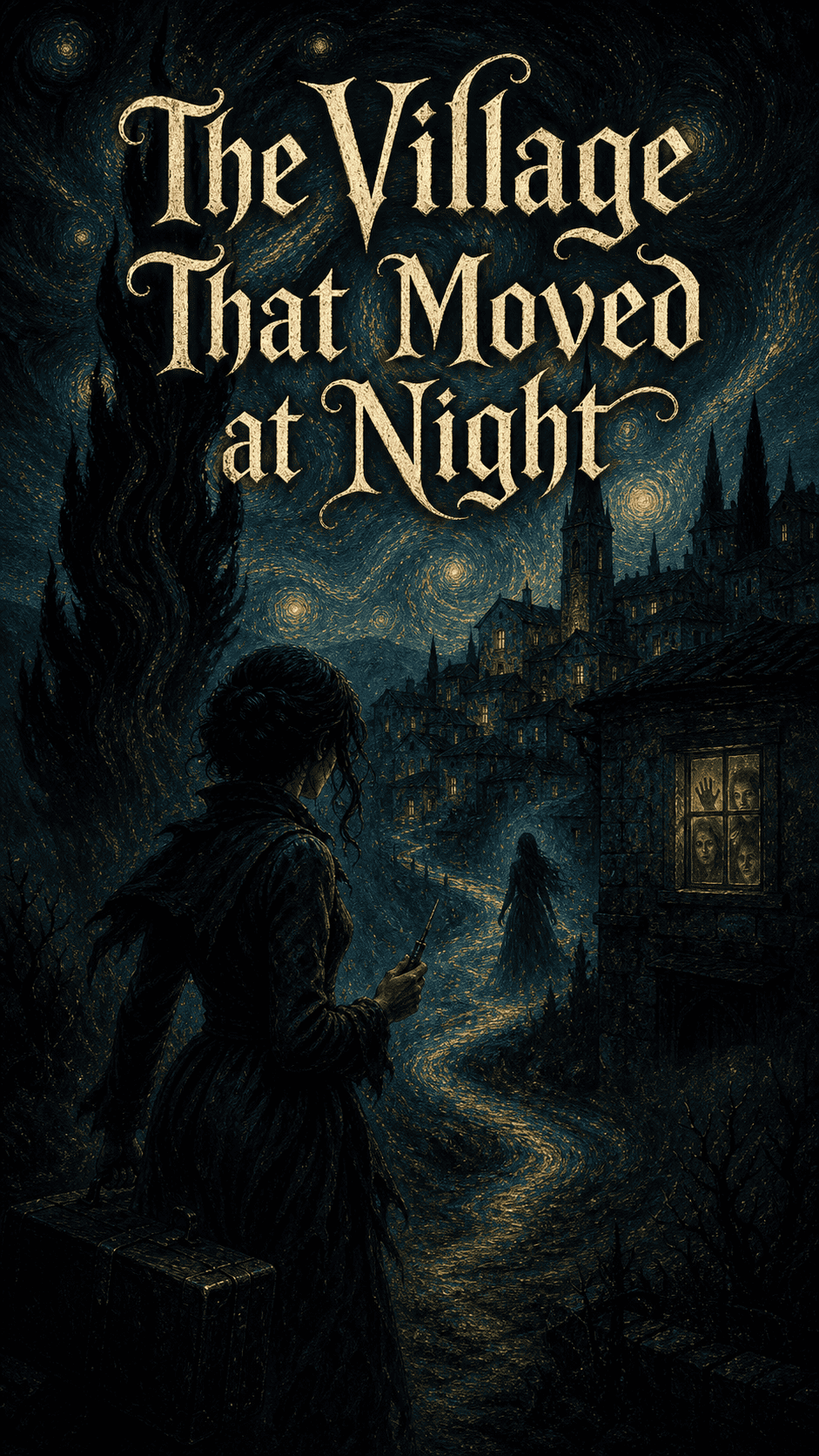
In The Village That Moved at Night, art restoration student Mara Vale travels to the remote village of Saint Orlan to restore a mysterious painting that seems to change after dark. As glowing windows appear, roads shift, and voices whisper from inside the walls, Mara discovers the painting is not just a picture of the village, but a doorway to something trapped beneath a swirling, unnatural sky. The deeper she studies it, the closer she comes to becoming part of the painting herself.
The Village That Moved at Night
Experience the story with audio, captions, and full-screen playback.
A small hillside village is famous for one impossible thing: every painting of it looks slightly different by morning. The stars shift. The church steeple leans closer. Windows appear where no houses exist. Tourists think it is a charming local legend until Mara, an art restoration student, arrives to study the village’s oldest painting, a swirling night scene said to have been painted by a man who vanished before sunrise.
At first, Mara notices tiny changes in the canvas: one painted window glows gold, then two, then five. The painted road bends toward the foreground. A dark figure appears beneath the cypress tree. That same night, she hears knocking from inside the wall of her rented room. When she looks out the window, the real village matches the painting exactly, except the stars are spinning.
The villagers refuse to go outside after midnight. They say the sky “chooses” someone every few decades, and the painting is not art. It is a door. Anyone who studies it too long begins to see the village as it truly is: a place trapped between the world and something vast above it.
Mara discovers the missing painter did not vanish. He was painted in. His face is hidden in the brushstrokes of the sky, screaming silently among the stars. Now the dark figure beneath the tree has Mara’s shape, and each night it moves closer to the painted village door.
The final horror: Mara tries to destroy the painting, but when she cuts the canvas open, she does not find wood or wall behind it. She finds wind, cold starlight, and a road leading into the painted town. From somewhere beyond the frame, the church bell rings thirteen times.
By morning, the museum receives a new masterpiece: the same village beneath a swirling sky, but now there is a young woman standing in one glowing window, her hand pressed against the glass.
The Village That Moved at Night
By the time Mara Vale arrived in Saint Orlan, the sun had already begun to die behind the hills.
It went reluctantly, bleeding orange through the bare branches of the cypress trees, staining the village roofs the color of old rust. The houses leaned together along narrow stone lanes, their windows dark, their doors painted blue against bad luck. Above them, the church steeple rose like a black needle, pointing at a sky that seemed too large for such a small place.
Mara stood at the edge of the village with her suitcase in one hand and the letter from the museum folded in the other.
Saint Orlan was not on most maps.
That had been the first thing she learned.
The second was that everyone who had tried to document the place had produced something inconsistent. Photographs showed streets where maps showed walls. Sketches showed two church towers where the village had one. A travel writer in 1912 described a stone bridge that no one had ever found.
And then there was the painting.
The Night Over Saint Orlan.
No signature. No confirmed date. Oil on canvas, badly cracked, quietly famous among restoration circles for being technically impossible. The brushwork suggested the late nineteenth century, but the pigment analysis showed materials from several different periods. Layers that should have been underneath appeared on top. Stars had been painted with a mineral compound no one could identify.
Mara had been chosen to restore it because she was careful.
That was what Professor Ellery had said.
“You have patience,” he told her. “You don’t force a painting to answer. You let it confess.”
Now, standing in the cold at the edge of Saint Orlan, Mara was not sure she wanted anything here to confess.
A woman waited for her beside the village fountain.
She was tall and severe, dressed in a black coat buttoned to her throat. Her gray hair was pinned so tightly it looked painful. When Mara approached, the woman did not smile.
“You are the restoration student,” she said.
“Mara Vale.”
“I am Madame Voss. I keep the museum.”
The museum, as far as Mara understood, had once been the home of the vanished painter. Or the supposed painter. Records disagreed about whether he was a local man, a traveler, a priest, or a patient from the old sanatorium beyond the ridge.
“I’m sorry I’m late,” Mara said. “The driver refused to come past the lower road.”
Madame Voss looked toward the hills.
“He was wise.”
Mara laughed once, thinking this was a joke.
Madame Voss did not laugh with her.
Instead, she took Mara’s suitcase and began walking. Mara followed her through the village.
Saint Orlan was beautiful in the way abandoned things can be beautiful before you realize they are not abandoned at all. Lace curtains hung in windows. Smoke curled from chimneys. Somewhere behind a shutter, a spoon struck the side of a bowl. Yet no one came outside. No children ran in the lanes. No old men sat smoking beneath doorways.
The whole village seemed to be holding its breath.
“Is it always this quiet?” Mara asked.
“After sunset, yes.”
“Why?”
Madame Voss stopped at the base of the church steps and turned.
“Do not go outside after midnight,” she said.
Mara waited for more.
None came.
“That’s it?”
“That is enough.”
The museum stood at the top of the village, half swallowed by ivy. It had narrow windows and a blue door like the others, though its paint had peeled into pale flakes. Inside, the air smelled of dust, beeswax, old paper, and something metallic beneath it all.
Madame Voss led Mara through three rooms of local artifacts: farm tools, cracked saints, yellowed letters, a child’s rocking horse with one painted eye missing.
The painting waited in the back room.
Mara stopped when she saw it.
She had studied photographs for weeks, but they had not prepared her for the thing itself.
The Night Over Saint Orlan filled the wall.
It showed the village from the southern hill, its roofs clustered below a violent sky. The stars spiraled in wide strokes of blue, white, and gold. A black cypress tree twisted upward on the left side of the canvas, its branches reaching like fingers. The church steeple stood in the center. The windows of the houses glowed with thick yellow paint, each one bright as a trapped candle.
And above it all, the sky moved.
Not literally.
Mara told herself that at once.
Paintings did not move. Brushstrokes could imply motion. Human eyes could be tricked by contrast and pattern. A tired mind could make a swirl seem alive.
Still, for one dreadful second, she felt the stars turning.
Madame Voss watched her.
“You see it.”
“I see why people talk about it,” Mara said carefully.
“The last man who restored it cut out his own tongue.”
Mara turned.
Madame Voss said it as plainly as someone discussing weather.
“I’m sorry?”
“He lived for three days after. He wrote on the floor with lampblack. Same sentence again and again.”
“What sentence?”
Madame Voss looked at the painting.
“The sky is full of rooms.”
Mara felt cold gather beneath her ribs.
“That wasn’t in the museum notes.”
“No,” Madame Voss said. “It was not.”
Mara should have left then.
Later, she would understand that every tragedy has a clean door at the beginning. A moment when a person can turn away, laugh it off, take the road down the hill and keep their life intact.
But Mara stayed.
She was twenty-six years old. She had debts, ambition, and a stubborn hunger to touch something that mattered. The world was full of copies and prints and polished glass displays. This painting was wounded, strange, alive with mystery.
And Mara had always loved wounded things.
Madame Voss showed her to a small room above the museum. There was a bed, a desk, a washbasin, and one window overlooking the village square. A kettle sat on a hot plate. A brass key lay on the pillow.
“Lock your door at night,” Madame Voss said.
“Because of the painting?”
“Because of what looks through it.”
Before Mara could respond, the woman left.
That first night, Mara dreamed of stars.
Not stars in the sky.
Stars behind walls.
Tiny bright eyes pressing through cracks in plaster, widening, blinking, watching her sleep.
She woke just after three in the morning with her heart hammering.
The room was dark.
For a moment she did not move.
Then she heard knocking.
Not at the door.
Not at the window.
Inside the wall beside her bed.
Three soft taps.
Mara sat up.
The wall was bare except for old wallpaper faded to a yellow-gray. She listened, barely breathing.
Tap.
Tap.
Tap.
Then a whisper.
So faint she might have imagined it.
“Mara.”
She switched on the lamp.
The room snapped into ordinary shape. Bed. Desk. Suitcase. Coat over chair. Nothing in the wall. Nothing whispering her name.
Mara stayed awake until morning.
At breakfast, Madame Voss served coffee and black bread in silence.
Mara did not mention the knocking.
The restoration room had been prepared with more care than she expected. A worktable stood beneath bright lamps. Cotton gloves, solvent, brushes, linen, and scalpels had been arranged with surgical precision. The painting itself remained on the wall, too large and fragile to move.
Mara began with documentation.
Measurements. Surface notes. Crack patterns. Pigment samples. She took photographs from every angle.
That was when she noticed the first change.
The painting had seven glowing windows.
In every photograph Mara had studied before arriving, it had six.
She opened her laptop and pulled up the museum archive. Six windows. Always six.
She looked back at the painting.
Seven.
The new one was on the second floor of a narrow house beside the church. Its yellow paint looked wet.
Mara stepped closer.
Inside the tiny window, something dark stood just beyond the glow.
A person, perhaps.
Or a shadow shaped like one.
“You saw it, then.”
Mara flinched.
Madame Voss stood in the doorway.
“Was this window always here?” Mara asked.
“No.”
“Paintings don’t change.”
“No.”
“That’s not an answer.”
“It is the only one I have.”
Mara forced herself to breathe. “There has to be another version. A restoration layer. Maybe overpainting under varnish becoming visible in the light.”
Madame Voss crossed the room and stood beside her.
“When I was a child, the painting had four windows,” she said. “When my mother was a child, it had none.”
Mara stared at her.
“The village is waking,” Madame Voss said.
Mara laughed because the alternative was harder.
“I need to work.”
“As you like.”
Madame Voss left her alone.
Mara spent the next six hours testing the varnish along the lower edge of the canvas. The work steadied her. Solvent, cotton, patience. The old varnish lifted in amber stains. Beneath it, the colors sharpened.
The village roofs became redder.
The church steeple blacker.
The sky deeper.
By evening, Mara had uncovered a section near the cypress tree that had been hidden under grime. A path curved from the village toward the foreground. It ended at the bottom edge of the canvas, as if inviting the viewer to step onto it.
She was certain the path had not been there before.
That night, the village bells rang at midnight.
Mara counted them from her bed.
One.
Two.
Three.
The sound rolled through the walls, low and heavy.
Ten.
Eleven.
Twelve.
Then silence.
Mara waited.
The thirteenth bell struck.
Her lamp went out.
From the wall came the knocking.
Tap.
Tap.
Tap.
“Mara,” whispered the voice.
She gripped the blanket.
“Who’s there?”
A pause.
Then the voice whispered, “I can see your window.”
Mara threw back the blanket and ran to the window.
The village square below was empty.
Moonlight silvered the fountain. The houses stood dark and still. The church door was closed.
Then, one by one, windows began to glow.
Not in the real village.
In the glass.
Mara saw them reflected there: yellow squares blooming behind her face, dozens of them, though the houses outside remained black. The reflection showed the village as it appeared in the painting.
And beneath the cypress tree, at the edge of the square, stood a dark figure.
It looked up at her.
Mara stumbled back and hit the desk.
The room returned in a rush. The reflected windows vanished. The village outside was dark again.
But in the glass, for just one second longer, the figure remained.
Then it raised one hand.
The next morning, Mara packed her suitcase.
Madame Voss found her at the front door.
“You are leaving.”
“Yes.”
“That would be best.”
Mara blinked. “You’re not going to stop me?”
“No.”
Madame Voss looked tired. Older than she had the night before.
“Then why bring me here?”
“Because the painting asked for you.”
Mara’s hand tightened around the suitcase handle.
“That is insane.”
“Yes.”
“The painting didn’t ask for anything.”
Madame Voss reached into her coat and withdrew a folded sheet of paper. She handed it to Mara.
It was a letter from the museum board, approving Mara’s appointment.
Except the date was wrong.
It was dated three months before Mara had applied.
At the bottom, below the signatures, someone had drawn a small black cypress tree.
Mara dropped the paper.
Madame Voss said, “It chooses through those who look too long.”
“I don’t believe you.”
“Then leave.”
Mara opened the door.
Cold daylight waited beyond it.
The road down the hill wound between stone walls and winter fields. She could see the lower valley. She could see the place where the driver had left her.
She stepped outside.
The church bell rang once.
The road shifted.
Not dramatically. Not like a dream melting. It simply changed while she was looking at it.
The lane that had led down the hill now curved back toward the village square.
Mara turned.
Behind her, the museum door was still open. Madame Voss stood inside, watching with pity.
Mara ran.
She ran through the village with her suitcase banging against her leg, taking every downhill lane she could find. Each one returned her to the square. She passed the same blue door four times. The same shuttered bakery. The same stone saint with no head.
Finally she stopped at the fountain, gasping.
A curtain twitched in a nearby window.
An old man peered out.
“Help me,” Mara called.
The curtain dropped.
All around the square, shutters closed.
Madame Voss approached slowly.
“It will not let you leave in daylight once it has seen you at night,” she said.
Mara bent over, hands on knees, fighting nausea.
“What does it want?”
Madame Voss looked up at the sky.
Even in daylight, the clouds seemed to spiral.
“A witness,” she said. “A door. A body. It changes its hunger.”
“That means nothing.”
“It will.”
Mara spent the afternoon in the village records.
There had been a painter once. His name was Elias Roen. He had arrived in Saint Orlan in 1889 and rented the upper room above what was now the museum. He was described as polite, feverish, and obsessed with the night sky.
His journal had survived.
Madame Voss unlocked it from a cabinet and placed it before Mara.
The pages smelled of mildew.
At first, the entries were ordinary.
Sketches of rooftops.
Notes on pigment.
Complaints about the cold.
Then they changed.
January 12: The village was not where I left it.
January 16: The church faces east in the morning and west after midnight.
January 20: I have painted seven windows though there are only six houses on the lane. Something lit the seventh from within.
January 23: The sky presses closer every night.
January 25: I heard my mother calling from the well. She has been dead eleven years.
January 27: I looked too closely at the stars and understood they were not stars.
Mara turned the page.
The final entry was written in a trembling hand.
January 29: The painting is not of Saint Orlan. Saint Orlan is of the painting. I have made the frame too thin. It can reach through.
Below the words, Elias had drawn a face in the sky.
Not a human face.
A suggestion of one, made from spirals and dark spaces between stars. Huge. Patient. Watching.
Mara pushed the journal away.
“What happened to him?”
Madame Voss opened a wooden box.
Inside was a scrap of painted canvas, brittle with age.
Mara leaned close.
It showed a small window.
Behind the painted glass was a man’s face, mouth open, eyes wide with silent terror.
“He was found in the painting three days after he vanished,” Madame Voss said. “At first, only his hand. Then his shoulder. Then this.”
Mara stared at the scrap.
“Someone cut him out?”
“My grandmother. She thought it would free him.”
“Did it?”
Madame Voss closed the box.
“No. The next morning, the window was back. So was he.”
Mara returned to the painting at dusk.
She did not want to, but every room in the museum seemed to lean toward it. Every floorboard creaked in its direction. Even the light under the doors appeared to stretch toward the back room.
The painting had changed again.
The dark figure beneath the cypress was closer to the path now.
And Mara knew, with a certainty that hollowed her out, that it was not coming out of the village.
It was going in.
It wore her coat.
It carried her suitcase.
Its painted head was tilted toward the glowing windows as if listening to voices inside.
“No,” Mara whispered.
Behind her, Madame Voss said, “It begins as a shape. Then it remembers your face.”
“How do I stop it?”
“You cannot stop the sky.”
“There has to be a way.”
Madame Voss was quiet for a long time.
“There is one thing Elias tried and failed to do.”
“What?”
“Widen the tear before it widens itself.”
Mara turned.
Madame Voss handed her a restoration scalpel.
“If the painting is a door,” the old woman said, “then perhaps a door can be closed from the other side.”
Mara almost laughed.
“You want me to go inside?”
“I want nothing. Wanting ended here a long time ago.”
The thirteenth bell rang at midnight.
Mara stood before the painting with the scalpel in her hand.
The museum had gone bitterly cold. Frost webbed across the inside of the windows. From somewhere in the walls came whispering, many voices layered over one another.
Mara.
Mara.
Mara.
The painted village glowed brighter than any lamp.
The figure on the path now had her face.
It stood at the edge of the canvas, looking out.
Its eyes were not painted.
They were wet.
Mara stepped forward and pressed the scalpel into the canvas.
The painting screamed.
Not a sound from the wall.
From the village.
Every painted window filled with faces. Hands struck glass. Mouths opened. The stars twisted violently overhead.
Mara dragged the blade downward.
The canvas split.
Behind it was not plaster.
Not wood.
There was wind.
Cold, endless wind.
Beyond the torn canvas, a road led into the painted village beneath a sky full of turning lights.
The smell of oil paint and rain flooded the room.
Madame Voss shouted something behind her, but the wind swallowed the words.
A hand reached through the tear.
It was Mara’s hand.
The painted thing gripped her wrist.
Its skin was cold and unfinished, slick with wet pigment. Mara screamed and slashed at it with the scalpel. Blue-black paint sprayed across her face. The thing did not let go.
From the torn opening came voices.
Her mother.
Professor Ellery.
A child laughing.
A man sobbing in a language she did not know.
Then, beneath them all, a vast whisper rolled down from the painted sky.
The sky is full of rooms.
Mara dug her heels into the floorboards.
Madame Voss seized her from behind, wrapping both arms around her waist. For a moment they held there, two living women straining against the pull of a world that should not exist.
Then Madame Voss saw something inside the tear.
Her face changed.
“Mama,” she whispered.
Mara looked.
In one of the painted windows stood a young woman with gray eyes, holding out her arms. She looked like Madame Voss, but softer. Younger. Weeping.
“Don’t,” Mara gasped.
Madame Voss let go.
The wind took her.
She flew past Mara into the torn canvas, black coat snapping behind her. The village swallowed her without impact. One moment she was there, the next she stood in the painted square below the cypress tree, staring up at the sky.
The tear began to close.
Mara did not think.
She grabbed the wooden frame with both hands and pulled herself forward.
The painted version of herself clung to her wrist, trying to trade places, trying to climb out.
Mara slammed the scalpel into its eye.
The thing released her.
Mara fell backward onto the museum floor as the canvas sealed with a sound like a sigh.
Silence rushed in.
The painting hung whole again.
No tear.
No blood.
No wind.
Mara lay on the floor until dawn.
When the first gray light touched the windows, she stood.
The painting had changed.
The village still slept beneath its spiraling sky. The church steeple still pierced the dark. The cypress tree still twisted beside the road.
But now there were more figures.
Madame Voss stood in the square, her hand pressed to the glass of a glowing window where a younger woman waited behind it.
Elias Roen’s face watched from another house.
And on the path near the foreground, a half-formed woman crouched with one hand over a ruined eye.
Mara’s coat.
Mara’s hair.
Mara’s almost-face.
Waiting.
Mara left Saint Orlan at sunrise.
This time, the road allowed it.
She walked until her feet bled. She did not look back when the church bell rang once behind her. She did not stop when she heard Madame Voss calling her name from the trees.
Weeks later, The Night Over Saint Orlan arrived at the National Museum in a sealed crate.
The accompanying note was unsigned.
The board called the restoration a miracle. Critics praised the newly revealed depth, the haunting human details, the strange emotional power of the windows. Visitors stood before it for hours.
Mara did not attend the opening.
She moved to a city with no hills and took work restoring water-damaged portraits in a basement archive. She slept with the lights on. She covered every painting in her apartment with sheets.
For a while, that was enough.
Then, one winter night, she woke to knocking.
Not at the door.
Not at the window.
Inside the wall beside her bed.
Three soft taps.
Mara opened her eyes.
Across the room, beneath the sheet covering an old portrait, yellow light began to glow.
A voice whispered from inside the plaster.
“Mara.”
She did not move.
The sheet slid to the floor by itself.
The portrait was gone.
In its frame was a narrow stone lane beneath a swirling sky.
And at the end of the painted road, Saint Orlan waited for her, every window bright, every face turned toward home.