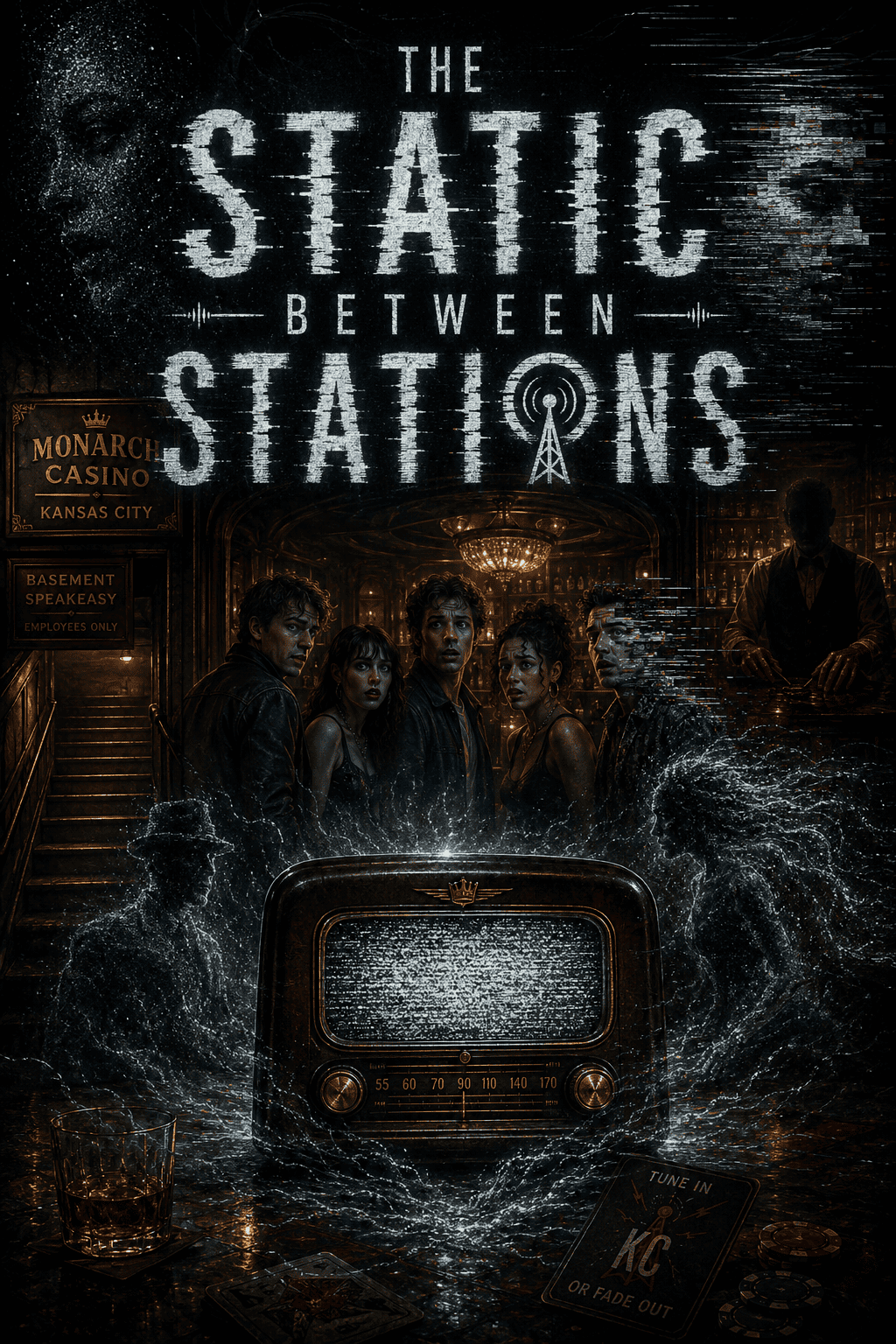
The Static Between Stations
After visiting a strange casino basement bar, five friends wake with a buzzing in their ears and a terrifying inability to hear one another clearly. As their identities begin to blur, they must trace the signal back before the static erases them completely.
The Static Between Stations
Experience the story with audio, captions, and full-screen playback.
By the time the last card hit the felt, Marcus Bell had decided the night was trying to warn them.
He would remember that later.
He would remember the dealer’s hand pausing half a second too long over the blackjack shoe. The way the overhead lights in the casino flickered, not all at once, but in a wave, as if something unseen had passed through the ceiling. He would remember the little pop in his left ear just after midnight, sharp and painless, like pressure changing on an airplane.
At the time, though, he blamed the noise.
Every casino had its own kind of weather. The weather at Crown Nine Casino, tucked along the Kansas City riverfront in a building that had once been a warehouse and then a nightclub and then nothing for nearly twenty years, was made of slot machines, bad perfume, bourbon, fried food, carpet cleaner, and people pretending they were having more fun than they were.
Marcus was there with four friends, celebrating nothing in particular and everything at once.
Talia Reed had just left her job at a marketing firm she hated and was treating the night like a victory parade. Devon Pike had come because he never said no to a casino, even though he always claimed he was “statistically due” and had never once been right. Priya Shah was taking pictures of everything for reasons nobody understood, because she hated social media but loved documentation. And Owen Mercer, quiet, pale, and dryly funny, had driven them all there in his ancient blue Honda because he was the only one who trusted himself to stop after two drinks.
Marcus was the unofficial glue. Not the leader exactly, but the one who made sure nobody wandered off, nobody overpaid for shots, nobody texted an ex, and nobody, under any circumstances, let Devon explain betting strategy to strangers.
They had known each other since college, though college had ended seven years ago. Now they were all thirty-ish, employed-ish, tired in different ways, and less able to pretend that friendship kept itself alive. Nights like this mattered. You picked a date, sent the group text, bullied everyone into showing up, and then tried not to think too hard about how rare it had become.
At 12:17 a.m., Talia won two hundred dollars on a slot machine shaped like a pirate ship and shouted loud enough for a security guard to look over.
At 12:28, Devon lost $80 in less than 6 minutes and called it “research.”
At 12:41, Priya took a photo of Marcus eating fries under a neon sign that made his face look radioactive green.
At 12:58, Owen checked his watch.
“Last lap?” he asked. “I can drive us home before Devon tries to mortgage his shoes.”
“My shoes have equity,” Devon said.
“Your shoes have trauma,” Talia told him.
Marcus laughed, but then the sound thinned in his ear. For one strange second, the casino around him seemed to drop away. The dinging machines dulled. The voices softened. Beneath everything, he heard a low hum.
Not loud.
Not mechanical exactly.
Rhythmic.
Like a tone hiding inside the building.
“Do you hear that?” he asked.
Priya looked up from her phone. “Hear what?”
“That… hum.”
Devon leaned dramatically toward the carpet. “That’s the sound of my ancestors telling me to go back to roulette.”
“Your ancestors are exhausted,” Owen said.
Talia tilted her head. “Actually, I hear something too.”
Marcus glanced at her.
The lights flickered again.
This time, they all noticed.
A row of slot machines went dark, then bright. A cocktail server stopped mid-step, blinking as though she had forgotten where she was going. Somewhere behind the blackjack tables, a speaker crackled.
Then everything resumed.
“Old building,” Owen said, but he sounded less certain than usual.
They should have left then.
Instead, Devon saw the door.
It was tucked beneath a staircase near the back wall, half-hidden behind a heavy velvet curtain the color of dried blood. There was no sign above it, no employee posted nearby, no velvet rope, nothing to suggest guests were meant to use it.
But the curtain shifted.
Not from wind. There was no wind.
It breathed outward, then settled.
Devon pointed. “What’s that?”
“A door,” Priya said. “Common architectural feature.”
“No, behind it.” He was already walking.
“Devon,” Marcus warned.
But Devon pulled the curtain aside.
Behind it was a narrow stairwell descending into dim amber light.
A brass plaque on the wall read:
THE BETWEEN ROOM
PRIVATE BAR
LAST CALL SERVED NIGHTLY
Talia grinned. “Oh, absolutely not.”
Which, in the Talia language, meant absolutely yes.
Owen frowned at the stairwell. “I don’t remember seeing this on the way in.”
“That is because you are not fun,” Devon said.
“I am extremely fun in well-lit, legally inspected spaces.”
Marcus looked down the stairs. The hum was stronger here. It seemed to gather in the bones behind his left ear.
Priya lifted her phone to take a picture.
The screen turned black.
She tapped it. “That’s weird.”
“What?”
“My camera crashed.”
“Because even your phone thinks this is how people die,” Owen said.
From below, music should have been playing. Jazz maybe. Piano. Something classy and dim.
Instead, there was only that hum.
Low.
Steady.
Almost like a note being held by a throat too large to imagine.
“Just one drink,” Talia said. “Then we leave.”
“That sentence has killed millions,” Owen said.
Marcus should have stopped them. He was good at stopping them. He had stopped Devon from getting into a golf cart at a wedding. He had stopped Talia from confronting a man who had cut in line at a taco truck. He had stopped Priya from adopting a stray cat she found outside a dentist’s office.
But the hum had begun to feel familiar.
That was the worst part.
Not safe. Not pleasant.
Familiar.
Like something he had heard as a child while sleeping in the backseat of his father’s car, late at night, between radio stations, when static swallowed voices and then gave them back wrong.
“One drink,” Marcus said.
They went down.
The stairwell was longer than it needed to be. The casino was only two stories, and the basement, if there was one, could not have been far below. But they descended for nearly a minute, each step carpeted in old red fabric worn thin at the center. Brass sconces glowed along the walls. The air cooled. The smell changed.
Ozone.
Old velvet.
Dust warmed by electricity.
At the bottom, the stairwell opened into a bar.
It was beautiful.
That was what made it so convincing.
The room had a low ceiling and walls covered in dark wood paneling. Round tables sat beneath shaded lamps. The bar itself curved like the inside of a grand piano, polished black and trimmed in brass. Behind it, shelves of bottles gleamed in amber light. No television. No windows. No visible exit except the stairs behind them.
There were other patrons, though not many. A woman in a pearl necklace sat alone at a corner table, stirring a drink she never raised to her lips. Two men in matching gray suits leaned close together near the bar, their mouths moving without sound. A thin older man sat in a booth, smiling at nothing, both hands flat on the table.
The bartender stood beneath the shelves.
He was tall and narrow, dressed in a white jacket, black bow tie, and red gloves.
His face was forgettable, like a dream. Marcus looked directly at him, then immediately lost the details.
“Welcome back,” the bartender said.
No one moved.
Talia laughed once. “Back?”
The bartender’s smile widened by exactly the wrong amount. “Figure of speech.”
Devon slid onto a stool. “What’s good?”
The bartender reached beneath the bar and set five coupe glasses on the polished surface.
“You are just in time,” he said. “The Last Call.”
“We haven’t ordered,” Owen said.
“Everyone does.”
The hum pulsed through the room.
Priya looked toward the speakers mounted in the corners. They were old, square, cloth-covered things, the kind that belonged in school hallways or municipal buildings. They gave off a faint vibration that trembled in Marcus’s teeth.
“What is that sound?” she asked.
The bartender’s red gloves moved with delicate precision as he poured from a bottle with no label.
“House music.”
“That’s not music,” Marcus said.
The bartender placed a glass before him. The liquid inside was dark blue, almost black, but when the light hit it, it flashed silver.
“Not to everyone.”
Talia picked up her glass. “Okay, that’s a line.”
Devon raised his. “To statistically due.”
“No,” Owen said. “Absolutely not to that.”
“To quitting terrible jobs,” Talia said.
“To documenting bad decisions,” Priya added.
“To getting older and still showing up,” Marcus said.
That one softened them.
They clinked glasses.
The drink was cold, sweet, and metallic. It tasted like blackberries, smoke, and the instant before a thunderstorm.
Marcus swallowed.
The hum stopped.
For one impossible second, the silence was total.
Then someone screamed.
He turned, but the bar smeared. Lights stretched into long gold lines. Talia’s face blurred. Devon’s mouth opened, but instead of his voice, Marcus heard a blast of static so loud he dropped his glass.
The bartender leaned close.
His face was no face now, only a suggestion of features beneath a trembling skin of gray light.
“Hold the frequency,” he whispered.
Then the room blinked out.
Marcus woke in his own bed with sunlight on his face.
He stared at his ceiling fan for a long time, waiting for nausea, headache, regret, anything recognizable.
Nothing came.
No hangover.
No sour stomach.
No dry mouth.
He felt fine.
Except for the buzzing in his left ear.
It was low and constant, as if someone had placed a tiny machine behind his eardrum. Not painful. Not even loud. Just present.
He sat up.
His phone was on the nightstand, fully charged.
There were twenty-six unread messages in the group chat.
TALIA: Everybody alive?
DEVON: define alive
PRIYA: Does anyone else have ringing in their ear?
OWEN: Left ear?
MARCUS: Yeah.
The typing bubbles appeared and vanished.
TALIA: What the hell happened last night?
DEVON: We went to the casino.
PRIYA: Then the basement bar.
OWEN: What basement bar?
That stopped Marcus.
He remembered the stairwell. The plaque. The bartender’s red gloves. The drink.
But the memory was slippery, like holding ice in a warm hand.
MARCUS: The speakeasy.
TALIA: I remember it.
PRIYA: Me too.
DEVON: Same.
OWEN: I remember stairs. Then waking up.
Marcus got out of bed and went to the bathroom.
He looked normal.
Tired, yes. His beard needed trimming. His eyes looked a little red. But he was himself.
Then his reflection flickered.
It lasted less than half a second.
His face softened, pixelated, lost definition. His left eye dragged downward like a video buffering on bad internet.
Then it snapped back.
Marcus gripped the sink.
“No,” he whispered.
The buzzing in his ear deepened.
His phone rang.
Talia.
He answered immediately.
“Hey, are you—”
Static exploded from the speaker.
Marcus cried out and dropped the phone onto the bathroom rug.
The sound was awful. Not ordinary static, not white noise, but jagged and layered, like glass being ground inside an old television. Beneath it, something almost human tried to form syllables.
He stared at the phone.
The call ended.
A text came through.
TALIA: DID YOU HEAR THAT TOO?
Marcus’s hands shook as he typed.
MARCUS: Your voice was static.
TALIA: Yours too.
DEVON: group calls?
OWEN: No calls.
PRIYA: Everyone, come to my apartment. Text only.
Priya lived in a converted brick building near the Crossroads, the kind with exposed ductwork, concrete floors, and rent that everyone pretended was reasonable because the windows were tall.
Marcus arrived at 11:32 a.m. Talia was already there, pacing barefoot across the living room. Devon sat on the couch, pale and unusually quiet. Owen stood by the kitchen island with his arms crossed. Priya had her laptop open and three notebooks spread out in front of her.
No one spoke.
The moment Marcus walked in, Talia turned toward him, and her mouth twisted with relief. She took one step forward like she might hug him, then stopped.
Right.
No voices.
They all held their phones.
Priya had created a shared note titled: DON’T TALK.
Talia typed first.
TALIA: This is insane.
Devon looked up and mouthed something.
The room filled with static.
Not as loud as the phone had been, but sharp enough to make everyone flinch.
“Stop,” Marcus said without thinking.
To his own ears, his voice sounded normal.
Everyone else recoiled.
Talia clapped both hands over her ears. Owen staggered backward into the island. Priya’s laptop screen flickered.
Marcus froze.
Priya typed with furious speed.
PRIYA: YOU TOO. WE CAN’T HEAR YOU. ONLY STATIC.
Marcus sat down slowly.
The buzzing in his left ear pulsed once.
Owen typed.
OWEN: We can hear strangers?
TALIA: Barista spoke to me. Sounded normal.
DEVON: My neighbor yelled at his dog. Normal.
PRIYA: I talked to my mom. Normal.
Marcus added:
MARCUS: So it’s only us. To each other.
They sat with that.
Outside the tall windows, Kansas City went on being Kansas City. Cars moved through sunlit intersections. A delivery truck double-parked. Someone laughed on the sidewalk below. The world looked cruelly intact.
Priya turned her laptop toward them.
She had pulled up her bank app.
PRIYA: Check your transactions from last night.
Marcus opened his banking app.
There were the expected charges. Casino parking. Drinks at the main bar. Late-night fries.
Then a pending charge for $0.00.
Merchant: BETWEEN ROOM LLC
Time: 1:01 a.m.
He showed the others.
They all had the same charge.
Devon typed:
DEVON: I don’t like LLC ghosts. That feels too organized.
Priya switched tabs to her phone’s location history.
A map appeared. A blue line traced her route from her apartment to the casino, then stopped.
From 1:00 a.m. to 5:00 a.m., the location dot was several blocks away from the casino, in a rectangular area near the riverfront.
An empty lot.
Not the casino.
Not the speakeasy.
Just an abandoned patch of gravel and weeds between two old industrial buildings.
Priya zoomed in.
PRIYA: All of us. Same location?
One by one, they checked.
All five phones showed the same thing.
They had been stationary in the empty lot for four hours.
Marcus pulled up street view. The lot was surrounded by chain-link fence and broken concrete barriers. There was no bar. No stairs. No building entrance. Just scrub grass, rubble, and the remains of what might once have been a small brick structure.
Owen typed:
OWEN: Could be GPS error.
Talia stared at him.
He sighed and typed again.
OWEN: I know.
Then Devon made a sound.
It was small and frightened.
Everyone looked at him.
He was staring at Talia.
Talia’s face was blurring.
At first, Marcus thought his eyes were watering. But no. It was her. Her features shifted in and out of focus. Her nose flattened, then sharpened. Her mouth smeared to the side, then corrected. For two seconds, her entire face became a gray mosaic of moving squares.
Then she was back.
Talia looked from one friend to another, horrified by their expressions.
TALIA: What?
Priya’s fingers hovered over her keyboard.
PRIYA: Your face buffered.
Talia touched her cheeks.
DEVON: I’m going to throw up.
OWEN: Don’t be alone.
They looked at him.
Owen swallowed and typed.
OWEN: I don’t know why I said that.
But they all felt it.
The room had become dangerous around its edges. Corners seemed darker than they should have been. Doorways felt less like openings and more like mouths waiting for someone to pass through alone.
Priya began searching.
The Between Room. Crown Nine Casino basement. Kansas City speakeasy Last Call. Ozone old velvet hum radio static.
Nothing useful came up.
The casino website had no mention of a basement bar.
No “Between Room LLC” appeared in Missouri business records.
Then Priya searched the empty lot.
An article from a local history blog loaded slowly.
The lot had once housed KZKC, a small independent radio station that operated from the late 1940s into the early 1960s. It broadcast jazz, local ads, weather bulletins, church services, emergency alerts, and late-night call-in shows. In 1962, the building burned down during a thunderstorm. The owner, a man named Everett Vale, vanished. Three technicians were found dead inside.
The article included a black-and-white photo.
A squat brick building with a radio tower rising behind it.
In the front window, painted in block letters:
KZKC 1310 AM
THE VOICE BETWEEN STATIONS
Marcus felt the buzzing in his ear sharpen.
Priya scrolled.
The last paragraph mentioned rumors. After the fire, nearby residents claimed they could hear broadcasts from the ruined station on radios that were not plugged in. A woman reported hearing her dead husband singing an advertising jingle. A police officer claimed an emergency warning played from his squad car radio at 3:13 a.m., describing a tornado that never happened.
The final line made Marcus cold.
The station’s old transmitter was never recovered.
Devon typed:
DEVON: So haunted radio bar. Cool cool cool.
Talia wrote:
TALIA: We go back to the casino and make them explain.
Owen shook his head.
OWEN: They won’t know. Or they’ll say they don’t.
Marcus stared at the article photo.
The radio tower. The burned building. The empty lot.
MARCUS: We weren’t at the casino from 1 to 5.
Priya looked at him.
He kept typing.
MARCUS: We were at the station.
The buzzing in his ear rose until it seemed to fill his skull.
Then the speakers in Priya’s apartment clicked on.
She had no music playing.
Her Bluetooth speaker sat on the kitchen counter, dark and unplugged.
It crackled.
Everyone turned.
A burst of static filled the room.
Then a voice emerged.
Not one voice. Many.
Layered.
A deep announcer’s tone. A bright commercial jingle. A clipped emergency broadcast. A woman laughing far away.
“This is a test—”
“—smoothest smoke in Kansas City—”
“—remain indoors and await further—”
“—tell them you heard it on KZKC—”
“—do not adjust—”
“—do not adjust—”
“—do not adjust—”
Priya grabbed the speaker and threw it across the room.
It hit the wall and broke apart.
The static continued from the pieces.
Then every phone lit at once.
A new message appeared in the group chat.
No sender.
Just text.
HOLD THE FREQUENCY.
The lights went out.
In the darkness, Devon screamed.
Not static.
A real scream.
When the lights snapped back on, he was standing in the hallway outside the bathroom, staring at his hands.
They were fading.
Not vanishing exactly. Losing color. His brown skin drained toward gray. The edges of his fingers fuzzed and trembled, tiny black-and-white sparks crawling around them like ants.
Talia lunged for him and grabbed his wrist.
His color rushed back.
He collapsed against the wall.
Priya typed with shaking hands.
PRIYA: Were you alone?
Devon nodded.
He typed one-handed.
DEVON: Bathroom. Door closed. Maybe 20 seconds.
Owen’s face hardened.
OWEN: Nobody alone. Not even for a second.
They pushed the furniture into the center of the living room and sat together like children at a sleepover, except no one laughed and no one spoke. They texted, researched, watched each other’s faces, and listened to the buzzing in their ears.
By afternoon, the static began changing.
When Talia forgot and whispered, Marcus heard static first, then something inside it.
A man’s voice:
“Lucky Strike means fine tobacco—”
Then a siren.
Then Talia’s mouth closed and she burst into tears without making a sound.
Marcus wanted to comfort her, but what was comfort when your voice had become a weapon?
He texted:
MARCUS: We’re going to fix it.
TALIA: You don’t know that.
MARCUS: No. But I’m typing it anyway.
At 5:46 p.m., Owen disappeared.
It happened because of soup.
Priya had insisted they needed food. She ordered delivery, met the driver downstairs while Marcus, Talia, Devon, and Owen stayed together in the living room. No one was alone. They had rules now.
But when the food arrived, a container of soup leaked through the bag and spilled across the kitchen floor.
Owen stood.
Talia grabbed his sleeve, but he gestured toward the mess and typed:
OWEN: I’m literally six feet away.
He went to the kitchen.
Still visible. Still in the apartment.
He grabbed paper towels.
Marcus glanced down at his phone because Priya had texted something.
PRIYA: Did anyone else find references to “signal traps”?
Marcus looked up.
Owen was gone.
The kitchen was empty.
The roll of paper towels spun slowly on the counter.
For one full second, nobody moved.
Then a shape appeared near the refrigerator.
Owen.
Or the outline of him.
A gray silhouette, flickering with static, hands raised, mouth open in a silent cry. The air around him warped like heat over asphalt. His glasses hung on his face as dark smudges. His body had no depth, no color, no personhood.
Talia ran for him.
Marcus caught her around the waist.
The silhouette shook violently.
From everywhere at once came Owen’s voice, not as static now but as dozens of old broadcasts speaking through him.
“Severe weather advisory—”
“Come on down this weekend—”
“Children should leave the room—”
“The following message has been transmitted at the request—”
“Owen!” Talia screamed.
Her voice was static to them, but maybe Owen heard it.
His silhouette turned.
For a heartbeat, his face came back inside the gray.
Terrified.
Then he burst apart.
No blood.
No body.
Just a soft collapse of magnetic dust that fell to the kitchen floor in a narrow pile.
His phone hit the tile and cracked.
The buzzing in Marcus’s left ear cut out.
For one blissful second, silence.
Then it returned louder.
Talia made no sound.
She dropped to her knees.
Priya covered her mouth with both hands.
Devon curled forward on the couch and rocked.
Marcus stared at the pile of dust.
Owen had driven them there.
Owen had made jokes when things got uncomfortable.
Owen had always been the first to say the practical thing, the sensible thing, the thing nobody wanted to hear but everyone needed.
Now he was dust on Priya’s kitchen floor.
The apartment lights flickered.
On the wall, the shadow of an old radio tower stretched where no shadow should have been.
They left immediately.
They did not discuss it. They could not. Priya packed flashlights, duct tape, a hammer, a tire iron, and a small emergency radio she found in a closet. Marcus took Owen’s cracked phone. Talia took a jar from under Priya’s sink and swept Owen’s dust into it with trembling hands.
Devon refused to look at the jar.
By 10:30 p.m., they were in Marcus’s car outside a diner near the river, parked under a failing streetlamp, waiting for midnight to pass.
They had decided the lot mattered.
The charge had appeared at 1:01 a.m.
Their location histories had placed them there from 1:00 to 5:00.
Whatever had happened, whatever was still happening, began at one.
So they would return at one.
The hours before it stretched horribly.
Devon deteriorated first.
His face flickered more often than the others. Sometimes, when Marcus looked at him from the corner of his eye, Devon’s body seemed slightly transparent, as if he had become a bad copy of himself laid over the real world.
At 11:17, Devon typed:
DEVON: I can hear it talking when nobody is talking.
Priya replied:
PRIYA: What does it say?
Devon stared at his phone for a long time.
DEVON: My name.
At 11:52, Talia opened Owen’s phone.
No passcode. Typical Owen, who claimed nobody wanted his data except “boring federal agencies.”
His last unsent text was still open.
To the group chat.
The message read:
It wants us separated. Not just physically. Forgotten from each other. That’s the static. It’s breaking the signal between us.
Marcus read it three times.
Then another message appeared beneath it.
Typed from Owen’s phone.
Although Owen was dead.
YOU ARE ALREADY OFF AIR.
Priya threw the phone out the car window.
It landed on the pavement, screen glowing.
The radio in Marcus’s dashboard turned on by itself.
The car was off.
The display showed no station.
Just: 1310 AM.
Static poured from the speakers.
Then a man’s voice, smooth and cheerful, said, “It’s one minute to midnight in beautiful Kansas City, friends. Don’t touch that dial.”
Marcus ripped the keys from the ignition, though they were already out.
The radio kept playing.
“Tonight’s forecast calls for scattered memories, isolated identity loss, and a strong chance of total erasure by morning.”
Talia slammed both hands against the dashboard.
The radio cut to a jingle.
“The Last Call, the Last Call, the drink that drinks you back—”
Devon opened the car door and stumbled out.
Marcus lunged after him.
Too late.
Devon ran toward the river.
Not fast. Not even purposefully. More like sleepwalking, drawn by a sound only he could hear.
They chased him across the gravel shoulder and down a service road lined with weeds and broken fencing. The city lights shimmered behind them. Ahead, the empty lot sat under a low, cloudy sky.
At 12:43 a.m., they reached the gate.
A rusted chain hung loose around it.
The lot beyond was exactly as street view had shown it. Gravel. Weeds. Chunks of concrete. The burned outline of an old foundation barely visible in the dark.
But in the center stood a staircase descending into the ground.
The same staircase from the casino.
The velvet curtain hung at the entrance, stirring without wind.
Devon stopped.
Marcus caught his arm.
Devon turned.
His eyes were full of static.
Not metaphorically. The whites, the irises, the pupils—all of it crawling gray and black, like a detuned television.
His mouth moved.
From it came a child’s voice singing:
“Brush your teeth with Sparkle-Dent, nine out of ten mothers recommend—”
Then Devon smiled.
Not his smile.
He yanked free and walked through the curtain.
Talia started after him.
Priya grabbed her.
The stairwell vanished.
One blink it was there.
The next it was only broken concrete and weeds.
Devon was gone.
On the ground where he had stood lay a thin scatter of magnetic dust.
Talia folded forward, retching silently.
Marcus wanted to collapse. To stop. To let whatever had them finish the work. There was a strange seduction to it now, inside the buzzing. A promise that if he let go, he would become part of something vast and humming and painless. No bills. No grief. No need to keep gathering friends who were harder and harder to hold onto.
Just signal.
Just transmission.
Priya slapped his face.
Hard.
Marcus blinked.
She held up her phone.
PRIYA: STAY WITH ME.
He nodded.
Talia wiped her mouth and stood.
There were three of them now.
12:58 a.m.
The lot changed.
The air thickened. The weeds bent inward. From beneath the rubble came the hum, louder than ever. Not from speakers this time. From underground.
The old station foundation trembled.
Priya pointed her flashlight toward the center of the lot.
A rectangle of concrete lay cracked in three places. Beneath one crack, silver light pulsed.
Marcus and Talia ran to it. Priya followed with the tire iron.
They dug with their hands first, then the tools. Concrete scraped skin from Marcus’s knuckles. Dust filled his mouth. The buzzing in his ear became a drill, a living thing pushing inward.
At exactly 1:00 a.m., the ground split.
The radio emerged.
It was not large. That almost made it worse.
An old tabletop radio, dark wood casing, brass dial, cloth speaker grille. It should have been rotten after decades underground, but it looked freshly polished. The dial glowed amber. The needle slid slowly across numbers that did not belong to any frequency Marcus knew.
Then beyond.
Into symbols.
Into scratches.
Into shapes that hurt to see.
The hum came from inside it.
The speaker cloth bulged in and out like something breathing.
Priya raised the hammer.
A voice boomed from the radio.
“Ladies and gentlemen, we interrupt this life for a special bulletin.”
Priya froze.
Her face blurred.
Marcus grabbed her wrist, but she did not move. Her eyes filled with tears.
The radio spoke in her mother’s voice.
“Priya, sweetheart? Why don’t you come home?”
Priya shook her head violently.
Talia took the hammer from her.
The radio switched voices.
Talia’s father.
“Baby girl, I’m proud of you.”
Talia stopped as if shot.
Marcus had never met Talia’s father. He had died when she was nineteen. She had once told them, drunk and furious, that the worst part of grief was forgetting the exact sound of someone’s voice.
Now that voice came from the radio, warm and clear.
“I’m right here,” it said.
Talia lowered the hammer.
Marcus typed with one hand, shoved the phone in front of her face.
NOT HIM.
The radio crackled.
Then it used Owen’s voice.
“Marcus,” it said.
He closed his eyes.
Owen sounded tired. Annoyed. Real.
“Come on, man. You’re the glue, right? Hold us together.”
Marcus’s throat tightened.
The radio’s dial turned.
Priya screamed without sound.
Her left arm went gray.
Talia saw it and swung the hammer.
The radio shrieked.
The blow cracked the wooden casing but did not break it.
The hum became a roar.
All around the lot, silhouettes appeared.
People made of static.
Dozens.
Maybe hundreds.
A woman in a pearl necklace. Two men in gray suits. A thin older man smiling at nothing. Others in old-fashioned clothes. Casino guests. Radio technicians. Children. Bartenders with red gloves.
All of them flickering.
All of them facing the radio.
The dial kept turning.
Marcus grabbed the tire iron and drove it into the crack Talia had made.
The radio screamed in every voice at once.
“Please stand by—”
“Tonight only—”
“Take shelter immediately—”
“Welcome back—”
“Hold the frequency—”
Priya fell.
Her legs were fading.
Talia dropped beside her, gripping her shoulders, refusing to let her be alone. Talia’s own face buffered violently, her features rearranging in stuttering frames.
Marcus lifted the tire iron again.
The radio spoke in his own voice.
Not static.
Not an imitation.
His voice.
“Do it, and they’re gone forever.”
He stopped.
The silhouettes flickered.
The radio continued.
“Break the signal, break the archive. Every voice inside me disappears. Owen. Devon. Everyone. Their last trace.”
Marcus stared at the radio.
That was the hook.
Not survival.
Memory.
The thing had not simply killed them. It had collected them. Preserved them in its awful way. Turned consciousness into broadcast. A graveyard with speakers.
If he smashed it, Owen and Devon would not come back.
But if he did not, no one would remember they had existed at all.
Talia looked up at him.
Her eyes were still hers.
She mouthed one word.
Please.
Marcus thought of Owen’s practical voice. Devon’s ridiculous confidence. Talia winning at the pirate slot. Priya taking pictures of things no one else thought mattered. All the years behind them. All the years they thought they still had.
Then he swung.
The tire iron punched through the speaker grille.
The radio burst open.
Inside was no circuitry.
No tubes.
No wires.
Only a small, wet, star-shaped thing, pulsing with silver light.
It looked like an eye.
It looked at him.
Marcus swung again.
The lot exploded into sound.
Not a bang. Not thunder.
Broadcast.
Every station at once. Every warning. Every advertisement. Every love song. Every dead voice. Every unsent apology. Every prayer spoken into a microphone after midnight by someone who thought no one was listening.
The static silhouettes lifted into the air like ash.
The radio collapsed inward, folding into itself, wood and brass and impossible flesh twisting smaller and smaller until there was nothing left but smoke.
Then silence.
Real silence.
Marcus woke on the gravel with blood on his hands and dawn in the sky.
His left ear was quiet.
For a moment, he did not move.
Then he heard someone breathing.
Priya lay a few feet away, curled on her side, alive.
Talia sat beside her, holding the glass jar of Owen’s dust against her chest.
There were only three of them.
The lot was empty. No staircase. No curtain. No radio. No silhouettes.
Marcus sat up.
His phone buzzed.
A notification from his banking app.
The $0.00 charge from Between Room LLC had vanished.
So had the casino parking charge.
So had every photo from the night before.
Priya checked her phone with shaking hands. Her pictures from the casino were gone. The group chat still existed, but every message from the previous day had been replaced by blank gray bubbles.
Owen’s contact was still in Marcus’s phone.
Devon’s too.
That felt like mercy.
Then Marcus opened his photo gallery.
At the very bottom, dated 1:00 a.m., was one image he did not remember taking.
Five coupe glasses on a black polished bar.
Five hands holding them.
Behind the glasses, reflected in the mirror, stood the bartender in red gloves.
His face was blurred.
Beneath the photo was a caption.
Not typed by Marcus.
Not typed by anyone living.
THANK YOU FOR LISTENING.
They held a funeral for Owen with no body.
Devon’s family held a memorial two weeks later after the police classified him as missing. Marcus, Talia, and Priya attended both services. They sat together without speaking much, not because they couldn’t, but because grief had its own frequency, and sometimes words only made it worse.
They could hear each other again.
Mostly.
Every now and then, if the room was too quiet or if a storm rolled over Kansas City after midnight, Marcus would hear a faint buzz in his left ear.
Talia heard it too.
Priya pretended she didn’t, which meant she did.
Crown Nine Casino closed six months later after an electrical fire started in a storage room near the rear staircase. The news reported no injuries. The building was sold to developers, then stalled in the permitting process, and then sat empty.
The lot where KZKC once stood was paved over.
A luxury apartment complex went up there, all glass balconies and rooftop fire pits. In the lobby, the developers installed vintage decor as a tribute to the neighborhood’s “broadcast history.”
An old microphone.
A framed radio schedule.
A tabletop radio behind glass.
Marcus saw it one evening through the lobby window as he walked back to his car.
He stopped so suddenly that someone behind him cursed.
The radio sat on a decorative shelf, polished dark wood, brass dial, cloth speaker grille.
A small placard read:
ORIGINAL 1950s RADIO
RECOVERED DURING CONSTRUCTION
Marcus stepped closer to the glass.
The lobby was empty.
The radio was silent.
Then the dial moved.
Just a little.
From behind him, on a street full of traffic and voices and ordinary life, Marcus heard a low rhythmic hum.
His phone buzzed.
One new message.
No sender.
Just text.
LAST CALL SERVED NIGHTLY.